



Li-Fi Market Size, Key Companies, Company Market Share, User Adoption, Technology Deployment, Revenue Growth, Competitive Positioning, and Demand Forecast
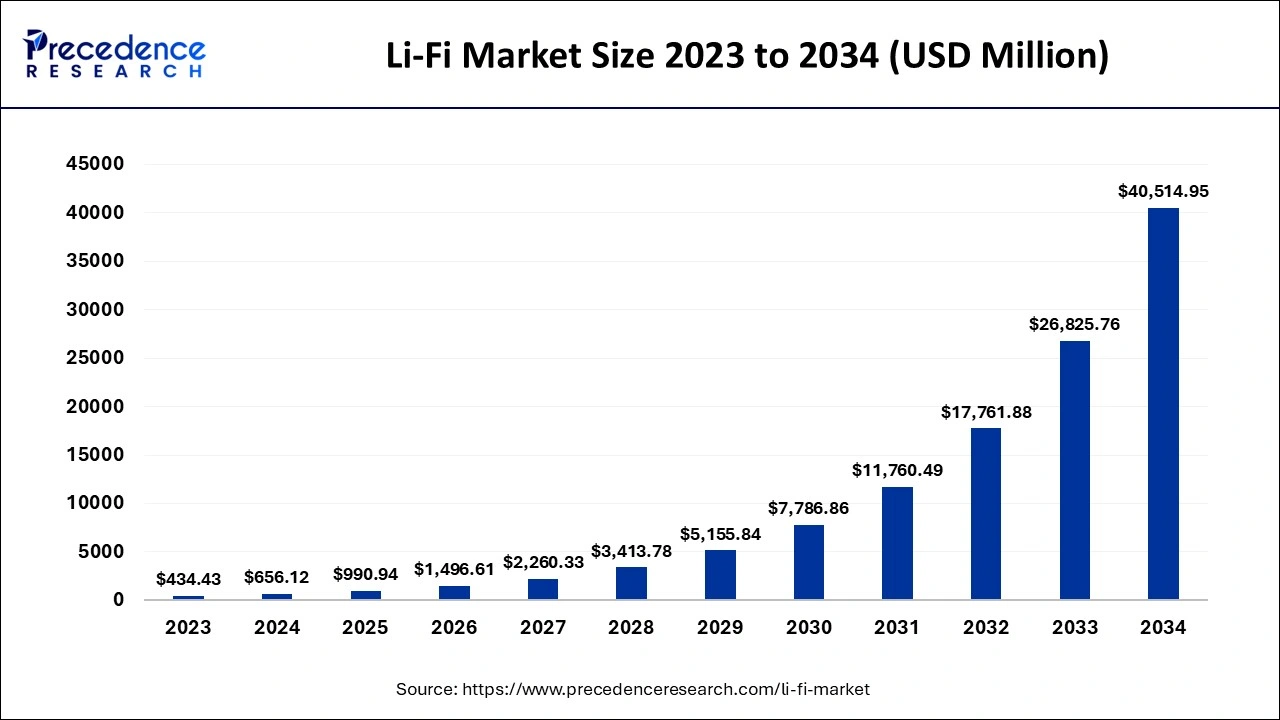
The global Li-Fi market was valued at USD 990.94 million in 2025 and is projected to grow from USD 1,496.61 million in 2026 to USD 51,120.60 million by 2035, registering a remarkable CAGR of 51.03% during the forecast period. Market growth is fueled by the increasing demand for secure, high-speed, and interference-free wireless communication, rapid adoption of LED-based networking infrastructure, expanding smart city initiatives, AI-powered network optimization, and rising deployment of Li-Fi across healthcare, defense, automotive, retail, and industrial applications.
Source: https://www.precedenceresearch.com/li-fi-market
 Get a Sample
 Table Of Content


What Is Driving the Growth of the Global Li-Fi Market?
The global Li-Fi market size is estimated at USD 990.94 million in 2025 and is predicted to increase from USD 1,496.61 million in 2026 to approximately USD 51120.6 million by 2035, expanding at a CAGR of 51.03% from 2026 to 2035. The market is witnessing substantial growth driven by rising demand for secure and interference-free wireless data transmission, supported by faster integration with present LED and smart building infrastructure.
Key Takeaways
- North America dominated the market with a major market share in 2025.
- Europe is expected to grow at the fastest CAGR between 2026 and 2035.
- By component, the LED segment captured the highest market share in 2025.
- By component, the photodetector segment is poised to grow at a healthy CAGR between 2026 and 2035.
- By application, the indoor networking segment contributed the highest market share in 2025.
- By application, the location-based services segment is growing at a strong CAGR between 2026 and 2035.
- By end user, the retail segment held a major market share in 2025.
- By end user, the automotive segment is expected to expand at a notable CAGR from 2026 to 2035.
- By transmission, the bidirectional segment generated the biggest market share in 2025.
- By transmission, the unidirectional segment is expanding at the fastest CAGR between 2026 and 2035.
What is Li-Fi?
The Li-Fi technology was first introduced in the year 2011. It is a light communication system which is capable of transmitting information at high speed over ultraviolet infrared spectrums and visible light. The technology is similar to Wi-Fi but the most important difference is that Wi-Fi uses radio frequency whereas Li-Fi uses the modulation of light intensity to transfer data. Li-Fi can be used as they are functional in many areas which are otherwise susceptible to electromagnetic interference. Li-Fi network connections are more secure and easier to control as the shortwave radiations do not penetrate through walls and doors. Since light can travel through water Li-Fi can be used for communication in water bodies up to 200 meters. This technology may be used in other environments like the commercial passenger aircrafts.
What is the Impact of AI in the Li-Fi Market?
Artificial intelligence (AI) is a major factor in the growth of the Li-Fi market as it improves performance, increases range, and adds security. AI management alters the lighting parameters for constant signal quality, and interference is minimized, making the transition between Li-Fi zones go unnoticed. It handles huge data streams in real-time, which is a great help for data management in various fields such as smart cities and health care. AI also helps with the disadvantages of Li-Fi by adjusting the position of the light source and strengthening encryption for secure communication. This union empowers intelligent decision-making, energy conservation, and fast innovation, thus installing Li-Fi as a major part of the future wireless communication and smart infrastructure development.
Major Trends in the Li-Fi Market
- Total Security with Li-Fi Defense Systems: Governments are actively utilizing Li-Fi in defense and high-security sectors because visible light cannot penetrate walls. This technology offers secure, contained data zones that completely mitigate the risk of remote interception and radio frequency (RF) eavesdropping.
- Powering Smart Cities with Li-Fi and LEDs: Many municipalities are adopting Li-Fi to develop intelligent infrastructure. By using LED streetlights, cities can broadcast location-based services, traffic updates, and emergency alerts without contributing to RF pollution.
- Zero Electromagnetic Interference for Ultimate Patient Safety: Li-Fi is being implemented in hospitals, as it offers high-speed data transmission without generating electromagnetic interference. This complies with stringent medical equipment standards for wireless patient monitoring and data transfer in sensitive areas, such as ICUs and operating theaters.
- Uninterrupted Connectivity through Hybrid Li-Fi/Wi-Fi Evolution: Research focuses on the development of networks that seamlessly switch between Li-Fi and traditional Wi-Fi to overcome coverage limitations and short transmission distances. This ensures maximum throughput, leading to continuous and uninterrupted service.
Li-Fi Market Outlook
- Industry Growth Overview: The Li-Fi marketplace will see robust growth due to the need for high-bandwidth, secure wireless broadband connections. The uptake of LED light sources in all vertical markets and Wi-Fi's limitations associated with spectrum are propelling significant global enterprise adoption of Li-Fi.
- Sustainability Trends: Li-Fi supports environmental sustainability because it leverages the existing infrastructure of LEDs to reduce energy usage and reduce electromagnetic interference. Therefore, governments, as well as green building and energy-efficient programs, are increasingly adopting, or approving, smart lighting solutions that incorporate Li-Fi technologies.
- Global Expansion: An increase in urbanization and the implementation of smart city strategies as well as the advancement of digital transformation initiatives across Asia-Pacific, Europe and the Middle East is widely expected to continue to drive new commercial and public infrastructures supporting Li-Fi applications.
- Startup Ecosystem: The universe of startups innovating in the Li-Fi space is exploding, with many startups targeting solutions in the areas of miniaturization, improved pricing and hybrid Wi-Fi/Li-Fi connection solutions to accelerate mainstream adoption of Li-Fi technologies.
Trade Analysis
- As per the worldwide Li Fi import data between June 2024 and May 2025, the buyers has globally imported 75 shipments of LiFi.
- Such shipments were being assisted by 75 exporters and bought by 69 official worldwide buyers.
- Russia, the United States, and the Philippines have come up as the leading three Li Fi importing countries.
- United Arab Emirates, China, and Russia are the leading 3 exporting countries. (Source: https://www.volza.com)
- The United Arab Emirates has shipped 586 shipments, followed by China with 438 shipments and Russia with 190 shipments, which are the biggest worldwide LiFi exporters. (Source: https://www.volza.com)
Market Report Coverage and Key Metrics
| Report Coverage | Details |
| Market Size in 2025 | USD 990.94 million |
| Market Size in 2026 | USD 1,496.61 million |
| Market Size by 2035 | USD 51,120.6 million |
| Growth Rate from 2026 to 2035 | CAGR of 48.34% |
| Base Year | 2025 |
| Forecast Period | 2026 to 2035 |
| Segments Covered | Component, Application, End User, Transmission, and Region |
Market Dynamics
Driver
The Clean-Energy Leap to High-Speed Li-Fi
Li-Fi presents an innovative, complementary solution by transmitting high-speed data through the visible light spectrum, offering significantly enhanced bandwidth for data transfer. The widespread rollout of energy-efficient LED lighting helps lower deployment costs while positioning Li-Fi as a scalable, clean-energy alternative to traditional Wi-Fi.
Restraint
The Line-of-Sight Hurdle
Despite its strong potential, the market is restrained by physical propagation laws. Since visible light cannot penetrate opaque objects like walls, signals are limited to a direct line of sight. This requires a high density of optical transceivers for full room coverage, restraining seamless mobility and necessitating significant upfront infrastructure investments.
Opportunity
Defense and Healthcare Empowerment with Li-Fi and IoT
Li-Fi offers an inventive opportunity for secure, localized communication, especially for defense, aerospace, and financial institutions. Since light waves cannot penetrate opaque walls, Li-Fi effectively prevents signal leakage and reduces external cyberattacks, ensuring secure military and national security environments. Moreover, its integration with the IoT allows building owners to utilize existing LED lighting fixtures for dual-purpose illumination and data transmission with enhanced connectivity
Market Segmentation Analysis
Component Insights
How did the LED Segment Dominate the Li-Fi Market?
The LED segment dominated the market in 2025. This dominance is primarily due to its capability as a dual-purpose data transmitter and light source. LEDs possess ideal solid-state properties for rapid light modulation, enabling high-speed wireless communication. Government and regulatory bodies are accelerating the installation of LED fixtures with the foundational infrastructure needed for Li-Fi without compromising illumination quality. By using existing LED lighting systems, they minimize the demand for additional hardware in long-term data communication networks.
The photodetector segment is expected to experience the fastest growth during the forecast period. This growth is mainly driven by advanced avalanche photodiodes and silicon photomultipliers, which enable broader transmission ranges through multi-gigabit innovations. High-sensitivity detectors are essential for reducing noise, improving signal clarity, and capturing low-intensity light signals. Government-funded military and security programs require the security assurances provided by optical containment, fostering government investment in specialized photodetectors.
Application Insights
What made the Indoor Networking Segment Lead the Li-Fi Market?
The indoor networking segment led the market in 2025. This is due to its extensive use in highly secure zones. It outperforms congested RF networks, especially in indoor environments such as hospitals, schools, and busy corporate offices that often suffer from crowded Wi-Fi networks. Li-Fi reduces bandwidth pressure to provide faster data speeds. High-security government facilities and defense sites apply this technology to prevent unauthorized remote access. Government-supported smart cities and digital infrastructure provide the rollout of smart building environments that offer secure connectivity.
The location-based services segment is expected to have the fastest growth during the forecast period. This is due to it offering precise indoor positioning, leveraging standard LED lights to transmit data to smartphones and cameras, outpacing traditional RF tracking. High-speed, localized Optical Wireless Communications eliminate the blind spots with conventional GPS to seamlessly guide pedestrians and automated guided vehicles. Because optical signals propagate effectively in environments where RF struggles, Li-Fi enables secure navigation for subsea robotics and industrial safety tracking.
End User Insights
What made the Retail Segment Dominate the Li-Fi Market?
The retail segment held the market dominance in 2025. This is due to its superior use for smart lighting, indoor positioning, and secure, hyper-localized data delivery. Stores integrate Li-Fi into existing LED luminaires to optimize in-store navigation, deliver targeted promotions, and track foot traffic. Li-Fi enables precise, room-level positioning that traditional radio frequencies struggle to achieve. By using retail ceiling lights as wireless access points, accurately map store layouts, find products, and access indoor navigation. Retailers transmit location-specific data directly to customer devices as they browse specific aisles.
The automotive segment is projected to have the fastest growth during the forecast period. This is mainly driven by the rollout of autonomous vehicles and smart transportation policies where Li-Fi enables low-latency communication for connected cars, using LED headlights and smart infrastructure to exchange crucial safety and traffic management data wirelessly. Automakers are integrating Li-Fi into LED headlights and taillights for high-speed, line-of-sight data, allowing vehicles to instantly share position, speed, and hazard alerts without RF congestion. This helps to optimize traffic flow and enforce road safety standards.
Transmission Insights
Why did the Bidirectional Segment Dominate the Li-Fi Market?
The bidirectional segment held the market dominance in 2025. This is mainly due to its superior two-way data transfer for uplink and downlink communications to provide jam-resistant, secure networking and allow for real-time interactive feedback in classified environments. Bidirectional models support non-intrusive, continuous data feedback, essential for medical equipment in hospital operating theaters. Bidirectional Li-Fi bypasses RF spectrum congestion by utilizing the massive visible light continuum, driving public and private sectors to adopt two-way optical systems for high-speed, interactive workloads.
The unidirectional transmission segment is projected to have significant growth during the forecast period. This growth mainly stems from its cost-effectiveness, high speed, and secure data broadcasting. Municipalities are actively integrating Li-Fi into intelligent infrastructure projects. By utilizing existing streetlights, cities can broadcast unidirectional data, including public service information and real-time traffic updates, to vehicles and pedestrians. Retail spaces and museums leverage unidirectional Li-Fi to broadcast localized advertisements and interactive exhibit information to consumer smart devices.
Market Regional Analysis: North America, Europe, Asia-Pacific
What is the U.S. Li-Fi Market Size?
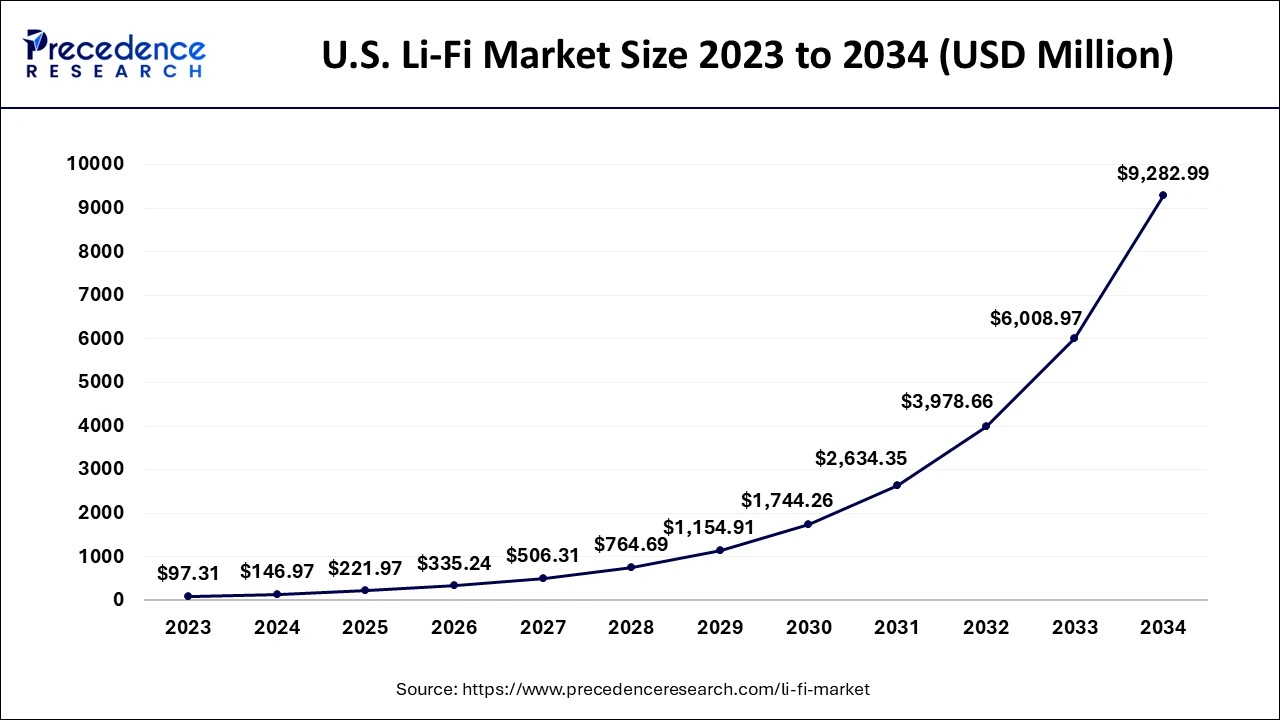
The U.S. Li-Fi market size is evaluated at USD 221.97 million in 2025 and is predicted to be worth around USD 9282.99 million by 2035, rising at a CAGR of 48.69% from 2026 to 2035
How did North America Dominate the Li-Fi Market?
North America dominated the market in 2025. This dominance stems from the robust federal cybersecurity mandates, the demand to mitigate the RF spectrum congestion, and a healthy environment for rapid IoT and smart city deployments. Federal and military agencies not only necessitate ultra-secure, tamper-proof communications but also provide an intrinsically secure communication barrier, reducing external hacking. Healthcare and aerospace also demand wireless connectivity without disrupting sensitive equipment, where Li-Fi applies an unregulated visible light spectrum for seamless connectivity.
U.S. Market Trends
The U.S. leads the market in North America due to extensive adoption across defence, healthcare, and smart infrastructure sectors. High investments in research and development, along with the strong presence of technology companies, support innovation. Government-backed smart city and secure communication projects increase the deployment. Rising demand for high-speed, interference-free data transmission in sensitive environments such as military bases, hospitals, and enterprise networks significantly contributed to market expansion and technological advancements.
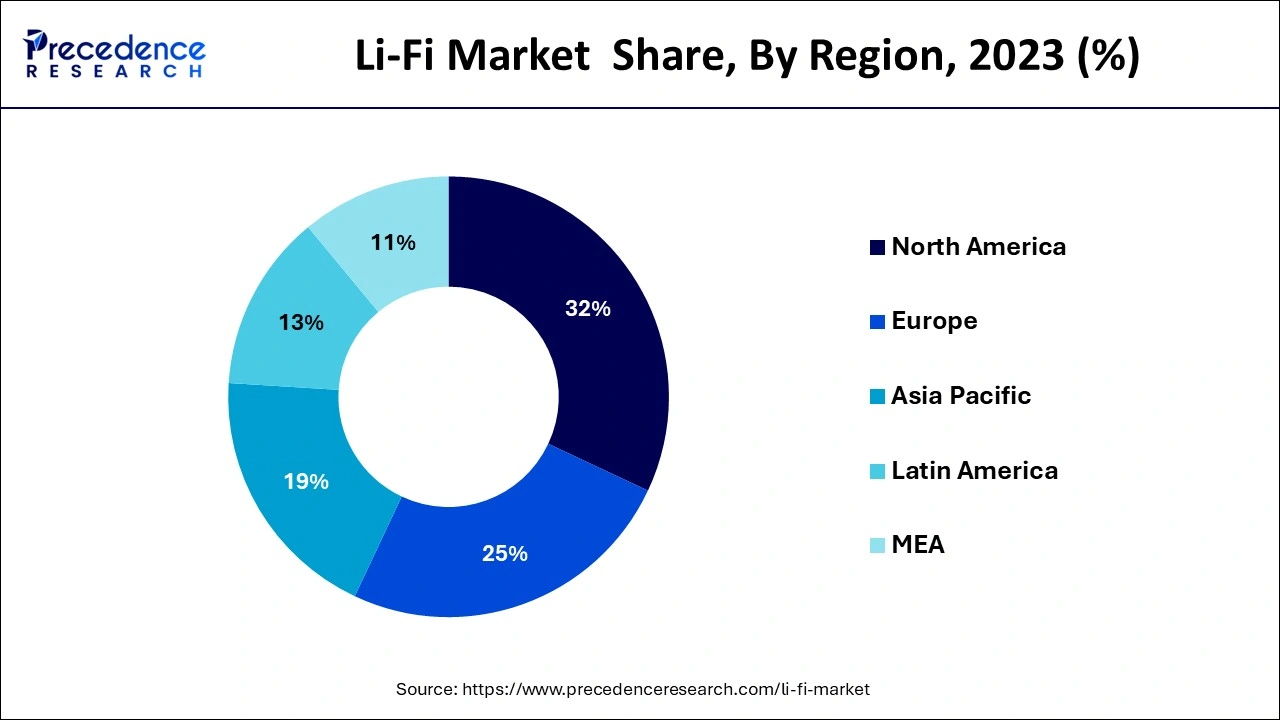
Followed by the North American market the European market is also expected to register a significant growth during the forecast period. The Europe region was valued at USD 33 million in 2023 and UK held 30% of the revenue share. This region has a well established automotive sector across many countries. The use of this technology can be made for vehicle to vehicle connectivity in the autonomous cars, it can also be used to avoid possible collisions and the use of this technology can also help the vehicles to differentiate between the nonhuman objects and the humans. The use of vehicle to vehicle connectivity will also provide and advantage of avoiding the overcrowded or congested roads. This helps in improving the decision making capability of these automated vehicles. Due to the increase in the various innovative technologies into the modern cars there'll be a significant increase in the acceptance of this technology for the automotive industry. All of these factors are expected to boost the growth of this market in the European region.
Why did the Asia-Pacific region grow at a rapid rate in the Li-Fi Market?
The predicted growth trajectory of the Asia Pacific region within the Li-Fi market is primarily driven by substantial investment in digital infrastructure and smart cities across this region. The governments of India, China, and Japan, due to their support for optical communication, are enabling and accelerating growth in 5G networks and the IoT industry, resulting in exponential growth within the Asia-Pacific region. Existing opportunities within the Asia Pacific for high-volume growth will arise from the continued commercialization of devices relying on connectivity.
China Li-Fi Market Trends
China has positioned itself as the leader in the Asia-Pacific market for Li-Fi and has benefited from the support of its electronics and semiconductor-related industries. China's governmental programs promoting smart cities and 5G development have, in turn, promoted Li-Fi in the region. The numerous universities and startup companies within China have been working on affordable Li-Fi chips and LED for the mass market. Continued emphasis on secure data transmission and reducing network congestion has improved China's position in the Asia-Pacific Li-Fi market.
Why did the Latin American Region Experience Significant Growth in the Li-Fi Market?
With the increase in the demand for high-speed, affordable communication, the Latin American region is projected to experience significant growth in the Li-Fi market. The Government has strongly promoted the adoption of Li-Fi technology through public institutions, including schools and public transport. In Brazil, Chile, and Mexico, smart lighting investments have helped this market develop, while increased awareness of energy-efficient connected devices has created new opportunities for commercial and governmental utilization of Li-Fi.
Brazil Market Trends
Brazil dominates the Latin American market due to growing smart city initiatives and the rapid expansion of LED lighting infrastructure. Increasing urbanization and digital transformation encouraged the adoption of advanced communication technologies. Government efforts to modernize public infrastructure and improve connectivity boost the market. Additionally, rising demand for secure wireless communication in industrial operations, transportation systems, and public sector applications further accelerated the growth of Li-Fi technology across the country.
Why did the Middle East & Africa Region Experience Significant Growth in the Li-Fi Market?
Significant potential existed in the Middle East and Africa for the growth of Li-Fi technology, mainly because of the amount of money being spent on developing smart cities and modernizing infrastructure. In many of these countries, especially those in the Gulf Cooperation Council (GCC), Governments are investing heavily in using Li-Fi in government, education, and health projects, and they have also created ways for energy efficiency and data security, thus creating new opportunities. Africa's increased urbanization has led to the creation of pilot projects in both universities and commercial buildings.
The UAE Li-Fi Market Trends
The UAE is the leading country in the Li-Fi market in the region, and the introduction of smart cities and AI into its government was supported by the creation of many pilot programs where Li Fi was tested in schools, airports, and office buildings to increase the number of people who use it. Partnerships were developed between international technology companies and local authorities to speed up the process of creating an environment where people would use Li Fi regularly.
How will Europe grow in the Li-Fi Market?
Europe is projected to have the fastest growth during the forecast period. This growth is due to robust industrial automation, data privacy regulations, increasing investments in smart cities, and the demand for sustainable infrastructure. The EU actively supports this innovation through major and cross-border research and standardization initiatives. Many renowned northern European countries are deploying Li-Fi technologies in their business, including Germany, France, and the UK. European metropolitan initiatives integrate Li-Fi for sustainable street lighting networks and data-driven urban sensing.
Germany Market Trends
Germany plays a major role in the market due to its strong industrial base and emphasis on Industry 4.0 and smart manufacturing. The country has actively adopted advanced communication technologies to enhance automation and operational efficiency. Government support for digital transformation, innovation funding, and smart infrastructure projects boosted Li-Fi implementation.
Government Initiatives taken for Li-Fi Market
- In November 2024, the Centre for Development of Advanced Computing (C-DAC) Chennai, which comes under the Ministry of Electronics and Information Technology (MeitY), signed a Transfer of Technology (ToT) agreement for its innovative technologies, NLOS VICINITY and ILLUMINATE, with Nav Wireless Technologies Pvt. Ltd. (Source: https://www.pib.gov.in)
Partnership Landscape
- In April 2026, pureLiFi, which is the top leader in LiFi technology, revealed a major partnership with Askey, a top producer of advanced network communications equipment, that has changed the Fixed Wireless Access (FWA) market. (Source: https://www.purelifi.com)
- In December 2025, Li-Fi Protocol, which is a strong toolkit that allows developers to construct on-chain saps and have cross-chain bridges within their use, has currently revealed the close of a USD29 million Series A extension investment round. The current round, supported by CoinFund and Multicoin, has brought total capital raised to USD51.7 million. (Source: https://li.fi/knowledge-hub)
Value Chain Analysis
- Research, Design, and Product Development: Creating Li-Fi parts such as LEDs, photodiodes, and chips that will speed up integration and offer data security.
Key Players: pureLiFi, OLEDcomm, Signify - Inbound Logistics: Buying the needed optical sensors, controllers, and software components for Li-Fi device production and system integration.
- Operations: Mounting and checking the performance of the tested lighting fixtures and devices to ensure stable and efficient data transmission.
Key Players: VLNComm, pureLiFi, OLEDcomm - Outbound Logistics: Marketing Li-Fi products and infrastructure solutions to the end-users in the commercial, healthcare, and industrial sectors.
- Marketing and Sales: Informing the enterprises, institutions, and smart infrastructure developers about Li-Fi's advantages, such as high bandwidth, security, and sustainability.
Key players: Velmenni, Wipro Lighting, pureLiFi
Competitive Landscape
The global Li-Fi market is highly consolidated and established, and major leading companies like pureLiFi Ltd., Oledcomm, and Velmenni are escalating demand for highly secure, ultra-fast wireless communication that bypasses radio frequency limitations to manufacture LED-based optical networking systems and miniature photodetectors. Additionally, technology's inherent resistance to electromagnetic interference with precision automation in hospitals and defense facilities.
Looking ahead, many emerging players and startups like Signify and Lucibel have future opportunities in integrating Li-Fi with 5G backhaul, IoT infrastructure, and critical-security environments. However, these are restrained by the limited transmission range of light wavesand the high initial infrastructural costs of replacing traditional radio frequency networks.
Li-Fi Market Companies
- VLNComm Inc. – Provides secure Li-Fi networking solutions focused on defence, healthcare, and enterprise wireless communication systems.
- Velmenni– Develops Li-Fi-enabled smart lighting solutions for indoor networking and industrial communication applications.
- Global Li-Fi Tech – Offers high-speed optical wireless communication systems for smart cities, transportation, and commercial environments.
- Lightbee – Provides Li-Fi-based lighting communication systems for indoor positioning and high-speed internet connectivity.
- Panasonic Corporation – Develops advanced Li-Fi integrated lighting and communication systems for smart infrastructure and enterprise applications.
- Signify Holding B.V. – Offers Li-Fi-enabled LED lighting systems supporting high-speed, secure connectivity in offices and industrial spaces.
- Lucibel – Specializes in Li-Fi lighting solutions for enterprise, defense, and secure communication environments.
- PureLiFi Limited – Provides Li-Fi components, modules, and integrated systems for mobile devices and enterprise networks.
- Oledcomm SAS – Develops Li-Fi communication systems for transportation, aerospace, and smart building applications.
- Infinity Technology Services – Offers Li-Fi-based communication and networking solutions for industrial and commercial use cases.
Market Developments
- LIFI based communication facilities had been set up by Nav Wireless Technologies Pvt Ltd., at Civil Hospitals in Gujarat Medical Education & Research Society Hospital and Ahemdabad, Surat Municipal Institute of Medical Education & Research, in August 2020.
- Li-fi technology was powered by pureLiFi into the rugged mobiles, in January 2020 by the Getac Technology.
Recent Developments
- In December 2025, Li. Fi has secured USD 29 million in current investment. Multicoin Capital and CoinFund have led the round. The growth has expanded its earlier Series A development and has brought total capital raised to USD51.7 million. (Source: https://ventureburn.com)
- In April 2026, Lido, Chainlink, and LI.FI formed a partnership to create an easy, one-click method for cross-chain staking that facilitates the staking of ETH on Layer 2 by immediately generating wstETH. This was achieved through the use of Chainlink's CCIP, LI.FI routing, and Lido infrastructure.
(Source: https://cryptobriefing.com) - In October 2025, Nav Wireless Technologies claims to have deployed America's first commercial LiFi internet system in New York City, installed at the Silicon Harlem office with JESCO Venture Labs. (Siurce: https://www.livemint.com)
- In March 2025, pureLiFi launched the LINXC Bridge system at Mobile World Congress Barcelona, enabling Fixed Wireless Access providers to offer self-installable, reliable connectivity with outdoor Customer Premises Equipment, improving installation times and user experience. (Source: https://www.businesswire.com)
Segments covered in the LiFi market
By Component
- Photodetector
- LED
- Optical Sensing
- Microcontroller
- Others
By Application
- Advanced Tracker
- Location Based Services
- Standalone Tracker
- Indoor Networking
- Underwater Communication Line
- Smartphone
- Others
By End User
- Automotive
- Retail
- Healthcare
- Aerospace and defense
- Government
- Transportation
- Education
- Consumer electronics
- Others
By Transmission
- Unidirectional
- Bidirectional
By Geography
- North America
- U.S.
- Canada
- Europe
- U.K.
- Germany
- France
- Asia-Pacific
- China
- India
- Japan
- South Korea
- Malaysia
- Philippines
- Latin America
- Brazil
- Rest of Latin America
- Middle East & Africa (MEA)
- GCC
- North Africa
- South Africa
- Rest of the Middle East & Africa
For inquiries regarding discounts, bulk purchases, or customization requests, please contact us at sales@precedenceresearch.com
Frequently Asked Questions
Tags





Ask For Sample
No cookie-cutter, only authentic analysis – take the 1st step to become a Precedence Research client
 Get a Sample




 sales@precedenceresearch.com
 Schedule a Meeting
