



Methanol Market Size, Key Companies, Company Market Share, Production Capacity, Raw Material Pricing, Export & Import Analysis, Manufacturing Cost, Competitive Positioning, and Demand Forecast
Methanol Market (By Feedstock: Coal, Natural gas, Biomass and Renewables;; By Derivatives: MTO/MTP, Solvent, Biodiesel, Acetic acid, Formaldehyde, Others; By Sub-derivatives: Gasoline additives, Olefins, UF/PF resins, VAM, Polyacetals, MDI, PTA, Acetate Esters, Acetic anhydride, Fuels, Others; By Application: Construction, Electronics, Automotive, Paints and Coatings, Pharmaceuticals, Others) - Global Industry Analysis, Size, Trends, Leading Companies, Regional Outlook, and Forecast 2026 to 2035
Source: https://www.precedenceresearch.com/methanol-market
 Get a Sample
 Table Of Content


What is the Methanol Market Size?
The global methanol market size is accounted at USD 35.68 billion in 2025 and predicted to increase from USD 37.22 billion in 2026 to approximately USD 54.21 billion by 2035, growing at a CAGR of 4.27% from 2026 to 2035. The global methanol market is growing due to increased demand as a cleaner fuel alternative, rising chemical and plastic production, and the rise of sustainable fuels.
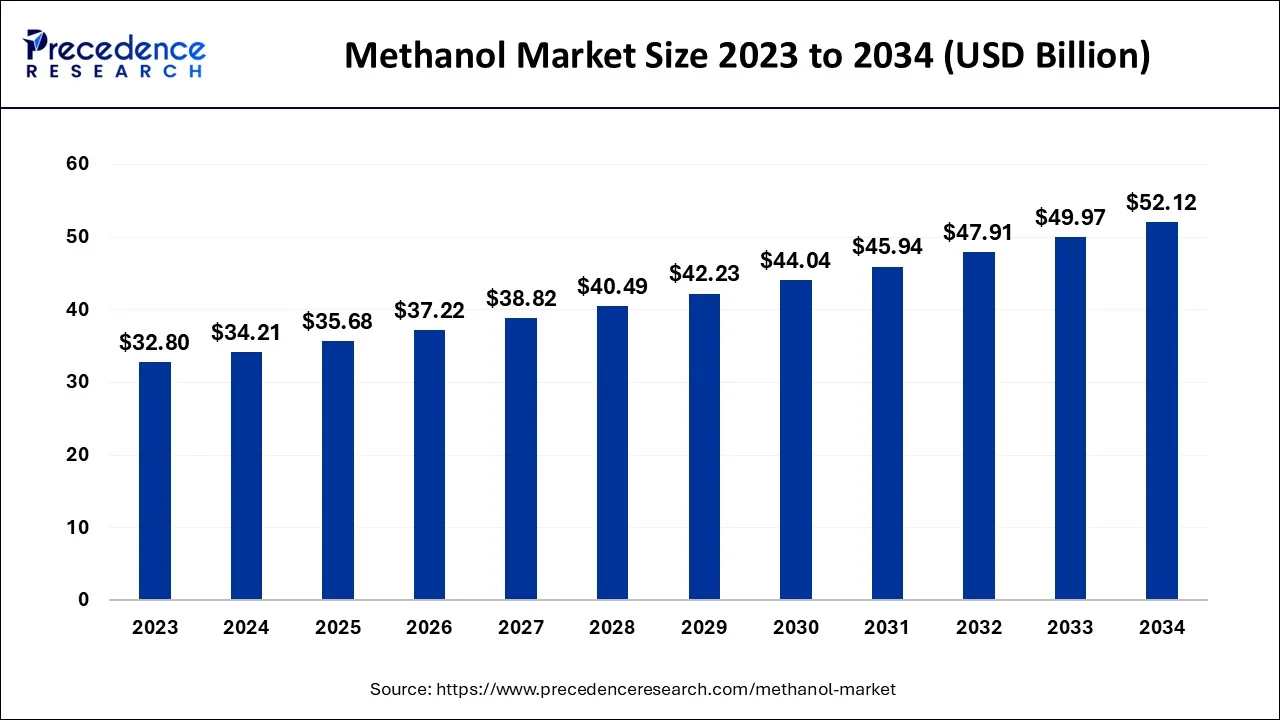
Methanol Market Key Takeaways
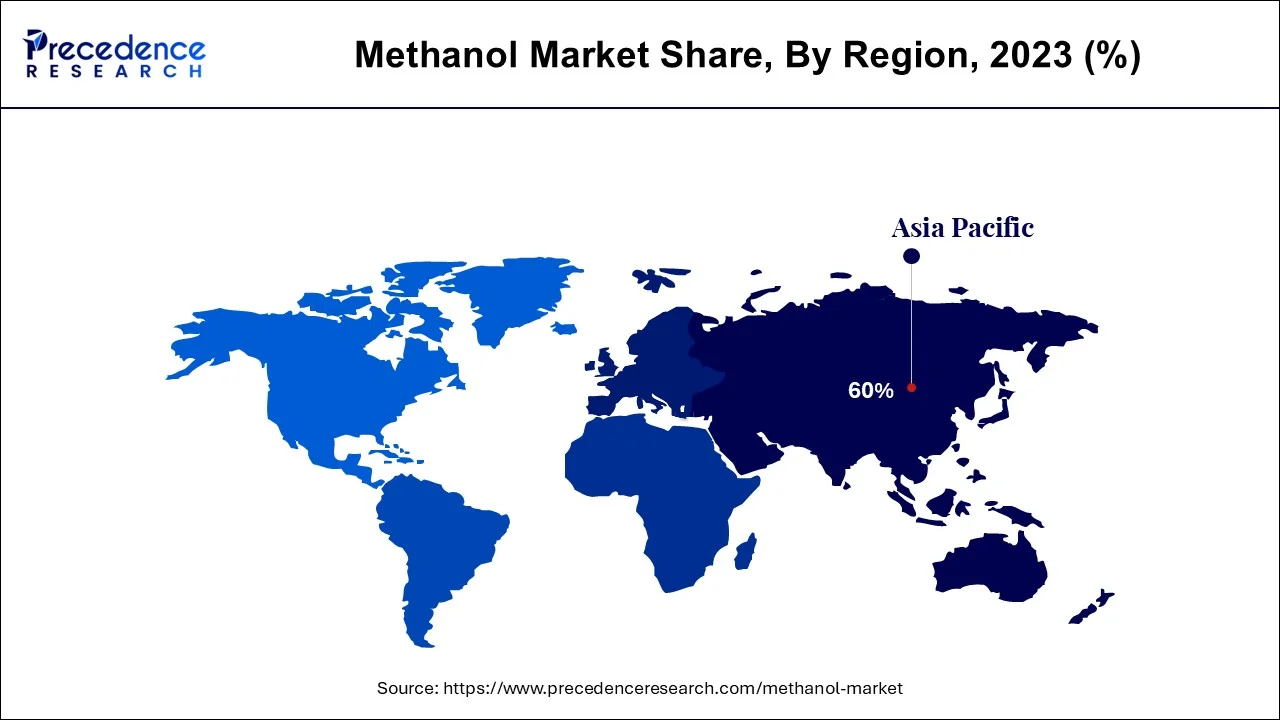
- In 2023, Asia Pacific accounted largest revenue share 60%.
- China methanol market is projected to grow at a CAGR of 6.5% from 2026 to 2035.
- The U.S. methanol market is projected to be worth around US$ 8.4 billion by 2035.
- By feedstock, the coal segment has accounted largest revenue share of around 60% in 2025.
- By derivatives, the acetic acid segment accounted for 5.6% of revenue share in 2025.
- The natural gas segment was valued at USD 15,381.2 million in 2025.
- The coal segment was valued at USD 8,530.5 million in 2025.
- By end use, the automotive segment accounted for USD 8,358.2 million in 2025 and is expected to grow at a CAGR of 6.8% from 2026 to 2035.
- The methylic alcohol market is projected to grow at a CAGR of 8.5% from 2026 to 2035.
- The construction segment is expected to grow at a CAGR of 6.2% from 2026 to 2035.
What is Methanol?
Across the globe major factors that contribute to the environmental pollution leading to changes in the climate add global warming is the use of heavy fuels like gasoline and diesel. Other than increase of methanol and the fuels blended with methanol dad was effects on the climate change will slow down. Many advantages are provided by the use of methyl alcohol as a transportation fuel. Including high octane fuels will help in reducing the toxic emissions which could be used in combination with gasoline. Due to an increased adoption of vehicles which helped in lowering the carbon dioxide emissions in the transport industry the market is expected to grow during the forecast period. The substitution of heavy fuel oils buy methanol in the marine industry will have a positive effect on the growth of the market.
AI in the Market
The application of artificial intelligence to methanol production has brought forth several benefits, such as improved efficiency, safety, and sustainability. The technology has also made the entire process more efficient, reduced the time required for maintenance, discovered new catalysts faster, and improved the management of the supply chain by means of forecasting and logistics. Moreover, AI provides a significant boost to the adoption of sustainable practices in the sector, such as the use of carbon capture systems that not only reduce emissions but also lead to operational efficiency and the creation of new ideas amongst the companies, while also maintaining the lesser environmental impact of the methanol industry through the adoption of eco-friendly practices.
Methanol Market Growth Factors
The rising demand for industries like the construction and the automotive industry we will have an increased consumption of methanol. Methyl alcohol is used for the production of adhesives, textiles, plastics add insulation materials. Plastics play a vital role in automobiles by reducing the weight of the vehicle which helps in increasing the fuel efficiency of the vehicle and appears to be similar to a metal. The use of plastics in the construction industry will propel the growth during the forecast period. The demand for dresses in the furniture and consumer good industries will support the growth of the market during the forecast period. Increasing consumption of methanol in fuel blending applications is another driving factor. Methanol is a colorless volatile light, flammable liquid which is usually mixed with ethyl alcohol which is useful for many industrial applications. Major opportunities are created for the methanol market as there is a shift of end users towards the sustainable fuels. The nature of this alcohol is versatile and has application in various industries; owing to these factors it shall serve the needs of the growing world.
- Expanding End-Use Industries: The demand for methanol, which is used in plastics, adhesives, and insulation, is mainly driven by construction, automotive, and chemical sectors, which are playing a significant role in the consumption of methanol.
- Rising Use in Fuel Blending: The use of methanol as a fuel additive and blending agent is skyrocketing, which is a major reason for the growth of the market in the energy and transportation sectors.
- Sustainability Shift: On the other hand, the shift towards cleaner fuels allows the development and establishment of green and bio-methanol.
- Versatile Industrial Applications: Methanol's versatility in different industries, including furniture and consumer goods, results in higher and broader demand.
- Strategic Collaborations: The production capacity gets increased through the support of producers and governments' investments and partnerships.
Market Outlook
- Industry Growth Overview: The methanol market is experiencing massive transformation because methanol serves as the engine for the energy transition. Methanol is of key importance in the energy transition from fossil fuels to renewable energy. Methanol is increasingly used as an alternative fuel in the marine industry.
- Sustainability Trends: There is a rising trend of methanol production from several feedstocks like fossil fuels and sustainable alternatives such as bio-based materials and recycled waste products. Sustainable methanol has immense value due to its potential to reduce emissions compared to conventional fossil-based alternatives. Another promising approach involves the capture and chemical conversion of carbon dioxide into methanol.
- Startup Ecosystem: The methanol economy is expected to create multiple jobs through production, application, and distribution services of methanol. Methanol replaces fuels like petrol and diesel in the energy sector, transport sector, and retail cooking. The methanol economy program of NITI Aayog aims to reduce greenhouse gas emissions and India's oil import bill. It also aims to convert municipal solid waste and coal reserves into methanol.
- Global Expansion: The methanol market is evolving through an increased focus on maritime transportation, industrial decarbonization, and sustainable aviation. Strategic investments are made in e-methanol production facilities, marine infrastructure, and innovative waste-to-methanol conversion technologies across various regions like Europe and Asia Pacific. The regional industrial powerhouses are experiencing economic development.
Market Scope
| Report Coverage | Details |
| Market Size in 2025 | USD 35.68 Billion |
| Market Size in 2026 | USD 37.22 Billion |
| Market Size by 2035 | USD 54.21 Billion |
| Growth Rate from 2026 to 2035 | CAGR of 4.27% |
| Base Year | 2025 |
| Forecast Period | 2026 to 2035 |
| Segments Covered | Feedstock, Derivatives, Sub-derivatives, Application, Geography |
Market Dynamics
Driver
How can Versatility and Sustainability Drive the Methanol Market?
Research focuses on green methanol initiatives and fossil-free methanol production. Addressing the environmental impact of methanol production has led to the development of alternatives like fossil-free methods for methanol synthesis. Research explores alternatives like the electrochemical splitting of water and carbon dioxide and biomass gasification with the Fischer-Tropsch process. A transition towards these cleaner production methods will lead the methanol industry to mitigate its environmental footprint.
Restraint
How did Carbon Emissions Challenge the Methanol Production?
The methanol production method was dependent on reforming natural gas to create Syngas, which can also be produced from coal. This was a dual reliance on coal and natural gas, which comes with significant environmental challenges. When the production process relies on natural gas reforming, it is related to the release of significant amounts of methane and carbon dioxide into the atmosphere. It raises concerns related to climate change and greenhouse gas emissions.
Opportunity
How does Methanol Impact the Maritime Industry and Drive Commercial Viability?
The commercial operations running on methanol have provided valuable data on reliability and operational costs. The collaborative efforts of end-users, fuel suppliers, classification societies, and engine providers have confirmed that methanol is a commercially viable solution for the maritime industry. For marine engines, methanol can undergo combustion and can be converted to electricity in internal combustion engines, fuel cells, or gas turbines.
Segments Insights
Feedstock Insights
How does the Natural Gas Segment Dominate the Methanol Market in 2025?
The natural gas segment dominated the market in 2025, owing to the wide use of natural gas as a raw material for the generation of chemicals, hydrogen, hydrocarbons, and energy for plants and processes. Research focuses on the assessment of the sustainability of the natural gas-to-methanol and methanol-to-gasoline processes.
The coal segment is expected to grow at the fastest CAGR in the market during the forecast period due to the growing focus on the design and development of the coal-to-methanol process with carbon capture and utilization. Research has been performed on coal gasification and the natural gas reforming process for methanol production.
Derivatives Insights
On the basis of the derivatives the MTO/MTP segment is anticipated to grow with the highest cigar during the forecast period. Polypropylene thermoplastic, polyolefins and polyethylene are opted from methyl alcohol there is an extensive use of these thermoplastics in many industries. Just over plastics are used in the construction, furniture and automotive industries as they are versatile and have many beneficial properties. There's an increasing demand for polyolefin's from many end user industries. The formaldehyde segment we'll also have larger share in terms of volume. It is the most important component in the production of molding materials, pesticides and adhesives. There's a great demand for formaldehyde in many industries. The textile industries come out mobile industries and construction industries are driving the growth of the formaldehyde segment.
The acetic acid segment is estimated to grow at the fastest rate in the market during the predicted timeframe due to the key role of acetic acid as a well-developed intermediate used in several chemical and commercial processes. It is used as both a solvent and chemical intermediate, and applications for acetic acid derivatives include latex emulsion resins for paper coatings, adhesives, etc.
Application Insights
The construction segment on the basis of the application is expected to hold the largest market share during the forecast period. Methanol is expected to have high demand as N number of products are manufactured using it. Forms, diesel, plastics and plywood sir floors make use of methanol. These products have a wide range of application in the construction industry. The increasing demand solid to a growth in the consumption of these products. Followed by the construction segment the automotive segment is expected to register a good growth during the forecast.
The automotive segment is anticipated to grow at the fastest rate in the market during the upcoming period due to the use of methanol in automotive applications for its high purity, minimizing the risk of contamination and ensuring optimal performance. Methanol can also be used as a fuel additive to reduce emissions and improve combustion efficiency in certain engine types.
Sub-derivatives Insights
Why did the Olefins Segment Dominate the Methanol Market in 2025?
The olefins segment dominated the market in 2025, owing to the major role of olefin sub-derivatives in enabling the transition to green methanol and securing green premium financing. The primary end-use industries for light olefin intermediates are packaging films, polyester fibers, automotive components, medical devices, etc.
The PTA segment is predicted to grow at a rapid rate in the market during the studied period due to the critical role of purified terephthalic acid in the global methanol economy. PTA production needs a massive volume of highly pure acetic acid to serve as the solvent.
Regional Insights
What is the Asia Pacific Methanol Market Size?
The Asia Pacific methanol market size is evaluated at USD 22.33 billion in 2026 and is predicted to be worth around USD 32.87 billion by 2035, rising at a CAGR of 4.38% from 2026 to 2035.
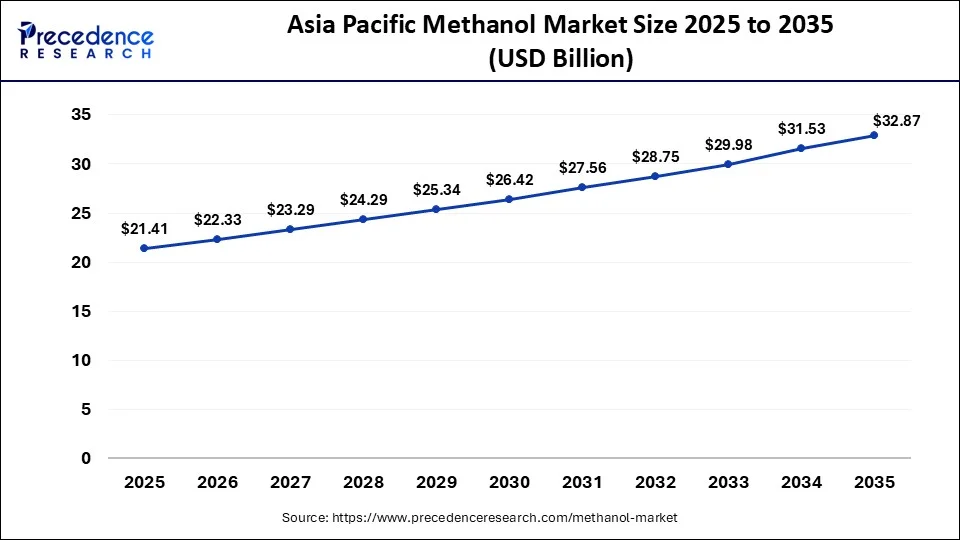
Asia Pacific region happens to be the major contributor for the growth of this market. As an expansion of the automotive and construction industries in China and India the market is expected to grow. China is a major manufacturer and consumer of derivatives and this happens to be an important factor in the growth of the market.
How is Asia-Pacific leading in the Methanol Market?
The methanol market in the Asia Pacific is on a rapid growth path, and the main reason is the industrialization and demand coming from sectors like automotive, construction, and chemicals. The transition to olefins from methanol and the increased use of methanol as a green fuel are some of the factors that are positively impacting the regional growth. The emphasis on self-sufficiency and renewable energy development not only secures the region's spot as a major player in methanol production and consumption but also ensures that it remains a global hub for methanol trade.
The Chinese methanol market is a significant global player, characterized by high demand and growing consumption, particularly for applications in chemical manufacturing and as a fuel alternative. The market is expected to continue expanding, driven by increasing demand from industries such as chemical manufacturing and the potential for methanol as a clean-burning fuel. A significant portion of methanol demand in China is attributed to its use in MTO/MTP (Methanol to Olefins/Methanol to Propylene) processes, which produce olefins such as ethylene and propylene. China is increasingly looking at methanol as a cleaner-burning alternative fuel, both neat and in blends with gasoline. This is due to its lower environmental impact compared to traditional fuels. China exports methanol to some major export destinations including Vietnam, Other Asian countries, Indonesia, Malaysia, and the Philippines.
China Methanol Market Trends:
The methanol market in China is on the rise, and the reasons for this are the modernization of industries, the introduction of more efficient production methods, and the strong domestic demand for both chemical and fuel applications. The country is moving towards cleaner production, and so its investments in advanced manufacturing technologies are going hand in hand with large-scale methanol production. The uptake of renewables and the development of logistics that are eco-friendly and effective are going to be China's assets in the production and consumption of methanol, which will then translate into the country being a major player globally.
The South Korean methanol market is experiencing steady growth, driven by its use as a feedstock in the chemical industry, particularly for formaldehyde production, and as a clean energy alternative. The market is also influenced by government initiatives promoting sustainable energy solutions and advancements in methanol production technologies.
The North American region is also seeing a good growth in the methanol market as there is a demand for fueling applications like production of green fuels and fuel blending. The increasing petrochemical industry is also supporting the market's progress. A growing preference for sustainable products and increased demand for automotive's in the European region will lead to a growth of the market in this region.
How is North America performing in the Methanol Market?
The North American market gets a big advantage from the plentiful natural gas supply and the increasing focus on switching to cleaner fuels. The need for methanol is coming mainly from blending with gasoline, the making of petrochemicals, and sustainability-motivated methanol projects. The tech-savvy nature of the region's technology and the existence of energy-friendly policies are the main factors that attract investments in the area of renewable methanol. This combination establishes North America as an important participant in the worldwide innovation and supply stability of methanol.
How is North America performing in the Methanol Market?
The North American market gets a big advantage from the plentiful natural gas supply and the increasing focus on switching to cleaner fuels. The need for methanol is coming mainly from blending with gasoline, the making of petrochemicals, and sustainability-motivated methanol projects. The tech-savvy nature of the region's technology and the existence of energy-friendly policies are the main factors that attract investments in the area of renewable methanol. This combination establishes North America as an important participant in the worldwide innovation and supply stability of methanol.
The U.S. methanol market is experiencing rapid growth due to Methanol is a crucial feedstock for producing chemicals such as formaldehyde, which is used in resins, plastics, and adhesives. Methanol is used in gasoline to improve octane rating and is being explored as a low-emissions alternative fuel. The United States has several major methanol production facilities, with a notable center in Beaumont, Texas. This facility, jointly owned by Consolidated Energy Limited (CEL), OCI N.V., and Natgasoline LLC, produces 5,000 metric tons of methanol per day (1.8 million metric tons per year). Methanex, Celanese, and US Methanol LLC are the major players in the U.S.
The Canadian methanol market is expected to grow significantly, driven by increasing demand from the automotive and chemical industries, and government support for cleaner fuels. Government initiatives, such as the Clean Fuel Standard and Renewable Fuel Standard, are driving demand for low-carbon fuels such as methanol.
The Middle East, Africa and Latin America are also expected to see a growth due to industrialization and rising construction activities. The Indian government is consistently pushing the utilization of methanol in the automobiles and the use of methanol in cooking fuel. These steps will help in promoting sustainable development as it is an eco friendly option. A capital investment of U.S. dollar to 46 million was made in order to convert around 3,60,000 tons of waste into green methanol by the Netherlands. This initiative is expected to provide growth opportunities for the methanol market across the European region.
What are the driving factors of the Methanol Market in Europe?
In Europe, the development of renewable methanol is closely connected to the area's sustainability and emission reduction targets. The manufacturing and shipping industries are decarbonizing by replacing fossil fuels and using low-carbon fuels so that they can comply with environmental regulations. The progress of technology, together with circular economy initiatives, is leading to the production of bio-methanol and e-methanol, thus making Europe a forerunner in providing environmentally friendly methanol solutions.
Germany Methanol Market Trends
Germany is a significant producer of methanol due to the country's industrial innovations, sustainability policies, and the application of renewables in production technologies. The government is focusing on converting industrial waste gases to methanol and promoting e-methanol as a carbon-neutral fuel. Considerable research and investment in green technologies, together with the imposition of environmental regulations, make Germany a major actor in the European shift towards sustainable methanol solutions.
Which Major Growth Factors Drive the Notable Growth of the Methanol Market in Latin America?
Latin America is expected to grow at a notable rate in the market during the predicted timeframe, driven by petrochemical and construction sector demands, fuel blending and biodiesel production, and shifting supply chains. The producers are expected to focus on value-centered sales strategies and operating discipline. On the other hand, buyers maintain flexible purchasing approaches. Latin American governments are shifting toward green and low-carbon methanol initiatives through mandated biofuel blending targets, new regulatory frameworks, and multi-billion dollar-tax credits.
How can the Methanol Market Expand in Brazil?
Brazil is transitioning toward rising biodiesel mandates, green e-fuel and renewable ambitions, and chemical sector recovery. Brazil is focused on emissions monitoring and reporting, and allows regulated companies to build data collection systems. It also allows them to adapt to the new frameworks.
How does the Methanol Market Majorly Impact the Significant Growth of MEA?
MEA is expected to grow significantly in the market in the coming years, propelled by surging demand for cleaner alternative fuels, rising investments in petrochemical hubs, and emerging green fuel initiatives. The UAE government has shifted focus toward integrating methanol into its domestic manufacturing through public-private partnerships. The regional governments focused on securing feedstock allocations for traditional mega-plants. They have built specialized regulatory frameworks and infrastructure for green methanol.
What is the Major Footprint of Saudi Arabia in the Methanol Market?
Saudi Arabia is transforming due to significant product capacity expansions, optimization of existing infrastructure, and downstream integration for industrial chemicals. Saudi Arabia is expected to drive a new era of petrochemicals. It is an ideal investment destination for businesses and cleaner industries.
Trade Analysis for Methanol Market
- Global methanol imports accounted for 553 shipments backed by 553 exporters and 780 verified buyers in international trade networks
- The U.S., Vietnam, and Belgium became major importing nations fueled by high industrial demands in various chemical and fuel sectors
- The U.S., Japan, and Venezuela are leading global exporters of methanol, supported by large-scale production and high distribution capabilities
- India-linked methanol imports during the time period 1,990,000 of shipments of 553 exporters and 321 buyers in active participation in the global trade
- Global export activity reached 3,042 shipments facilitated by 553 exporters and 321 buyers, showing balanced and stable trade flow
- Methanol trade registered 10% year on year growth, showing steady growth and rising global demand in all industrial applications.
- The U.S. led in exports with 5,815 shipments, followed by Japan with 673 and Venezuela with 556 shipments globally
- Trade intelligence on 203 countries and more than 3.5 billion shipments, allowing for in-depth insights on methanol market trends
- Volza tools, such as Market Entry Strategist and Global Partner Finder, to identify buyers and optimise sourcing strategies effectively
Latest Updates on Methanol Market
E-methanol
E-methanol is a synthetic fuel created from renewable electricity and captured carbon dioxide (CO2) which offers a sustainable alternative to traditional fossil fuels. It is produced by first generating hydrogen (H2) from water using renewable electricity through electrolysis, then combining this hydrogen with CO2 to form methanol. This process can significantly reduce lifecycle greenhouse gas emissions, making e-methanol a potential solution for decarbonizing hard-to-abate sectors such as shipping and aviation. E-methanol can be used in various sectors, including transportation (road, marine, aviation), power generation, and the chemical industry. E-methanol offers several advantages, such as being a stable liquid fuel, having existing infrastructure for handling and distribution, and being compatible with some existing combustion engines.
Bio-methanol
It is also known as green methanol, is a renewable fuel produced from biomass or biogas, offering a sustainable alternative to traditional methanol production from fossil fuels. Bio-methanol can lead to lower greenhouse gas emissions and particulate matter as compared to fossil fuels. It offers a high-octane number, suitable for use in fuel cell-powered vehicles. Methanol is emerging as a fuel for ships, with infrastructure for storage and bunkering being developed. Methanol is used as a raw material in various chemical processes such as the production of formaldehyde, methyl tertiary butyl ether (MTBE), and other chemicals.
Value Chain Analysis
- Feedstock Procurement: This process is characterized by the natural gas extraction and the procurement of other raw materials for the production of methanol.
Key Players: Saudi Aramco, SABIC, and PetroChina (CNPC) - Chemical Synthesis and Processing: This involves the conversion of feedstock into methanol through a series of chemical reactions and careful manufacturing under controlled conditions.
Key Players: Proman, SABIC, and OCI Global - Compound Formulation and Blending: The methanol-based compounds that are made for different applications are the result of this process.
Key Players: Celanese Corporation - Quality Testing and Certification: The products are only shipped out once they have gone through rigorous testing for performance, safety, and purity standards.
Key Players: SGS, Intertek, and Chem-Tech Laboratories - Packaging and Labeling: The finished products receive suitable containers and labels before they are dispatched to the market.
Key Players: Simalin Chemical Industries Ltd - Distribution to Industrial Users: The huge task of logistics for giving a prompt delivery to the end users is managed.
Key Players: Methanex and Proman - Waste Management and Recycling: The waste from the production process is treated with care, and sustainability is enhanced through recycling.
Key Players: Veolia and Enerkem - Regulatory Compliance and Safety Monitoring: Environmental laws compliance and safety procedures are monitored through continual checks.
Key Players: Petroleum and Explosives Safety Organisation (PESO) and the International Maritime Organization (IMO)
Competitive Landscape
The methanol market is dominated by top industry leaders such as Methanex Corporation, Proman AG, SABIC, Sinopec, PETRONAS Chemicals Group, Zagros Petrochemical Company, Celanese Corporation, BASF SE, and Mitsubishi Gas Chemical Company. These leading companies deliver chemical-grade methanol, fuel-grade methanol, low-carbon or renewable portfolios, biomethanol, e-methanol, conventional and fuel methanol, acetic acid base feedstocks, carbon-reuse polymers, and many more product offerings. The core focus areas of R&D are maritime fuel scaling, carbon capture and catalysts, and alternative powertrains.
Methanol Market Companies
- Celanese Corporation: Produces methanol by joint ventures using captured carbon dioxide. Focuses on low-carbon solutions for coatings and adhesives as well as chemical applications.
- BASF SE: Offers certified low-carbon and biomass-balanced methanol. Supplies high-purity methanol for plastics, formaldehyde, and fuel additives worldwide.
- Methanex Corporation: Provides natural gas-based methanol worldwide. Focuses on low-carbon production and marine fuel solutions with dedicated shipping operations around the world.
- SABIC: Manufactures traditional and low-carbon methanol from captured carbon dioxide. Supports sustainable fuel, resins, and chemical derivatives production applications.
- Petroliam Nasional Berhad (PETRONAS): Produces and supplies methanol for industrial and chemical applications through its integrated petrochemical facilities.
- Mitsubishi Gas Chemical Company, Inc.: Manufactures high-purity methanol used as a feedstock in chemical synthesis and formaldehyde production.
- Valero Energy Corporation: Operates methanol production and blending for fuel and industrial chemical markets.
- Mitsui & Co., Ltd.: Supplies methanol globally through trading operations and investments in production projects.
- Zagros Petrochemical Co.: Produces methanol as a key petrochemical product for domestic use and export.
- Methanol Holdings (Trinidad) Limited: Specializes in large-scale methanol production for international chemical and energy markets.
Recent Developments
- In 2025, European Energy has begun commercial e-methanol production in Denmark. (Source: https://energynews.pro)
- In May 2025, China launched the world's first methanol dual-fuel car carrier. Anji Ansheng employs energy-saving technologies and intelligent low-carbon systems. The CM Hong Kong, which is expected to be delivered in the second half of 2025, however, was outfitted with a complete methanol power plant. The main engine, the auxiliary engine and boiler are all designed to use methanol. (Source: https://maritime-executive.com)
- In march 2025, Sushui Energy Technology announced to launch Methanol Fuel Cell to onto UK Market at BAPCO 2025. (Source: https://fuelcellsworks.com)
- Saudi Aramco took to the market and acquired 70% stakes of the global company named SABIC. This was done from the Public Investment Fund (PIF). The total amount of the purchase summed up to an amount of USD 69.1 billion.
Segments covered in the Report
By Feedstock
- Coal
- Natural gas
- Biomass and Renewables
By Derivatives
- MTO/MTP
- Solvent
- Biodiesel
- Acetic acid
- Formaldehyde
- Others
By Sub-derivatives
- Gasoline additives
- Olefins
- UF/PF resins
- VAM
- Polyacetals
- MDI
- PTA
- Acetate Esters
- Acetic anhydride
- Fuels
- Others
By Application
- Construction
- Electronics
- Automotive
- Paints and Coatings
- Pharmaceuticals
- Others
By Geography
- North America
- Latin America
- Europe
- Asia-pacific
- Middle and East Africa
For inquiries regarding discounts, bulk purchases, or customization requests, please contact us at sales@precedenceresearch.com
Frequently Asked Questions
Tags





Ask For Sample
No cookie-cutter, only authentic analysis – take the 1st step to become a Precedence Research client
 Get a Sample




 sales@precedenceresearch.com
 Schedule a Meeting
