



Sweeteners Market Size, Production Volume, Consumption Trends, Pricing Analysis, Export & Import Dynamics, Market Share, and Demand Forecast
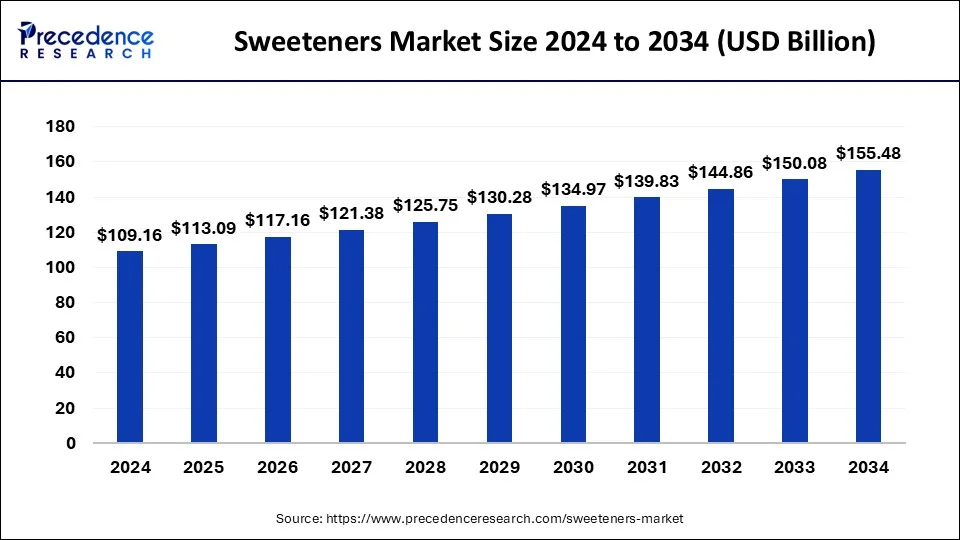
The global sweeteners market was valued at USD 113.09 billion in 2025 and is forecast to reach approximately USD 159.46 billion by 2035, advancing at a CAGR of 3.50% over the forecast period. The sweeteners market growth is driven by rising consumer demand for low-calorie and reduced-sugar foods and beverages, increasing health awareness, and the growing prevalence of diabetes and obesity. The rising preference for natural and plant-based sweeteners, expanding processed food and beverage consumption, and government initiatives promoting sugar reduction are further supporting market expansion.
Source: https://www.precedenceresearch.com/sweeteners-market
 Get a Sample
 Table Of Content


Sweeteners Market Size and Forecast 2026 to 2035
The global sweeteners market size was estimated at USD 113.09 billion in 2025 and is predicted to increase from USD 117.16 billion in 2026 to approximately USD 159.46 billion by 2035, expanding at a CAGR of 3.50% from 2026 to 2035. The sweeteners market is driven by rising consumer demand for low calorie and reduced sugar foods and beverages.
Sweeteners Market Key Takeaways
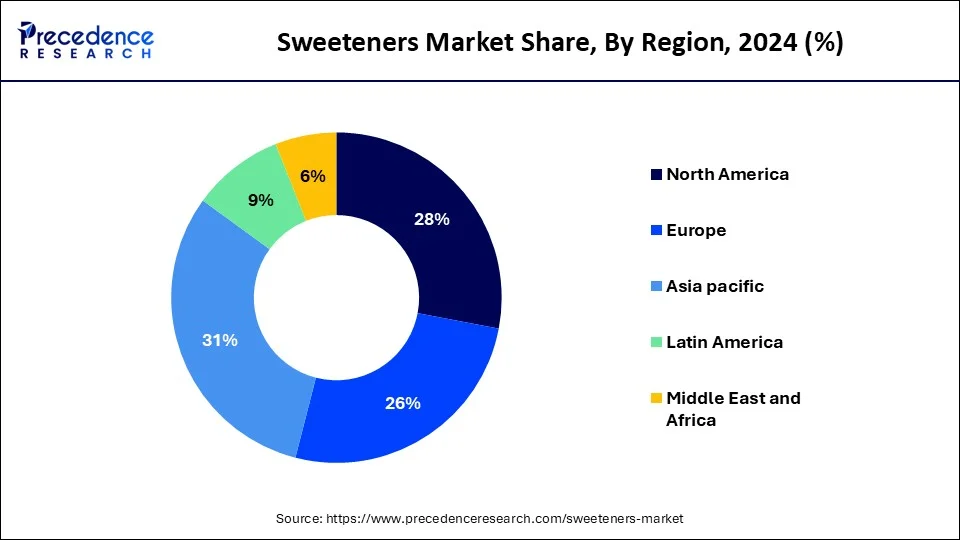
- By geography, the Asia Pacific region has emerged as the largest market of around 31% in 2025.
- By type, the sucrose segment contributed the highest market share in 2025.
- By form, the solid segment captured the biggest market share of 71% in 2025.
- By application, the bakery and confectionery segment generated the major market share in 2025.
Market Overview
The sweeteners market comprises the agents that help to substitute sugar but still provide sweetness to food products. There are variations in the calorific value of the final food product. The glycemic response which is provided by these sweeteners also varies according to the type.
Sucrose has been or actual sweetening agent for a long period. The sweetness that is provided by the sweeteners is considerably higher as compared to the natural sweetening agents. A very small amount of the sweetener can provide a substantial level of sweetness to the food product. These sweeteners do not directly contribute to the calorific value of the food product and hence are considered as a first choice by many consumers.
The energy that is provided by beverages and food products containing sweeteners is not like the energy that is provided by natural sugar. The calories that are provided by beverages and food products are considerably lower and hence are majorly preferred by the younger generations. The key market players have been carrying out research and development programs for introducing dietary sweeteners into the market so that sucrose can be replaced.
The outbreak of the pandemic had a marginal effect on the sweeteners market. The amount of sugar consumed by people globally is seen to be stagnated in 2020 because of the increasing demand for artificial sweeteners. People became increasingly conscious regarding their health after the outbreak of the pandemic which resulted in a reduction in sugar intake. Increasing awareness among people regarding the importance of health harmed the growth of the sweeteners market. The various health benefits that were obtained from artificial sweeteners were successful in capturing the potential market.
Sweeteners Market Growth Factors
- Growing awareness of excessive sugar intake is encouraging consumers to choose lower sugar foods and beverages. Manufacturers are adopting stevia, monk fruit, polyols and other alternatives, creating new opportunities for market growth.
- The growing prevalence of diabetes, obesity and other lifestyle related diseases forces consumers to cut or lower sugar consumption to live a healthy life.
- The rapidly growing food and beverage industry due to increasing demand for packaged foods, flavoured drinks and bakery products.
- Consumers are preferring plant based sweetening alternatives, supporting stevia, monk fruits, honey and other options in products.
- Public health programs and government efforts are encouraging manufacturers to lower sugar levels in processed foods and beverages.
Key Factors
- Lower calorific value makes it a primary choice for many consumers.
- A very small amount of sweetener is required to match the sweetness provided by natural sugar.
- It helps to maintain blood sugar levels which proves to be beneficial for the diabetic population.
- Increasing demand for processed beverages and food products.
Market Outlook
- Industry growth overview - The sweeteners market is expected to grow as food and beverage manufacturers expand reduced sugar products. Rising demand for natural sweeteners, polyols and low calorie alternatives is supporting market expansion.
- Global expansion - Asia Pacific remains a major growth region because of its large consumer base and expanding food industry.
- Major Investor - Major investors in the market include S2G Ventures, Khosla Ventures, Blue Horizon, Cargill, ADM, and Tyson Ventures,
- Startup ecosystem - Startups are entering the market with monk fruit, allulose, sweet proteins, and improved sweetener blends designed to deliver better taste and lower sugar. 
Market Scope
| Report Coverage | Details |
| Market Size in 2025 | USD 113.09 Billion |
| Market Size in 2026 | USD 117.16 Billion |
| Market Size by 2035 | USD 159.46 Billion |
| Growth Rate from 2026 to 2035 | CAGR of 3.50% |
| Base Year | 2025 |
| Forecast Period | 2026 to 2035 |
| Segments Covered | Type, Form, Application, and Region |
| Regions Covered | North America, Europe, Asia-Pacific, Latin America and Middle East & Africa |
Increasing demand for processed food products has boosted the market for artificial sweeteners. Because of modern lifestyle practices, the demand for packed food products and beverages has increased rapidly. Consumption of baked food products and beverages helps to save a huge amount of time which proves to be beneficial for the working class.
On the other hand, increasing the consumption of energy drinks by youngsters to fulfill their nutrition demands is assisting the market to record a significant revenue. Increasing demand for soft drinks has also emerged as a major driving force for the sweeteners market. Carbonated soft drinks have emerged as one of the largest-selling beverages globally.
Increasing demand for higher nutritive value is also supporting the growth of the sweetener market. The demand for convenience foods has increased due to a hectic lifestyle and this is one of the major reasons driving the market growth. The demand for carbonated drinks has also increased, especially in the younger population. The profit margin of this industry is increased to a great extent as the manufacturer distributes the products through hypermarkets and supermarkets.
Market Dynamics
Key Market Drivers
Growing demand for natural sweeteners
Consumers' inclination towards natural products has increased in recent times and health-conscious consumers are making healthier choices. The use of natural sweeteners in various industries has grown significantly. The food and beverages industry is making use of natural sweeteners to a great extent owing to the benefits offered by these sweeteners. This is a low-calorie option available in the market which will provide maximum growth opportunities.
Increasing prevalence of diseases
As the number of patients suffering from various chronic disorders in the world has grown, the need for sweeteners is also expected to grow. Diabetes is one such chronic illness that has created the maximum demand for sweeteners in the market. Sweeteners that offer low-calorie intake have better market growth. The side effect of natural sweeteners is less due to which the demand for this product is less.
Restraints
Expensive raw materials
The cost of raw materials needed for the manufacturing of sweeteners is high. The manufacturing process is also complex. And this happens to be a major challenge for the growth of the market, especially for the production of high-intensity products. Prominent market players are constantly making efforts to invest in research and development activities to come up with innovative products.
Challenges
Side effects
Prolonged consumption of artificial sweeteners may have several side effects. Tooth decay, weight gain, health problems, and poor nutrition are a few side effects associated with the consumption of artificial sweeteners. Limited consumption of this product may not cause many health problems. Kidney damage and low blood sugar are the prolonged issues associated with the consumption of sweeteners. All of these factors will hamper the market growth.
Opportunities
Increased consumption of processed food products and convenience products
A hectic lifestyle is one of the factors creating growth opportunities for the sweeteners market. Processed beverages and foods are easily available in the market. Frozen meals and snacks with good nutritive value are offered. All of these factors will drive the market for sweeteners during the forecast period. The working women population is another factor driving the market growth. Rapid urbanization and the increase in disposable income will also provide major opportunities for the growth of this market.
Segmental Insights
Type Insights
Based on the type, the sucrose segment has emerged as the leading segment in the global market. The common name of sucrose is table sugar which is one of the daily consumable food products. Sucrose can be obtained naturally from nuts, fruits, and vegetables. Sucrose can be obtained from fructose and glucose which is a disaccharide.
Sugar cane is one of the largest sources of sucrose and hence it is utilized commercially for obtaining the final product. Bakery food products obtain they are required consistency and structure with the help of sucrose. Medicine formulations include the application of sucrose as it plays an important role in imparting an agreeable smell and taste to the chemicals. Various medicines in the market have been introduced that make use of sweeteners, such as chewable tablets, lozenges, syrups, and gummies. These medicines usually have a sweet taste because of the sucrose content in them.
The utilization of sucrose in manufacturing soft drinks and other beverages plays an important role in the growth of the market. Sucrose has been largely utilized for making desserts, which proves to be a major driving force. Tagatose is gradually gaining popularity because of the various health benefits that are obtained from them.
The properties are similar to that of sucrose and hence it is utilized in the pharmaceutical industry. This product is also utilized in the healthcare industry for the treatment of obesity and diabetes. Constant research and development programs are being carried out by the key market players for introducing new applications of tagatose.
Application Insights
Based on application, the bakery and confectionery segment has emerged as the largest segment as these products commonly make use of sucrose as a sweetener. Sucrose forms an important component of the food products that are baked as they provide a particular shape and structure. Cookies and cakes contain huge amounts of sucrose for maintaining their shape and structure. Sucrose is also utilized as a bulking agent in bakery food products.
The presence of sucrose provides a specific color to the food products. It helps to increase the shelf life of the food products which makes them durable. Faster growth is expected from the pharmaceutical segment because of the utilization of sweeteners in manufacturing medicines. The usage of sweeteners in the pharmaceutical industry makes the medicines palatable for the consumer. The utilization of artificial sweeteners for diabetic patients has emerged as a major driving force for the growth of the market.
Form Insights
Based on form, the solid form segment has emerged as the largest segment and was generated more than 71% of revenue shares in 2025 as it is the most common form of sweetener that is available in the market. Various functional benefits that are provided by the solid form of sweeteners make it feasible for the manufacturers to transport it from one place to another.
The beverage and food industry makes use of solid sweeteners on a large scale in bakeries, confectionery, and other food applications. The physical properties of the solid form of sweeteners make it easy to use in the food and beverage industry.
Regional Insights
Asia Pacific Sweeteners Market Size and Growth 2026 to 2035
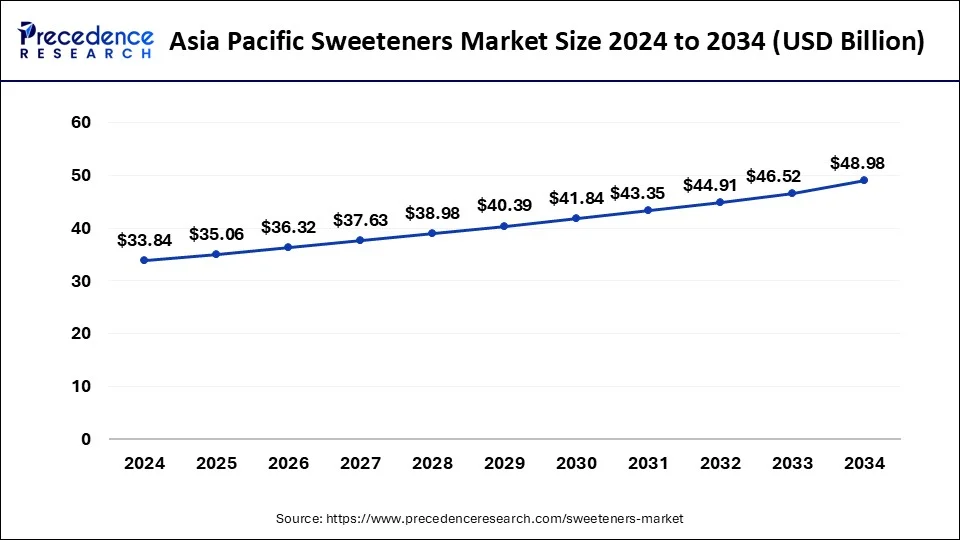
The Asia Pacific sweeteners market size was estimated at USD 35.06 billion in 2025 and is expected to be worth around USD 49.78 billion by 2035, rising at a CAGR of 3.57% from 2026 to 2035.
Asia Pacific has emerged as the largest market with around 31% in 2025. because of the booming beverages and food industry. Growing economies that are present in this region include the younger population that is influenced by fast food and beverages. Because of the emerging modern lifestyle practices, the consumption of fast food and beverages has increased rapidly. Asian countries are the largest consumers and producers of sucrose.
The availability of raw materials such as sugar cane is high in these regions, which proves to be a major driving force for the market. Significant growth has been presented by the region of North America because of the increasing demand for low-calorie food products and beverages. Increasing health consciousness among the people regarding the benefits of artificial sweeteners has helped the market to record significant revenue.
China Market Trends
China accounts for the largest share of the sweeteners market in Asia-Pacific in 2025. The growth is driven by its large population, expanding food processing industry, and high consumption of beverages and packaged foods. The market is further driven by high disposable incomes and rapid urbanization supporting demand from dairy, bakery and beverage industries. Growing awareness of healthier diets and government efforts to reduce sugar consumption are creating opportunities for stevia, sugar alcohols and other low calorie sweeteners.
U.S. Market Trends
The United States represents the largest share of the sweeteners market in North America. The growth is driven by its extensive food and beverage manufacturing base. Consumers are preferring low calorie, stevia, sucralose and corn based sweeteners due to rising health awareness and sugar reduction. This encourages manufacturers to reformulate beverages, dairy products, bakery items and adopt sugar reduction solutions. The rising cases of diabetes and obesity further support the market expansion in the United States.
Which Factors Made Europe a Significantly Growing Region in the Market?
Europe is expected to grow at a considerable CAGR in the sweeteners market in the coming period. The region is growing as consumers increasingly prefer low sugar and clean label food products. The sugar reduction initiatives and growing health awareness are encouraging manufacturers to explore stevia and other alternative sweeteners. The rising numbers of diabetes and obesity cases drive demand for healthy, natural and low calorie sweeteners in bakery, dairy and beverages.
Germany Market Trends
Germany leads the European sweeteners market in 2025 due to its large food processing, bakery, confectionery, and beverages industries. The rising awareness of sugar reduction and clean label product consumption encourages consumers to choose low calorie sweeteners in bakery, dairy, food and beverages. The changing lifestyle and choices encourage manufacturers to adopt stevia, polyols and other sweetening solutions. Germany's robust food processing industry and strict regulatory standards accelerate innovation in reduced sugar formulations, which further supports market expansion.
What are the Advancements in the Market in Latin America?
Latin America held a considerable share of the sweeteners market in 2025, supported by its expanding processed food and beverages industries and growing urban population. Brazil and Mexico remain major markets with sugarcane production supporting regional sweetener supply. Demand is growing from pharmaceutical and beverage applications for sugar reduction, which further contributes to the market expansion. The region's developing food processing capacity and gradual adoption of sugar reduction are creating opportunities for market growth.
Brazil Market Trends
Brazil accounts for the largest share of the Latin American sweeteners market in 2025 due to its extensive sugarcane cultivation, large scale sugar industry, and strong position in global sugar exports. Brazil's large food and beverages industry provides a strong customer base for sweetener producers. Industries are also adopting low calorie and natural sweeteners in dairy, bakery, confectionery and beverage sectors. The government id also promoting low sugar consumption in the country due to rising diabetes cases.
What are the Key Trends in the Market in the Middle East and Africa Region?
The Middle East & Africa held a notable share of the sweeteners market in 2025, driven by growing urbanization, population growth, and increasing packaged food consumption. The growing awareness of sugar disadvantages and ill health effects encourages consumers to choose sugar alternatives such as coconut sugar and date sugars. The growing preference for these natural alternatives drives manufacturers to adopt sugar reduction alternatives across dairy and beverage industries.
Saudi Arabia Market Trends
Saudi Arabia represents the leading market within the Middle East and Africa sweeteners market in 2025, supported by high consumption of packaged foods, soft drinks, and other processed products. Increasing awareness of diabetes, obesity and healthier diets is creating interest in sugar reduced and low calorie products. Health focused initiatives across the region are encouraging manufacturers to balance sweetness, taste, and product affordability.
Competitive Landscape
The sweeteners market is moderately competitive, with major ingredient companies and pharmaceutical companies competing through their product quality and pricing. The leading companies in the market include ADM, Cargill, Ingredion, Tate & Lyle, Roquette, Foodchem International Corporation, PureCircle, Pyure, Beeyond the Hive and Kerry Group plc. The companies are strengthening their market position through innovation, expanded production capacity, application specific solutions, and stronger distribution networks.
For future growth in the sweeteners market, companies should prioritize natural and low calorie sweeteners, improved taste and formulation performance and develop customized solutions for beverages, dairy, bakery and confectionery manufacturers.
Top Companies in the Sweeteners Market and Their Offerings (Addition)
- Cargill - A United States global food and agricultural company offering corn sweeteners, glucose syrup and polyols.
- Key offerings - Stevia extracts, erythritol blends, sucrose, high-fructose corn syrup (HFCS), polyols
- Archer Daniels Midland (ADM) - A United States agricultural processing and global ingredient supplier. It offers corn sweeteners, glucose syrup, fructose used across food and beverage applications.
- Key offerings - Corn sweeteners, fructose, dextrose, sorbitol, sucralose, stevia
- Tate & Lyle - A United Kingdom based company offering low and no calorie sweeteners, fibres, and solutions.
- Key offerings - Sucrose, stevia, fructose, allulose
- Ingredion - A United States based major ingredient manufacturer serving food, beverages, pharmaceutical, and industrial customers.
- Key offerings - Stevia, polyols, dextrose, high-fructose syrup, starches
- Roquette - A France based global plant based ingredients manufacturer offering polyols and other specialty ingredients used in food and beverage applications.
- Key offerings - Glucose syrups, polyols, starch derivatives, tagatose
Sweeteners Market Companies
- ADM
- Ingredion
- Cargill, Incorporated
- Roquette Frères
- Tate & Lyle
- Foodchem International Corporation
- PureCircle
- Pyure Brands LLC
- Beeyond the Hive
- Dabur India Ltd.
- Kerry Group plc
- Ajinomoto Co., Inc.
- International Flavors & Fragrances Inc.
- DFI Corporation
- Nascent Health Sciences, LLC
Recent Developments
- In July 2020 - Tate and Lyle introduced a sweetener solution under the name of VANTAGE which is a design tool. This is an education program that provides the latest sweetener solution tool. This design has been introduced for producing drinks and foods that have low calorific value.
- In July 2018 - Aston foods and ADM Collaborated to form a combined venture of starches and sweeteners in Russia. The footprint of the company could be expanded in Russia because of this step in the natural sweeteners market.
Segments Covered in the Report
By Type
- Sucrose
- High-fructose Corn Syrup
- Polyol Sweeteners/Sugar Alcohols
- Sorbitol
- Xylitol
- Mannitol
- Maltitol
- Isomalt
- Erythritol
- Lyxitol
- Others
- High Intensity Sweeteners
- Aspartame
- Sucralose
- Saccharin
- Cyclamates
- Acesulfame Potassium (Ace- K)
- Stevia
- Monk Fruit (Luo Han Guo)
- Brazzein
- Others
- Allulose
- Tagatose
- Cambya
- Others
By Form
- Solid
- Liquid
By Application
- Bakery & Confectionery
- Beverages
- Dairy & Frozen Desserts
- Pharmaceuticals
- Others
By Geography
- North America
- Europe
- Asia-Pacific
- Latin America
- The Middle East and Africa
For inquiries regarding discounts, bulk purchases, or customization requests, please contact us at sales@precedenceresearch.com
Frequently Asked Questions





Ask For Sample
No cookie-cutter, only authentic analysis – take the 1st step to become a Precedence Research client
 Get a Sample




 sales@precedenceresearch.com
 Schedule a Meeting
