



Transient Voltage Suppressor Diode Market Size, Share and Trends 2026 to 2035
Transient Voltage Suppressor Diode Market (By Type: Uni-polar TVS, Bi-polar TVS; By Application: DC Supply Protection, DC Load Protection, AC Supply Protection, Electro-Magnetic Interference Limiting, Operational Amplifier Protection, Others; By End User: Automotive, Industrial Power Supplies, Military/Aerospace, Telecommunication, Computing, Consumer Goods, Others) - Global Industry Analysis, Size, Trends, Leading Companies, Regional Outlook, and Forecast 2026 to 2035
Source: https://www.precedenceresearch.com/transient-voltage-suppressor-diode-market
 Get a Sample
 Table Of Content
What is the Transient Voltage Suppressor Diode Market Size?
The global transient voltage suppressor diode market size is accounted at USD 1.15 billion in 2025 and predicted to increase from USD 1.24 billion in 2026 to approximately USD 2.41 billion by 2035, representing a CAGR of 7.68% from 2026 to 2035.
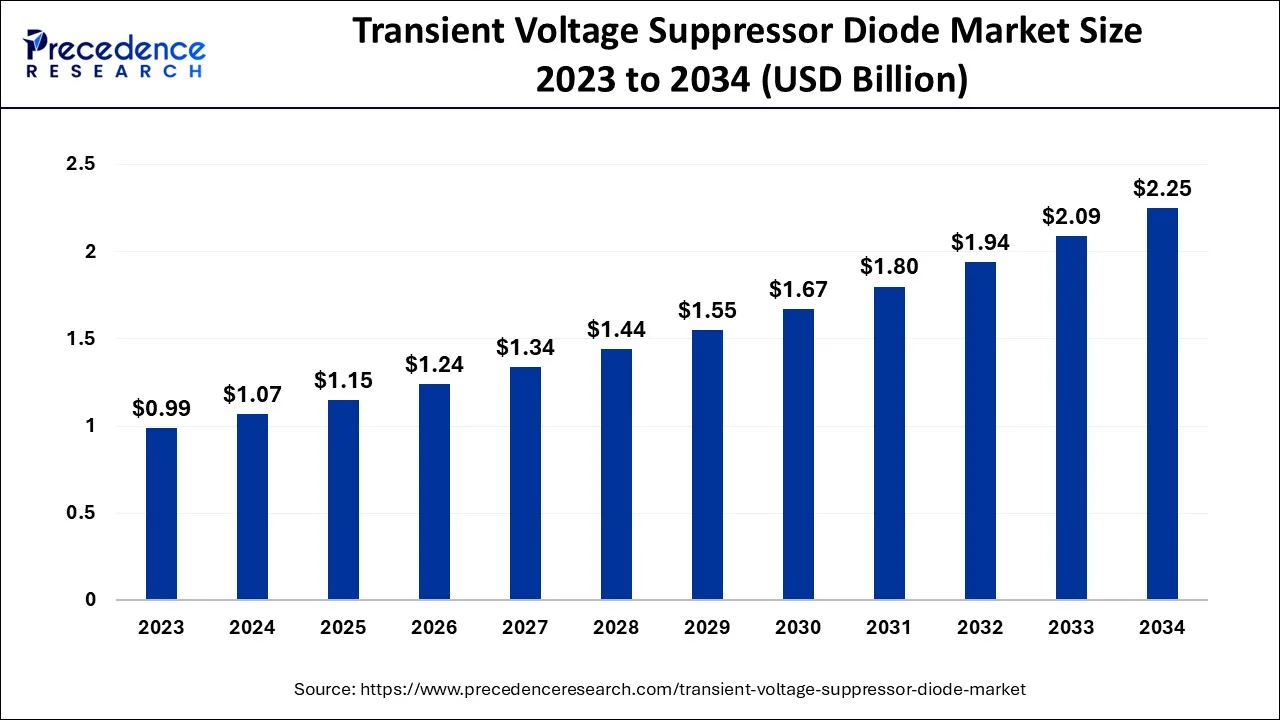
In order to handle strong transient currents, transient voltage suppressor diodes are specifically created with junctions that have a large cross-sectional area. The TVS diodes are particularly built, examined, and described for the suppression of transient voltages.
Key Takeaways
- By geography, the Asia-Pacific generated for the maximum revenue share in 2025.
- By type, the uni-polar TVS segment was captured greatest revenue share in 2025.
- By application, the AC supply protection segment had the highest revenue share in 2025.
- By end user, the industrial power supplies segment is expected to experience the quickest revenue growth from 2024 to 2034.
How is AI contributing to the Transient Voltage Suppressor Diode Industry?
Optimizing design simulations, performing reliability analyses, and, finally, controlling the quality of manufacturing are the three main areas where artificial intelligence (AI) technology takes TVS diode performance to another level. Predictive failure detection, automated defect inspection, adaptive surge protection behavior, faster testing characterization, and intelligent supply chain planning are just a few of the advantages delivered by AI.
All these capabilities are necessary for the development of solid components, the establishment of responsive protection systems, and the implementation of efficient production workflows, together with the lasting availability of components across the whole electronics-intensive industry.
Growth Factor
Voltage transients are defined as rapid bursts of electrical energy that are the result of the unexpected release of energy that was previously stored or started by other mechanisms, such as intense inductive loads and lightning. This energy can be expelled in an unexpected manner through regulated exchanging activities in electrical /electronic circuits, or it can be arbitrarily triggered into circuits from outside sources.
The factors including doping concentration junction area as well as substrate resistivity influence the diodes' electrical properties. To absorb strong transient currents, TVS diodes are built with massive junction cross-sections. The diodes' VI properties are the same as those of zener diodes. Zener diodes are built for voltage control, TVS diodes are designed specifically, characterized and tested for transient voltage suppression. TVS diodes are known for reacting relatively immediately. The TVS diode's response time is one of its key features.
The quick reaction time of TVS diodes suggests that the PC board traces as well as lead inductance are to blame for the voltage overshoot. TVS diodes come in a wide variety of working voltages; typical device voltage ranges for discrete devices vary from 5V - 440V.
Arc contacts, filters, and solid-state semiconductor devices are only a few examples of the diverse types of transient suppression equipment. The Metal-oxide Varistor, or MOV, is one of the most widely used discrete semiconductor transient suppression devices because it comes in a variety of energy-absorbing and voltage ratings, allowing for precise control over undesirable and sometimes harmful transients or voltage spikes.
Transient suppression devices can be connected in series or parallel with the load to restrict or clamp the residual voltage or to redirect the transient away, often to ground, so attenuating or reducing the energy value of a transient and stopping its propagation through the circuit.
Transient Voltage Suppressor Diodes provide a number of advantages, including less incremental surge resistance and the capacity to protect large currents of 6 KA to 10 KA. Also, the rapid reaction time of the diode is the main driver of the TVS diode market.
The time between 0 volts and BV is often less than one NS. Low energy handling and the associated expense are the main factors limiting the expansion of transient voltage suppressor diodes. Compared to zener diodes and metal oxide varistors, TVS diodes are more costly. However, some of the TVS diodes provided by Semtech Corporation function at 2.8V and 3.3V due to technological advancements.
In the near future, it is anticipated that operating the diodes at such a low voltage would accelerate the growth of the TVS diode market. Transient voltage suppressor (TVS) demand is expected to increase in major end-use applications due to the growing trend of component miniaturization, which has increased electrical sensitivity and is anticipated to remain one of the key growth drivers for the transient voltage suppressor market over the course of the study.
The fast reaction time of the diode (less than 1ns from 0 volts to BV), growth in trend of component shrinking, technological breakthroughs, rise in demand from diverse end-use applications, and increase in sensitivity to electrical stressors are the main market drivers for TVS diodes. The quick reaction time suggests that lead inductance and PC board traces are to blame for the voltage overshoot.Arc contacts, filters, and solid-state semiconductor devices are only a few examples of the diverse types of transient suppression equipment. The Metal-oxide Varistor, or MOV, is one of the most widely used discrete semiconductor transient suppression devices because it comes in a variety of energy-absorbing and voltage ratings, allowing for precise control over undesirable and sometimes harmful transients or voltage spikes.
Transient suppression devices can be connected in series or parallel with the load to restrict or clamp the residual voltage or to redirect the transient away, often to ground, so attenuating or reducing the energy value of a transient and stopping its propagation through the circuit.
Transient Voltage Suppressor Diodes provide a number of advantages, including less incremental surge resistance and the capacity to protect large currents of 6 KA to 10 KA. Also, the rapid reaction time of the diode is the main driver of the TVS diode market.
The time between 0 volts and BV is often less than one NS. Low energy handling and the associated expense are the main factors limiting the expansion of transient voltage suppressor diodes. Compared to zener diodes and metal oxide varistors, TVS diodes are more costly. However, some of the TVS diodes provided by Semtech Corporation function at 2.8V and 3.3V due to technological advancements.
In the near future, it is anticipated that operating the diodes at such a low voltage would accelerate the growth of the TVS diode market. Transient voltage suppressor (TVS) demand is expected to increase in major end-use applications due to the growing trend of component miniaturization, which has increased electrical sensitivity and is anticipated to remain one of the key growth drivers for the transient voltage suppressor market over the course of the study.
The fast reaction time of the diode (less than 1ns from 0 volts to BV), growth in trend of component shrinking, technological breakthroughs, rise in demand from diverse end-use applications, and increase in sensitivity to electrical stressors are the main market drivers for TVS diodes. The quick reaction time suggests that lead inductance and PC board traces are to blame for the voltage overshoot.
- Numerous new possibilities are anticipated to be created as a result of the high adoption of cutting-edge technology and the rise in R&D activities, which will fuel market expansion.
- The rapid reaction time of the diode and the semiconductor industry's rapid global growth are also predicted to have a beneficial effect on the market's expansion.
- There will be a significant increase in demand for diodes due to the availability of TVS diodes in a variety of operating voltages.
- A number of advantages, such as low incremental surge resistance and simple access to high current protection for 6KA to 10KA, are also projected to boost market expansion.
Market Outlook
- Industry Growth Overview:
Reliability in circuit protection solutions has been and still is one of the main reasons for the expansion of the electronic devices, automotive systems, and telecom markets. - Sustainability Trends:
The TVS diode market will shift more towards eco-friendly practices and products as manufacturers use lead-free materials and energy-efficient technologies compliant with environmental standards. - Global Expansion:
The Asia Pacific region is the main source of manufacturing growth; simultaneously, North America and Europe are growing through electrification and advanced network deployments. - Major Investors:
Vishay, Littelfuse, ON Semiconductor, STMicroelectronics, and Infineon are the principal investors in the market. - Startup Ecosystem:
Companies such as Wayon Electronics and Rocsolem Semi are at the forefront of innovation using super materials for better TVS diodes.
Market Scope
| Report Coverage | Details |
| Market Size in 2025 | USD 1.15 Billion |
| Market Size by 2035 | USD 2.41 Billion |
| Growth Rate from 2026 to 2035 | CAGR of 7.68% |
| Largest Market | Asia-Pacific |
| Base Year | 2025 |
| Forecast Period | 2026 to 2035 |
| Segments Covered | By Type, By Application and By End User |
| Regions Covered | North America, Europe, Asia-Pacific, Latin America and Middle East & Africa |
Market Dynamics
Key Market Drivers
TVS is in greater demand for key end-use applications
In recent years, the market's revenue growth has been significantly impacted by the need for constant electricity supply, growing emphasis on dynamic mobility, and greater awareness of its importance among individuals in developed countries.
Traditionally designed to protect fragile electrical equipment from being damaged by high voltage transients, transient voltage suppressors are now widely used in the automotive, computing, and telecommunications industries. They give a far faster reaction time than their conventional diode-based counterparts. Electrical stress sensitivity has increased due to the trend toward smaller components, which has increased the requirement for TVS in important end-use applications.
Key Market Challenges
Frequent failure of TVSS (Transient Voltage Surge Suppressors) devices
The predicted period of market growth would be hampered by the failure of TVSS devices caused by an overflow of power levels exceeding the capability of microprocessors or integrated circuits.
Commonly installed at AC as well as DC inputs and outputs, TVSS devices serve as barriers against transients and long-term power changes. Also High installation costs, the availability of several conventional instruments for regulating the energy supply, uneven suppression in certain models, the unavailability of TVS in some places, and poor customer awareness might all constrain market revenue development over the anticipated timeframe.
Factors like fluctuating advanced diode raw material prices, low energy handling capacity, complicated manufacturing processes, an absence of appropriate Research & Development (R&D) systems in developing countries, and strict governmental regulations may also seriously hinder the market's potential for revenue growth.
Key Market Opportunities
Rising government initiatives
Increasing public and private sector investments, rising government measures to improve electrical infrastructure, and rising market revenue growth are anticipated throughout the projection period. TVS are carefully built, tested, and characterized for transient voltage suppression. TVS are designed with large cross sectional area junctions to absorb strong transient currents.
Additionally, as electronic devices are used more often and people become more aware of the advantages of TVS, such as their low incremental surge resistance and the availability of high current protection for 6KA to 10KA, more industries are adopting them.
Type Insights
The market is divided into uni-polar and bi-polar TVS segments based on type in 2023, the market's greatest revenue share was accounted for by the uni-polar TVS segment. Because bi-polar TVS are becoming more and more popular with customers, the bi-polar TVS category is anticipated to increase at the quickest pace throughout the projection period.
This segment's revenue growth is anticipated to be driven by the ability to instantly clamp transient voltages to safe levels before they may harm a circuit and the growing usage of bi-polar TVS for diversion in low-energy circuits and systems. Additionally, bi-polar TVS are more in demand since they operate on a bi-directional flow of charge, are simple to use, quick to act, and perform perfectly under moderate-frequency applications.
Application Insights
The market is divided based on application into operational amplifier protection, DC supply protection, DC load protection, AC supply protection, electromagnetic interference limitation, and others. Due to the rising usage of alternate current in residential power supply stations, the AC supply protection sector had the biggest revenue share in 2022 and is anticipated to maintain its dominance over the projected period. The increasing usage of TVS to safeguard delicate AC circuitry in series connections and supply fluctuations caused by lightning are anticipated to propel this market's revenue growth.
End User Insights
The market is divided into automotive, industrial power supply, military/aerospace, communications, computer, consumer products, and other segments based on end users. Due to rising power consumption in industries, ongoing technological advancements, and support from the government for the installation of transient voltage suppressors that are required, the industrial power supplies segment is anticipated to experience the fastest revenue growth rate during the forecast period.
The industrial sector is anticipated to adopt TVS at a higher rate because to the growing usage of heavy equipment such air conditioners, manufacturing machines, decompressors, and lighting and heating equipment, which is anticipated to enhance this segment's revenue growth. Due to the growing use of TVS in office buildings and data centers, which use a significant amount of electricity daily at a streamlined flow of voltage, the telecommunications segment had the second-largest revenue share.
Regional Insights
Asia Pacific Transient Voltage Suppressor Diode Market Size and Growth 2026 to 2035
The Asia Pacific transient voltage suppressor diode market size is estimated at USD 379.50 million in 2025 and is expected to be worth around USD 817.80 million by 2035, rising at a CAGR of 7.98% from 2026 to 2035.
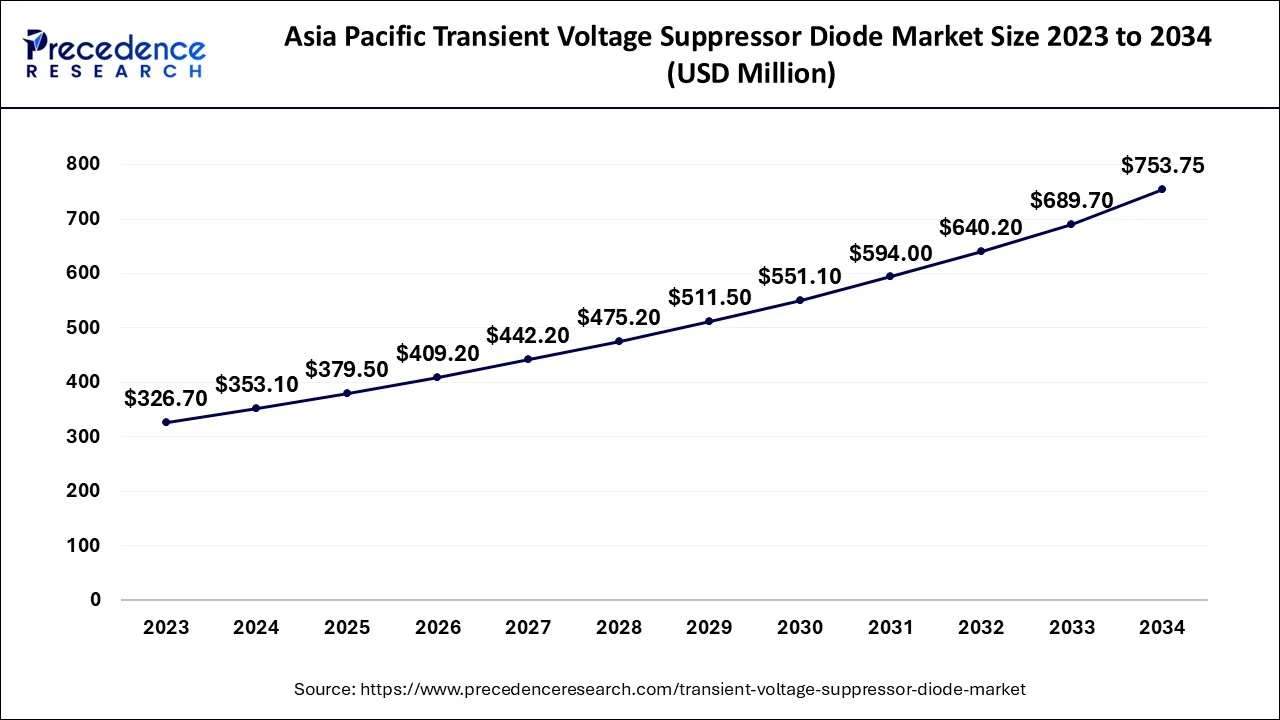
Due to the region's rapid urbanization, rising energy demand, and the implementation of successful solar and wind power projects, Asia-Pacific accounted for the largest revenue share in 2025 and is anticipated to maintain its leadership in the transient voltage suppressor market throughout the forecast period.
The government initiatives for sustainable energy management with significant reserves and the increasing deployment of electrical suppressor systems due to regulatory conditions and standardized policies in several developing countries, including India and China, are actively supporting the revenue growth of this regional market.
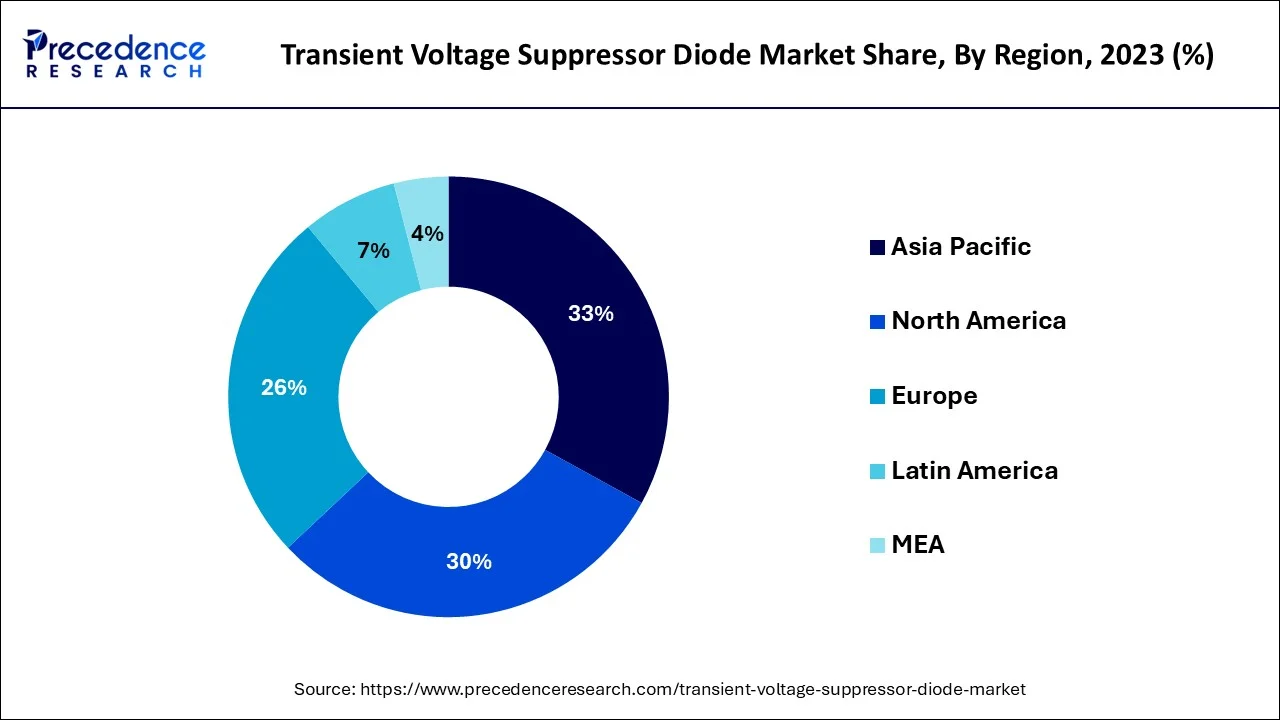
Because of the region's higher demand for and consumption of electronic devices, as well as the widespread installation of voltage suppressors in the industrial sector to help reduce excessive energy flow during peak periods, North America is anticipated to account for a significantly large revenue share in the market during the forecast period.
The market revenue growth in North America is being driven by factors such as increasing computing device adoption, the rapidly growing electronics industry, ongoing research initiatives for developing advanced devices, as well as administrative regulations and policy standardization in the countries in the region.
China Transient Voltage Suppressor Diode Market Trends:
One of the main factors behind the market growth in China is the increase in semiconductor manufacturing capacity, along with government support for electronics production. The companies in the market are focusing on automated fabrication along with advanced processes in order to meet the demand coming from consumer electronics and the automotive industry, where the concentration on the efficiency and performance of TVS diode solutions is getting stronger.
U.S. Transient Voltage Suppressor Diode Market Trends:
The U.S. market is powered by strong research activity and quick adoption of advanced technologies. Automotive safety systems, data centers, defense electronics, and electrified platforms that require reliable protection for mission-critical and high-reliability applications are all drivers behind the demand for the integration of TVS diodes.
What Are the Driving Factors of The Transient Voltage Suppressor Diode Market in Europe?
Europe is a market that is stable and innovation-driven at the same time; strict electric safety regulations act as one of the key drivers for it. The growing electric mobility adoption and investments in smart infrastructure are the factors that are mainly responsible for the increasing demand for high-quality surge protection components, which, in turn, ensure reliability, compliance, and long-term operational safety across industrial and energy systems.
Germany Transient Voltage Suppressor Diode Market Trends:
Germany is a major player in both the automotive and industrial manufacturing industries in Europe. The market is characterized by high precision, long-lasting products, and safety regulatory compliance, leading to the development of cutting-edge TVS diodes designed specifically for EVs, power generation from renewable sources, and high-tech industrial electronics applications.
Transient Voltage Suppressor Diode Market-Value Chain Analysis
- Raw Material Procurement: High-purity silicon wafers and specialty gases are the primary materials whose procurement assures the uniformity of the input and the reliability of the semiconductor production.
- Key Players: Wacker Chemie, SUMCO, Shin-Etsu
- Wafer Fabrication (Front-end): Physical and chemical techniques for manufacturing are strictly controlled to convert silicon wafers into applicable semiconductor devices.
- Key Players: TSMC, Intel, Samsung
- Photolithography and Etching: The patterns of the circuits are first transferred to the wafers, and then, the circuits are finely etched to create the electrical structures needed for TVS to work.
- Key Players: ASML, KLA
- Doping and Layering Processes: The diode structure is created by altering the electrical characteristics through impurity introduction and the deposition of several layers of the material.
- Key Players: Applied Materials, Lam Research, Tokyo Electron
- Assembly and Packaging of Transient Voltage Suppressor Diode: The individual dies are encapsulated, isolated, and bonded to the external leads to integrate them into the function of the electronic circuit.
- Key Players: ASE Technology Holding, Amkor Technology, JCET Group
Top Companies in the Transient Voltage Suppressor Diode Market & Their Offerings:
- Vishay: Offers a wide range of TVS diodes in different package types, including those specially designed for the automotive industry.
- Littelfuse: Offers TVS diodes and arrays for both surface-mount and through-hole applications to shield electronic components from lightning transients, power surges, and ESD events.
- On Semiconductor: Delivers tough-to-beat TVS diodes that keep integrated circuits from being damaged by ESD and high-voltage transients.
Transient Voltage Suppressor Diode Market Companies
- Vishay
- Littelfuse
- On Semiconductor
- Stmicroelectronics
- Bourns
- NXP
- Diodes Inc.
- Infineon
- Brightking
- Anova
- Semtech
- MDE
- Toshiba
- EIC
- Protek
- Wayon
- Inpaq
- Socay
- Un Semiconductor
- Microsemi
Recent Developments
- In December 2025, Littelfuse, Inc. launched the TPSMB Asymmetrical Series TVS Diodes, designed for 12V battery anti-reverse protection. These diodes offer superior performance over traditional symmetrical bi-directional TVS solutions. (https://www.electronicsmedia.info)
- In September 2025, Littelfuse, Inc. launched the 5.0SMDJ-FB TVS Diode Series, utilizing foldback technology for up to 15% lower clamping voltage, improving protection for sensitive DC power lines in Power over Ethernet, servers, and industrial supplies. (https://www.bisinfotech.com)
Segments Covered in the Report
By Type
- Uni-polar TVS
- Bi-polar TVS
By Application
- DC Supply Protection
- DC Load Protection
- AC Supply Protection
- Electro-Magnetic Interference Limiting
- Operational Amplifier Protection
- Others
By End User
- Automotive
- Industrial Power Supplies
- Military/Aerospace
- Telecommunication
- Computing
- Consumer Goods
- Others
By Geography
- North America
- Europe
- Asia-Pacific
- Latin America
- The Middle East and Africa
For inquiries regarding discounts, bulk purchases, or customization requests, please contact us at sales@precedenceresearch.com
Frequently Asked Questions





Ask For Sample
No cookie-cutter, only authentic analysis – take the 1st step to become a Precedence Research client
 Get a Sample




 sales@precedenceresearch.com
 Schedule a Meeting
