



Diode Market Size, Semiconductor Production, Component Demand, Cost Structure, Technology Roadmap, Market Penetration, and Competitive Landscape
Diode Market (By Indication Type: Schottky, Zener, Rectifier, ESD, Others; By Application: Consumer Electronics, Communication, Automotive, Manufacturing) - Global Industry Analysis, Size, Trends, Leading Companies, Regional Outlook, and Forecast 2026 to 2035
Source: https://www.precedenceresearch.com/diode-market
 Get a Sample
 Table Of Content
What is the Diode Market Size?
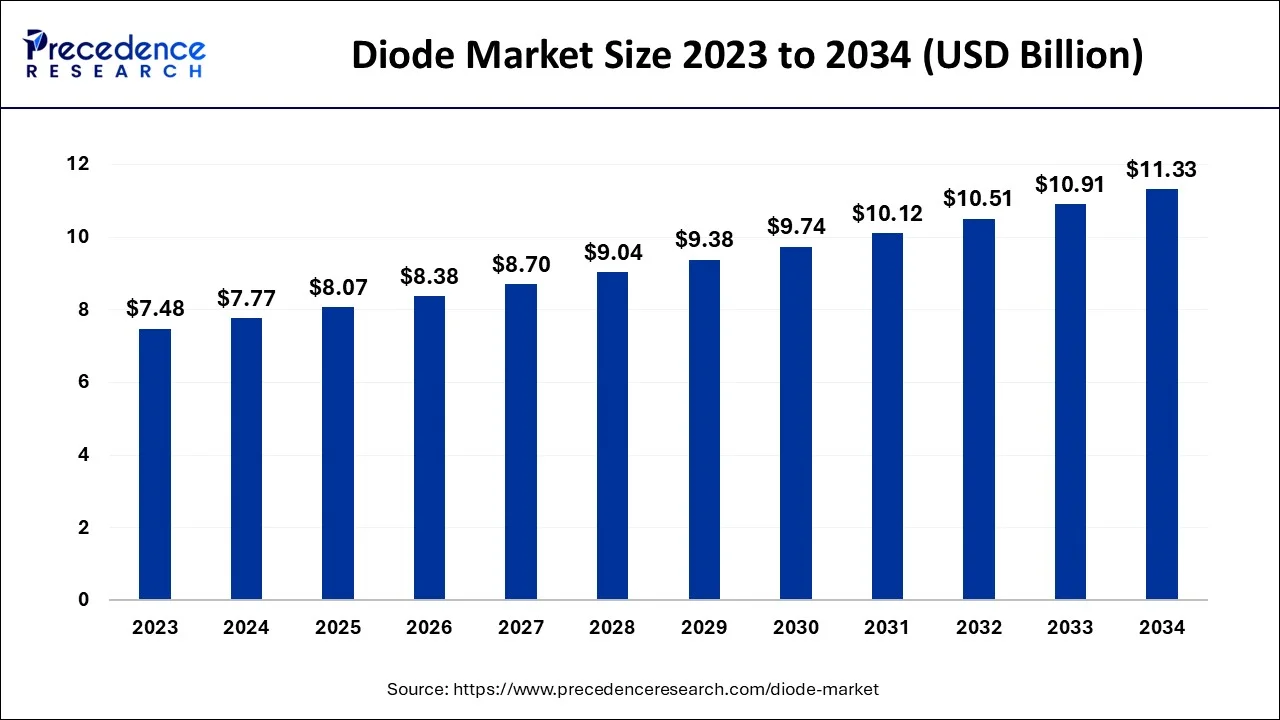
The global diode market size is accounted at USD 8.07 billion in 2025 and predicted to increase from USD 8.38 billion in 2026 to approximately USD 11.75 billion by 2035, representing a CAGR of 3.83% from 2026 to 2035. global diode Market growth is driven by rising demand for consumer electronics, electric vehicles, renewable energy systems, telecommunications infrastructure, and efficient power management solutions across industrial applications.
An electrical diode is a semiconductor materials component with two terminals that, theoretically, allows current to flow through easily in one direction but blocks it in the other direction. A diode may be thought of as a switch that controls the flow of electrons via an electrical circuit.
Market Overview
Electricity and Environmental Sustenance Made More Accessible thanks to Diodes
The diode market refers to devices which are semiconductor products that are used for performing the tasks of conducting electric current through their circuit as well as being involved in functions such as rectification, voltage regulation, switching, signal processing, protection, sensing, and power conversions. Various sub-categories of products within diode market include rectifiers, Schottky devices, Zener devices, switching diodes, laser diodes, and photonic diodes.
The market is in a phase of constant development and growth thanks to such factors as fast electrification, higher volume of consumer electronics production, progress and development in industrial automation, wide implementation of renewable energy solutions, technological advancement of telecommunications infrastructures and progressive rise in electronic concept in cars. In particular, automotive applications of diodes are being enhanced nowadays as it is known that electric vehicles and those defined by software inherently require a more sophisticated power management and protection solutions.
Diode Market Growth Factors
Across all consumer electronics categories, electronic items are becoming smaller. All electronic manufacturers strive to produce products that are as small as possible, use the least amount of power, and offer the most power. As a result, there is a growing need for novel and distinctive diodes.
There is a rising desire for cell phones that can perform a variety of duties, such as FM radios, MP3 players, MP4 players, portable TVs, note recorders, cameras, and even projectors. The need for signal routing solutions has risen due to the rising quantity of signals. Mobile phone designers may continue to push for smaller form factors while still including improved functions in their designs thanks to these ideas, which call for diodes with reduced size and better functionality. The demand for diodes is increasing due to this technological requirement.
The market for diodes is expanding as there is a growing need for electric cars. Diodes of many kinds are employed in the production of EVs. The International Energy Agency (IEA) predicts that the number of electric vehicle sales will reach 6.6 million in 2021, more than doubling from 2020. In 2021, electric vehicles accounted for approximately 9% of the worldwide auto market, more than doubling their market share from the previous year.
- Over the course of the forecast period, increasing laser diode utilization across a range of end-use industries is anticipated to fuel market expansion.
- As a result of technological advancements, the use of laser diodes will increase in the aerospace and defense industries.
- The rise of the aerospace and military industries is driving the need for diodes, which is in turn being driven by favorable government laws encouraging the adoption of sophisticated technologies and technical breakthroughs.
How is AI contributing to the Diode Industry?
The diode industry is supported by AI in the areas of speeding up the designing of semiconductors, predicting the performance of semiconductors, and reducing the amount of testing done manually. With the help of machine learning, voltage, current, and thermal behavior are evaluated, thus enabling fast simulation-based optimization. The AI-driven materials discovery is accelerating the combination usage of GaN and SiC.
The automated modeling is creating the new diode layouts, and the computer vision is ensuring the quality checks are precise. Predictive analytics is reducing downtime and increasing efficiency by monitoring the equipment, while lean manufacturing is intelligently balancing the supply, production, and market response.
Future Trends In Diode Market
- Power Electronics Wanting: The growing popularity of electric vehicles, renewable power installations, automatic manufacturing, and energy-saving devices will result in the increased need in manufacturing such components as high power, Schottky, and fast recovery diodes.
- EV Integration: Extension of the electric cars industry will generate the demand for diodes as integral devices for battery control techniques, charging technologies, energy conversion processes, and heat control systems.
- SiC Diodes: Silicon carbide diodes will become more popular in heavy-duty processes due to their high efficiency and ability to operate at a high temperature in combination with the reduced losses and applicability to electric transport and green power principles, etc.
- Miniaturization Wanting: The ever-increasing demand for small electronic devices will lead to the creation of more compact and efficient packages for diodes.
- Smart Production: The use of AI, robotics, and advanced semiconductor production practices will enable further improvement in the quality of diode testing and manufacturing, thus increasing productivity and helping manufacturers comply with the demands of the customers.
Market Outlook
- Industry Growth Overview: The growth process has begun with consumer electronics and renewable energy sources pushing the mobility of electric cars and, in turn, the associated technology of diodes.
- Sustainability Trends: Eco-materials usage, energy efficiency improvements, and better end-of-life recycling practices are the areas of major concern in sustainability.
- Global Expansion: The semiconductor adoption in the Asia-Pacific region is gradually uplifting the presence of diodes worldwide, and at the same time, the expansion of the manufacturing ecosystems in the area
- Major Investors: The companies BlackRock, Vanguard, Fidelity, and State Street Corp are behind the long-term innovations and scalability in the diode industry.
- Startup Ecosystem: The startups are working on new materials for semiconductors, such as Gallium Nitride (GaN), and are thus paving the way for specialized device manufacturing and competition in the market.
Market Scope
| Report Coverage | Details |
| Market Size in 2025 | USD 8.07 Billion |
| Market Size by 2035 | USD 11.75 Billion |
| Growth Rate from 2026 to 2035 | CAGR of 3.83% |
| Base Year | 2025 |
| Forecast Period | 2026 to 2035 |
| Segments Covered | By Indication Type and By Application |
| Regions Covered | North America, Europe, Asia-Pacific, Latin America and Middle East & Africa |
Strategic Growth Opportunities in the Diode Market
- High-Growth Commercial Opportunities: The increasing need for power electronics in electric vehicles, renewable energy systems, industrial automation, consumer electronics, and fast charging infrastructure create market opportunities for suppliers of advanced rectifier diodes, Schottky diodes, TVS diodes, and power diodes.
- Emerging Technology Opportunities: The field of wide bandgap semiconductors, especially silicon carbide, and gallium nitride presents market possibilities for advanced diodes that have low switching loss, possess high-temperature tolerance, and high efficiency.
- Geographic Expansion Opportunities: The Asia-Pacific region has great potential in terms of expansion owing to semiconductor manufacturing investments, EV adoption, electronics production, and the deployment of renewable sources of energy. Countries such as India and Southeast Asia shall provide additional chances for locale production and diversifying the supply chain.
- White Space Analysis: There are opportunities for application-specific and high-reliability diodes in EV powertrains, charging stations, data centers, solar inverters, aerospace electronics, and industrial equipment. Custom solutions, compact designs, and better thermal performance may allow manufacturers to target such inadequately served niches.
Market Dynamics
Key Market Drivers
Increased use across a wider range of industry sectors
Integrated circuits (ICs) using discrete diodes are used by manufacturers in the automotive, electrical, and communication sectors in place of digital circuits. Discrete components are condensed with sizes in micrometers and millimeters, which results in gains in power consumption and speed since smaller components have lower parasitic resistors, capacitances, and inductances. Producers in end markets, however, should be aware about the advantages and disadvantages of discrete diodes in order to effectively create products.
The sector is anticipated to advance due to the adoption of numerous government initiatives on modern distribution networks and generating infrastructure. By 2021, the International Energy Agency (IEA) predicts that 6.6 million electric vehicles will have been sold worldwide. 9% of all new automobiles sold worldwide were electric vehicles. The cooling fan drive in the battery management system of an electric car uses diodes. Electric cars are becoming more popular, which benefits the diode market.
Key Market Challenges
High initial investment costs in laser diode industries
The fact that laser diodes need a larger initial investment than other light-emitting diodes severely restricts the market for laser diodes as a whole. A few hundred to thousands of watts of laser power are required for diverse systems, processes, and applications. Although adopting laser goods would reduce labor expenses in the industrial and automotive industries, installing laser products is relatively expensive. Installing laser-capable items typically costs more than doing so via the conventional method.
Key Market Opportunities
The increasing usage of electronic gadgets such as television, mobile platforms, electric cars
The market for diode semiconductors is expanding rapidly as a result of low cost availability and alluring incentives that are driving up demand for consumer electronics. In addition, the leading market players are investing heavily in R&D activities to create cutting-edge consumer electronics. For instance, in a fresh round of series B fundraising announced in June 2022, Renesas disclosed their stake in Arduino, an open-source business.
According to the contract, Renesas will provide a wide range of goods for the use of the Arduino technology platforms by its global developer community. Renesas also disclosed an investment in its Kofu Factory, which is situated in Kai City, Yamanashi Prefecture, Japan, in May 2022. The investment is intended to increase the company's ability to produce power semiconductors. It is carried out in an effort to promote decarbonization.
According to its plan of action, Renesas' overall manufacturing capacity for power semiconductors will more than quadruple if the Kofu facility is successful in achieving mass production. Additionally, these elements are anticipated to fuel market growth. However, market expansion may be constrained by design and continuously rising prices. As a result, the worldwide market for diodes is being favorably impacted by all of these reasons.
Diode Market Segment Insights
[[segment_insights]]
Diode Market Regional Insights
[[regional_insights]]
Diode Market-Value Chain Analysis
- Raw Material Procurement: Controlled material preparation of the silicon wafers and gases forming the semiconductor manufacturing foundation by sourcing and purifying them.
Key Players: Wacker Chemie, Shin-Etsu Handotai, SUMCO - Wafer Fabrication: The fabrication facilities with complex multi-step semiconductor processes are used to build microscopic electrical structures on the wafers.
Key players: TSMC, Intel, Samsung, GlobalFoundries - Photolithography and Etching: The circuit patterns are transferred by light, and the material is removed chemically to form the required device structures.
Key Players: ASML, Applied Materials, Lam Research - Doping and Layering: The impurities are introduced to control the conductivity, while the thin films used to build the p-n junctions and multilayer device architecture are deposited.
Key Players: Applied Materials, Lam Research, ASM International - Assembly and Packaging: After cutting the wafers into dies, the components are first encapsulated, and then their electrical performance is tested before distribution.
Key Players: Amkor Technology, ASE Technology Holding, JCET Group
Competitive Landscape
The diode market is quite competitive and semi-consolidated, with numerous established semiconductor companies, and specialized regional manufacturers vying for market share. Various factors, such as production capability, size, and technology expertise have resulted in moderate to high entry barriers.
Some of the major players, like Infineon Technologies, Nexperia, Vishay Intertechnology, ROHM Semiconductor, and onsemi have been able to maintain strong footholds in the market due to comprehensive product portfolios and advanced semiconductor technologies.
Market competition is influenced by the invention of new products, expansion of manufacturers' efficiencies, investments into research and development, collaboration with strategic partners, and advances in technology for automotive, industrial, consumer electronics, and renewable energies.
High capex requirements, semiconductor know-how, quality control standards, intellectual property protection, and supply chain complexities serve as some of the barriers for new entrants. Future competition is expected to increasingly focus on energy efficiency, power electronics, usage in automotive segment, and advanced diode technologies.
Top Companies in the Diode Market & Their Offerings
- NXP Semiconductors N.V.: NXP is a provider of standard power products for automotive applications and thus a great partner for efficient circuit performance and reliable system integration.
- STMicroelectronics: Microelectronics manufacturing power diodes, rectifiers, and hybrids will not only fulfill the requirements of the industrial and consumer sectors but also of the advanced technology market.
- Diodes Incorporated: Diodes, a manufacturer of power devices, provides the entire range of electronic components, including diodes, rectifiers, and protection elements that are widely accepted and demanded by the global electronic equipment industry.
Diode Market Companies
- NXP Semiconductors N.V.
- STMicroelectronics
- Diodes Incorporated
- Microchip Technology Inc.
- Renesas Electronics Corporation
- ROHM Semiconductor
- Panasonic Corporation
- Toshiba Corporation
- Skyworks Solutions, Inc.
- Analog Devices, Inc.
Recent Developments
- In September 2025, Littelfuse, Inc., launched its 5.0 SMDJ-FB TVS Diode Series. It possesses foldback technology that enables lowering by 15% the clamping voltage for the sensitive DC power lines in Power over Ethernet, servers, and industrial power supplies to be better protected. (https://www.bisinfotech.com)
- In February 2025, CDIL Semiconductors launched the first-ever indigenous Solar Bypass Diodes in India, boosting the solar panel's performance and longevity. The diodes, which are made in Mohali, are contributing to the country's self-reliance, and they can also cater to extreme weather conditions. (https://www.tndindia.com)
Diode Market Segment Covered in the Report
[[segment_covered]]
For inquiries regarding discounts, bulk purchases, or customization requests, please contact us at sales@precedenceresearch.com
Frequently Asked Questions





Ask For Sample
No cookie-cutter, only authentic analysis – take the 1st step to become a Precedence Research client
 Get a Sample




 sales@precedenceresearch.com
 Schedule a Meeting
