



Tunable Diode Laser Analyzer Market Size, Key Companies, Company Market Share, Chip Production Volume, Wafer Capacity, Technology Adoption, Pricing Trends, Competitive Positioning, and Demand Analysis
Tunable Diode Laser Analyzer Market (By measurement type: In-situ, Others; By industrial application: Power, Oil and gas, Mining and metal, Healthcare, Chemicals, Fertilizers, Paper and pulp, Cement, Others) - Global Industry Analysis, Size, Trends, Leading Companies, Regional Outlook, and Forecast 2026 to 2035
Source: https://www.precedenceresearch.com/tunable-diode-laser-analyzer-market
 Get a Sample
 Table Of Content


What is the Tunable Diode Laser Analyzer Market Size?
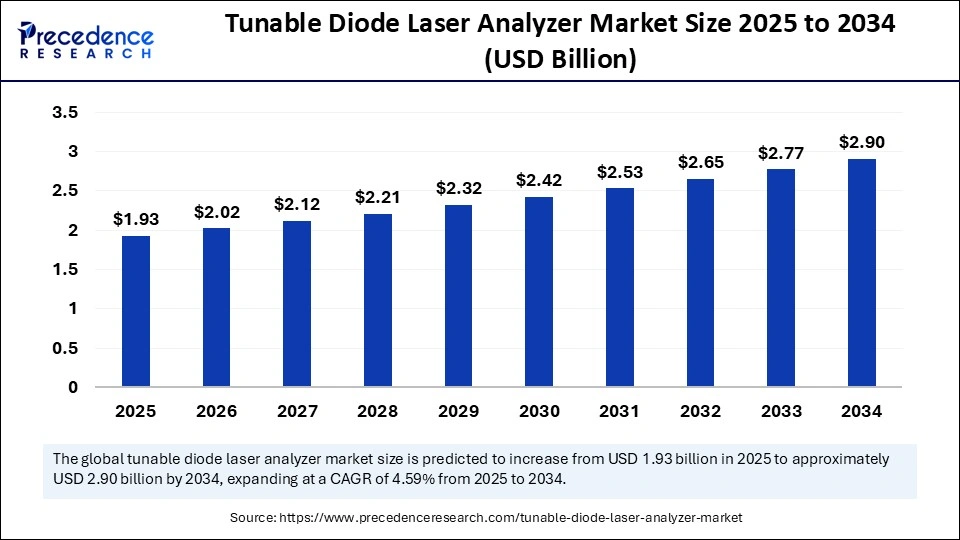
The global tunable diode laser analyzer market size is calculated at USD 1.93 billion in 2025 and is predicted to increase from USD 2.02 billion in 2026 to approximately USD 3.02 billion by 2035, expanding at a CAGR of 4.58% from 2026 to 2035. The tunable diode laser analyzer is driven by rising demand for real-time, precise gas analysis and stringent environmental regulations.
Tunable Diode Laser Analyzer Market Key Takeaways
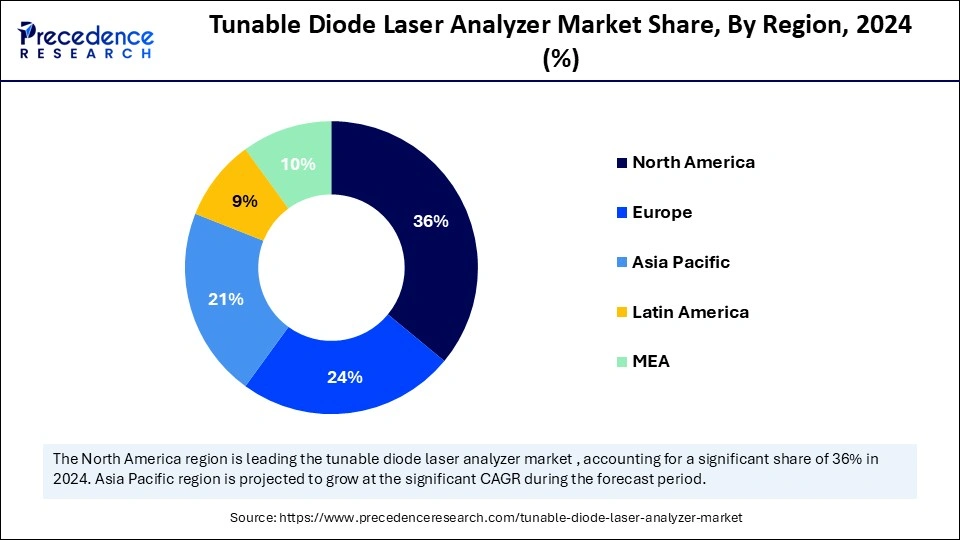
- North America dominated the global market with largest market share of 36% in 2025.
- Asia Pacific is anticipated to witness the fastest growth during the forecasted years.
- Europe has emerged as a notable player in the global market.
- By measurement type, the in-situ segment held a significant market share in 2025.
- By industrial application, the oil and gas segment contributed the biggest market share in 2025.
- By industrial application, the cement segment is anticipated to show substantial growth in the forecast period.
What is a Tunable Diode Laser Analyzer?
A tunable diode laser analyzer (TDLA) operates as a precise measuring device to quantify gas concentrations in mixtures. Tunable diode laser absorption spectroscopy functions through an instrument that detects each gas based on its absorption wavelength. TDLA provides beneficial services to power generation, oil and gas, chemical, cement, healthcare, and metals industries through safety protection, regulatory compliance, and operational efficiency maintenance.
The enhanced global concern about environmental regulations leads industries to use gas analyzers for monitoring and managing emissions effectively. The need to optimize industrial processes in oil and gas, chemical, power generation, and cement industries increases TDLA system demand, since it the lower operational expenses while boosting production performance. Fast responsiveness, high sensitivity, and low maintenance requirements of TDLA systems make them suitable for combustible fumes monitoring systems and dangerous atmospheric gas sensing mechanisms in critical industrial environments.
What are the Impacts of Artificial Intelligence in the Tunable Diode Laser Analyzer Market?
Artificial intelligence (AI) delivers TDLA systems with significant advantages as a result of predictive maintenance, automated calibrating capabilities, and methods for real-time data analysis. The automated system can operate seamlessly. AI integration in the tunable diode laser analyzer market enables it to identify patterns and have remote control data monitoring periods by providing them greater functionality in sophisticated industrial applications.
Competitive Landscape
The tunable diode laser analyzer market is partially consolidated because there are global industrial automation firms and specialized gas analysis firms operating in this market based on innovation and performance. Top companies operating in this market include ABB, Siemens, Yokogawa, Emerson, Honeywell, and SICK. These companies have a substantial market share because of their large product lines and worldwide reach. Innovation in the form of real-time monitoring, Internet of Things, artificial intelligence diagnostic features, and sophisticated laser sensing systems plays a vital role in creating competition within the market.
Tunable Diode Laser Analyzer Market Outlook
- Industry Growth Overview: The tunable diode laser analyzer market is poised for rapid growth from 2025 to 2030 due to increased utilization across gas measurement, emissions monitoring, and industrial automation. Demand was bolstered due to industries' desires for highly precise, low-maintenance analyzers, particularly in Asia-Pacific and North America.
- Sustainability Trends: Sustainability has driven several industries to adopt TDLAs to support cleaner operations, account for emissions in real-time, and remain compliant with environmental regulations. Companies increased their investments in innovative laser technologies to improve monitoring efficiency and lower energy use in refineries, power generation, and chemical facilities.
- Global Expansion: Major manufacturing companies are expanding into Southeast Asia, the Middle East, and Eastern Europe to serve the growing demand from further industrialization and increased air quality regulations. Several manufacturers also scaled product and service centers to meet demand in petrochemical, metal processing, and power generation.
- Large Investors: Investors were excited by the technical complexity, consistent demand, and growth driven by regulations. Private equity and industrial automation corporations focused on acquisitions in laser sensing, process analytics, and environmental monitoring.
- Startup Ecosystem: New startups focused on compact laser modules, AI-based gas analytics, and ultra-rugged industrial sensors have started to generate interest. The U.S., Europe, and India have seen venture funding for the development of quicker, more energy-efficient analyzers built for the strongest industrial environments.
What are the Growth Factors in the Tunable Diode Laser Analyzer Market?
- Rising environmental regulations: To reduce the environmental footprint, manufacturing industries must fulfill regulatory requirements about air emissions. The precise instantaneous monitoring performance of TDLA suits operational requirements.
- Growing industrial automation: The tunable diode laser analyzer market experiences growth due to industrial automation, the rising need for real-time system monitoring, and control systems. A tunable diode laser analyzer benefits from automated system integration by creating improved operational performance while increasing safety measures.
- Expansion of end-use industries: The power, cement, chemical, oil, and gas industry expansion demands gas monitoring solutions. These industries need specific equipment to control emissions while demanding precise monitoring tools, safety products, and process optimization systems.
Market Scope
| Report Coverage | Details |
| Market Size by 2035 | USD 3.02 Billion |
| Market Size in 2026 | USD 2.02 Billion |
| Market Size in 2025 | USD 1.93 Billion |
| Market Growth Rate from 2026 to 2035 | CAGR of 4.58% |
| Dominated Region | North America |
| Fastest Growing Market | Asia Pacific |
| Base Year | 2025 |
| Forecast Period | 2026 to 2035 |
| Segments Covered | measurement type, industrial application, and Regions |
| Regions Covered | North America, Europe, Asia-Pacific, Latin America and Middle East & Africa |
Market Dynamics
Drivers
Stringent environmental regulations
Government agencies around the world are making environmental safety a priority and are increasing regulations on pollution and climate controls because the public is generally more concerned about pollution and climate change. Industrial entities are using TDLA technology because new regulations require precision real-time detection for measurements of various gas concentrations. The strict emission regulations apply tremendous pressure on high-emission sectors that include the oil and gas, petrochemicals, and power generation facilities.
Organizations worldwide face environmental policies and global carbon reduction mandates, which lead them to spend on emission-controlling technologies and active responsibility measures. Government institutions and environmental protection agencies lead the market development through their commitment to promoting TDLA systems since they serve as crucial instruments for regulatory compliance and environmental accountability.
Rising demand for process optimization
Various power generation facilities, chemical plants, manufacturing facilities, and cement plants require accurate gas analysis to run their operations efficiently and at the lowest cost possible. The industry can use TDLAs for precise, in-moment gas analysis, which helps the industry maximize its combustion processes and reduce energy use and material waste. Organizations select system solutions that meet their operational efficiency and regulatory compliance needs. Demand for the tunable diode laser analyzer market will continue to be robust because the industrial sector needs to be streamlined, more productive, and to survive in a competitively harsh modern industry.
Restraint
Calibration and maintenance
The most limiting factor of the tunable diode laser analyzer market is the rigor of periodic calibration and regular maintenance. Periodic calibration with certified gas mixtures is the largest technical barrier to TDLAs providing accurate and reliable performance, as it is a fundamental component of any maintenance procedures. Many maintenance functions need some specialized knowledge and maintenance expertise, such as beam alignment, debris removal, replacement of optical components, replacement of filters, etc., and fault detection, which require specialist capabilities, which smaller organizations do not have. Time for maintenance, cost of calibration, and specialist knowledge and skills continue to contribute to TDLA market constraints.
Opportunity
Industry focuses on sustainability
TDLA offers an accurate, real-time method of gas analysis that will be increasingly required for emissions monitoring and compliance as environmental regulations become more stringent. This increase in investment in clean operational infrastructure is a cause for significant investment in TDLAs in industries with the inclusion of TDLA into their operations as part of a sustainable operational environment. TDLA systems are firmly positioned as vital long-term solutions in attaining environmental and regulatory goals across several industries. This flexibility and versatility offer a significant growth opportunity for manufacturers and solutions providers.
Segment Insight
Measurement Type Insights
The in-situ segment held a significant tunable diode laser analyzer market share in 2025. In-situ TDLAs further provide advantages by providing real-time measurement with high accuracy by measuring precisely where they occur in the process stream. An in-situ process analyzer operates directly in the process, so no sample extraction is needed, and the opportunity for sample contamination is greatly reduced.
Industries that produce energy, petrochemicals, cement, and metal processing sectors heavily rely on these analyzer systems. Companies experience improved safety, waste reduction, and better regulation of their environmental compliance through this method. The in-situ segment shows continuous expansion because organizations select quick, reliable, and efficient monitoring solutions for gases.
Industrial Application Insights
The oil and gas segment dominated the tunable diode laser analyzer market with the largest share in 2025. The vital role of TDLAs has emerged in the industry due to enhanced attention toward automated systems, environmental standards, and operational efficiency performance. Real-time gas concentration analysis is done in various stages of oil and gas operations within pipelines and storage facilities.
TDLAs provide leak detection and assure safety while optimizing process combustion owing to their accuracy and quick measurements. The oil and gas industry has stringent environmental regulations on greenhouse gas and methane emissions, and more advanced monitoring systems must be implemented.
The cement segment is anticipated to show substantial growth in the forecast period due to increasing environmental regulations and the sector's commitment to emission reduction. The cement industry generates high carbon emissions that drive worldwide regulatory bodies to issue stricter mandatory environmental regulations to reduce the pollution footprint.
TDLAs enable plant facilities to observe fuel combustion response as well as emissions, which improve operational control while minimizing waste generation. Through its detection capabilities, TDLAs measure CO, CO2, NH3, and H2O gases in real-time for optimizing current processes and environmental surveillance, and need precise data.
- HeidelbergCement has set a goal to decrease CO? emissions by 30% until 2030 while striving for 400 kg CO?/t CEM emissions, which represents a 47% reduction from 1990 levels. The company plans to generate half of its total revenue through sustainable product sales. Their carbon capture operations will expand to achieve a total 10 Mt CO? reduction during the 2030 timeframe.
Regional Insights
U.S. Tunable Diode Laser Analyzer Market Size and Growth 2026 to 2035
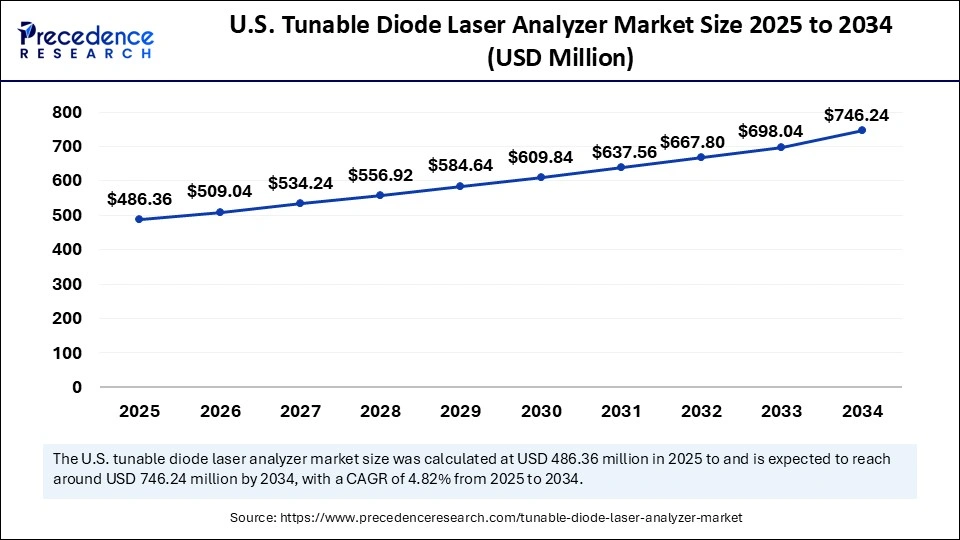
The U.S. tunable diode laser analyzer market size is exhibited at USD 486.36 million in 2025 and is projected to be worth around USD 782.47 million by 2035, growing at a CAGR of 4.87% from 2026 to 2035.
North America accounted for the largest share of the tunable diode laser analyzer market in 2025. Environmental concerns and air quality problems fuel this market growth. Policies from governments and regulatory bodies trigger industries to adopt advanced monitoring technologies. The instruments achieve market success because they provide accurate measurement and real-time monitoring, and work effectively to monitor industrial spaces.
The United States functions as the largest customer base in North America. The environmental policies and rising sustainability focus have driven U.S. industries to adopt contemporary emission monitoring systems. Businesses operating in manufacturing, oil and gas, and chemical sectors invest in TDLAs as they need to fulfill regulatory requirements.
- In August 2024, Endress+Hauser Canada, a global leader in measurement instrumentation, marked an agreement with CR Wall and Co., a leading distributor in the Canadian gas energy industry, to support CR Wall's clients' measurement and automation needs in Western Canada.
U.S. Market Trends
The market in the U.S. is growing due to increasing demand for highly accurate, real-time gas measurement and process control across industries such as oil & gas, chemicals, and power generation. Additionally, strict environmental regulations and the need for improved emissions monitoring are driving the adoption of advanced laser-based analytical technologies.
Asia Pacific is anticipated to witness the fastest growth in the tunable diode laser analyzer market during the forecasted years, due to the industrial growth at a fast rate and growing environmental awareness. The leading regions in this growth include China, India, Japan, and South Korea because these countries enforce strict emission control measures to stop air pollution and enhance air quality standards.
The adoption rate of the tunable diode laser analyzer market has grown substantially since it enables real-time analysis of gases without interference. Government-initiated air quality improvement programs in China have resulted in extensive implementation of continuous emission monitoring systems for industries where TDLS functions as their top selection technology. Both Japan and South Korea require their industries to establish clean technology investments as part of regulatory requirements.
- In February 2023, Yokogawa Electric Corporation (Japan) completed its acquisition of Fluence Analytics. The acquisition will merge Fluence Analytics operations with Yokogawa's current business operations to enhance their technologies through this deal.
Why did Asia-Pacific emerge as the fastest-growing region in the tunable diode laser analyzer market?
Asia Pacific emerged as the fastest-growing region due to strong growth in specific industries as well as government-imposed regulations with more stringent emission requirements. This growth in power generation, chemicals, metals, and manufacturing increased the demand for TDLAs for safe and precise gas monitoring. The Asia Pacific region had further opportunities through major industrial projects, the implementation of renewable energy projects, and further automation efforts aimed at enhancing worker safety and maximizing productivity.
China Tunable Diode Laser Analyzer Market Trends
China was the dominant country in the Asia Pacific due to its huge base of industry and rapid development in its power generation and chemical sectors. The country pushed for stricter pollution-control regulations, which compelled certain manufacturers to adopt more advanced gas monitoring systems. China also made significant investments in automation and new industrial facilities. These developments created new opportunities for TDLA suppliers to offer high-performance systems specifically designed and suited for large-scale and complex industrial operations and the development of renewables.
Europe has emerged as a notable player in the global tunable diode laser analyzer market. Gas monitoring technology and industrial sustainability development occur through robust environmental regulations and industrial sustainability initiatives in industry applications. The region, including Germany, France, and the United Kingdom, is employed through its government to develop clean technologies while addressing emissions. European investments enable industrial infrastructure renewal and low-carbon economic transformation, which positively impacts the market.
Germany Market Trends
In Germany, the market is driven by its highly developed manufacturing industry and the use of industrial automation. Tunable diode laser analyzers are used by industries to enhance process efficiency and reduce emissions and other pollutants in accordance with regulations. Germany's commitment to Industry 4.0 technologies also supports market growth.
Why did Latin America grow strongly in the tunable diode laser analyzer market?
Due to the growth in industrial activity and an increased emphasis on oil, gas, and mining, Latin America grew at a strong rate. Latin American nations began using time-delay alarm systems (TDLAs) to provide enhanced safety and better emissions tracking. The region has opportunities for modernization projects in refineries, power generation facilities, and large automated industrial sites. Growth in renewable energy projects and infrastructure, in particular, provided market demand in countries with long-term energy and manufacturing plans.
Brazil Tunable Diode Laser Analyzer Market Trends
Brazil was the largest market for Latin America, with a sizable oil and gas sector, and industrial plants increasing production. It used more TDLAs to oversee emissions and improve industrial plant safety than any other country in the region. Investments in power generation, chemicals, extraction and mining all provided demand for TDLAs as well. Brazil offered opportunities for TDLA companies to provide advanced systems for new industrial projects and modernize older facilities.
What made the Middle East and Africa grow rapidly in the tunable diode laser analyzer market?
The growth in both the Middle East and Africa was rapid due to robust activity in oil, gas, and petrochemicals. Several plants employed TDLAs for safe, real-time gas monitoring. Governments also made some improvements to emission regulations. The region presented opportunities for considerable expansion of existing refineries, and gas projects were being planned, along with strong investment in power generation. The continued development of mining and increases in industrial automation also provided support for the need for new advanced monitoring solutions.
Saudi Arabia Tunable Diode Laser Analyzer Market Trends
Saudi Arabia utilized advanced gas monitoring or monitoring solutions to improve safety and to achieve operational efficiency. Existing expansions in refineries and new petrochemical projects created strong demand for continuous gas monitoring. Furthermore, opportunities emerged as jobs were modernized, and more risk resided with automation.
Value Chain Analysis – Tunable Diode Laser Analyzer Market
- Raw Material Procurement (Silicon Wafers, Gases)
Pure silicon wafers, special gases, and optical materials are acquired for laser production purposes.
Major companies: Shin-Etsu Chemical, SUMCO Corporation, Linde plc. - Wafers Production (Front-end)
Semiconductor wafers are processed to form laser diodes with certain optical characteristics.
Major companies: Coherent Corp., Hamamatsu Photonics. - Photolithography and Etching Processes
Advanced lithography and etching processes result in the formation of microcircuits of laser diodes.
Major companies: ASML Holding, Applied Materials. - Doping and Deposition Processes
Layers of semiconductors are doped and deposited to produce a particular wavelength of lasers.
Major companies: IQE plc, Veeco Instruments. - Assembly and Packaging (Back-end)
Lasers are assembled and packed along with optics and detectors.
Major companies: Yokogawa Electric Corporation, Siemens AG. - Testing and Quality Assurance
All products are calibrated and tested for accuracy and performance before marketing.
Major companies: ABB Ltd., Endress+Hauser. - Distribution to OEMs and System Integrators
Ready analyzers are delivered to original equipment manufacturers, automation systems providers, and industrial system integrators.
Major companies: Emerson Electric Co., Honeywell International Inc.
Tunable Diode Laser Analyzer Market Companies
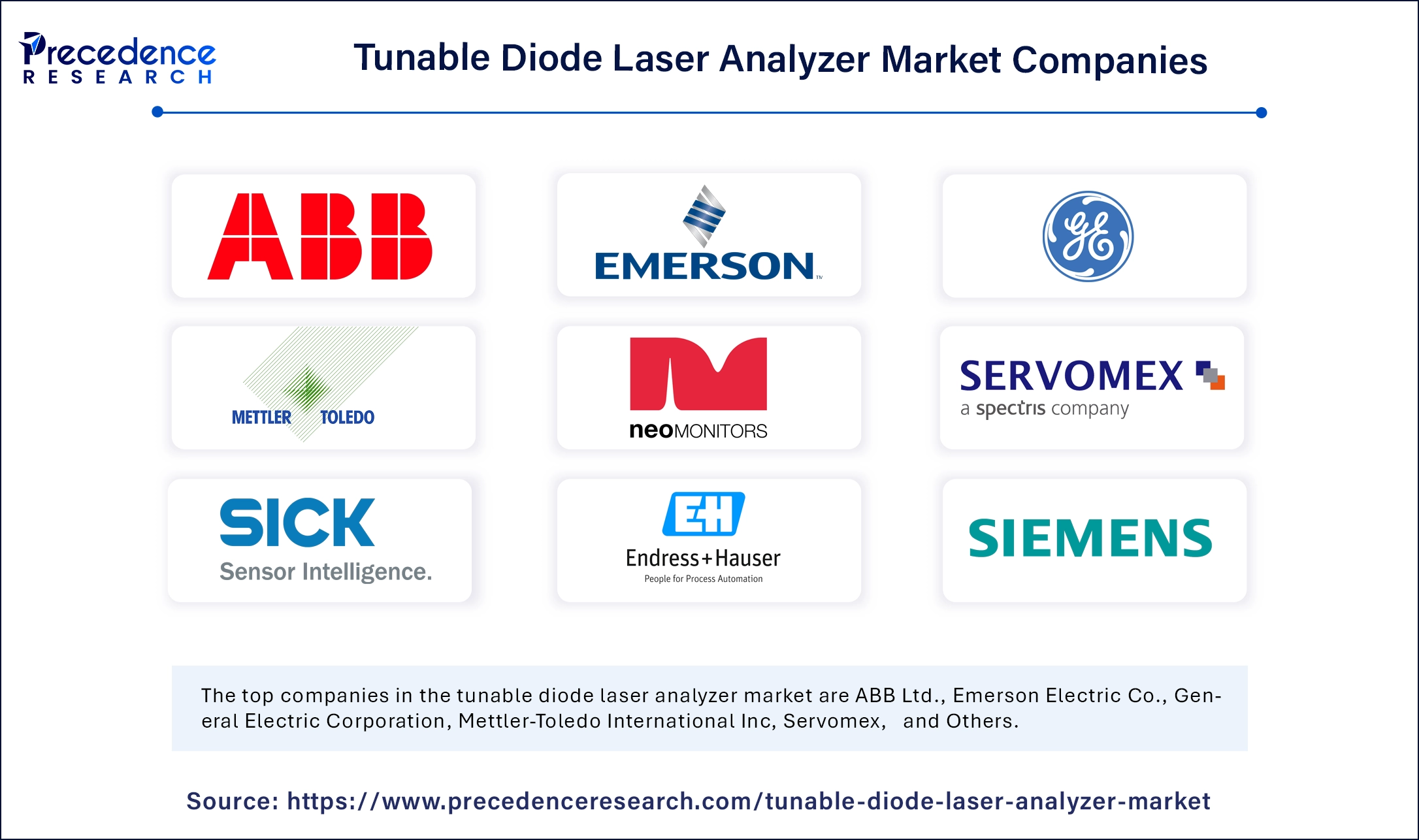
- ABB Ltd.
- Emerson Electric Co.
- General Electric Corporation
- Mettler-Toledo International Inc
- Norsk Elektro Optikk (NEO) Monitors AS
- Servomex
- Sick AG
- Endress+Hauser
- Siemens AG
- Yokogawa Electric Corporation
Recent Developments
- In January 2025, A high-stability temperature sensor was developed by Tianjin University along with some other organizations, based on Light-Induced Thermoelastic Spectroscopy or LITES technology. This innovation increased the efficiency and stability of temperature measurement for industrial gas analysis and laser sensors. (Source: https://spj.science.org)
- In August 2024, ABB declared its acquisition of the Födisch Group, improving its continuous emission monitoring systems (CEMS). This acquisition enables ABB to expand its product range as well as meet industrial emission measurement requirements.
- In December 2023, Sivers Semiconductors AB ("Sivers") announced that its subsidiary, Sivers Photonics, united with LioniX International and Chilas BV to develop and offer a narrow-linewidth integrated O-Band CW tunable 1310nm laser designed for expanding markets in optical communications and optical sensing fields.
Segments Covered in the Market
By measurement type
- In-situ
- Others
By industrial application
- Power
- Oil and gas
- Mining and metal
- Healthcare
- Chemicals
- Fertilizers
- Paper and pulp
- Cement
- Others
By region
- North America
- Asia Pacific
- Europe
- Latin America
- Middle East and Africa
For inquiries regarding discounts, bulk purchases, or customization requests, please contact us at sales@precedenceresearch.com
Frequently Asked Questions





Ask For Sample
No cookie-cutter, only authentic analysis – take the 1st step to become a Precedence Research client
 Get a Sample




 sales@precedenceresearch.com
 Schedule a Meeting
