



Ultra-Mobile Devices Market Size, Key Companies, Company Market Share, User Adoption, Technology Deployment, Revenue Growth, Competitive Positioning, and Demand Forecast
Ultra-Mobile Devices Market (By Type: Premium Ultra-Mobile Devices, Basic Ultra-Mobile Devices, Utility Ultra-Mobile Devices; By Application: Healthcare, Consumer Electronics, Telecom & IT, Retail, BFSI, Education, Entertainment, Others) - Global Industry Analysis, Size, Trends, Leading Companies, Regional Outlook, and Forecast 2026 to 2035
Source: https://www.precedenceresearch.com/ultra-mobile-devices-market
 Get a Sample
 Table Of Content


What is the Ultra-Mobile Devices Market Size?
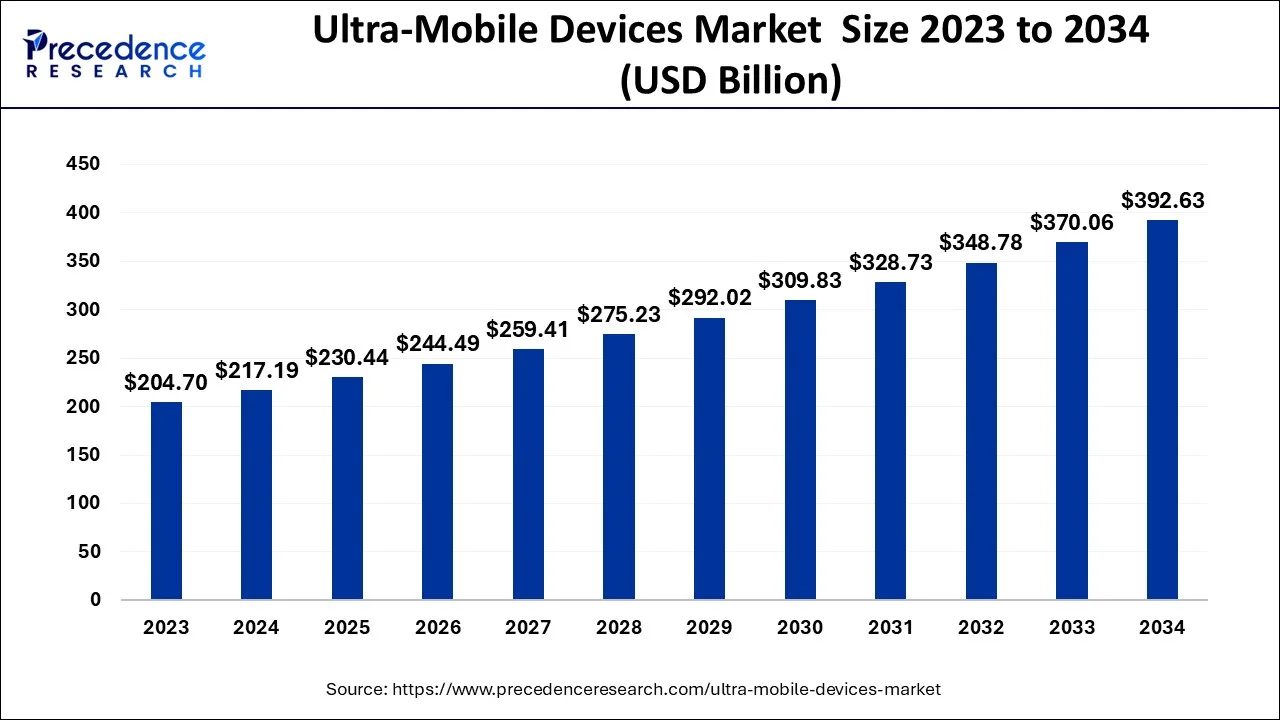
The global ultra-mobile devices market size is estimated at USD 230.44 billion in 2025 and is predicted to increase from USD 244.49 billion in 2026 to approximately USD 414.34 billion by 2035, expanding at a CAGR of 6.04% from 2026 to 2035.
Market Highlights
- By type, the premium ultra-mobile segment accounted 42% market share in 2025. However, the utility ultra-mobile segment is growing significantly during the forecast period.
- By application, the consumer electronic segment held highest revenue 30% in 2025. However, the IT & telecommunication segment is poised to reach highest growth rate from 2026 to 2035.
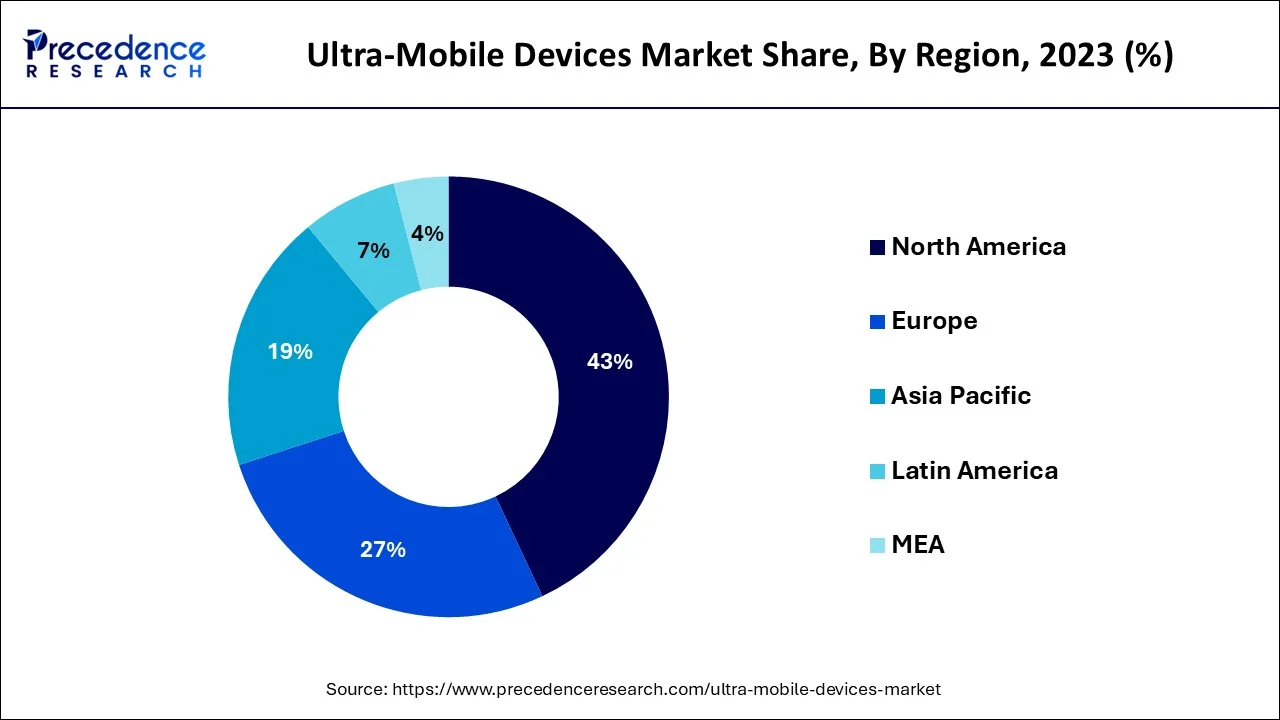
- The North America region has reached 43% market share in 2025.
- The Asia-Pacific is projected to growth at a significant CAGR from 2026 to 2035.
What are Ultra-Mobile Devices?
One group of small, light-weight computing devices is referred to as ultra-mobile devices. These gadgets have a display size that ranges from 7 inches to 13 inches and are designed with mid-size specifications. Due to technology improvements, communication with the rest of the world has undergone a significant transformation. With the use of extremely portable internet gadgets, the user can access information and material whenever they choose. A rising number of end users are switching from conventional PCs and related devices to the newest and most cutting-edge devices as a result of the emerging trend of mobility. These devices are used for both personal and business purposes and are excellent for satisfying changing client expectations. The difference between conventional laptops or PCs and tablets is eliminated by the wide variety of functionality offered by ultra-mobile devices. Therefore, across all age groups, ultra-mobile gadgets are being used in a variety of ways and for a variety of uses.
Increased trends in business improvement, expanded mobility, and continual learning are what are fueling the expansion of the ultra-mobile device industry. Additionally, it is anticipated that adding extra features to the device will open up lucrative business opportunities in the worldwide ultra-mobile device industry.
How is AI Influencing the Ultra-Mobile Devices Industry?
Artificial Intelligence is fundamentally changing the ultra-mobile devices industry, like smartphones, tablets, and wearables, by shifting focus from conventional hardware specifications to on-device, intelligent capabilities. AI is allowing devices to act as proactive, personalized assistants, with Generative AI turning devices into creative, content-generating tools that function directly on the handset, enhancing privacy and performance.
Ultra-Mobile Devices Market Growth Factors
As part of their digitalization agenda, governments all around the world are enticing citizens to utilize the internet more frequently. Due to rising urbanization and technological advancements, a sizeable section of the world's population will have internet access in the next years. Growing numbers of young people entering the workforce, decreasing bandwidth, faster internet, and technological breakthroughs are all factors in the expansion of the internet user base. Additionally, as they provide quicker internet connections, long-term evolution, or LTE, and 5G communication technologies have enhanced the adoption of social networking sites across mobile devices. For millions of individuals, mobile gadgets have become an integral part of daily life. The high-speed internet availability and disposable income is the driving factor of ultra-mobile devices market.
A substantial amount of data is generated by social media platforms and social networking sites, and this number is expected to keep increasing in the future. In order to gain a competitive advantage, businesses rely on social media to comprehend consumer needs. As a result, there is a greater need for collaboration tools that support data analysis as well as social business intelligence software.
Moreover, the rising demand for consumer mobility and the proliferation of smart devices, including wearables. Growing demand from the retail industry as a result of programs for improving consumer interaction and sales through digital transformation. Due to their capacity to efficiently access real-time information about patient care and treatment plans, ultra-mobile devices are being more widely used in the healthcare sector, which is boosting the market.
Market Outlook
- Industry Growth Overview: The ultra-mobile devices market is experiencing significant growth, driven by the acceptance of advanced technology such as 5G, AI, and IoT, growing demand for portable tech (smartphones, tablets, convertibles), hybrid work needs, and digital transformation in sectors like healthcare.
- Global Expansion: The market is experiencing significant global expansion, driven by Continuous innovation such as faster processors, improved battery life, AI integration, and enhanced displays are making UMDs more appealing and authoritative. North America is dominated in the market by advanced infrastructure, such as 5G, and a strong presence of tech giants.
- Major investors: The major investors are the great, established technology organizations that design, manufacture, and sell these devices, along with important venture capital firms and spending entities that fund startups and associated technology advancement.
Market Scope
| Report Coverage | Details |
| Market Size in 2025 | USD 230.44 Billion |
| Market Size in 2026 | USD 244.49 Billion |
| Market Size by 2035 | USD 414.34 Billion |
| Growth Rate from 2026 to 2035 | CAGR of 6.04% |
| Base Year | 2025 |
| Forecast Period | 2026 to 2035 |
| Segments Covered | Type, Application, and Geography |
Segment Insights
Type Insights
Depending upon the type, the premium ultra-mobile device segment is the dominant player and is anticipated to have the biggest impact on ultra-mobile devices market. A Premium Ultra-Mobile is a device that runs Windows, iOS, or Android. It has a powerful processor and enough storage for installing complicated software. The screen's high resolution is due to the multi-touch technology it enables. Premium ultra-mobile gadgets are incredibly thin and light, making it simple to hold one in one hand. On panels with high pixel densities and high resolution, they offer a fantastic gaming experience. Hence, owning to these benefits this segment expected to hold major share in the ultra-mobile devices market. Additionally, government programs for technological development, growing public awareness of technology, and consumer gadgets that are affordable all contribute to this segment's growth.
The utility segment held a significant share in the ultra-mobile market during the forecast period. This is due to the growing ultra-mobile device market, the development of cognitive intelligence applications, predictive analytics, and mobile applications, as well as the rise in system security concerns. Computing devices that fit in a pocket or purse are called utility ultra-mobile devices. They offer quick access to databases, information systems, application programs, and the Internet due to their great processing capacity. Smart wearables, tablets, and smartphones are examples of ultra-mobile devices.
For a variety of use cases, Ultra-Mobile devices are in Basic Ultra-Mobile. Ultra-mobile devices can be used in the healthcare industry to track patients' health conditions and other variables while they're on the go. They have contributed significantly to telemedicine by making it possible for remote diagnosis via video conferencing.
Application Insights
During the projected period, the consumer electronics segment is anticipated to be the largest in the ultra-mobile devices market. Consumer electronics employ ultra-mobile technology to give people the ability to perform many jobs. The main platforms for using mobile apps are smartphones. In today's society, ultra-mobile technologies are more prevalent than ever. These devices can be used for a variety of purposes, such as on-the-go multimedia consumption and remote access to web services. Ultra-mobiles are now used by more people than simply businesspeople and professionals for occupational purposes.
The ultra-mobile devices market had a sizable revenue share for the telecom and IT segment. This market's rapid expansion is linked to the quick uptake of cutting-edge, ultra-mobile gadget technologies. Systems for ultra-mobile devices are used by IT and telecom organizations in their operations for a number of reasons, including monitoring and security. Important IT and telecom companies are also more likely to pursue technological innovation in order to create communications solutions that are secure, network-savvy, and energy-efficient, which might offer the IT and telecom industry lucrative growth potential. As a result, it is anticipated that this segment's growth would accelerate during the upcoming years. An international trend towards thin clients or zero client terminals that can interact with cloud servers through broadband networks has emerged as a result of many businesses replacing desktop computers with ultra-portable laptops.
Remote information regarding the patient's health is gathered via ultra-mobile medical devices. Patients and healthcare professionals can communicate in real-time using ultra-mobile devices, giving them the chance to voice or video chat about their experiences. Hence, healthcare segment is using these devices and that is expected to rise in the forecast period.
Regional Insights
What is the U.S. Ultra-Mobile Devices Market Size?
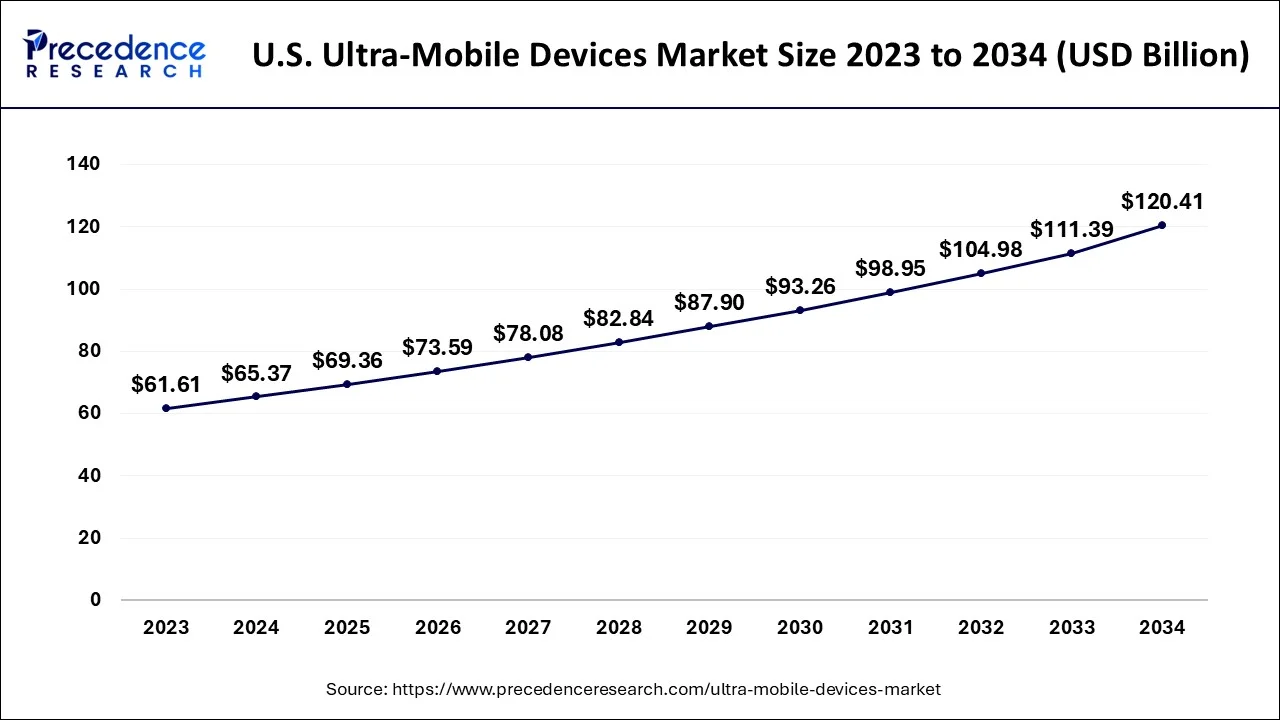
The U.S. ultra-mobile devices market size is evaluated at USD 73.59 billion in 2026 and is predicted to be worth around USD 127.69 billion by 2035, rising at a CAGR of 6.29% from 2026 to 2035.
U.S. Ultra-Mobile Devices Market Trends
The U.S. is a leader in premium device purchases, with strong consumer loyalty to brands such as Apple, supported by trade-in programs that lower upfront costs. Early and increasing 5G deployment creates demand for compatible tools with high-speed connectivity, supporting cloud services, edge computing, and gaming. A strong hybrid work model, advanced IT infrastructure, and significant requirements in the healthcare and education sectors drive enterprise procurement of sophisticated ultra-mobile technology.
North America: Increasing innovation and early adoption
The highest market share and dominant position in the ultra-mobile devices market belongs to North America. This region includes U.S. and Canada. Rise in disposable income and the habit of socializing through online platforms are the reason behind the market growth. Almost everyone has access to the internet and people are preferring ultra-mobile devices as they are portable and can handle the things as personal computers. Hence, the demand for such products is rising mostly among young and professionals owning to their benefits.
Asia Pacific: Rising Government Industrial Policy
Asia-Pacific is considered as second largest region in the ultra-mobile devices market. This region includes China, Japan, and India. Due to the rising number of small and medium-sized businesses in the region, it is anticipated that demand for ultra-mobile devices such smartphones, tablets, laptops, and PCs would increase. The market for ultra-mobile devices in the region is anticipated to expand as internet usage rises in some developing nations. Additionally, the rise in the number of people watching OTT (Over-the-Top) content locally is causing an increase in the use of ultra-mobile devices there. Additionally, as the region's population expands, medical professionals in developing nations like India and China are starting to use solutions like remote surgery, remote audio/video diagnosis, and remote health monitoring via portable devices, which is driving up the demand for ultra-mobile devices.
China Ultra-Mobile Devices Market Trends
China is the global dominant producer of consumer electronics, with a massive, effective, and affordable network of suppliers, component manufacturers, and assembly plants. This ecosystem, specifically in hubs such as Shenzhen, permits high-volume manufacturing at lower costs and faster speeds than other regions.
Europe: Rising pharmaceutical sector
Europe is significantly growing in the market as strong enterprise acceptance, government digital pushes like smart cities and education, and unique customer demand for maintainable, high-quality, feature-rich devices. Strong initiatives in smart cities, regulatory digitalization, medical, and education drive demand for portable and rugged devices.
The UK Ultra-Mobile Devices Market Trend
In the UK, continuing digital development in the sectors increases reliance on portable tech for productivity. Stricter guidelines regarding data privacy, such as GDPR and e-waste management, influence tools trends, driving for compliance with legal and environmental standards.
Ultra-Mobile Devices Market in Latin America
Latin America's market shows notable growth during the forecast period. It is driven by the increasing need for portable computer devices, growing customer preference for tiny and even lightweight gadgets, innovations in battery technology, advancing remote work habits, and increased internet access. Manufacturers are focusing on enhanced performance, long battery life, and integrated productivity features to cater to hybrid work and learning trends.
Argentina Ultra-Mobile Devices Market Trends
Argentina's market is driven by significant smartphone usage, high penetration rates, and a rising reliance on mobile applications for many daily activities and commerce. With developments in technology and rising internet accessibility, the future of mobile connectivity in Argentina appears bright, promising thus, for growth and innovation in the sector.
Ultra-Mobile Devices: The Next Wave in MEA
MEA's market shows a rapid growth rate during the forecast period. It is driven by the increasing need for compact, efficient, and versatile devices. These devices, which involve ultrabooks, tablets, and convertible laptops, are undergoing rapid adoption across various sectors, including business, education, and entertainment.
UAE Ultra-Mobile Devices Market Trends
UAE's market is driven by the extremely high mobile penetration of over 195% of the population, along with widespread 5G adoption drive need for data-heavy usage such as UHD streaming and cloud gaming. High disposable incomes support the need for premium devices with advanced features, along with high-end experiences. E commerce platforms and retail partnerships are expanding accessibility and competitive pricing, while device financing options are making upgrades more affordable for a broader user base.
Value Chain Analysis – Ultra-Mobile Devices Market
- Raw Material Sourcing:
The market relies on sourcing a multifaceted array of raw materials, primarily critical metals, minerals, plastics, and particular glass.
Key Players: Microsoft and Google - Material Processing:
Material processing includes the dedicated techniques and technologies used to manufacture moveable electronic gadgets such as tablets, smartphones, and 2-in-1 convertibles, from raw materials in the end products.
Key Players: Apple and Samsung - Waste Management:
Ultra-mobile device (UMD) waste management deals with the quickly growing electronic waste (e-waste) from tablets, smartphones, and smartwatches, focusing on safe collection, recycling, and disposal to recover valuable materials.
Key Players: Xiaomi and Oppo
Ultra-Mobile Devices Market Companies
|
Company |
Headquarters |
Key Strengths |
Latest Info (2025) |
|
United States |
Strong financial health and excellence in design |
In June 2025, Apple unveiled novel Apple Intelligence features coming to iPhone, iPad, Mac, Apple Watch, and Apple Vision Pro. |
|
|
Taiwan |
Strong R&D, innovative hardware design |
In May 2025, HTC is still holding on in the field of smartphones, now at multi-price tiers. |
|
|
Dell Inc |
United States |
Strong brand reputation |
In June 2025, Dell unveils the novel Dell 16 Premium and Dell 14 Premium, delivering performance advancements to meet the needs of students, creators, and entrepreneurs. |
|
Sony Corporation |
Japan |
Diverse portfolio and technological innovation |
In May 2025, Sony announced its flagship smartphone Xperia 1 VII, designed in collaboration with the engineers of its α (Alpha) digital cameras, Walkman portable audio players, and BRAVIA televisions, and incorporating cutting-edge technologies found in these iconic Sony devices. |
|
Lenovo |
China |
Offering strong build quality and powerful performance |
In 2025, Lenovo is adding Core Ultra processors across our line-up of work, home, and gaming laptops |
Other Major Key Players
- HP Development Company, L.P.
- Google Inc.
- HTC Corporation
- Microsoft Corporation
- Samsung Electronics Co., Ltd.
Key Market Developments
- Sony introduced the Xperia 1 IV. The brand-new item was designed to include the most recent Qualcomm Snapdragon 8 Gen 1 chipset, a 6.5-inch display, a quad-camera system, and a separate periscope module.
Segments Covered in the Report
By Type
- Premium Ultra-Mobile Devices
- Basic Ultra-Mobile Devices
- Utility Ultra-Mobile Devices
By Application
- Healthcare
- Consumer Electronics
- Telecom & IT
- Retail
- BFSI
- Education
- Entertainment
- Others
By Geography
- North America
- Europe
- Asia-Pacific
- Latin America
- Middle East & Africa (MEA)
For inquiries regarding discounts, bulk purchases, or customization requests, please contact us at sales@precedenceresearch.com
Frequently Asked Questions
Tags





Ask For Sample
No cookie-cutter, only authentic analysis – take the 1st step to become a Precedence Research client
 Get a Sample




 sales@precedenceresearch.com
 Schedule a Meeting
