



U.S. Buy Now Pay Later Market Size, Key Companies, Company Market Share, User Adoption, Technology Deployment, Revenue Growth, Competitive Positioning, and Demand Forecast
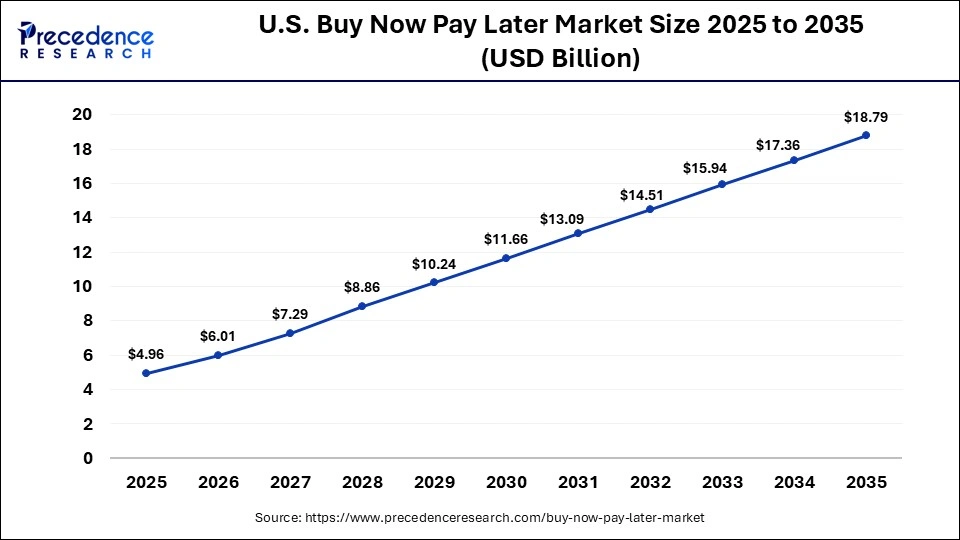
ICT industry specialist Gautam Mahajan estimates the U.S. buy now pay later market at USD 6.01 billion in 2026, with continued technology adoption expected to take the market to USD 18.79 billion by 2035 at a CAGR of 14.25%. Leading U.S. buy now pay later market providers such as sizzle, zip co limited, splitit payments ltd, affirm holdings inc, paypal holdings inc, perpay are expanding their capabilities across segments including component, purchase ticket size, business model, mode, vertical.
Source: https://www.precedenceresearch.com/us-buy-now-pay-later-market
 Get a Sample
 Table Of Content


What is the U.S. Buy Now Pay Later Market Siz?
The U.S. buy now pay later market size was exhibited at USD 4.96 billion in 2025 and is predicted to hit around USD 18.79 billion by 2035 with a CAGR of 14.25% from 2026 to 2035. The U.S. buy now pay later market is driven by the improved consumer affordability and financial freedom.
U.S. Buy Now Pay Later Market Key Takeaways
- By component, the platform/solutions segment dominated the market in 2025.
- By purchase ticket size, the small ticket item (Up to US$ 300) segment held the dominating share of the market in 2025.
- By business model, the business-driven segment dominated the market in 2025.
- By mode, the online segment held the largest share of the market in 2025.
- By vertical, the electronics segment dominated the market in 2025.
What is the U.S. Buy Now Pay Later?
The U.S. buy now pay later market offers services while providing customers with a flexible payment alternative. With the help of financial technology, customers are viable to make purchases right away and pay for them overtime in interest-free installments. But now pay later services are becoming increasingly integrated into online shopping platforms, making it easier for customers to use these payment alternatives online.
Significant online marketplaces and retailers are collaborating with buy now pay later (BNPL) suppliers to give customers greater options at the point of sale. More established businesses are acquiring smaller startups or merging with rivals to get a more significant market share, causing the U.S. buy now pay later market to consolidate. As the industry develops, more consolidation is anticipated.
- According to Adobe Analytics, throughout the Amazon Prime Day Sale in 2023, 20% more customers than the previous year preferred to purchase now and pay later.
How is AI contributing to the U.S. Buy Now Pay Later Industry?
U.S. BNPL is enhanced by AI, which makes real-time credit decisions based on non-traditional behavioral and cash flow information. It complements fraud detection through detecting synthetic identities and abnormal transactions in real-time. Predictive models forecast the risk of delinquency and respond to it in advance.
There is also the use of AI to customize repayment plans according to the income trends. Smooth checkout optimization means a reduction in friction, a faster approval rate, user satisfaction, portfolio stability, and trust in the ecosystem.
U.S. Buy Now Pay Later Market Data and Statistics
- According to a February 2023 Forbes Advisor Survey, only 9% of Americans made purchases with cash. At the same time, credit and debit cards accounted for 54% of all American payment methods for purchases.
- WooCommerce, an open-source eCommerce platform, and Sezzle, a provider of buy now, pay later (BNPL) services, extended their collaboration in September 2023. With new customer payment alternatives, the partnership intends to make it easier for WooCommerce shops to integrate Sezzle's BNPL service.
- Buy now, pay later (BNPL), a financing option previously only available online and lets customers pay for their goods over time in installments, is expanding to retail locations and gas pumps.
U.S. Buy Now Pay Later Market Growth Factors
- Smaller, interest-free payments are provided via Buy Now Pay Later (BNPL), attractive to customers on a tight budget or looking to spread out expenses.
- Growth in e-commerce drives using BNPL as platforms include it to provide a more seamless purchasing experience.
- A smooth interaction with online checkout processes makes instant credit access possible.
- Younger generations welcome the digital aspect and financial control of BNPL.
- More merchants are starting to accept BNPL as a form of payment to draw clients and raise average order value.
- More BNPL access is made possible by enhanced risk assessment and data analytics technologies.
- BNPL growth can be increased by government assistance for alternative payment methods.
- Players extend their product offers, add new features, and offer tailored experiences to draw in customers.
- Customers may find BNPL more appealing during recessions because of its affordability.
- Underbanked populations can be reached by BNPL, expanding the pool of potential users.
Market Outlook
- Industry Growth Overview: The market is shifting to controlled maturity, built-in finance, and sustainable profitability in digital and physical channels of commerce.
- Sustainability Trends: Providers combine industry carbon-offset programs and financial wellness services that promote responsible, low-debt consumer consumption patterns.
- Major investors: Block Inc, JPMorgan, Elliott Management, Blue Owl Capital, Visa, Mastercard, funding, partnership, and integration of payment networks.
U.S. Buy Now Pay Later Market Dynamics
Drivers
Evolving retail landscape
Customers are looking for various payment solutions that fit their interests and financial status more and more. Because BNPL services let customers break up their payments into smaller, interest-free installments, they provide a substitute for conventional credit cards. By giving those who would not be eligible for traditional credit cards or loans access to credit, BNPL services can aid in the promotion of financial inclusion. More customers find this inclusivity appealing, which propels U.S. buy now pay later market's growth.
Shifting consumer preferences and economic anxieties
BNPL services provide a practical substitute for traditional credit card debt as consumers grow increasingly suspicious of it and want more flexible payment choices. With these services, customers can spread out their payments over time rather than paying the entire amount once for their products. This is consistent with spending within a budget and avoiding high-interest loans. Economic uncertainties like unstable employment and income fluctuations also encourage customers to look for flexible payment options that don't put a load on their finances.
Restraints
Impact of credit score
The increased reliance on digital gadgets for business, education, and leisure, along with new product releases and technological breakthroughs, contributed to a notable spike in consumer demand for electronic goods. Electronics retailers worked with BNPL providers to smoothly include their services in the buying process so that customers may choose to pay in installments at the point of sale.
Consumer debt and affordability
A considerable amount of debt, including mortgages, credit card debt, and student loans, is already borne by many consumers. Customers may be reluctant to pay off extra debt using BNPL services due to their high level of debt. Even though BNPL services frequently promote themselves as interest-free, if payments are neglected, late fines and penalties can mount up quickly. Customers who are already in debt can be cautious about spending more money. Missed payments or defaults can have a negative impact on individuals' credit scores even if BNPL transactions might not always be reported to credit bureaus. Customers who are concerned about preserving or enhancing their creditworthiness may find this concerning.
Opportunities
Expansion of retail sector
BNPL services, which enable customers to buy and pay for products in installments, have been linked to Internet shopping. However, the industry can reach a wider audience and satisfy customers who like in-person purchasing experiences by expanding BNPL services to physical stores. Merchants can provide consumers greater flexibility and convenience by incorporating BNPL choices into their physical retail locations. This could lead to an increase in sales and customer loyalty.
Additionally, by growing their business, BNPL suppliers can stand out from the competition and forge new alliances with merchants. Furthermore, by facilitating a smooth omnichannel retail experience, delivering BNPL in-store can aid in bridging the gap between online and offline purchasing experiences.
Financial inclusion & responsible lending
BNPL providers can reach a broader range of consumers by encouraging financial inclusion. This includes individuals who might not otherwise have access to traditional credit cards or loans because of a poor credit history or low income. This increases their market potential by allowing them to contact previously underserved population segments. Stressing appropriate lending ensures that people with debt they can't afford are in good standing. Consumer trust and confidence in BNPL services are enhanced by clear and concise disclosure of fees and payback schedules, transparent conditions, and strict adherence to regulatory requirements. As a result, fewer defaults and long-term connections with clients are fostered.
Segment Insights
Component Insights
The platform/solutions segment dominated the U.S. buy now pay later market in 2025. The expansion of online platforms that provide BNPL services and satisfy different customer demands and tastes. These platforms offered customers a practical and adaptable payment option at the time of sale by seamlessly integrating with brick-and-mortar retailers and e-commerce websites. The platform/solutions industry profited from technology improvements by evaluating credit risk and customizing customer payment plans using data analytics and AI-driven algorithms.
Purchase Ticket Size Insights
The small ticket item (Up to US$ 300) segment dominated the U.S. buy now pay later market in 2025. Convenience and affordability drove consumers to make smaller, more frequent purchases. Because BNPL allowed for interest-free payment splitting, it was a desirable choice for regular expenses. To improve the shopping experience and boost conversion rates, many physical and virtual businesses incorporated BNPL services into their checkout procedures. More clients choose this payment option because of the smooth integration of the BNPL choices.
Business Model Insights
The business-driven segment dominated the U.S. buy now pay later market in 2025. Numerous companies collaborated with BNPL suppliers to give their clients adjustable payment plans. Through these alliances, BNPL services were able to reach a broader range of sectors, including travel, e-commerce, retail, and healthcare. BNPL providers customize their products to match the unique requirements of companies, including white-label platforms, payment system integration, and customized financing choices, among other solutions. Business-to-business (B2B) transactions are now included in the services offered by BNPL providers and consumer transactions. This enabled companies to expedite the purchase process and better manage cash flow.
Mode Insights
The online segment dominated the U.S. buy now pay later market in 2025. BNPL services flourished due to the sustained expansion of e-commerce platforms. Customers were exposed to additional BNPL alternatives at checkout as more and more shopped online. By choosing strategic partnerships with large online shops, BNPL providers could easily integrate their services into the checkout process. This increased customer accessibility and convenience and accelerated adoption.
Vertical Insights
The electronics segment dominated the U.S. buy now pay later market in 2025. The need for leisure, distant work, and technological breakthroughs increased the demand for electronics. By forming strategic alliances with large electronics retailers, BNPL providers give easy payment choices at the point of sale. When more people shopped online and looked for easy and accessible payment options, BNPL adoption for electronic purchases increased.
U.S. Buy Now Pay Later Market Companies
- Sezzle: Provides no-interest pay-in-four payment options within six months, credit-soft checks, and credit-building capabilities under the Sezzle Up.
- Zip Co Limited: The company offers a virtual card through which customers can use Quadpay to make four installments of online and in-store purchases without interest charges.
- Splitit Payments Ltd.: Allows the capacity to make monthly payments without interest using current credit card limits and maintains card benefits.
- Affirm Holdings Inc.: Offers point-of-sale buy now, pay later financing in the U.S. that lets shoppers split purchases into interest-free or low-interest installment plans with transparent pricing and no hidden fees.
- PayPal Holdings Inc.: Provides a BNPL service called “Pay in 4” which allows U.S. customers to divide eligible purchases into four interest-free payments over about six weeks through their PayPal accounts.
- Perpay: Offers a payroll-linked BNPL service where shoppers get spending power based on their income, buy items on the Perpay marketplace, and repay over time via automatic paycheck deductions with no interest or fees.
- Quadpay: Now part of Zip, this U.S. BNPL option lets consumers split purchase costs into four interest-free installments over six weeks at many online and in-store retailers via an app or virtual card.
U.S. Buy Now Pay Later Market Recent Developments
- In October 2025, Liberis launched its Buy Now, Pay Later product, Pay with Liberis, in the U.S. Vagaro, a business management platform, is the first partner to adopt it, offering the option as Capital for Hardware. This allows users to pay a fixed percentage of future revenue at checkout, aiding SMBs in funding challenges. (https://www.businesswire.com )
- In June 2025, Klarna is launching a Visa debit card, the Klarna Card, as part of its strategy to diversify beyond short-term credit services. The pilot begins with select U.S. customers, with plans for a wider rollout and a European launch later this year. (https://www.cnbc.com )
- In January 2022, Buy now, pay later (BNPL) company Sezzle Inc. is reportedly negotiating to be purchased by more significant Australian competitor Zip Co Ltd (Z1P.AX), according to a new source. The news sent Sezzle's shares plunging 23% during the trading session. Separate comments from the corporations noted that negotiations were in their early stages and that there was no guarantee that a deal would be reached. Sezzle, a U.S.-based company, is worth approximately A$425 million ($303.5 million) on the market, whereas Zip is estimated to be worth A$1.94 billion.
Segments Covered in the Report
By Component
- Platform/Solutions
- Services
By Purchase Ticket Size
- Small Ticket Item (Up to US$ 300)
- Mid Ticket Items (US$ 300 - US$ 1000)
- Higher Prime Segments (Above US$ 1000)
By Business Model
- Customer Driven
- Business Driven
By Mode
- Online
- Offline
By Vertical
- Home & Furniture
- Electronics
- Fashion
- Others
For inquiries regarding discounts, bulk purchases, or customization requests, please contact us at sales@precedenceresearch.com
Frequently Asked Questions





Ask For Sample
No cookie-cutter, only authentic analysis – take the 1st step to become a Precedence Research client
 Get a Sample




 sales@precedenceresearch.com
 Schedule a Meeting
