



Anti-Drone Market Size, Key Companies, Company Market Share, Chip Production Volume, Wafer Capacity, Technology Adoption, Pricing Trends, Competitive Positioning, and Demand Analysis
Anti-Drone Market (By Mitigation Type: Non-destructive System, Destructive System; By Defense Type: Drone Detection System, Drone Detection and Disruption System; By Type: Radar-Based Detection, Radio-Frequency (RF), Electro-Optical (EO), Infrared Radiation (IR), Others; By Technology: Electronic System, Laser System, Kinetic System; By Platform: Ground-based, Handheld, UAV-based; By End User: Commercial, Military and defense, Government, Others) - Global Industry Analysis, Size, Trends, Leading Companies, Regional Outlook, and Forecast 2026 to 2035
Source: https://www.precedenceresearch.com/anti-drone-market
 Get a Sample
 Table Of Content


What is the Anti-Drone Market Size?
The global anti-drone market size accounted for USD 4.41 billion in 2026, and is expected to reach around USD 30.91 billion by 2035, expanding at a CAGR of 26.4% from 2026 to 2035. The anti-drone market is driven by rising drone threats and increasing investments in advanced defense and airspace security systems.
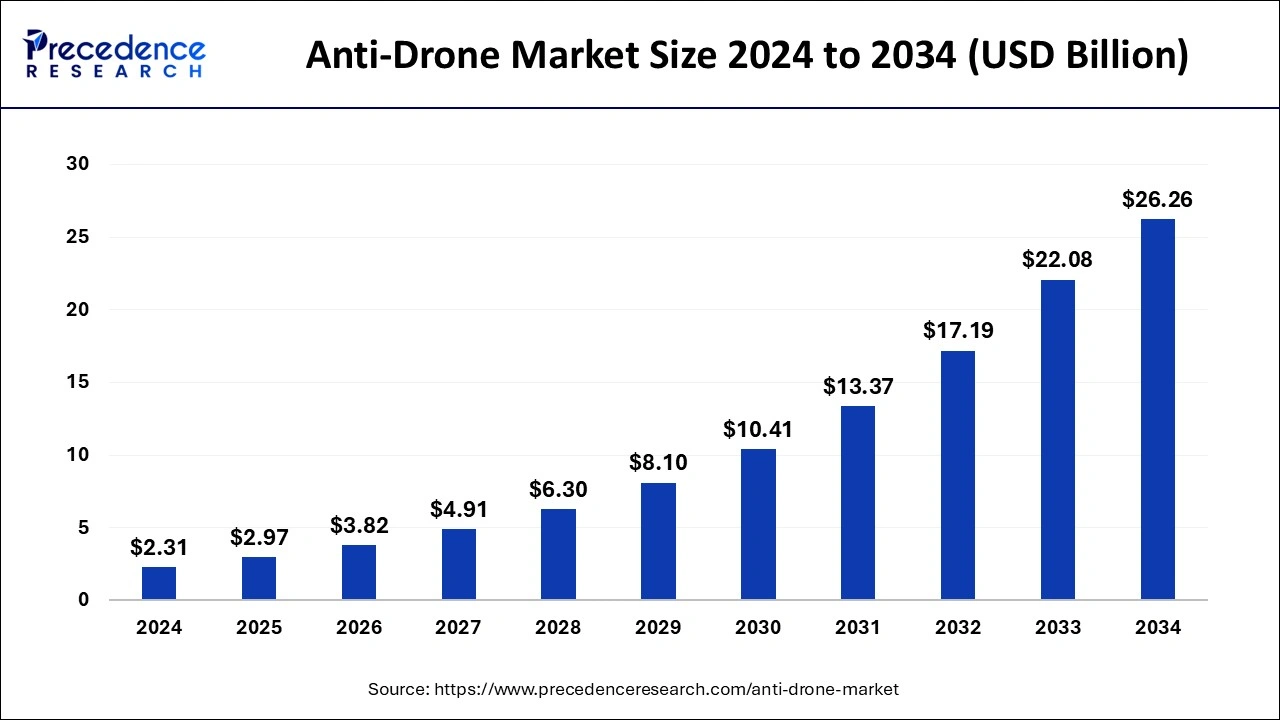
Market Highlights
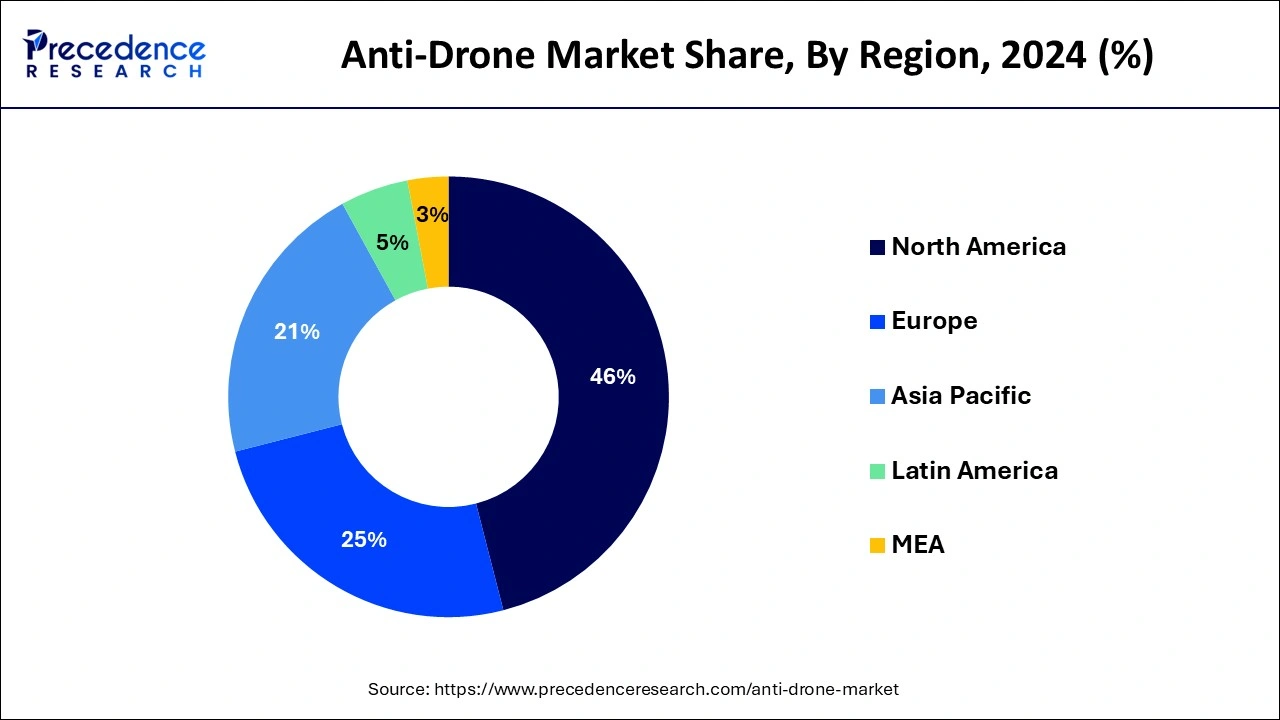
- By region, North America dominated the global Market in 2025.
- By region, the Asia Pacific is expected to grow at the fastest CAGR during the forecast period.
- By mitigation type, the destructive system segment dominated the market in 2024.
- By mitigation type, the electronic countermeasure segment is expected to grow at the fastest rate during the forecast period.
- By defense type, the drone detection and disruption system segment contributed the biggest revenue share in 2024.
- By defense type, the drone detection system segment is expected to witness the fastest growth over the forecast period.
- By type, the radar-based detection segment accounted for the highest revenue share in 2024.
- By type, the radio-frequency segment is expected to grow at the fastest CAGR during the forecast period.
- By technology, the electronic system segment registered its dominance over the global market in 2024.
- By technology, the laser system segment is expected to show the fastest growth over the forecast period.
- By platform, the ground-based segment held a dominant revenue share in 2024.
- By platform, the UAV-based segment is expected to expand rapidly in the coming years.
- By end-user, the military and defense segment registered its dominance over the global market in 2024.
- By end-user, the commercial segment is expected to show the fastest growth over the forecast period.
Market Overview
The number of aerial vehicles that are unmanned have drastically increased all over the world during the recent times. Unmanned aerial vehicles are utilized in the commercial sector on a large scale which has helped the market to record a considerable revenue over the period of time. The recreational uses of unmanned aerial vehicles have also rapidly increased in the recent years due to the modernization of the systems and procedures which are adopted by various sports organizations all over the world.
The involvement of modern technology into the various systems all over the world has helped the market for anti-drone to record a considerable revenue over the period of time which is expected to grow further. The outbreak of the pandemic had a considerable impact on the market owing to the decline in the demand from the industries that utilize such services. The restrictions imposed by the government hampered the demand and supply to a great extent which had experienced minor purchases from the regions of Africa and Middle East.
Impact of Artificial Intelligence on the Anti-Drone Market
Artificial intelligence (AI) plays a vital role in the development of industries dedicated to addressing UAV illicit operations. The defense industry can track malicious UAV activities in real time using AI technologies. AI algorithms can analyze huge amounts of data collected from the sensors and cameras to improve accuracy and response time and differentiate the drone from other aerial objects. The application of artificial intelligence expands the controllability of these systems since they respond to new threats and reduce false alarms. AI also automates the operation of drones.
Anti-Drone Market Growth Factors
- Rising concerns about aerospace security drive the adoption of advanced anti-drone technologies.
- The growing integration of machine learning and artificial intelligence enhances the effectiveness of drone detection and countermeasure systems.
- Increasing drone activity in restricted zones accelerates the demand for reliable counter-drone solutions.
- The rising adoption of drones in the military and defense sectors boosts market growth.
- Advancements in radar, optical sensors, and other detection technologies significantly improve the precision of anti-drone systems.
- The rising investments in R&D by the defense sector to develop innovative counter-drone technologies contribute to market expansion.
- The increasing development of portable and scalable anti-drone solutions to meet the varying needs of military operations propels the growth of the market.
Market Scope
| Report Coverage | Details |
| Market Size in 2025 | USD 3.82 Billion |
| Market Size in 2026 | USD 4.41 Billion |
| Market Size by 2035 | USD 30.91 Billion |
| Growth Rate from 2026 to 2035 | CAGR of 26.4% |
| Base Year | 2025 |
| Forecast Period | 2026 to 2035 |
| Segments Covered | Mitigation Type, Defense Type, Type, Technology, Platform, End User, and Region |
| Regions Covered | North America, Europe, Asia-Pacific, Latin America, and Middle East & Africa |
Market Dynamics
Key Market Drivers
- Availability of integrated cameras - A number of drones have been introduced into the market which are accompanied by advanced cameras which makes it a very popular equipment for the professionals. Aerial photography and videography have emerged as a recent trend which has boosted the demand for more stable and advanced drones which help to capture clear pictures and videos from a far distance.
- Active participation of the government - Various major governmental organizations are providing active support to the manufacturing and production of advanced unmanned aerial vehicles with a view to boost the equipment that are utilized for tracking and detection for security purposes. The increasing demand of advanced drones in the market has encouraged various companies to increase their production capacities.
Key Market Challenges
- Breaching of national security - The increasing acceptance of unmanned aerial vehicles has challenged the security setups of the government as the number of unauthorized entries into the restricted premises have increased tremendously. This hampers the security measures which are taken by the government for the important people and places. Various reduction technologies have been introduced by the key market players for limiting the drones mainly in the aviation sector.
- Introduction of counter drone technology - A number of key market players and the government are focusing on developing counter drone technologies with a view to combat the various threats that are arising from the usage of advanced drones in the market. Different methods are utilized by the companies for detecting the presence of drones in the vicinity.
Key Market Opportunities
Rising private investments - The increasing number of people who utilize drones is helping the market with new opportunities. Increasing number of anti-drone software providers in the market has also emerged as a substantial opportunity for the growth of the market.
Segments Insights
Mitigation Type Insights
The Destructive System Segment Held the Largest Share of the Anti-Drone Market in 2025
The destructive system segment held a dominant position in the market in 2025, as it has an effective neutralizing capability against hostile drones physically. They are widely applied in military and critical infrastructure applications. High-risk airborne elements - they were well equipped to destroy them, which was not overlooked by the market.
The electronic countermeasure segment is expected to witness strong growth during the forecast period, as jamming is being attempted across governments, the GNSS system must ensure that current governments and future applications alike are protected from such threats. They are all cost-effective, non-kinetically neutralised drone options. Drone swarms are stirring up more threats - so it's no wonder that uptake continues.
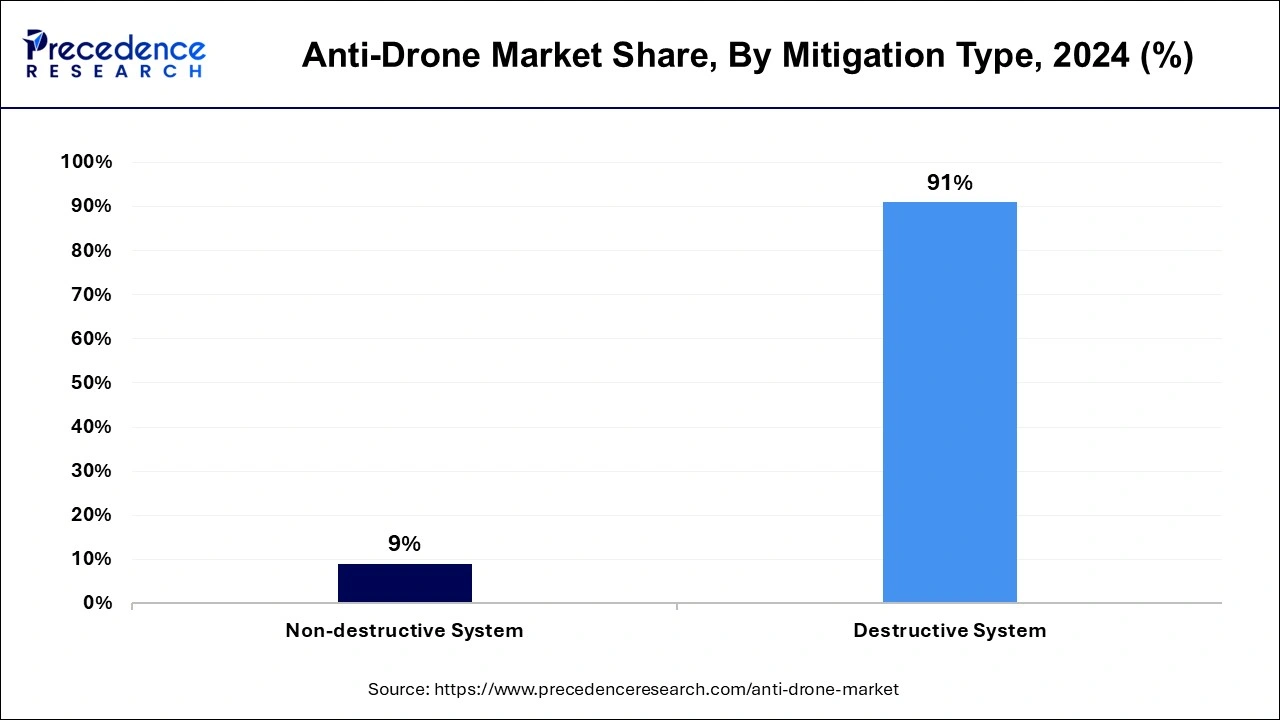
The non-destructive system segment is projected to grow at a notable pace because of the safe drone disqualifications. Like any other filtration systems, they are becoming more popular to use for civilians and as well in urban areas. The enhancement of public safety issues is increasing and also contributing to the market growth.
The laser system segment is expected to witness steady growth during the forecast period with its reputed high accuracy and cost-effectiveness. Laser-based systems allow for the engagement of aerial threats with minimal collateral damage and a very rapid response. Continued advancement of directed-energy technologies that assist in promoting their use.
Defense Type Insights
The Drone Detection and Disruption System Segment Dominated the Anti-Drone Market in 2025
The drone detection and disruption system segment dominated the market in 2025 due to its in-built capability to detect, track, and neutralize drones. These are capable of protecting from new air threats. They were very broadly used within critical infrastructure and in defense, leading to market leadership.
The drone detection system segment is expected to grow significantly during the forecast period due to its increased demand for timely detection of threats. Advanced sensors and AI-powered analysis make them more accurate in detecting. Investments in surveillance technology have continued to increase, and adoption of such technology has rapidly advanced.
Type Insights
The Radar-Based Detection Segment Dominated the Anti-Drone Market in 2025
The radar-based detection segment dominated the market in 2025, as it can detect a drone from a long distance and under various climatic conditions. The radars can track several targets in the air at one time. They installed a wide range of military security and border security services, which promoted the development.
The radio-frequency segment is expected to grow steadily during the forecast period, with the RF technologies being able to identify and receive drone communication signals. They allow for the quick identification of drone threats without having to see them. The growing deployments in the security operations segment are contributing to the market growth.
The electro-optical segment is projected to grow at a healthy pace as it helps in the high-resolution visual identification and tracking of drones. These systems are utilised to raise awareness of SS and to offer better comparison. They're also quickly becoming part of AI-driven analytics, and this, too, is contributing to their uptake.
The infrared radiation segment is expected to experience considerable growth during the forecast period, as this will allow the detection of unmanned aircraft during night or in low visibility conditions. A web camera with thermal imaging is more precise when monitoring the very difficult environments. Greater demand for 24×7 monitoring is creating market growth. The growth of the market is driven by the higher 24×7 monitoring requirement.
Technology Insights
The Electronic System Segment Dominated the Anti-Drone Market in 2025
The electronic system segment dominated the market in 2025, as it was a highly effective disruptor in the communication and navigation operations in drones. These solutions can react quickly and without physical interaction and are scalable. The continuous development and innovations of the Electronic Warfare field made its application feasible.
The laser system segment is expected to witness notable growth driven by an increasing amount of spending on directed-energy weapons. Precision and the low cost of the system ensure distance and the exactness of the neutralization of opponents' drones in laser systems. The modernisation of defence programmes is picking up momentum in the world.
The kinetic system segment is expected to grow steadily due to the strong demand for the effective interception of high-end threats. Interceptor drones and missiles, and engagement weapon stations are examples of such systems. They are useful for enterprising attacks in the air and are increasingly becoming popular.
Platform Insights
The Ground-based Segment Dominated the Anti-Drone Market in 2025
The ground-based segment dominated the market in 2025, due to the highest ground-based installations, which are being utilized for critical infrastructure, military bases, airports, and border security. These have powerful monitoring capabilities and are good for rapid response. They were readily able to integrate into some of the defenses they already had in place, and that kept the market in their hands.
The UAV-based segment is expected to witness notable growth as the capabilities of autonomous drone technologies improve. The aerial defense missions will be performed more by interceptor drones. The platforms offer greater mobility and flexibility of movement.
The handheld segment is projected to witness stable growth during the forecast period due to a rising demand from law enforcement and event security agencies. Portable Anti-Drone systems are rapidly deployable and have a have hassle-free operation. They come in moderately priced, too, leaving them a preferred option.
End User Insights
The Military and defense Segment Dominated the Anti-Drone Market in 2025
The military and defense segment dominated the market in 2025, due to the high demand for counter-drone systems. Increasing international geopolitical tensions have increased investments in the defense sector around the world. The military still has anti-drone as its highest priority.
The commercial segment is expected to witness notable growth since the protection of aircraft at airports, stadiums, industrial machinery, and critical infrastructure is becoming more and more important. In recent years, a greater investment has been made in the security measures that are available to protect the airspace. Commercial activity of drones continues to be a part of this, helping drive sales.
The government segment is projected to witness stable growth during the forecast period due to rising investments in homeland security and public safety. In response to the use of drones at public gatherings and even on critical infrastructure, government agencies are beginning to install anti-drone tech therein. Currently, it is airspace security that's driving growth for regulators.
Regional Insights
North America will lead the Global Anti-Drone Market in 2025
North America dominated the global market in 2025 as its massive defense spending commitments and fast pace of adoption of advanced technology equipment for counter-drone. Increased commercial and military drone applications foresee an increase in the need for effective mitigation technologies. Technological innovation is encouraged by leading business players in the defense industry.
U.S. Anti-Drone Market Trends
The U.S. market is anticipated to grow significantly, as the U.S. military is beginning to spend more on upgrading its equipment and border security. Emerging technologies such as AI detection and EW are fueling this demand. Increasing use of counter-UAS solutions to secure critical infrastructure, supplied by federal agencies.
U.S. Anti-Drone Market Size and Growth 2026 to 2035
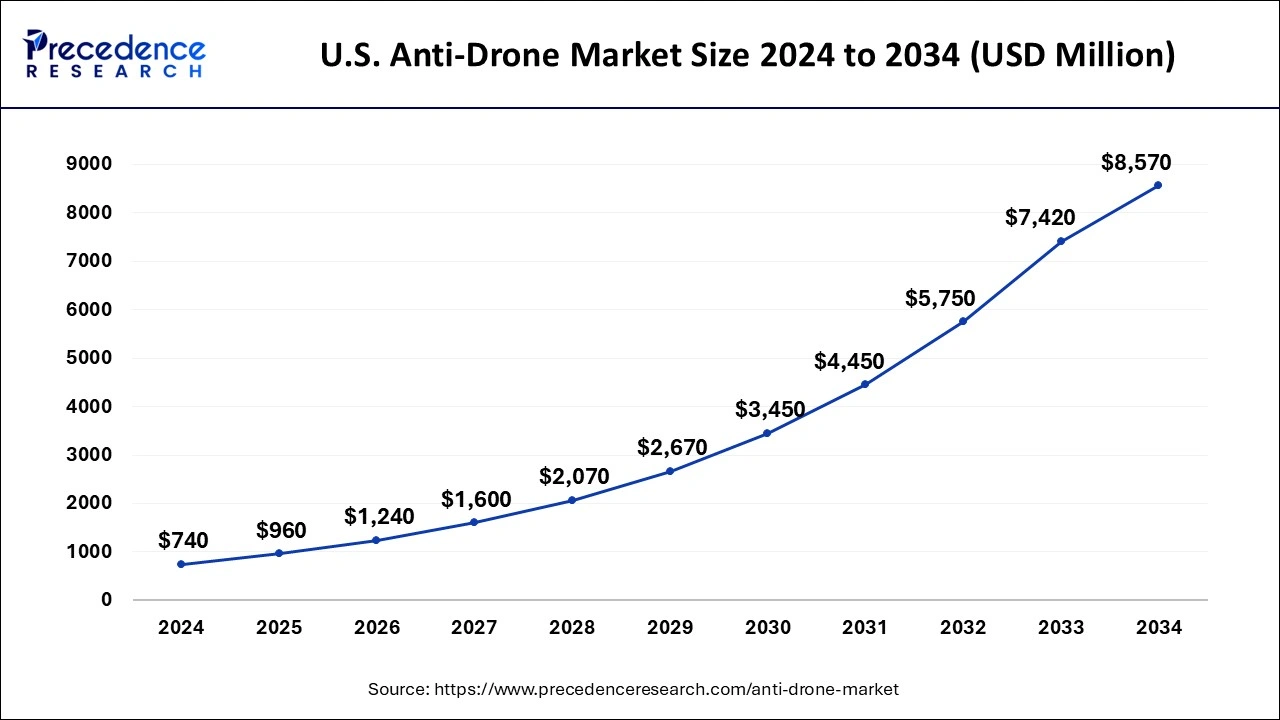
The U.S. anti-drone market size is estimated at USD 1,600 million in 2026 and is predicted to be worth around USD 10,060 million by 2035, at a CAGR of 26.48% from 2026 to 2035
Asia Pacific is Undergoing the Fastest Growth in the Anti-Drone Market
Asia Pacific is expected to grow at the fastest rate in the market. Indigenous technologies and surveillance systems are being put under government investment. Anti-drone solutions are needed as commercial drone operations rapidly expand. AI and radar technologies are helping to drive market growth. The market opportunities are growing since more defense systems are being produced locally.
China Market Trends
China's anti-drone market is anticipated to grow significantly, due to an increase in defense modernization and research and development on home-made drone technologies in China. The country's anti-UAS capabilities to protect military bases and government facilities are being strengthened. AI, radar, and electronic warfare R&D are promoting technological advancements.
Advancements in the Anti- Brazil Market in Europe
Europe is expected to witness significant market growth throughout the forecast period due to investments in border security and the protection of critical infrastructure. Greater advanced counter-drone deployments because of higher rates of defense modernization programs. With the rise in the number of drones being used in both commercial and public settings, there are escalating security concerns.
Germany Market Trends
Germany market is anticipated to grow significantly, owing to increased investments in advanced surveillance systems and the defense budget. The country is implementing measures against drones to guard military facilities, airports, and public events. Defence manufacturing and other manufacturing industries also have strong manufacturing sectors, which are also helping the development of markets.
Key Trends in the Anti-Drone Market in Latin America
Latin America is expected to witness significant growth in the market. Government counter-drone systems are being utilized to counter the illegal use of such systems and protect key infrastructure. Drones are also being used in the commercial sphere and are presenting new challenges for that industry. Increasing markets through the investment in surveillance technologies.
Brazil Market Trends
Brazil's anti-drone market is anticipated to grow significantly due to an increase in investments for homeland security and the protection of public infrastructure. The commercial drone use has driven the demand for airspace security. The government has been active in improving the surveillance of the market, which is helping the market expand.
Argentina Anti-Drone Market Trends
Argentina's anti-drone market is driven by the rising Latin American trend, which is driven by critical infrastructure protection, defense modernization, and growing security concerns over unauthorized drones. Growth is driven by increasing demand from the military, defense, law enforcement, and key industrial sectors for systems that can reliably identify and mitigate rogue drones.
Growth of the Middle East and Africa in the Anti-Drone Market
The Middle East and Africa region is expected to witness significant growth in the market as defense modernization and critical infrastructure protection are gaining more attention in the region. Advanced Counter-drone technologies are growing in investment as geopolitical tensions are on the rise. An anti-drone system is set up to safeguard military bases, oil facilities, and public property. New surveillance programmes are being adopted to meet the regional needs.
South Africa Anti-Drone Market Trends
South Africa's anti-drone market is undergoing rapid growth, driven by defence demands, critical infrastructure protection, and public safety, with a strong need for AI-integrated detection or disruption systems, ground-driven solutions, and software. Government and military investment in airspace security modernization is accelerating procurement of integrated anti-drone solutions to safeguard airports, power plants, borders, and urban centers.
Saudi Arabia Market Trends
The Saudi Arabian market is anticipated to grow significantly, due to the growing investments in defense and its growing emphasis on the protection of strategic infrastructure. The military modernization programs are projected to drive the demand for the advanced anti-drone systems. The military modernization programs are likely to further drive up demand for advanced anti-drone systems.
Value Chain Analysis for the Anti-Drone Market
- Raw Material Procurement
It includes sourcing high-tech components, customized electronic materials, and even advanced structural composites to build systems that detect, track, and neutralize unauthorized unmanned aerial vehicles.
Key Players: DroneShield, Dedrone, Rafael Advanced Defense Systems & IAI, Saab - Wafer Fabrication
It includes creating complex integrated circuits on thin, high-purity semiconductor materials, along with predominantly silicon, but increasingly broad-bandgap materials such as Gallium Nitride, along with silicon carbide for high-power, high-frequency applications.
Key Players: Raytheon Technology, Qorvo, Inc., Wolfspeed, Inc. - Photolithography and Etching
It allows the market by enabling the mass production of highly sensitive, compact, and lightweight electronic components required to detect, track, and neutralize unmanned aerial vehicles.
Key Players: Texas Instruments Inc., Infineon Technologies AG, Analog Devices Inc.
Competitive Landscape
The anti-drone market comprises “defense” companies and those specializing in counter-UAS technology. Advanced Radar Technologies S.A., Airbus Group SE, Blighter Surveillance Systems, Dedrone, DeTect, Inc., and DroneShield LLC are leading players, with a substantial market share at the global level. Leading industries are stepping up the use of AI for detection, collaboration, and product innovation, and defense contracts to gain a competitive advantage.
Additionally, businesses are increasingly expanding their reach to the world by engaging with governments, defense, and critical infrastructure operators. The challenges for market participants are evolving drone technologies, regulatory complexities, and continual following factors such as growing defense expenditure, the need for AI-powered counter-drone solutions, and the rise in the wake of drone swarm attacks.
Anti-Drone Market Companies
- Advanced Radar Technologies S.A.
- Airbus Group SE
- Blighter Surveillance Systems
- Dedrone
- DeTect, Inc.
- Drone shield LLC
- Enterprise Control Systems
- Israel Aerospace Industries Ltd. (IAI)
- Lit eye Systems, Inc.
- Lockheed Martin Corporation
- Orelia
- Prime Consulting and technologies
- Raytheon Company
- Saab Ab
- Selex Es Inc.
- Thales Group
- The Boeing Company
Latest Announcements by Industry Leaders
- In October 2024, ASELSAN introduced new anti-drone systems, KORKUT 25 mm, BUKALEMUN, KANGAL-FPV, and SEDA 100-cUAV, during a launch ceremony on the first day of SAHA EXPO 2024. This move significantly strengthens ASELSAN's position in the anti-drone systems market. The company emphasized the importance of developing adaptable and advanced systems to address the growing threats posed by drones in modern warfare. ASELSAN President & CEO, Ahmet Akyol, highlighted the increasing use of drones in military operations and stated that these new systems would provide a significant advantage in neutralizing drone threats.
Recent Developments
- In January 2025, India successfully tested its first indigenously developed micro-missile system, Bhargavastra, designed to combat the increasing threat of swarm drones. This multi-layered counter-drone system was tested at the Gopalpur Seaward Firing Ranges on January 12 and 13, where it effectively hit designated virtual targets over 2.5 kilometers away. Bhargavastra showcases a cost-effective and innovative solution to neutralize large-scale drone attacks, demonstrating India's growing capabilities in counter-drone technology.
- In July 2025, RTX Corporation revealed that it would be integrating autonomy software produced by Shield AI and ViDAR sensor technology into its Multi-Spectral Targeting System (MTS). The partnership dovetails into joint Maritime and Airborne drone swarm detection and tracking using AI. (Source: https://www.rtx.com)
- In June 2025, Blighter Surveillance Systems unveiled the B422LR, a smart border surveillance radar capable of reaching distances of up to 15 km with only 4 Watts. Radar provides 360° electronic scanning – covering the entire area at a distance – to provide for remote perimeter and border surveillance. (Source: https://blighter.com)
Segments Covered in the Report
By Mitigation Type
- Non-destructive System
- Destructive System
- Laser System
- Missile Effector
- Electronic Countermeasure
By Defense Type
- Drone Detection System
- Drone Detection and Disruption System
By Type
- Radar-Based Detection
- Radio-Frequency (RF)
- Electro-Optical (EO)
- Infrared Radiation (IR)
- Others
By Technology
- Electronic System
- Laser System
- Kinetic System
By Platform
- Ground-based
- Handheld
- UAV-based
By End User
- Commercial
- Military and defense
- Government
- Others
By Region
- North America
- Europe
- Asia-Pacific
- Latin America
- Middle East & Africa (MEA)
For inquiries regarding discounts, bulk purchases, or customization requests, please contact us at sales@precedenceresearch.com
Frequently Asked Questions
Tags





Ask For Sample
No cookie-cutter, only authentic analysis – take the 1st step to become a Precedence Research client
 Get a Sample




 sales@precedenceresearch.com
 Schedule a Meeting
