



Unmanned Aerial Vehicle (UAV) Market Size, Leading Companies, Company Technology / Innovation, Vehicle Production Volume, Sales Performance, Export & Import Analysis, Technology Adoption, Market Share, and Demand
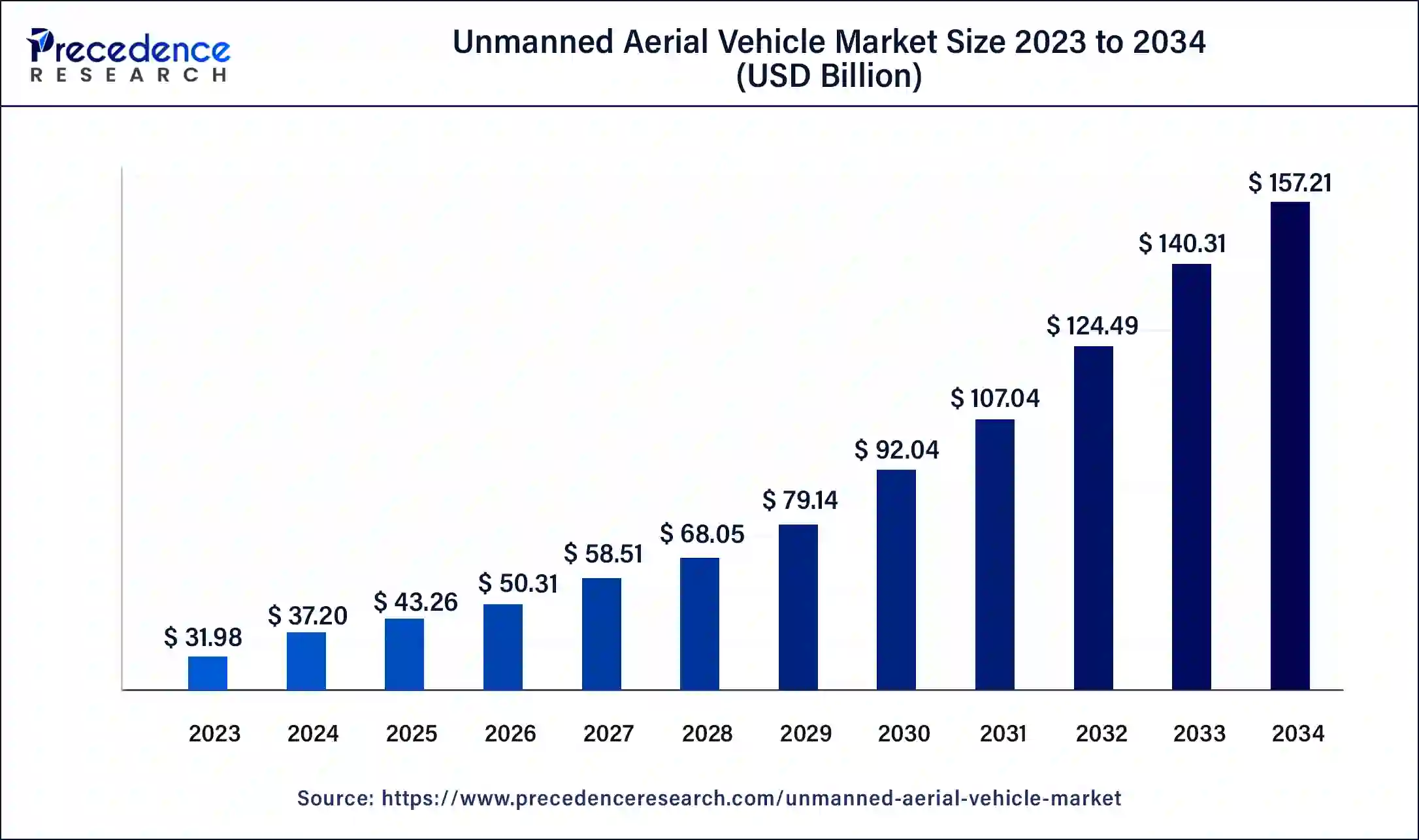
The global unmanned aerial vehicle (UAV) market was valued at USD 50.31 billion in 2026 and is projected to reach USD 174.11 billion by 2035, expanding at a CAGR of 14.94% from 2026 to 2035. Market growth is driven by increasing adoption of drones across defense, commercial, and civil applications, along with advancements in autonomous flight technologies, artificial intelligence, and beyond visual line of sight (BVLOS) operations. Rising demand for UAVs in surveillance, agriculture, logistics, infrastructure inspection, and emergency response, coupled with supportive government initiatives and investments in drone ecosystems, is expected to accelerate market expansion.
Source: https://www.precedenceresearch.com/unmanned-aerial-vehicle-market
 Get a Sample
 Table Of Content


Unmanned Aerial Vehicle (UAV) Market Size and Forecast 2026 to 2035
The global unmanned aerial vehicle (UAV) market was valued at USD 50.31 billion in 2026 and is projected to reach USD 174.11 billion by 2035, expanding at a CAGR of 14.94%. While defense modernization continues to support demand, the market's next phase of growth is increasingly being driven by commercial adoption as industries seek faster inspections, improved safety, and more efficient data collection.
Advances in autonomous flight, AI-enabled analytics, and evolving beyond visual line of sight (BVLOS) regulations are expanding the practical use of UAVs across sectors. As deployment scales, demand is expected to favor solutions that deliver operational value, actionable insights, and seamless integration into existing workflows.
Unmanned Aerial Vehicle Market Key Takeaways
- North America led the unmanned aerial vehicle market in 2025 with the largest share.
- Asia Pacific is expected to grow at the fastest CAGR during the forecast period.
- By class, the small UAVs segment held the largest share in 2025.
- By class, the tactical UAVs segment is expected to grow at the fastest CAGR in the coming years.
- By technology, the remotely operated segment held the largest share in 2025.
- By technology, the fully-autonomous segment is observed to expand at the fastest CAGR during the forecast period.
- By system, the UAV payloads segment accounted for the largest market share in 2025.
- By system, the UAV software segment is expected to grow at the fastest CAGR in the foreseeable period.
- By application, the commercial segment held the largest share in 2025.
- By application, the military segment is expected to expand at the fastest CAGR during the projection period.
UAV Market Overview
The unmanned aerial vehicle market refers to the technology of flying aircraft by remote pilot, semi-autonomous, and fully autonomous planes used in commercial, defense, and civil applications. The applications of UAVs are growing in the field of surveillance, agriculture, logistics, infrastructure inspection, mapping, and emergency response. Propulsion system, sensor, and automation technology improvements support market growth.
To promote domestic manufacturing, agricultural use of drones, and integration with regulatory frameworks, governments are working on initiatives like India's Production Linked Incentive (PLI) Scheme, Namo Drone Didi, Drone Shakti, and the DigitalSky Platform. All these efforts are helping to consolidate the UAV ecosystem and promote commercial and defense adoption.
Impact of Artificial Intelligence on the Unmanned Aerial Vehicle Market
The market is heavily influenced by AI, as artificial intelligence transforms UAVs from remotely operated systems into increasingly autonomous platforms capable of making real-time decisions. Much of this momentum is driven by defense modernization initiatives, where AI enables capabilities such as swarm-based operations, enhanced target recognition, and improved mission performance in contested or complex environments. As a result, AI integration is significantly expanding the operational scope, efficiency, and strategic value of drone technologies across both military and commercial applications.
On the commercial side, areas like agriculture, infrastructure inspection, logistics, and security are also leaning more and more into AI-enabled drones, mainly to boost productivity and cut down operational risks. With edge computing plus onboard AI processors, drones can do real-time analytics and obstacle avoidance, plus autonomous navigation, without needing a cloud connection every second. And companies such as DJI, Anduril, Shield AI, and Lockheed Martin are still pushing forward intelligent drone capabilities for both civilian uses and military programs.
Strategic Growth Opportunities
- High Growth Commercial Opportunities: The commercial opportunities highlight the compatibility to meet the commercial needs involving last-mile delivery. The UAV acts as an agricultural host that keeps an eye on the activities and can hold the capacity to present as a service. The rapid delivery of retail packages and medical supplies is paving the way for business interaction for the drones at large scale. The construction sites are meeting development points by integrating fancy technologies for monitoring purposes. The monitoring trends mark a high possibility for the market's commercial growth.
- Emerging Technology Opportunities: The AI-influenced technologies and modernized infrastructures are promoting unification at large scale. The proficiency of the power of hybrid models is possible with tech intervention to level up the propulsion in the electrifying dimensions. This propels the momentum of the drone reserved for the safety performance of the assets. The reach of the EO/IR sensors and compact LiDAR in agriculture and disaster-prone areas unlocks the potential value of the market. The transformation in the energy space and digital farming culture promotes technologies with great pride, beneficial for further safety endeavours. The automated aerial evaluation at construction sites and telecom towers promotes UAV perfection.
Unmanned Aerial Vehicle Market Trends
- AI-Powered Autonomous Operations: As AI continues to advance, its integration is poised to revolutionize autonomous flight, real-time analytics, swarm coordination, and intelligent mission execution, both in the commercial and defense sectors.
- Expansion of Drone Delivery Networks: Drones are being flown into various sectors such as e-commerce, healthcare, and logistics, with a growing number of companies using them to deliver goods more quickly, efficiently, and in a last-mile delivery service worldwide.
- Growth of Hybrid VTOL Drone Platforms: Surveys, logistics, and defense operations are the ideal applications for the hybrid VTOL drones that have long-range and vertical take-off capabilities.
- Increasing Adoption in Precision Agriculture: As farmers become more interested in crop monitoring, precision spraying, soil analysis, and yield optimization, the use of drones has become more prevalent on farms, which boosts productivity and saves resources and operational expenses.
Unmanned Aerial Vehicle Market Trade Analysis
Global Drones Export Analysis
- Exports of drones totaled 3,462 in international markets.
- 57 exporting countries across the world were recorded in the exports of drones.
- 844 exporters were involved in drone-related global trade.
- There was wide global demand, with products being sent out to 71 importing countries.
- The top three shipments were all exported from China (2,168), Costa Rica (490), and the United States (307).
- The U.S., Mexico, and Ecuador were among the top importers of drones.
Drones Export-Import Trade Indicators
- 3,471 import shipments of drones were detected globally.
- 771 buyer organizations purchased drone products from global markets.
- The number of countries involved in the trade activities was 71 importing countries and 57 exporting countries.
- There were 849 exporters in the market, which showed the wide range of exporters.
- The 3,471-export shipment was also up, indicating that international trade flows are balanced.
- Rising global demand indicates growing use of drones in various fields such as commercial, industrial, and defense.
Market Outlook
- Market Growth Overview: Between 2026 and 2035, the UAV market will expand rapidly, driven by logistics, surveillance, agriculture, regulation improvements, and declining hardware costs globally.
- Startup Ecosystem: Startups proliferate across delivery, inspection, autonomy, battery-tech, and sensing; accelerators, incubators, and corporate partnerships fuel rapid innovation market adoption waves.
- Major Investors: Major investors include venture capital, corporates, sovereign funds; strategic bets on autonomy, eVTOL, logistics, and software platforms accelerate scaling globally.
Market Scope
| Report Coverage | Details |
| Market Size by 2035 | USD 174.11 Billion |
| Market Size in 2026 | USD 50.31 Billion |
| Market Size in 2025 | USD 43.26 Billion |
| Market Growth Rate from 2026 to 2035 | CAGR of 14.94% |
| Largest Market | North America |
| Base Year | 2025 |
| Forecast Period | 2026 to 2035 |
| Segments Covered | Class, Technology, System, Application, and Region |
| Regions Covered | North America, Europe, Asia-Pacific, Latin America, and Middle East & Africa |
Market Dynamics
Driver
Industrial Modernization and Defense Drone Expansion
Geopolitical tensions drive investments in advanced drone technologies in the defense market. Cost-effective and attainable drones are making their presence more common in the armed forces for the purposes of intelligence, surveillance, reconnaissance, and combat. They are being widely procured and modernized around the world for their capability to improve operational awareness, minimize personnel risk, and enable network-centric warfare.
Restraint
Privacy and Security Concerns
The rise in unapproved drone use has triggered heightened worries related to privacy, public safety, and national security. Fears of criminal groups and non-state actors using the technology have led to more regulation and investment in counter-UAS technologies. Still, various requirements for compliance, airspace access, and security remain hurdles for wider drone use.
Opportunity
Drone Delivery and Logistics Network
Autonomous delivery technology continues to develop quickly and offers a lot of potential in the drone sector. Commercial drone use is growing in areas like e-commerce, healthcare, and emergency logistics as companies like Amazon Prime Air, Zipline, and Wing continue to expand their operations. The industry has seen faster delivery times, reduced costs, and access to remote areas, driving adoption in the global market.
UAV Market Segmentation Analysis
Class Insights
Why Did the Small UAVs Segment Dominated the Market in 2025?
The small UAVs segment dominated the unmanned aerial vehicle market in 2025, as they are low-cost, easy to deploy and operate, and flexible. They have many applications in military, commercial, and recreational use. They continue to be in demand because of their low maintenance, compact size, surveillance, mapping, and inspection capabilities. Common for short-range monitoring and short-range speedy response missions. As costs continue to drop, wider use is expected to occur in a variety of industries.
The tactical UAVs segment is expected to grow at the fastest rate during the forecast period. The Defense Modernization Program and demand for real-time Intelligence, Surveillance and Reconnaissance (ISR) capabilities are growth factors in adoption. They are essential tools for today's battlefield, offering increased endurance, enhanced sensor integration, and adaptability. Operational awareness is enhanced during missions using advanced communication systems. Increased border security concerns drive tactical platforms procurement. Border security concerns drive procurement of tactical platforms.
Technology Insights
The Remotely Operated Segment Held a Major Market Share in 2025
The remotely operated segment dominated the market by holding a major share in 2025, as it is more reliable, less strictly regulated, and has been widely used in defense, surveillance, agriculture, and infrastructure inspection applications. While human-operated UAVs are more closely monitored, remotely operated UAVs are ideal for missions that demand precision, safety, and real-time decision-making. Human oversight provides increased mission accuracy and control.
The fully-autonomous segment is expected to grow at the fastest rate during the forecast period. With the development of artificial intelligence (AI), machine learning, computer vision, and edge computing, drones are capable of executing increasingly complicated tasks with almost no human involvement. Global demand for autonomous logistics, defense activities, infrastructure monitoring, and precision agriculture is gaining momentum. They can dramatically cut down on manpower and operating expenses. The enhanced navigation functions increase efficiency in complex environments.
System Insights
What Made UAV Payloads the Leading Segment in the Market?
The UAV payloads segment dominated the unmanned aerial vehicle market in 2025, as they enable the successful completion of missions. Drone technologies are equipped with cameras, sensors, radars, communication systems, and surveillance equipment, which allow them to undertake specific missions in the field of defense and commercial applications. Technology advances in imaging, detection, and data collection continue to bolster segment growth. The high-performance sensors contribute to mission effectiveness and situational awareness. The more applications are being used in surveillance and monitoring, the greater the demand.
The UAV software segment is expected to grow at the fastest rate during the forecast period. The market is expanding as the demand for autonomous navigation, fleet management, AI-based analytics, and real-time data processing in the context of navigation grows. Indispensable for next-generation drone ecosystems, software platforms enhance operational efficiency, mission planning, cybersecurity, and decision making. Cloud integration makes it seamless to manage drone fleets across the world. The predictive maintenance and mission optimization are enhanced by AI algorithms.
Application Insights
How Did the Military Segment Dominate the Unmanned Aerial Vehicle Market in 2025?
The military segment dominated the market, driven by a combination of factors, including the growing need for intelligence, surveillance, reconnaissance (ISR), combat missions, and the rising defense budgets of various countries, especially those affected by conflicts. The Armed Forces have been using drones extensively for border security, target acquisition, electronic warfare, and even in autonomous operations, which has led to a significant rise in procurement and technological advancements worldwide. Military drone investments are due to rising geopolitical tensions. Improved weapons enhance the demand for defense industries.
The commercial segment is expected to grow at the fastest rate during the forecast period. The growth is attributed to the increased application in areas like logistics, agriculture, inspection, and survey in infrastructure, and emergency response. Drone delivery systems are gaining traction in various commercial sectors globally, driven by the potential for cost-effective, efficient, and reliable delivery services, as well as regulatory frameworks that are increasingly supportive of drone operations. Drones are becoming more common in business operations to enhance efficiency. Regulatory access for more drone operations is growing.
UAV Market Regional Analysis
What Made North America the Leading Region in the Unmanned Aerial Vehicle Market?
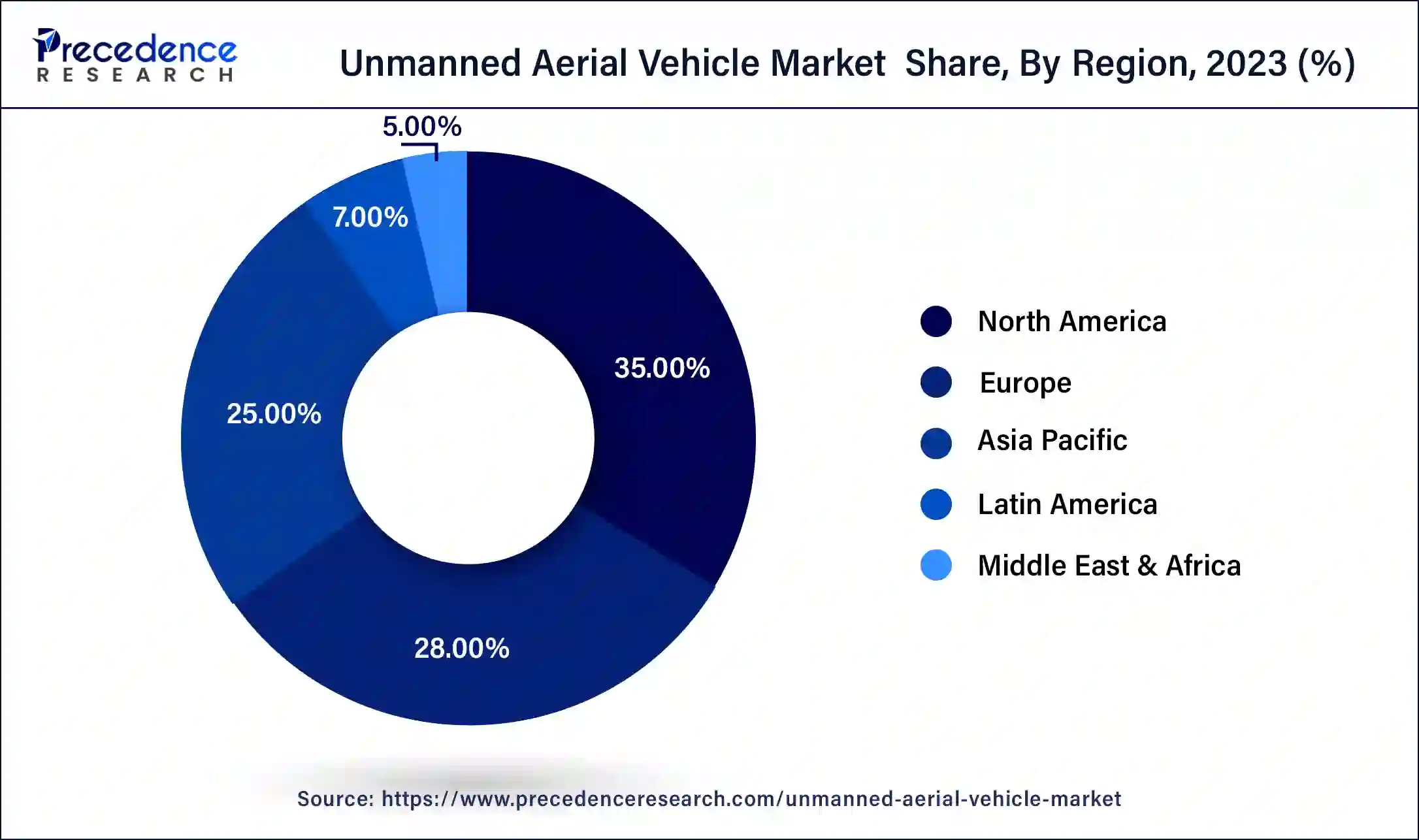
North America dominated the market while holding the largest share in 2025. This is because of strong defense spending, adoption of commercial drones, and advanced regulatory frameworks. The area is witnessing substantial investments in autonomous systems powered by AI, drone delivery systems, infrastructure monitoring, and public safety. Leading aerospace and defense companies add to market leadership. Growing investments in drone traffic management enhance operational safety. The greater the reach of commercial delivery trials, the faster the adoption of UAVs in the region.
What is the U.S. Unmanned Aerial Vehicle Market Size and Growth?
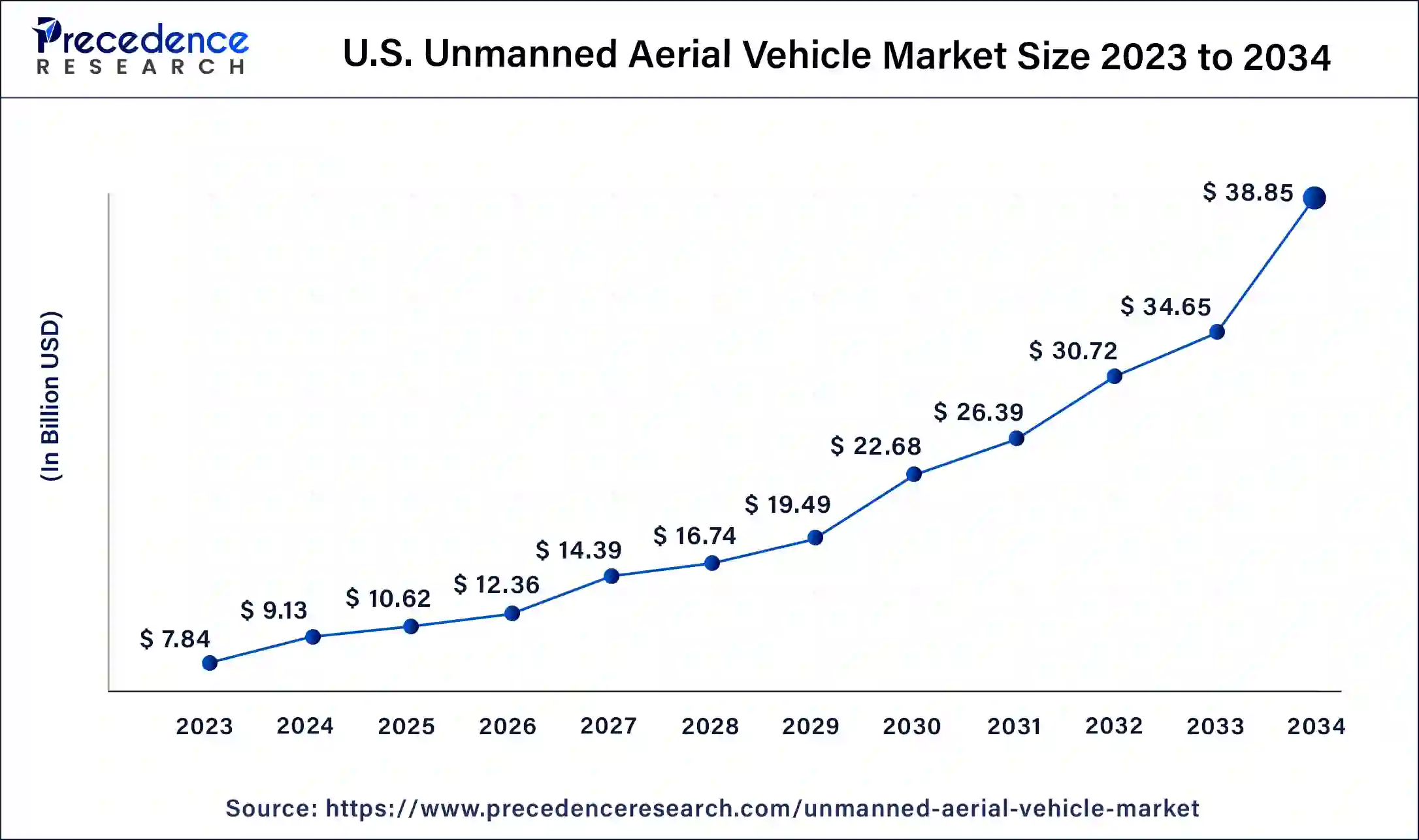
According to Precedence Research, the U.S. unmanned aerial vehicle (UAV) market size was valued at USD 10.60 billion in 2025 and is expected to be worth around USD 44.32 billion by 2035, at a CAGR of 15.38% from 2026 to 2035.
U.S. Market Trends
The U.S. continues to be the region's innovation leader. The FAA is still continuing to progressively expand BVLOS operations & drone integration programs. The autonomous swarms, counter-drone, and ISR missions are high-priority investments for defense agencies. In various applications such as agriculture, logistics, construction, and energy infrastructure monitoring, commercial adoption is rising. Rising Venture Capital funding for next-generation drone tech. The need for autonomous inspections pushes enterprise drone deployments.
How is Asia-Pacific Performing in the Unmanned Aerial Vehicle Market?
Asia-Pacific is expected to grow at a significant CAGR during the forecast period, driven by rapid industrialization, growing defense modernization, and growing commercial applications. The governments are promoting the manufacture and deployment of drones through policy. The increased adoption of the technology in agriculture, surveillance, mapping, and delivery services hastens the regional market's growth. Growth of manufacturing capacities enhances the competitiveness of a region in international markets. The increasing of the smart agriculture program leads to a huge demand for the UAV solution.
China Market Trends
China is leading the Asia Pacific UAV industry on the back of the most extensive manufacturing capability and a well-established local supply chain. Drones with artificial intelligence are becoming a more popular tool in precision farming for crop monitoring and spraying operations. The nation is also developing its own indigenous production of tactical and combat drones in support of the defense modernization effort and bolstering regional security capacity. Innovation programs by the government accelerate the development of advanced drone technology. The export drive further bolsters China's global UAV supply chains.
What are the Driving Factors of the Unmanned Aerial Vehicle Market in Europe?
Europe is expected to grow at a notable CAGR during the forecast period. Europe is fast advancing the use of UAVs as part of its defense modernization and economic diversification programs. Drones are recognized and utilized in border monitoring, intelligence, and security missions. UAVs are used in the oil and gas industry to monitor pipelines and inspect assets. Other potential applications for commercial drone use are on the horizon, such as smart city projects and healthcare logistics. Regulatory harmonization helps achieve cross-border drone operations and scalability. The sustainable measures promote UAV use in environmental monitoring.
Germany Market Trends
Germany is pushing the use of UAVs by implementing industrial automation and smart mobility projects. EASA's U-space framework helps to facilitate safe urban drone integration. There's a growing need for infrastructure inspection, predictive maintenance, and surveying. Drone-as-a-Service types are gaining traction as enterprises look to data analytical tools, monitoring, and operations without significant initial capital investment. The growing need for automated aerial inspection services is being driven by the growth of industrial digitalization. Innovation in autonomous drone technologies is encouraged by advanced research programs.
What is the Opportunistic Rise of Latin America in the Unmanned Aerial Vehicle Market?
Latin America is expected to grow at a lucrative rate during the forecast period. The rise in infrastructure inspections, environmental monitoring, mining activities, and precision agriculture is expected to drive growth. The increasing digitalization of the rural area, particularly in terms of connectivity, and the increasing investment in digital technologies are supporting the use of these technologies more widely across the commercial and public services sectors. Drones are increasingly being used in the public sector for environmental management. Better connectivity infrastructure paves the way for more widespread UAV usage in industry.
Brazil Market Trends
Adoption of UAVs in agriculture, mining, and infrastructure in Brazil is advancing rapidly. Drones are employed on large-scale farms for monitoring crops, precision spraying, and yield optimization. In the mining industry, UAVs are used to map terrain and measure stockpiles. The expansion of energy infrastructure further boosts demand for drone inspection and maintenance services. The expansion of energy infrastructure also drives the demand for inspection and maintenance services using drones. The demand for precision farming drones is still growing with agribusiness investments. Widespread commercial UAV applications across the country are promoted by regulatory enhancements.
What Influences the Unmanned Aerial Vehicle Market in the Middle East & Africa?
The market within the Middle East & Africa is influenced by rising drone deployments, driven by increasing security threats, border surveillance needs, and smart city programs. The advanced UAV technologies are being invested in defense, infrastructure management, and emergency response operations by Governments from across the region. Infrastructure megaprojects provide significant opportunities for drone applications. The increase in defense modernization programs provides opportunities for the procurement of advanced UAV systems.
UAE Market Trends
The UAE is becoming a hub for innovation in the field of drones. UAV use is speeding up in the context of national smart city programs, logistics modernization, and advanced air mobility projects. The nation's investment in autonomous flight technologies, drone delivery projects, and infrastructure surveillance applications is helping to move the country forward in the development of next-generation unmanned flight. Smart mobility initiatives promote testing of autonomous aerial platforms. Strategic partnerships build innovation in the logistics and drone sector.
Government Investments and Initiatives
- Social Programs: The use of drones in the country's mission is a valuable contribution in terms of safety. Whereas the modernized agricultural methods are heavily deploying the drone solution mainly for women farmers with the help of ‘Namo Drone Didi'. The comprehensive SVAMITVA Scheme promotes the recording of property to take a dig into the land intensity and area to continue with the framing or other projects. The popular ‘Mission Drone Shakti' is in favor of service startups. This is beneficial for individuals seeking a future in the drone or automation industry.
- Digitization Approval: The government is sincerely focusing on tech solutions in the country-centric business. The mission ‘safety' is at the heart of the government's decisions. The decisions are in favor of the respective country hero. The online airspace management proves to be a great integration that unveils the digital sky platform.
UAV Market Value Chain Analysis
- Raw Material Sourcing - It mainly allows procurement of high-performance materials, like advanced composite materials (such as carbon, glass, and aramid fibers), various metal alloys (aluminium, titanium, magnesium), and specialized materials for electronics, power systems, and propulsion.
Key Players: Hexcel Corporation, Toray Industries, Gurit, etc. - Vehicle Assembly and Integration - This process involves assembling the airframe, propulsion system (motors, propellers, and electronic speed controllers), power system (batteries), and the flight control and navigation systems (flight controller, GPS, IMU, and other sensors).
Key Players: General Atomics Aeronautical Systems, Northrop Grumman Corporation, DJI, etc. - Aftermarket Services and Spare Parts - Particularly, facilitates maintenance, repair, and overhaul (MRO), training, data analysis, and spare parts supply.
Key Players: AAR Corp., Lufthansa Technik, SIKA Aerospace & Defence, etc.
Competitive Landscape
The UAV market is semi-consolidated with competition among traditional aerospace manufacturers and fast-growing companies developing drone technology. Boeing, Airbus, and Amazon are among the leading players that enjoy strong market positions owing to their high-end UAV platforms, significant research and development spend, wide operational footprint, and strategic collaborations. Innovations in autonomous flight systems, AI navigation, swarm intelligence, real-time data analytics, and drone delivery solutions are increasingly becoming the driving force of competition.
There is a focus on developing greater endurance, payload, and more efficient flight operations. Compared to the traditional airline industry, the overheads, aviation restrictions, certification requirements, cybersecurity risks, and IP issues place restrictions on new entrants. The focus of the future competition will be on autonomy, BVLOS operations, urban air mobility, and the growing commercial drone ecosystems.
Unmanned Aerial Vehicle Market Companies and their offerings
- Boeing: Provides Autonomous military UAVs, uncrewed combat aircraft, cargo drones, and autonomous aircraft in general that incorporate artificial intelligence, surveillance, defense operations, and mission capabilities.
- Airbus: Provides military and civilian UAV solutions, such as tactical reconnaissance UAVs, high altitude platforms, and multi-mission autonomous aerial systems.
- Amazon: Amazon is currently developing autonomous delivery drones, known as Amazon Prime Air, which will allow for faster delivery times for packages, more efficient logistics, and easier deliveries at the end of the line.
- DHL: They test and test their Parcelcopter drones for delivering medical goods and urgent items to remote, inaccessible, and congested areas.
- Uber: Explores urban air mobility technologies, with a particular emphasis on the future of autonomous, aerial transportation for passengers and deliveries.
Other Unmanned Aerial Vehicle Market Companies
- AeroVironment, Inc.
- Elbit Systems Ltd.
- Northrop Grumman Corporation
- Autel Robotics
- Parrot Drone S.A.S.
- Hexagon AB
- Textron Systems Corporation
- Yuneec
- BAE Systems PLC
- SZ DJI Technology Co. Ltd.
- General Atomics Aeronautical Systems
- Israel Aerospace Industries
- Lockheed Martin Corporation
- Teledyne Technologies Inc.
Recent Developments
- In June 2026, IIT Ropar and Rajiv Gandhi National Aviation University signed a MoU to jointly offer a one-year Post Graduate Diploma in UAV Operations and Drone Technology. The agreement was signed by IIT Ropar's Prof. Rajeev Ahuja and RGNAU's Prof. Bhrigu Nath Singh, with faculty and officials present. (Source: https://ibgnews.com)
- In June 2026, Lockheed Martin intercepted a Group 3 attack drone with a Joint-Air-to-Ground Missile from a GRIZZLY™ launcher, utilizing Sanctum C-UAS battle manager and Fortem R-40 Radars for detection and engagement. (Source: https://news.lockheedmartin.com)
- In May 2026, DRDO completed final trials of the ULPGM-V3 precision-guided missile for air-to-ground and air-to-air combat near Kurnool, Andhra Pradesh, using an integrated Ground Control System, enhancing India's self-reliance in defence technology. (Source: https://www.wionews.com)
Segments Covered In Reports
By Class
- Tactical UAVs
- Small UAVs
- Strategic UAVs
By Technology
- Fully-autonomous
- Semi-autonomous
- Remotely Operated
By System
- UAV Payloads
- UAV Airframe
- UAV Avionics
- UAV Software
- UAV Propulsion
By Application
- Commercial
- Military
- Recreational
By Region
- North America
- US
- Rest of North America
- Europe
- UK
- Germany
- France
- Rest of Europe
- Asia Pacific
- China
- Japan
- India
- Rest of Asia Pacific
- Latin America
- Brazil
- Rest of Latin America
- Middle East & Africa (MEA)
- GCC
- North Africa
- South Africa
- Rest of the Middle East & Africa
For inquiries regarding discounts, bulk purchases, or customization requests, please contact us at sales@precedenceresearch.com
Frequently Asked Questions





Ask For Sample
No cookie-cutter, only authentic analysis – take the 1st step to become a Precedence Research client
 Get a Sample




 sales@precedenceresearch.com
 Schedule a Meeting
