



Biogas Market Revenue, Leading Companies, Company Project Pipeline, Renewable Energy Adoption, Infrastructure Investment, Operational Efficiency, Company Market Share, Competitive Positioning, and Growth Trends
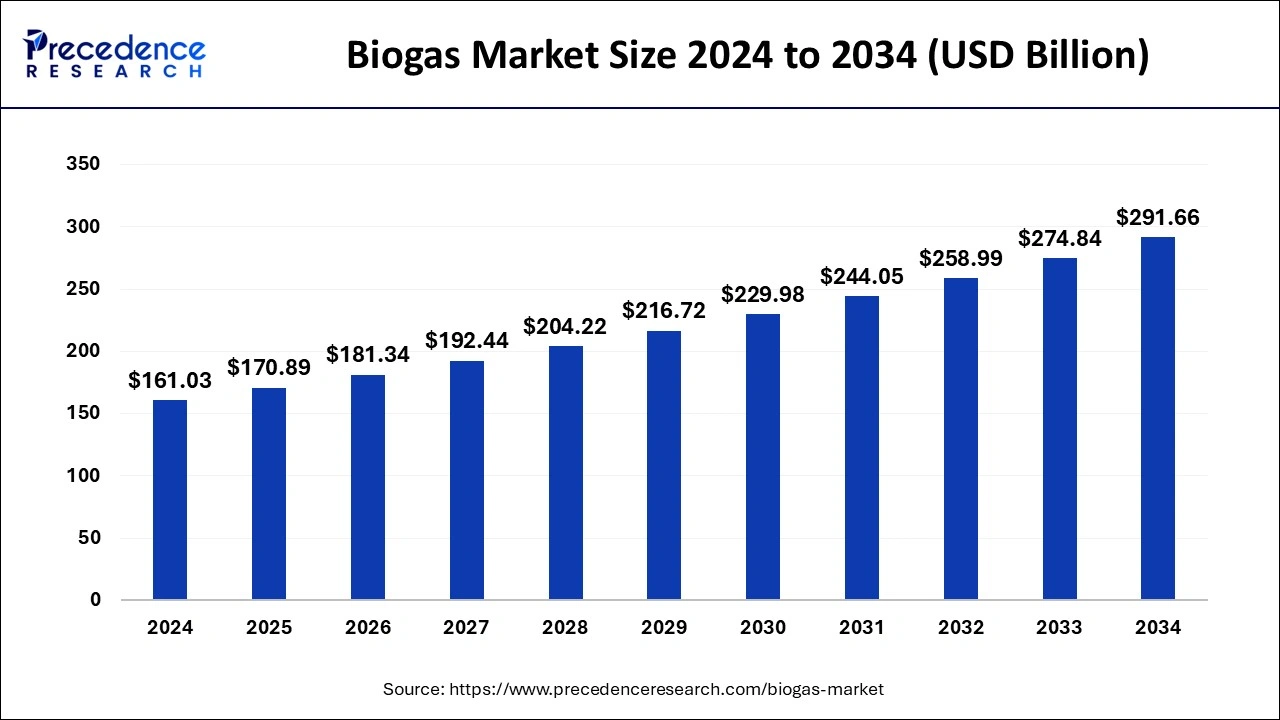
The global biogas market size is calculated at USD 181.34 billion in 2026 and is forecasted to reach around USD 291.66 billion by 2034, accelerating at a CAGR of 4.33% from 2025 to 2034. The Europe biogas market size surpassed USD 67.66 billion in 2025 and is expanding at a CAGR of 4.40% during the forecast period. The market sizing and forecasts are revenue-based (USD Million/Billion), with 2024 as the base year.
Source: https://www.precedenceresearch.com/biogas-market
 Get a Sample
 Table Of Content


Biogas Market Size and Forecast 2025 to 2034
The global biogas market size was accounted for USD 181.34 billion in 2026 and is anticipated to reach around USD 291.66 billion by 2034, growing at a CAGR of 4.33% from 2025 to 2034. The market is growing due to increasing demand for renewable energy, supportive government policies, and the rising utilization of organic waste for sustainable fuel production.
Market Highlights
- By region, Europe led the market in 2025.
- By region, North America is expected to grow in the market during the forecast period.
- By source, the agriculture segment led the dietary supplements market in 2025.
- By source, the municipal segment is expected to grow in the market during the forecast period.
- By application, the electricity segment led the market in 2025.
- By application, the vehicle fuel segment is expected to grow in the market during the forecast period.
- By feedstock, the organic residue & waste segment led the market in 2025.
- By feedstock, the energy crops segment is expected to grow in the market during the forecast period.
- By technology, the without pre-hydrolysis segment led the market in 2025.
- With technology, the pre-hydrolysis segment is expected to grow in the market during the forecast period.
Market Overview
The biogas market is experiencing steady growth due to the growing emphasis on waste management, greenhouse gas emission reduction, and the production of renewable energy. As a sustainable substitute for traditional fossil fuels, biogas, which is created by the anaerobic digestion of organic waste, including food waste, animal dung, and agricultural residues, is becoming increasingly popular. The market is expanding due to increasing government support in the form of incentives, targets for renewable energy, and investments in circular economy projects. Furthermore, the market's long-term growth in both developed and emerging economies is being supported by the growing demand for biomethane in industrial transportation and power generation applications, as well as by developments in biogas upgrading technologies.
Market Outlook
- Industry growth overview - The biogas market is expected to grow as governments promote renewable energy and encourage low carbon fuel production.
- Global expansion - Biogas projects are expanding across developed and emerging countries. Europe is dominating the market due to great awareness of sustainability and policy support for renewable energy.
- Sustainability trends - The sustainability goals focus on converting agricultural waste, food waste and wastewater into renewable energy sources. This also helps in reducing reliance on fossil fuels and complying with sustainability goals.
- Major Investors - Investment in the biogas market is rising from energy companies, public funding and private capital. Major investors in the market include EnviTec Biogas, Wärtsilä, and Air Liquide.
- Startup ecosystem - The startup economy in the market is focused on innovative digestion technologies, digital plant management, and upgrading biogas systems. The main goal is to increase operational efficiency and renewable gas production.
Impact of Artificial Intelligence (AI) on the Biogas Market
Integrating artificial intelligence (AI) into maintenance can provide better maintenance and simplify the process. Integration of smart technology with biogas plant operation and biogas production process to better monitor and evaluate important ads such as total waste, non-convertible waste change, volatile organic compounds, chemical oxygen demand, pH, and temperature. The possibility of joint intelligence is presented with a visual representation of biogas plant operation and monitoring process and different equipment with advanced applications in automation and prediction. Prediction and optimization of biogas production from micro-AD plants based on a new design concept. AI-based models are generated from historical data of different systems and can be used for the immediate commercialization of AD plants leading to the growth of the biogas market.
Biogas Market Growth Factors
- Biogas is used as fuel in a combustion engine and converted into an electric generator to power generator to generate electricity, leading to the growth of the biogas market.
- Once biogas is fully purified, it can be used to power natural gas vehicles (NGV) or dual-fuel vehicles instead of fossil fuels, which will lead to the growth of the biogas market.
- Stored biogas can replace coal or natural gas to provide clean, renewable, and reliable energy, which will lead to the growth of the biogas market.
- Biogas is a renewable energy that uses the anaerobic digestion process to convert waste into gas (called biogas), which has led to the growth of the industrial biogas market.
- Catalytic conversion of a biogas mixture of methane and carbon dioxide to produce methanol with steam has led to the growth of the biogas market.
Top Government Initiatives for Biogas Market
- Governments are stepping up to support the biogas sector with transformative policies and revenue generating programs. The Indian Biogas Association (IBA) announced on March 4, 2025, that when India advances its organic fertilizer agenda, this could create an incremental market of $2.6 billion for biogas.
- The recent positive amendment by the Ministry of Agriculture and Farmers Welfare on February 17, 2025, announced through a government notification S.O. 897(E) was to make official the definition of Organic Carbon Enhancers from Compressed Bio Gas (CBG) plants to be fertilizers as a result of the Fertiliser (Control) Order, 1985.The policy enhances soil health and provides biogas operators new revenue opportunities. (Source: https://bioenergytimes.com)
- Meanwhile, in the United States, the AgSTAR program, run by the EPA and USDA fosters biogas recovery from livestock waste, thereby reducing methane emissions. Additionally, by providing technical assistance and collaboration, it continues to contribute to the global transiton towards sustainable and climate aware energy solutions.
Market Scope
| Report Coverage | Details |
| Market Size by 2034 | USD 291.66 Billion |
| Market Size in 2026 | USD 181.34 Billion |
| Growth Rate from 2025 to 2034 | CAGR of 4.33% |
| Largest Market | Europe |
| Base Year | 2024 |
| Forecast Period | 2025 to 2034 |
| Segments Covered | Source, Feedstock, Application, Size, Technology, Region |
| Regions Covered | North America, Europe, Asia-Pacific, Latin America, and Middle East & Africa |
Market Dynamics
Driver
Rising Demand for Renewable Energy and Sustainable Waste Management
The biogas market is expanding due to rising demand for sustainable waste management and renewable energy. Through subsidies, incentives, and renewable energy. Through subsidies, incentives, and renewable energy targets, governments in a number of nations are encouraging the production of biogas. Additionally, market expansion is being supported by the increasing need to cut greenhouse gas emissions and make effective use of organic waste. The use of biogas systems is being further encouraged by the growing production of organic waste from agriculture, municipalities, and industries. Additionally, nations are diversifying their energy mix with locally produced renewable fuels due to growing concerns about energy security.
Restraint
High Capital Investment and Infrastructure Challenges
Market expansion is constrained by high initial investment costs for infrastructure and the installation of biogas plants. Adopting biogas technologies can be financially difficult for small-scale farmers and waste producers. Furthermore, the extensive implementation of biogas projects may be further impeded by operational difficulties and maintenance needs. Project viability is also impacted by certain areas, such as inadequate feedstock collection and transportation infrastructure. Long permitting processes and regulatory compliance requirements can also cause delays in project development.
Opportunity
Expanding Biomethane Applications and Circular Economy Initiatives
The market has enormous growth potential due to the increasing use of biomethane as a low-carbon fuel in the industrial and transportation sectors. Technological developments in biogas upgrading are increasing end-use applications and improving fuel quality. Additionally, it is anticipated that growing investments in waste-to-energy and circular economy projects will create a new source of income for market players. In a number of nations, the integration of biogas into natural gas grids is also gaining traction. Additionally, industries are being encouraged to invest in renewable gas solutions to lower their carbon footprint due to growing corporate sustainability commitments.
Segments Insights
Source Insights
The agriculture segment dominated the biogas market due to feedstocks like agricultural waste, crop residues, and animal manure being readily available. Biogas production is economically feasible because farms offer a steady and affordable supply of organic materials for anaerobic digestion. The segments of leadership have also been reinforced by growing initiatives to manage agricultural waste sustainably while producing renewable energy. Government incentives that promote the adoption of renewable energy systems by farmers also benefit the industry. Additionally, the production of biogas helps lower methane emissions from livestock operations while giving farmers more ways to make money.
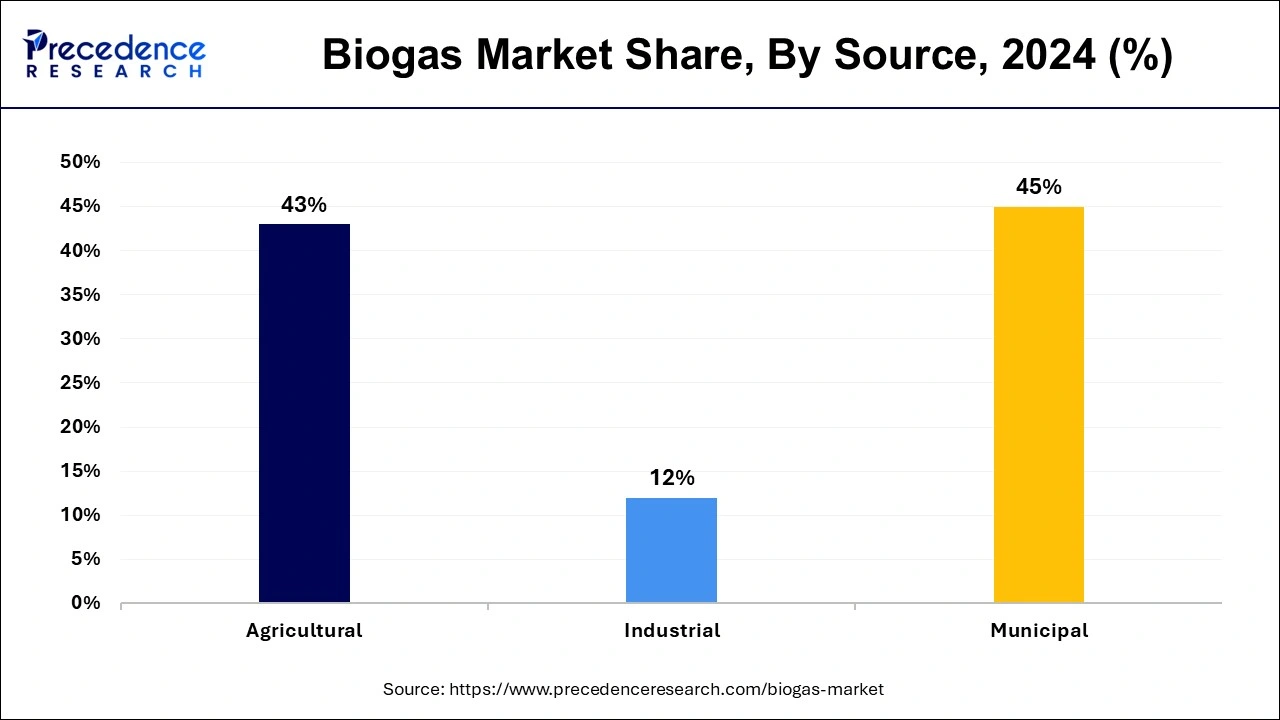
The municipal segment is projected to witness the fastest growth owing to growing urbanization and the production of sewage sludge and municipal solid waste. Municipalities and governments are funding waste to energy initiatives to lessen reliance on landfills and reduce pollution in the environment. Stricter waste management laws and expanding circular economy initiatives are driving the segment's expansion. Municipal biogas facilities are in high demand due to the growing need for environmentally friendly urban waste treatment solutions. Additionally, the efficiency of producing biogas from municipal waste streams is increasing due to technological developments in waste collection and processing.
Application Insights
The electricity segment dominated the biogas market due to biogas-powered combined heat and power systems being widely used for the production of renewable electricity. Biogas is being used more by utilities, businesses, and farms to generate dependable decentralized power. The segment's dominance has also been attributed to support for grid integration and favorable renewable energy policies. When compared to certain sporadic renewable energy sources, biogas-based electricity generation provides a reliable energy source. Additionally, the demand for electricity produced from biogas is still supported by expanding initiatives to lessen reliance on fossil fuel-based power generation.
The ehicle fuel segment is expected to register the fastest growth because biomethane is becoming increasingly popular as a low-carbon substitute for traditional transportation fuels. Governments are encouraging the use of renewable fuels in an effort to lower transportation-related greenhouse gas emissions. Growing demand for sustainable mobility solutions and expanding infrastructure for biomethane refueling are driving market expansion. Adoption is being further accelerated by the growing use of compressed biomethane in public transportation and commercial fleets. Furthermore, the shift to renewable transportation fuels is being encouraged by strict emission reduction targets.
Feedstock Insights
The organic residue & wastes segment dominated the market due to the abundance of industrial organic waste, animal manure, agricultural residues, and food waste. In addition to producing renewable energy, these feedstocks are reasonably priced and help solve waste disposal issues. They are the favored feedstock source to produce biogas due to their extensive availability and advantages for the environment. By transforming waste into useful energy resources, the use of feedstocks derived from waste also advances the goals of the circular economy. More use of these feedstocks is also being encouraged by stricter regulations on the disposal of organic waste.
The energy crops segment is anticipated to grow at the fastest rate due to the growing production of crops like grass and maize silage that are specifically grown for biogas production. These crops increase the efficiency of biogas plants by providing steady feedstock quality and predictable yields. The need for dependable feedstock sources and growing investments in bioenergy projects are propelling segment growth. Additionally, energy crops increase overall plant productivity by yielding more methane than some waste-based feedstocks. Additionally, improvements in crop breeding and cultivation methods are boosting market expansion and increasing biomass output.
Technology Insights
Without pre-hydrolysis, the segment dominated the biogas market because it requires less capital investment and has a simpler operational procedure. Many of the biogas plants that are currently in operation use traditional anaerobic digestion systems that don't require extra pretreatment steps, which makes them easier for operators to use. The technology's widespread use and demonstrated dependability sustain its market dominance. Its strong market position is further supported by lower maintenance requirements and simpler operations. Furthermore, the demand for this technology is maintained by the large installed base of traditional digestion facilities.
The pre-hydrolysis segment is expected to experience the fastest growth as it enhances the breakdown of complex organic materials before anaerobic digestion. This process improves biogas yield, increases feedstock conversion efficiency, and shortens digestion time. Growing demand for higher productivity and technological advancements in biogas processing are driving adoption of pre-hydrolysis systems. Operators are increasingly implementing this technology to maximize energy recovery from challenging feedstocks. Furthermore, rising investments in advanced biogas facilities are supporting the expansion of pre-hydrolysis-based systems.
Geography Insights
Europe dominated the biogas market because of its robust environmental laws, well-established infrastructure for renewable energy, and long-standing government support for biogas production. Large networks of biogas and biomethane production have been established in nations like France, Germany, and Italy. Market growth is still being driven by the region's dedication to energy transition objectives and carbon neutrality. Furthermore, substantial investments in biogas infrastructure have been stimulated by favorable feed-in tariffs and renewable energy incentives. Regional market dominance is further supported by the strong emphasis on waste management and sustainable agriculture.
North America is expected to witness the fastest growth in the biogas market because decarbonization is becoming more important, and investments in renewable natural gas (RNG) projects are rising. Biogas technologies are becoming more widely used in the industrial, municipal, and agricultural sectors of the region. Market expansion is being accelerated by corporate sustainability pledges, tax breaks, and supportive government policies. New growth prospects are also being created by the expansion of RNG production facilities and the rising demand for low-carbon transportation fuels. The regional biogas ecosystem is getting stronger thanks to growing collaborations between waste management companies, energy companies, and farmers.
Regional Insights
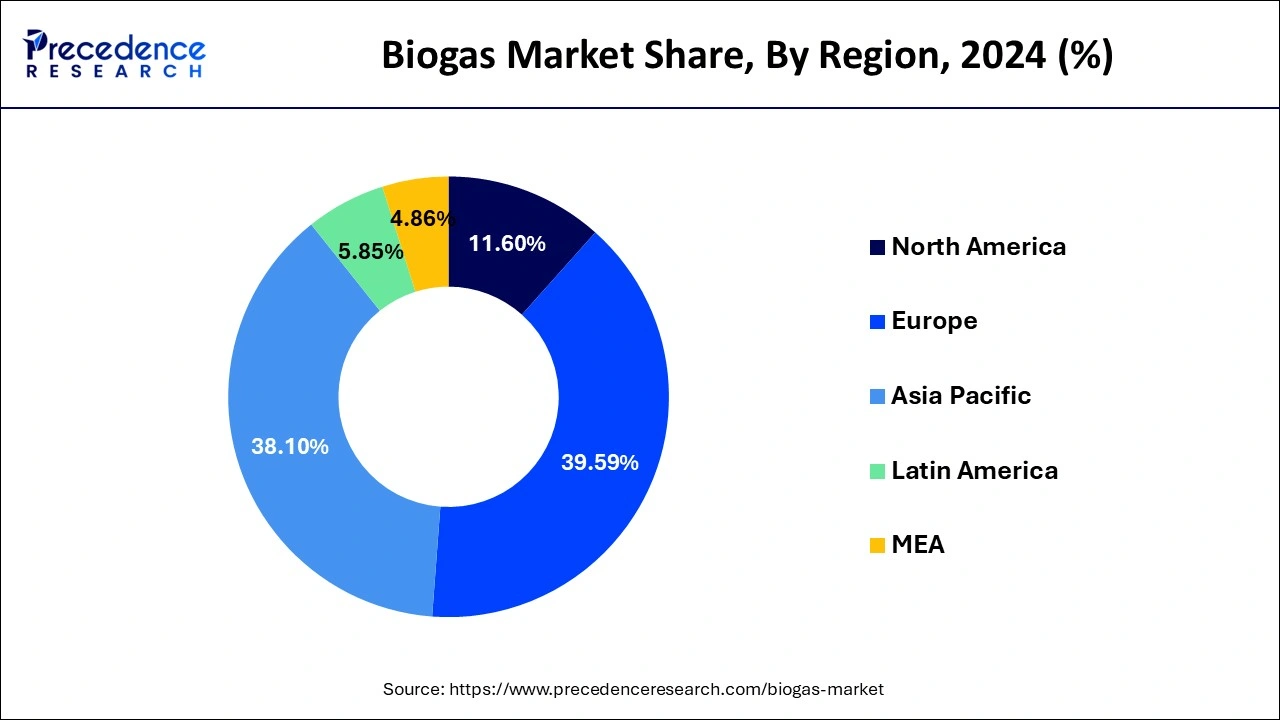
Europe dominated the global biogas market with the largest market share of 39.59% in 2024. The factors such as surge in demand for biogas in diverse sectors and industries, innovation and technological developments, and growing investments in the energy sector is contributing to the market growth.
Europe Biogas Market Size and Growth 2025 to 2034
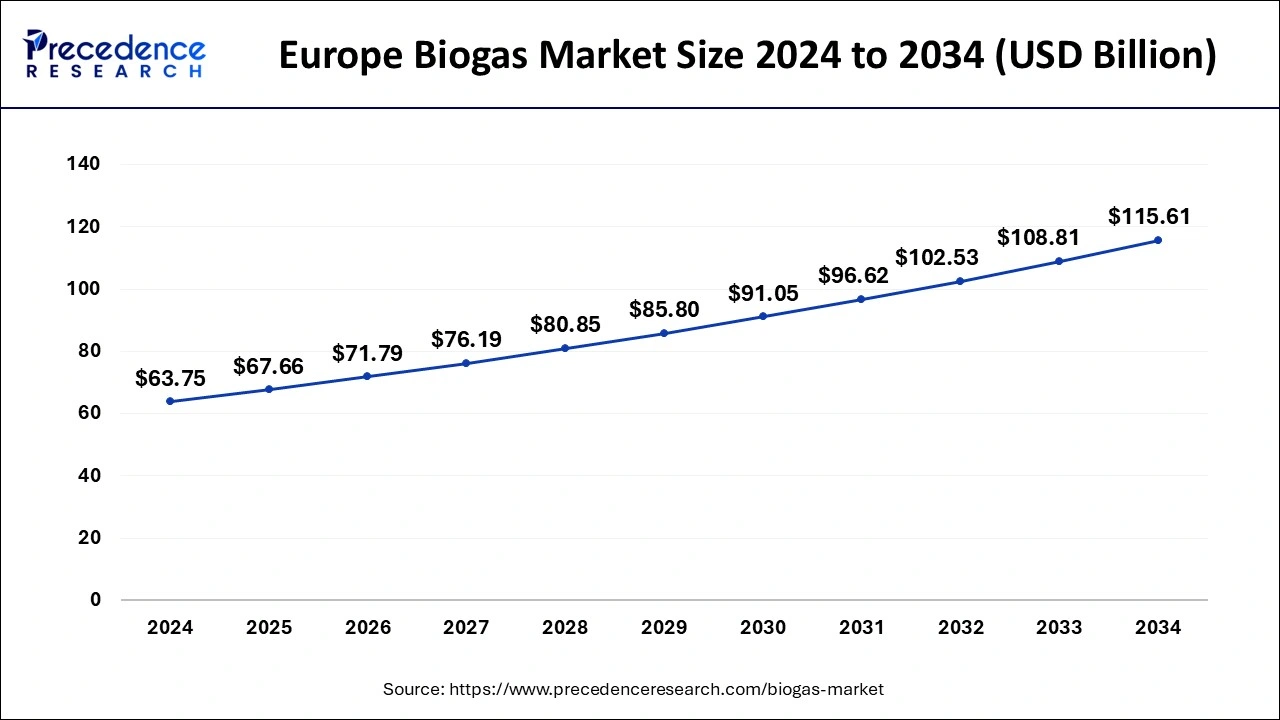
The Europe biogas market size was evaluated at USD 63.75 billion in 2024 and is predicted to be worth around USD 115.61 billion by 2034, rising at a CAGR of 4.40% from 2025 to 2034.
The European Green Deal aims to make the EU the world's first climate-neutral region by 2050, reducing pollution and restoring healthy nature and ecosystems. As countries such as Italy and Germany have proven, biogas could be a companion to the decarbonization of the European economy and Europe's energy transition. The Renewable Energy Sources Directive (“RED II”) includes an EU-wide legal renewable energy target of 32% renewable energy by 2030, with specific targets from the Ministry including increasing the share of renewables, with progress to be reviewed in 2023. The heating sector has seen an annual increase of 1.3%, leading to growth in the biogas market.
- In October 2024, the European Energy Exchange (EEX) will announce the three-month biogas Guarantee of Origin (GO) auction on behalf of the French Ministry. In the tender, the French government sells the GO produced by selected biogas plants that benefit from the state's support system.
Germany Market Trends
Germany leads the European biogas market in 2025 due to a well established network of agricultural biogas plants and advanced biomethane infrastructure. A robust agricultural sector in the country is primarily supporting the biogas market. Companies are investing in research and development of biogas production from existing sources. The government in the region has supporting policies, renewable targets, and expanding biomethane energy targets, further strengthening Germany's position in the biogas market.
North America, on the other hand, is expected to develop at the fastest rate during the forecast period. The UK dominates the biogas market in Asia-Pacific region. The huge number of market players is operating in the region. The government of Europe is highly investing in the research and development activities for the development of the market. In addition, the private entities are taking initiatives for the growth of the biogas market in Asia-pacific region.
North America is becoming a growing biogas market as U.S. biogas producers learn that these plants are making a real impact nationwide. Biogas is produced by digesting and chemically treating organic matter, but this organic matter can be obtained in many ways. The U.S. manufactures products using detailed specifications, raw materials, and technological advances. Feedstocks, installation information, costs and efficiencies of different conversion devices, and studies on the limitations of pipeline-quality biogas production were used to calculate the energy costs of biogas plants operating on waste, manure, wastewater, and sewage, sludge, and biomass waste feedstocks, this cause growth of biogas market.
U.S. Market Trends
The United States represents the largest share of the biogas market in North America. The growth is driven by strong renewable fuel policies, landfill gas recovery projects, a dedicated waste management infrastructure and growing investment in renewable natural gas (RNG). Agricultural waste, dairy farms and wastewater treatment plants provide abundant feedstock for biogas production. Federal initiatives such as the Inflation Reduction Act (IRA) and the Rural Energy for America Program (REAP) provide significant financial incentives, and state level programmes, particularly in California, continue to accelerate biomethane adoption for transportation and industrial applications.
Asia Pacific is expected to grow significantly in the biogas market during the forecast period. Due to the increasing organic waste in the Asia Pacific, the use of biogas is increasing. At the same time, animal manure, as well as food waste, is also contributing to the growing demands. Moreover, there is a rise in the energy demand, which in turn increases the use of as well as the development of biogas. Furthermore, the adoption of technologies is also enhancing this process. Thus, all these processes, along with the government support, promote the market growth.
China
The demand for energy is rising in China, due to which they are establishing biogas plants. At the same time, the adoption of advanced technologies is also increasing, which is being used in the development of these plants. Furthermore, to support these developments, the government as well as the private sectors are also contributing to the same.
India
The increasing organic waste, as well as animal manure, is encouraging the development of biogas in India. At the same time, various policies as well as subsidies are also being provided by the government and the private sectors to support these developments.
What are the Advancements in the Market in Latin America?
Latin America held a considerable share of the biogas market in 2025, supported by abundant agricultural resources and increasing interest in sustainable waste management. Countries such as Brazil, Mexico, Argentina, and Colombia are investing in anaerobic digestion facilities to convert organic waste into clean energy while reducing greenhouse gas emissions. The large amount of agricultural waste, livestock manure, and municipal waste is providing raw material for biogas production. The growing government support and renewable energy goals are further encouraging adoption of biogas.
Brazil Market Trends
Brazil accounts for the largest share of the Latin American biogas market in 2025, due to its extensive agricultural sector, livestock production, and sugarcane industries, which generate ample amounts of raw material for biogas production. National initiatives such as RenovaBio encourage biomethane development and adoption across the country. The government is investing in the development of infrastructure and promoting industrial decarbonization and sustainability initiatives. This encourages adoption of biogas production and integration with agricultural and energy sectors, further supporting market growth.
What are the Key Trends in the Market in the Middle East and Africa Region?
The Middle East & Africa held a notable share of the biogas market in 2025, as governments are seeking sustainable solutions for waste management and energy diversification. South Africa region is driving growth in the market through the Renewable Energy Independent Power Producer Procurement Programme (REIPPPP). The region is focusing on reducing dependence on fossil fuels, particularly in oil dependant economies. The increasing environmental awareness and supportive renewable energy policies are driving steady growth in the biogas market.
Saudi Arabia Market Trends
Saudi Arabia represents the leading market within the Middle East and Africa biogas market in 2025, supported by its broader energy diversification strategy under Vision 2030. The country is exploring opportunities to convert municipal solid waste, wastewater and agricultural residues into renewable energy. Growing initiatives to diversify energy sources, rising investment in circular economies and environmental sustainability are further supporting the growth of the market in Saudi Arabia.
Strategic Initiatives
- In May 2025, the government's decision was welcomed by the Indian Biogas Association (IBA) of increasing the procurement rates of compressed biogas (CBG). This decision is enhancing the potential of the bioenergy sector. (Source: https://timesofindia.indiatimes.com)
- In May 2025, to develop compressed bio gas plants in 2 phases, 18 acres of land at Deonar was approved by BMC to Mahanagar Gas Limited (MGL). This land will process 1,000 tons of wet waste every day, where 600 crore for the construction and operation of these plants will be invested by the MGL. (Source: https://www.goodreturns.in)
Competitive Landscape
The biogas market is moderately fragmented, with competition driven by technology innovation, feedstock management and operational efficiency. The leading companies in the market include Agrinz Technologies GmbH, DMT International, PlanET Biogas, Scandinavian Biogas Fuels International AB, Schmack Biogas Service, HomeBiogas Inc., Air Liquide, Xebec Adsorption Inc. and Gasum Oy. Strategic partnerships with municipalities, agricultural businesses and industrial waste producers are helping to secure reliable feedstock for biogas production. Companies are investing in advanced anaerobic digestion systems and biogas upgrading technologies to improve biogas production.
To achieve sustainable growth in the biogas market, companies should prioritise technology innovation and strategic partnerships. Companies can also invest in digital plants and align projects with carbon reduction policies and circular economy initiatives.
Top Companies in the Biogas Market and Their Offerings
- Air Liquide S.A. (France) - A global leader in industrial gases, technology and services. It delivers advanced biogas upgrading and gas purification technologies that convert raw biogas into high quality biomethane.
- Key offerings - membrane separation and cryogenic purification systems.
- EnviTec Biogas AG (Germany) - A leading biogas plant developer with expertise in engineering, construction and plant operation.
- Key offerings - Turnkey biogas plant construction.
- Gasum Oy (Finland) - It is a dominant energy company and leading supplier of biogas.
- Key offerings - Production of Bio CNG (Compressed Biomethane) and Bio CNG (Liquefied Biomethane)
- PlanET Biogas Group (Germany) - It develops customized biogas and biomethane facilities for industries, farms and municipalities.
- Key offerings - Plant construction, highly efficient anaerobic digesters and eco friendly waste handling components.
- TotalEnergies (France) - It offers renewable natural gas production, biogas project development and carbon reduction solutions.
- Wärtsilä Corporation (Finland) - It is a global lifecycle technology group.
Biogas Market Comapanies
- Agrinz Technologies GmbH
- Air Liquide
- DMT International
- Gasum Oy
- HomeBiogas Inc.
- PlanET Biogas
- Scandinavian Biogas Fuels International AB
- Schmack Biogas Service
- Total
- Xebec Adsorption Inc.
Recent Developments
- In April 2026, BPCL and Kochi Corporation began commercial operations of the Brahmapuram compressed biogas (CBG) facility, processing organic waste into renewable gas for sustainable waste management. The facility is designed to reduce landfill waste while contributing to India's clean energy objectives. (Source: https://timesofindia.indiatimes.com)
- In August 2025, Asahi Kasei successfully demonstrated a high-purity biomethane production technology capable of achieving more than 97% methane purity from organic waste-derived biogas and announced plans for global technology licensing. The innovation is expected to improve the efficiency and commercial viability of biogas upgrading facilities worldwide. (Source: https://www.asahi-kasei.com)
- In March 2024, PRODEVAL, AVENTECH, and INSA Lyon will join forces to ensure a carbon-neutral and sustainable business in the energy sector. The ALLIANCE project aims to offer the biogas industry new and unprecedented solutions to reach international standards in the construction of biogas and CO2 liquefiers. The aim is to be effective in solving important issues such as energy independence and decarbonization.
- In October 2024, Axpo announced that acquired a plant in West Pomerania which produces green energy mainly from agricultural waste. The company plans to build more biogas projects in the country in the coming years, making Poland one of five European countries where Axpo has entered the biogas market.
Segments Covered in the Report
By Source
- Agricultural
- Dairy
- Poultry
- Swine Farm
- Agricultural Residue
- Industrial
- Food Scrap
- Wastewater
- Municipal
- Landfill
- Wastewater
By Application
- Vehicle Fuel
- Electricity
- Heat
- Upgraded Biogas
- Cooking Gas
By Feedstock
- Organic Residue & Wastes
- Sewage Sludge
- Energy Crops
- Others
By Size
- < 500 kW
- 500 kW – 3 MW
- 3 MW
By Technology
- With Pre-hydrolysis
- Without Pre-hydrolysis
By Geography
- North America
- Asia Pacific
- Europe
- Latin America
- Middle East and Africa
For inquiries regarding discounts, bulk purchases, or customization requests, please contact us at sales@precedenceresearch.com
Frequently Asked Questions





Ask For Sample
No cookie-cutter, only authentic analysis – take the 1st step to become a Precedence Research client
 Get a Sample




 sales@precedenceresearch.com
 Schedule a Meeting
