



Citrus Pulp Pellets Market Size, Companies, Share, Crop Production Volume, Yield Analysis, Export & Import Trends, Pricing Metrics, Competitive Positioning, and Demand Forecast
Citrus Pulp Pellets Market (By Type: Orange-based, Grapefruit-based, Others; By Application: Swine Feed, Dairy Feed, Others) - Global Industry Analysis, Size, Trends, Leading Companies, Regional Outlook, and Forecast 2026 to 2035
Source: https://www.precedenceresearch.com/citrus-pulp-pellets-market
 Get a Sample
 Table Of Content


What is the Citrus Pulp Pellets Market Size in 2026?
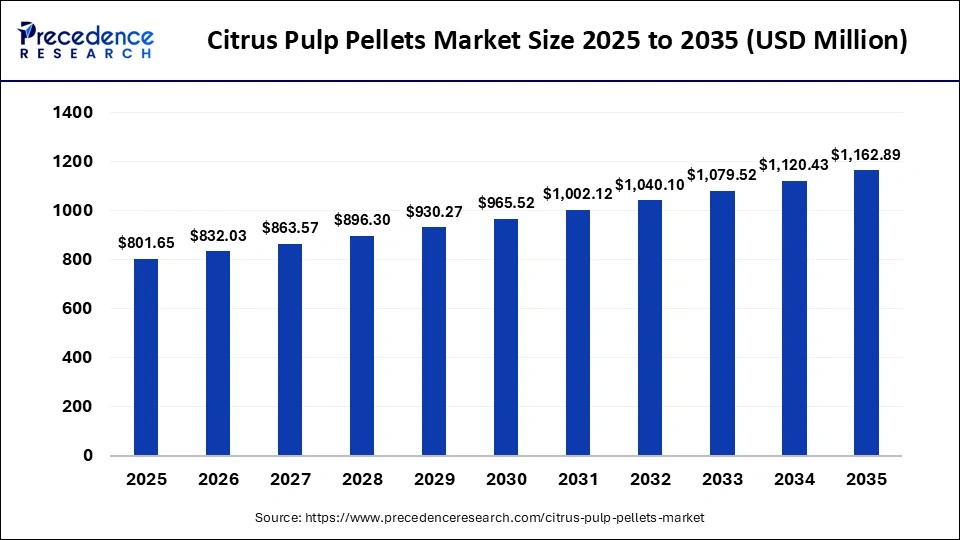
The global citrus pulp pellets market size accounted for USD 801.65 million in 2025 and is predicted to increase from USD 832.03 billion in 2026 to approximately USD 1,162.89 million by 2035, expanding at a CAGR of 3.79% from 2026 to 2035. The market is driven by growing adoption of citrus pulp pellets as a sustainable, fiber-rich nutrient source for animals, offering high digestibility and supporting improved quality of animal products.
Key Takeaways
- North America led the citrus pulp pellets market in 2025.
- Asia Pacific is observed to be the fastest-growing region in the upcoming period.
- By form type, the orange-based segment led the market with the largest share in 2025.
- By form type, the grapefruit-based segment is observed to grow at the fastest CAGR during the forecast period.
- By application type, the dairy feed segment led the global market in 2025.
- By application type, the swine feed segment is observed to grow at the fastest rate in the foreseen period.
Market Overview
Citrus pulp pellets, derived from juicing byproducts, offer an innovative solution to both agricultural waste and animal nutrition. They are widely used in livestock feed thanks to their high digestibility and energy content, and serve as an alternative to traditional grains. This makes them a sustainable option for livestock producers seeking to balance nutrition and cost. The use of citrus pulp pellets reflects a broader shift toward sustainability in agriculture, supporting livestock health while simultaneously reducing environmental impact.
Impact of Artificial Intelligence on the Citrus Pulp Pellets Market
Artificial intelligence is transforming every sector, including the food byproduct industry, and the citrus pulp pellets market is no exception. AI-driven solutions automate key compliance processes, e.g. traceability, quality assurance, and safety documentation, helping companies stay aligned with evolving standards from agencies like the FDA and USDA. By evaluating large volumes of social media data, purchase patterns, and online reviews, AI algorithms reveal subtle consumer preferences, emerging health trends, and changing dietary habits. In addition, AI enhances research and development by modelling products and anticipating sensory outcomes, enabling quicker commercialization of citrus pulp pellet products and fostering smarter, sustainability-focused innovation in the sector.
Key Market Trends
- Citrus pulp pellets are becoming increasingly popular as a sustainable feed alternative, as farmers and feed manufacturers become more aware of the benefits of using agricultural byproducts.
- Rising demand for organic food and dairy products is pushing livestock owners to adopt nutritionally enriched feed, thereby supporting the inclusion of citrus pulp pellets in animal diets
- Growing emphasis on circular economy practices within the feed industry is promoting the efficient conversion of citrus processing byproducts into value-added citrus pulp pellets.
Market Scope
| Report Coverage | Details |
| Market Size in 2025 | USD 801.65 Million |
| Market Size in 2026 | USD 832.03 Million |
| Market Size by 2035 | USD 1,162.89 Million |
| Market Growth Rate from 2026 to 2035 | CAGR of 3.79% |
| Dominating Region | North America |
| Fastest Growing Region | Asia Pacific |
| Base Year | 2025 |
| Forecast Period | 2026 to 2035 |
| Segments Covered | Type, Application, and Region |
| Regions Covered | North America, Europe, Asia-Pacific, Latin America, and Middle East & Africa |
Segment Insights
Type Insights
How Does the Orange-Based Segment Dominate the Market?
The orange-based segment dominated the citrus pulp pellets market with the largest share in 2025, driven by the high popularity of orange-based pulp pellets in livestock feed and increasing adoption among feed owners. There is a wide acceptance of these pellets across dairy and cattle applications due to their significant nourishing advantages. Superior nutritional properties, including high palatability, elevated energy content, balanced fiber composition, and a favorable overall nutritional profile, make orange pulp pellets a preferred alternative in both swine and dairy feed. Their high digestibility further enhances livestock performance, strengthening their position in the market.
Additionally, the abundant and reliable availability of raw materials supports segment growth. Widespread orange cultivation and high juice yields ensure a consistent supply, while the large-scale juice processing industry generates substantial volumes of pulp that are efficiently converted into feed. Strong reliance on orange processing by-products creates a steady raw material flow, reinforcing supply stability. Economic benefits and cost-effectiveness compared to conventional grains further contribute to this segment's dominance in the market.
The grapefruit-based segment is expected to grow at the fastest rate in the upcoming period, driven by its high fiber content and distinctive phytochemical composition, which support its use in specialized feed formulations. Its nutritional functionality and suitability for targeted livestock diets are contributing to rising demand. Additionally, grapefruit peel contains pectin, which adds further value to the segment through its utilization in food and related industries.
The increasing focus on efficient by-product utilization and value-added processing is strengthening segment growth. Moreover, market growth is supported by expanding grapefruit cultivation and the presence of processing facilities in key regions such as the U.S. and South Africa, where surplus by-products are converted into pellets. The steady raw material supply and economic utilization of processing waste continue to position grapefruit as a significantly growing segment in the citrus pulp pellets market.
Application Insights
What Made Dairy Feed the Dominant Segment in the Market?
The dairy feed segment held a dominant position in the citrus pulp pellets market in 2025, capturing the largest share. This is because dairy cattle have high energy and fiber requirements, which citrus pulp pellets efficiently fulfill. This dominance is closely linked to the rising consumption of milk-based products, alongside growing demand for premium milk, cheese, yogurt, and other dairy offerings. Shifting consumer behavior, increasing disposable incomes, and rapid urbanization, particularly in developing economies, are further accelerating this demand.
Citrus pulp pellets are highly digestible, improve milk yield and quality, and serve as a cost-effective alternative to traditional feed ingredients like grains. Their consistent nutritional profile and ease of storage and handling make them a preferred choice for dairy farmers, sustaining strong demand and driving market dominance. Simultaneously, the intensification of dairy farming in emerging markets and the expansion of A2 and lactose-free milk segments are increasing nutritional feed requirements. Additionally, growing emphasis on maintaining herd health and preventing metabolic diseases continues to strengthen the demand for efficient and nutritionally balanced feed solutions, reinforcing the segment's market dominance.
The swine feed segment is expected to expand at the fastest CAGR in the upcoming period, primarily due to rising global demand for animal protein, including pork meat products. This significantly augments the demand for citrus pulp pellets. Several factors have contributed to increased meat production. For instance, China's swine meat production has risen, and Australia's pork consumption is also on the rise, further boosting the need for efficient and economical feed solutions. Citrus pulp pellets, owing to their superior nutritional properties, are increasingly being adopted in swine feed. They are rich in fiber and vitamins and serve as a good source of healthy nutrients that support overall swine health.
Swine farmers are increasingly adding citrus pulp pellets to feed formulations to support gut health and boost feed efficiency. The product is cost-efficient, provides essential nutrition, and nurtures swine by making the feed more digestible. As a result, citrus pulp pellets have been gaining tremendous popularity in the market, driven by rising consumer awareness of their benefits in promoting swine health and their relatively lower side effects compared to some conventional feed ingredients.
Regional Insights
What Made North America the Leading Market for Citrus Pulp Pellets?
North America dominated the citrus pulp pellets market, accounting for the largest market share in 2025. This leadership is supported by evolving consumer behavior, a robust supply chain, regulatory shifts, advanced dairy practices, and a strong emphasis on sustainable feed utilization. Government support for agricultural by-product utilization has further encouraged innovation in citrus waste processing and expanded its application in alternative energy. The region's dominance in the market is further reinforced by a well-established livestock farming industry, the availability of advanced feed processing technologies, and the presence of a large number of industry players.
U.S. Citrus Pulp Pellets Market Analysis
In the U.S., the market is rapidly growing due to the increasing adoption of citrus pulp as a low-cost, nutrient-rich feed alternative. Higher citrus fruit consumption and expanded juice production have created a surplus of pulp, efficiently utilized across multiple applications. Strong distribution networks and robust demand for animal feed give the region a strategic advantage, while regulatory support for eco-friendly practices and the growth of organic farming further boost market expansion across the country.
How is the Opportunistic Rise of Asia Pacific in the Citrus Pulp Pellets Market?
Asia Pacific is poised for rapid growth in the market, driven primarily by rising demand for animal protein, expanding feed manufacturing infrastructure, and growing awareness of the nutritional and economic benefits of citrus pulp pellets. A rapidly expanding dairy and cattle industry in countries such as India, China, and Australia is a key growth driver. Increasing milk and meat consumption across these markets has created a strong need for cost-effective, nutrient-rich feed options. As a result, citrus pulp pellets are gaining traction as a highly economical feedstock, and many regions around the world now depend on the Asia Pacific for low-cost animal feed inputs.
Market growth is further supported by high livestock populations across major Asian countries, along with improved feed formulation methods that make it easier to incorporate citrus byproducts into balanced rations. Increased citrus production ensures a reliable supply of raw materials for pellet manufacturing, while growing recognition of agricultural byproducts as valuable inputs in animal feed, rather than waste, continues to strengthen market prospects. The expansion of the beef and pork industries in the Asia Pacific is also boosting demand for citrus pulp pellets, as producers seek sustainable, cost-effective feed ingredients. Countries such as China, India, Japan, and Australia are actively investing in sustainable feed production, encouraging the use of citrus pulp in dairy, beef, and poultry sectors.
Several emerging economies, including China, India, Indonesia, Vietnam, and other ASEAN countries, are expected to drive significant growth in the citrus pulp pellets market. Large-scale citrus production in these countries supports both local trade and export opportunities for citrus pulp pellets. Additionally, rising per capita incomes, growing awareness of livestock nutrition, and a shift toward natural feed ingredients are fueling strong market prospects across the Asia Pacific region.
Citrus Pulp Pellets Market Value Chain Analysis
- Raw Material Procurement
This stage involves sourcing large volumes of agricultural by-products generated by the citrus juice industry.
Key Players: Louis Dreyfus Company, Citrosuco
- Processing and Preservation
This stage transforms highly perishable juice by-products into a stable, nutrient-dense feed source
Key Players: Citrosuco, Louis Dreyfus Company (LDC), Citrus Products of Belize Limited
- Quality Testing and Certification
Quality testing and certification ensure citrus pulp pellets meet livestock nutrition standards and international trade safety requirements.
Key Players: SGS (Société Générale de Surveillance), Eurofins Scientific, Bureau Veritas
- Packaging and Branding
Packaging and branding for citrus pulp pellets prioritize bulk transport efficiency, strong moisture protection, and clear labelling.
Key Player: Citrus Packaging Solutions Pvt Ltd, Foodpack Paper Products Pvt. Ltd
- Cold Chain Logistics and Storage
Their logistics prioritize moisture regulation and temperature control to minimize risks of spontaneous combustion during storage.
Key Players: Louis Dreyfus Company, Furst-McNess Company, Citrus Freight
- Distribution to Retail
Distribution to the retail market primarily targets small-to-medium-sized livestock farmers and specialty agricultural stores.
Key Players: Furst-McNess Company, LaBudde Group Inc., KW Alternative Feeds
- Waste Management and Recycling
Citrus pulp pellets convert massive citrus waste into value, managed via anaerobic digestion and bio-packaging research.
Key Players: PeelPioneers, Orgatreatments Pvt. Ltd., Veolia
Citrus Pulp Pellets Market Companies
- Louis Dreyfus Company (LDC)
- Citrosuco North America, Inc.
- Furst-McNess Company
- LaBudde Group Inc.
- Cargill, Incorporated
- SAF Feed & Food
- Cefetra Group
- KW Alternative Feeds
- Citrus Products of Belize Limited (CPBL)
- Nutrinza Limited
- Suwannee Valley Feeds LLC
- Archer-Daniels-Midland Company (ADM)
- Lhoist
- Viterra Animal Nutrition
- R. H. Rohrer & Sons Inc.
Recent Developments
- In 2025, AgroFresh launched SmartCitrus, an inclusive, integrated quality platform offering AgTech solutions and services tailored to the citrus industry. This new platform is designed to help maintain fruit freshness and reduce food loss and waste.(Source: https://www.agrofresh.com)
- In 2025, Suchang, a Korean manufacturer, announced that it had successfully developed a new dog food product using gamgyul-bak, a by-product of Jeju's citrus processing industry. Tentatively branded as Orange Dogs the product is designed for global markets, with export plans targeting the United States, Japan, China, and Europe.(Source: https://sg.finance.yahoo.com)
Segments Covered in the Report
By Type
- Orange-based
- Grapefruit-based
- Others
By Application
- Swine Feed
- Dairy Feed
- Others
By Region
- North America
- Europe
- Asia-Pacific
- Latin America
- Middle East & Africa
For inquiries regarding discounts, bulk purchases, or customization requests, please contact us at sales@precedenceresearch.com
Frequently Asked Questions
Tags





Ask For Sample
No cookie-cutter, only authentic analysis – take the 1st step to become a Precedence Research client
 Get a Sample




 sales@precedenceresearch.com
 Schedule a Meeting
