



Cognitive Computing Market Size, Share, and Trends 2026 to 2035
Cognitive Computing Market (By Technology: Natural Language Processing, Machine Learning, Automated Reasoning, Information Retrieval; By Application: BFSI, Healthcare, Security, Retail, IT & Telecom, Aerospace & Defense, Others; By Deployment: On-premises, Cloud) - Global Industry Analysis, Size, Trends, Leading Companies, Regional Outlook, and Forecast 2026 to 2035
Source: https://www.precedenceresearch.com/cognitive-computing-market
 Get a Sample
 Table Of Content


What is the Cognitive Computing Market Size?
The global cognitive computing market size accounted for USD 59.93 billion in 2025 and is predicted to increase from USD 73.53 billion in 2026 to approximately USD 424.21 billion by 2035, growing at a CAGR of 21.62% from 2026 to 2035. Technology systems that are built on cutting-edge technology, particularly artificial intelligence (AI) and signal processing in general, are referred to as cognitive computing (CC). Additionally, CC is a brand-new approach to computing that seeks to enhance theories of how the human brain and mind sense, analyze, and react to stimuli. The technology satisfies the prerequisite for sectors like healthcare, retail, and financial organizations to assess massive volumes of data effectively in real time.
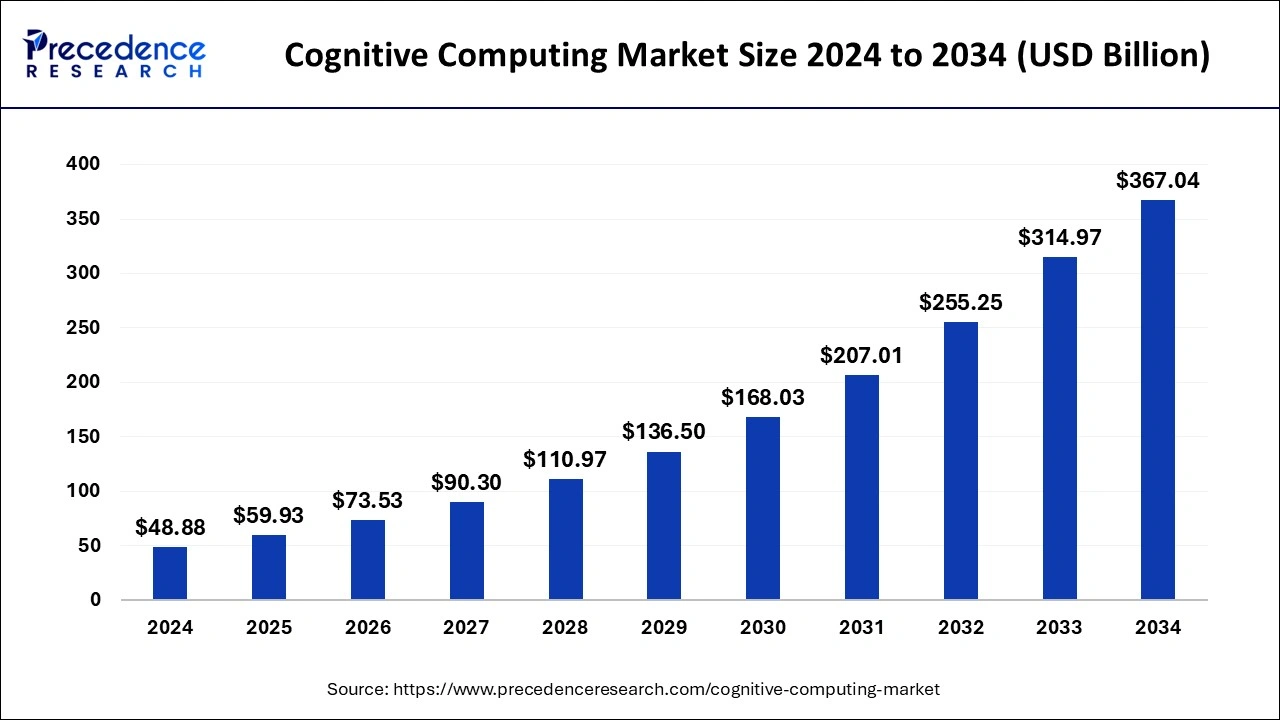
Cognitive Computing Market Key Takeaways
- In terms of revenue, the market is valued at 5.09 billion in 2025.
- It is projected to reach 20.86 billion by 2035.
- The market is expected to grow at a CAGR of 16.97% from 2026 to 2035.
- North America led the global market with the highest market share of 40% in 2025.
- Asia Pacific region is estimated to expand the fastest CAGR between 2026 to 2035.
- By Technology, the natural language processing segment has held the largest market share of 42.5% in 2025.
- By Application, the BFSI segment captured the biggest revenue share of 25% in 2025.
- By Application, the healthcare segment is expected to expand at the fastest CAGR of 26.6% over the projected period.
- By Deployment, the cloud segment captured the biggest revenue share of 71% in 2025.
How is AI Influencing the Cognitive Computing Industry?
AI enables systems to understand, interpret, and learn from context, which enables better pattern recognition along with natural language understanding. Cognitive systems continuously enhance their performance over time by understanding user interactions and feedback, thus becoming more accurate in their suggestions. AI has driven applications in specialized areas like personalized e-commerce, medical diagnosis, fraud detection, and robotics.
Cognitive Computing Market Growth Factors
Cognitive computing solutions are anticipated to expand as artificial intelligence and combined cloud platforms become more widely adopted. Throughout the forecast period, this element is anticipated to drive the industry's expansion. An additional factor accelerating industry development is the growing need for all major business organizations to evaluate massive amounts of data to determine the risk involved with any strategic venture.
The requirement for businesses in sectors like healthcare, retail, and financial organizations to evaluate massive amounts of data optimally in real time is thought to benefit the sector. Dispensing systems are adopting cutting-edge methods like automatic reasoning and machine learning due to the spread of technology.
The theoretical foundations of artificial intelligence and signal processing form the basis of the technological framework known as cognitive computing. The most widely used technology is Natural Language Processing (NLP), which has the ability to handle natural language exchanges.
The more impressive advancement of data science has been made possible by the expanded application of automatic reasoning, big data, and machine learning technologies, along with artificial intelligence and probability logic. With its numerous uses in the creation of interactive software platforms, the Internet of Things (IoT) is evolving and has contributed to an acceleration in the market's development.
Data analytics is now commonplace and will continue to be essential to the development of new technologies and creative strategies. The data analytics sector is, however, exposed to escalating cyber security risks. Cloud services and mobile messaging are on the rise, giving hackers a new target. The International Cyber Security Protection Alliance (ICSPA) makes it easier to direct money, knowledge, and support toward reactivating law enforcement's fight against cybercrime in both local and foreign markets. Participants in the industry are likely to highlight developments in data analytics to sort through network data and foresee security incidents.
- The widespread usage of cutting-edge computing platforms by significant business organizations is anticipated to drive the market's expansion through the effective analysis of enormous amounts of data and the quantification of the risk associated with any strategic endeavor.
- The incorporation of cutting-edge technology like the Internet of Things (IoT) is expected to drive market growth due to its wide range of uses in the creation of engaging software platforms.
- During the projection period, increased usage of cloud-based technologies is anticipated to create lucrative market possibilities.
Technological Advancement
Technological advancements in the cognitive computing market feature NLP, cloud computing, edge computing, cognitive analytics, and AI and machine learning. The edge computing process provides reliable data, results in a quick response. The process is important for applications such as autonomous vehicles and IoT. Cloud computing is a technology that holds a major contribution in the growth of this market by enabling scalability and low-cost effectiveness. Natural language processing (NLP) helps cognitive systems understand and connect with users. It's popularly recommended by applications like customer support and virtual assistants.
Cognitive analytics is a merger of cognitive computing and analytics. This detailed insight analysis helps businesses gain profit, along with decision-making accuracy. These technologies elevated the cognitive computing market. Scientific methodology can highly influence the market with the effective contribution of technology.
Market Scope
| Report Coverage | Details |
| Market Size in 2025 | USD 59.93 Billion |
| Market Size in 2026 | USD 73.53 Billion |
| Market Size by 2035 | USD 424.21 Billion |
| Growth Rate from 2026 to 2035 | CAGR of 21.62% |
| Largest Market | North America |
| Base Year | 2025 |
| Forecast Period | 2026 to 2035 |
| Segments Covered | Technology, Application, and Deployment |
| Regions Covered | North America, Europe, Asia-Pacific, Latin America, and Middle East & Africa |
Market Dynamics
Drivers
Growing demand for cloud-based cognitive technology
One of the market's emerging trends is the shift in corporate objectives toward the use of cloud-based cognitive technology. Businesses benefit from cognitive cloud computing's ability to increase revenue, reduce costs, and enhance organizational efficiency.
To satisfy the needs of real-time user cases like supply chain optimization and product development, companies are also focusing on implementing cognitive cloud computing solutions and other types of cloud-based services. To meet the rising demand from different industries and commercial groups, the main market participants are concentrating on developing the cognitive cloud computing platform.
Key Market Challenges:
Security threats to data
Data security concerns continue to be a significant obstacle for the market for cognitive computing. The Insurance Information Institute (III) U.S. reports that there were 68% more data breaches in 2021 than there were in 2020. Database management and supervision are largely under the control of suppliers of cognitive computing solutions. Databases contain a variety of sensitive user information as well as financial information like address, picture ID, and debit or credit card information. Some hackers use cyberattacks like malware, Distributed Denial-of-Service (DDoS), phishing, and SQL injection attempts to break into networks and take the passwords of real users.
As a consequence, events might have a negative impact on the stock price and image of the business. These elements are preventing the market for cognitive computing from expanding. A capable crew is also needed for the setup and running of cognitive computing systems. Additionally, the implementation of cognitive computing within a company calls for knowledge and specific skill sets, particularly proficiency in Natural Language Processing (NLP) and Machine Learning (ML).
A talent disparity prevents 34% of businesses from implementing AI in their operations. There are surprisingly few seasoned experts with an understanding of AI deployment techniques worldwide. As a consequence, during the projection period, a lack of skilled labor is likely to restrain the growth of the global cognitive computing market.
Key Market Opportunities:
Predictive analytics increasingly needs cognitive computing to cut company running costs.
Cognitive computing has developed quickly as a result of advances in AI and computer science, and it is anticipated that this sector will grow over the projection period. Cognitive computing's main objective is to help businesses make choices, and it is the perfect way to carry out smooth business operations by implementing ML tools like predictive analytics.
Because predictive analytics is a potent instrument for delivering precise results, many company users are utilizing these potent predictive analytics tools in carrying out regular business operations. By the beginning of 2030, 30% of company processes are anticipated to be computerized. Additionally, by suggesting goods and services to specific consumers based on historical data, predictive analytics tools increase income. By lowering company administrative costs, these business tactics are producing a return on investment.
The market for cognitive computing, a subset of AI, is growing rapidly as AI is increasingly used in a variety of corporate use cases. Research indicates that 35% of businesses worldwide will be using AI in 2021. More than any other technology introduced in the past two decades, artificial intelligence is allowing cognitive computing, and its pervasive integration is changing how productive businesses are.
Processing and transforming a large amount and diversity of data, including numerical, textual, and linguistic patterns, as well as sensory stimuli like pictures, videos, and noises in real-time, is another important aspect of the expanding cognitive computing market. In addition to encouraging businesses to develop new goods and services and finding new business possibilities by reducing risk, these solutions are also improving the employee and customer experiences. These aspects are anticipated to drive demand in the cognitive computing market.
Segment Insights
Technology Insights
The biggest income share in 2025 more than 42.5% was accounted for by the natural language processing sector. During the forecast period, the natural language processing sector is anticipated to hold a sizable worldwide market position. According to the current trends, the development of NLP has aided in the globalization of IT infrastructure through cognitive technology. Additionally, the use of predictive text and the soaring demand for smart companions like Siri and Alexa have increased the reach of cognitive computing solutions.
The market for cognitive computing is predicted to expand thanks to machine learning technology, largely because of the rising demand to make human contact easier. Machine learning for adaptive and dynamic learning is expected to gain momentum on platforms for cognitive computing technology. Industry insiders anticipate the use of NLP and machine learning to create better tools for translation and interpretation. Stakeholders would also look into chances to identify business openings and evaluate new trends.
Application Insights
In 2025, the BFSI segment's income portion was over 25%, which was the highest. In the BFSI industry, cognitive computing solutions are being adopted at an incredible rate. The BFSI application category had a market valuation of more than USD 6.45 billion in 2025 and is anticipated to expand at a CAGR of more than 28.7% between 2024 and 2033. Adopting cognitive solutions necessitates the use of powerful data analytics tools that are tailored to the needs of the business entity.
During the projection period, the healthcare sector is also anticipated to display a respectable CAGR of over 26.6%. By minimizing the necessary papers, cognitive solutions help doctors focus on treating patients. The goal of cognitive computing systems will remain to support human analysis and encourage decision-making with a human touch. The system will continue to be helpful in providing a data-driven therapy suggestion with the evaluation and collection of data from medical publications, reports, and diagnostic tools.
Deployment Insights
Over the projection period, the cloud sector, which had a market valuation of over USD 18.5 billion in 2025, is expected to expand at a CAGR of 28.2%. The evolution of customized cloud solutions, such as private and public clouds, and the new creation of data storage facilities, such as integrated cloud storage facilities, have bolstered market growth. Additionally, businesses and groups are turning to cloud options as a result of the exponential growth in data. There may be numerous possibilities for stakeholders to lower the cost of cognitive computing as a result of the usage of cloud solutions.
The development of on-premises storage solutions, which support the conventional file and block storage platforms, is receiving substantial investment from major companies. On-premise storage is expected to expand significantly during the projection period, with a CAGR of 26.8%. Leading businesses might demand total freedom and customization in the server setup. The current patterns may entice companies to invest money in the on-premise infrastructure. For instance, IBM stated in June 2022 that it was considering buying Randori to strengthen on-premise and cloud settings.
- Cloud segment has held revenue share of over 71% in 2025.
- On-premise segment has generated 29% revenue share in 2025.
Regional Insights
What is the U.S. Cognitive Computing Market Size?
The U.S. cognitive computing market size was evaluated at USD 16.86 billion in 2025 and is projected to be worth around USD 121.11 billion by 2035, growing at a CAGR of 21.80% from 2026 to 2035.
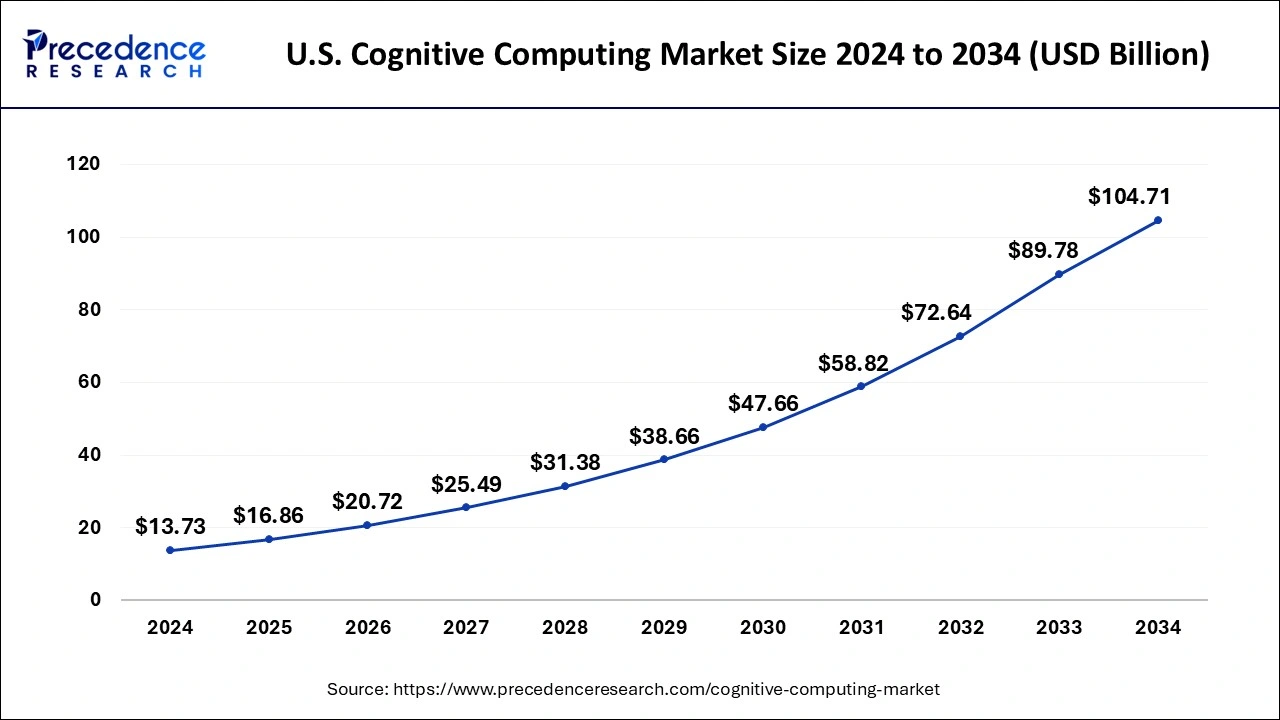
The cognitive computing market was led by the North American area in 2025, with a revenue share of over 40%. North America is currently dominating the cognitive computing market. With the leading tech companies and an estimated startup ecosystem, they are leveraging the market. The new technologies in operations help several sectors to experiment with advancements in their businesses. The adoption of innovations and digital transformation has accelerated the growth in North America. The rapid uptake of integrated cloud systems and the rise of new business models are credited with this increase. The importance of data security is likely to be promoted by strong government policies in the United States and Canada, hastening the implementation of these systems in the area.
U.S. Cognitive Computing Market Trends
The U.S. market supremacy of cloud deployment, surging acceptance in healthcare and BFSI for predictive analytics, and a focus on Natural Language Processing. Healthcare is a main driver, aiming on diagnostics, patient management, and medical imaging. The finance and IT sectors are also heavily accepting cognitive solutions to improve efficiency.
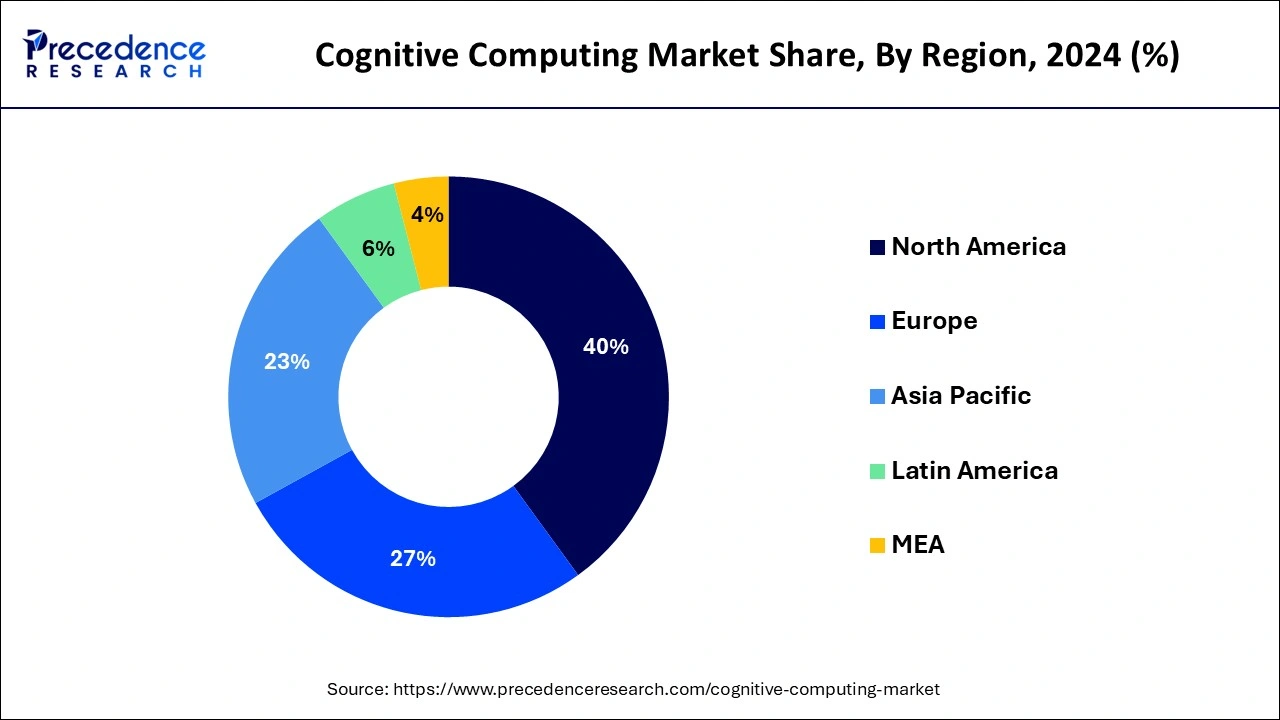
During the assessment era, the Asia Pacific is anticipated to expand at the fastest rate. Some positives have boded well for the regional prognosis, including the skyrocketing internet usage and the growing number of startups in India, China, Australia, and Japan.
Due to the tendency for IoT, 5G, and other technological developments across the area, leading companies are anticipated to investigate possibilities in cognitive computing solutions. Significantly, machine learning has boosted regional development by serving as a precursor to the augmentation of cognitive solutions. Investments are expected to increase as machine learning adoption soars in both developed and developing countries.
China Cognitive Computing Market Trends
China's market is driven by government initiatives as well as strategic investments in AI, with China positioning itself as a contributor to intelligent computing. There is a significant target on building national computing centres and data centers across 30 cities designated as computing hubs.
What are the Advancements in the Cognitive Computing Market in Europe?
Europe is expected to witness a significant amount of growth in the market, driven by increasing demand across developed economies and the expansion of international distribution networks. The region is witnessing a growing demand for big data analytics in various sectors, including IT and telecom, aerospace, defense, and even healthcare. Reduced tariffs and simplified regulatory frameworks under free trade agreements have further enhanced market accessibility, lowering entry barriers and fostering innovation.
Germany Cognitive Computing Market Trends
The adoption of cognitive analytics in industries such as retail, finance, and manufacturing is increasing in the region as companies increasingly recognize the potential of these tools to improve operational efficiency, reduce costs, and optimize customer experiences.
What are the Key Trends in the Cognitive Computing Market in Latin America?
Latin America is witnessing substantial growth in the market. This growth is driven by the increasing need for artificial intelligence solutions, big data analytics, and enhanced decision-making processes. Cognitive computing technologies have gained popularity across various industries, including healthcare, finance, retail, and manufacturing, due to their ability to offer real-time insights, reduce operational inefficiencies, and improve customer experience.
Brazil Cognitive Computing Market Trends
Businesses in the region are increasingly turning to cognitive computing to derive meaning from big data and make informed decisions, which is further contributing to the market's growth. Strategic partnerships between technology vendors and enterprises are fostering innovation, improving solution scalability, and enabling integration with existing IT systems.
How is the Middle East and Africa Region Growing in the Cognitive Computing Market?
The Middle East and Africa are projected to witness steady growth in the market and are expected to maintain this growth trajectory in the upcoming years as well. This is due to the region's evolving regulatory landscape, including data sovereignty laws and compliance frameworks, which significantly influence deployment strategies. The region also has strict data privacy policies, thus necessitating localized data processing and impacting cross-border data flows.
Saudi Arabia Cognitive Computing Market Trends
The country's market landscape is driven by the widespread use in various sectors, continuous advancements in artificial intelligence and machine learning technologies, as well as the increasing utilization of predictive analytics for risk assessment and resource allocation. Demand is driven by strong purchasing power, early adoption of new technologies and products, as well as high digitalization.
Competitive Landscape
The market is fragmented, with top AI providers and niche analytics companies vying against each other for innovation, scalability, and industry-specific expertise. Expert System S.p.A. excels in natural language understanding, SparkCognition Inc. has proven expertise in applying AI solutions for industrial problems, Microsoft Corporation is known for its cloud and AI solutions, and Numenta has gained a reputation for its AI solutions inspired by neuroscience. Companies are growing through strategic alliances, product development, and research & development investment.
The use of AI, predictive analytics, automation, and sophisticated machine learning models continues to be the distinguishing factor. There are entry barriers because of high development costs, data requirements, regulations, and IP protection. Contestants will focus on industry-specific, explainable, and scalable AI solutions in the future.
Cognitive Computing Market Companies
- International Business Machines Corporation: International Business Machines Corporation provides a comprehensive suite of cognitive computing along with artificial intelligence solutions, mainly anchored by IBM WatsonX, designed to assist enterprises in leveraging AI to automate, determine, and optimize business processes.
- Cisco Systems: Cisco Systems provides a comprehensive suite of products along with services for the cognitive computing market, aiming on integrating artificial intelligence and machine learning into security, networking, and partnership to enable autonomous, self-learning, as well as predictive systems.
- DeepMind Technologies Limited: Google DeepMind is a premier AI research laboratory that acts as a major driver for the Cognitive Computing Market, aiming on reinforcement learning, general-purpose learning algorithms, and Artificial General Intelligence.
- CustomerMatrix Inc: CustomerMatrix Inc. provides a specialized cognitive intelligence engine for CRM designed to transform user care centers into profit centers by leveraging natural language processing, machine learning, and semantic analysis to uncover hidden revenue opportunities.
- Planet labs: Planet Labs provides high-frequency, AI-based Earth observation data and analytics designed to change raw satellite imagery into actionable intelligence for the cognitive computing market.
Other Major Key Players
- Expert System S.p.A.
- SparkCognition Inc
- Microsoft Corporation
- Numenta
- Airware
- CognitiveScale
- Saffron Technology
- Enterra Solutions LLC
- ColdLight Solutions
- Palantir Technologies
- Hewlett Packard Enterprise
- Orbital Insight
- Vicarious
- DigitalGenius
- DataRobot
- Cylance
- Vicarious
- Darktrace
- Ross Intelligence
- Indico
- Cyberlytic
Recent Developments
- In May 2026, Kontron launched the VX30101, a rugged 3U VPX computing board designed for AI mission computing and tactical edge applications. It features a hybrid CPU architecture, Intel Xe graphics, 100Gb Ethernet, and low-latency memory, allowing workload consolidation across multiple boards. (Source: https://militaryembedded.com)
- In November 2025, Google's Gemini 3.0 Pro marks a pivotal advancement in AI interaction, highlighting the company's goal of leading large model integration, merging reasoning, creativity, and automation into a unified ecosystem. (Source: https://www.aicerts.ai)
- In October 2025, Enterra Solutions and Montfort Communications launched Enterra-Montfort, a platform leveraging Enterra's cognitive computing for strategic communications and reputation management. (Source: https://www.businesswire.com)
- In March 2025, Synchron, a category-defining brain-computer interface (BCI) company, introduced the roadmap to chiral, a foundation model of human cognition, marking the emergence of cognitive AI-artificial intelligence trained directly on human neural activity.
- In September 2023, IBM announced the creation of IBM Cognitive Business Solutions, a consulting organization under the umbrella of IBM Global Business Services to help clients accelerate getting the value out of cognitive computing solutions such as IBM's Watson.
- In September 2024, Verses AI Inc., a cognitive computing firm, announced its first joint smart city project with Analog, an edge computing company that focuses on seamlessly connecting people, places, and objects using smart sensors and mixed reality technology.
- VERSES Technologies Inc., a cognitive computing business specializing in advanced artificial intelligence technologies, has announced a partnership with SVT Robotics to facilitate the deployment of AI-powered robots in warehouses and distribution centers. This collaboration aims to enhance the efficiency and productivity of these facilities. The announcement was made in February 2023.
- IBM revealed the addition of improvements to Watson Discovery's natural language processing in November 2021. The business anticipates it will assist companies, including those offering banking, legal, and insurance services.
Segments Covered in the Report
By Technology
- Natural Language Processing
- Machine Learning
- Automated Reasoning
- Information Retrieval
By Application
- BFSI
- Healthcare
- Security
- Retail
- IT & Telecom
- Aerospace & Defense
- Others
By Deployment
- On-premises
- Cloud
By Geography
- North America
- Europe
- Asia-Pacific
- Latin America
- The Middle East and Africa
For inquiries regarding discounts, bulk purchases, or customization requests, please contact us at sales@precedenceresearch.com
Frequently Asked Questions
Tags





Ask For Sample
No cookie-cutter, only authentic analysis – take the 1st step to become a Precedence Research client
 Get a Sample




 sales@precedenceresearch.com
 Schedule a Meeting
