



Cosmetics Market Size, Key Companies, Company Expansion Strategies, Brand Performance, Sales Growth, Retail Expansion, Supply Chain Metrics, Company Investment Strategies, and Customer Experience
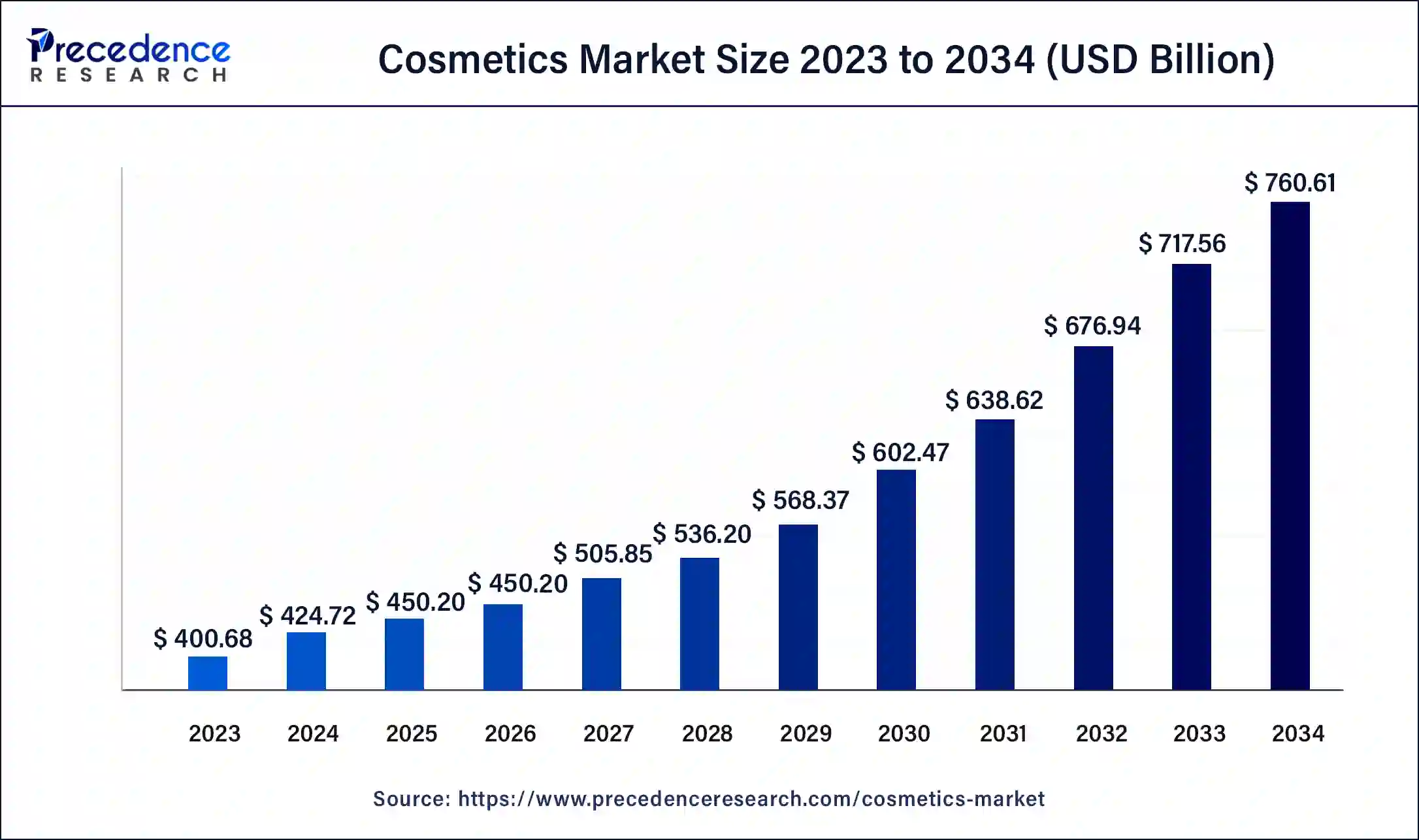
Vidyesh Swar, a Consumer Goods Industry Expert, finds that the cosmetics market has reached USD 450.20 billion in 2026 and is projected to reach USD 802.04 billion by 2035, growing at a CAGR of 6.56%. Leading cosmetics market brands and companies such as L'Oréal, Procter & Gamble, Estée Lauder, are competing across high-demand segments including by category, by gender, by distribution channel, and region.
Source: https://www.precedenceresearch.com/cosmetics-market
 Get a Sample
 Table Of Content


What is Cosmetics Market Size?
The global cosmetics market size accounted for USD 424.72 billion in 2025 and is predicted to increase from USD 450.20 billion in 2026 to approximately USD 802.04 billion by 2035, at a CAGR of 6.56% from 2026 to 2035. Consumers become growingly conscious about the ingredients with rising demand for speciality cosmetic products such as organic and herbal products driving the market.
Market Highlights
- North America led the global market with the highest market share of 34% in 2025.
- By category, the skin & sun care products segment has held the largest market share in 2025.
- By gender, the women segment captured the biggest revenue share in 2025.
- By distribution channel, the hypermarkets/supermarket segment registered the maximum market share in 2025.
Overview - Premiumization, Skin-Health Science, and Digital Discovery Are Shifting Value Toward High-Growth, Higher-Margin Categories
The global cosmetics market, spanning skincare, hair care, color cosmetics, fragrance, and toiletries, is estimated at about USD 430 billion in 2025 and is projected to reach USD 590 billion by 2030, a CAGR of about 6.5%. This adds roughly USD 160 billion of incremental revenue. The market grew at an estimated 5.5% CAGR between 2020 and 2025, recovering from a contraction of roughly 8% in 2020.
Asia Pacific is the largest region at about 36% of global value. Skincare is the largest segment at about 40% of revenue, while fragrance is the fastest-growing major category at about 8.5% annually. The market is moderately concentrated, with the top 10 companies holding an estimated 40-45% of value. Prestige and premium tiers account for nearly 30% of sales, and online channels for about 26%.
The full report quantifies the market by product, price tier, channel, consumer cohort, ingredient claim, and geography, with company-level share and profitability benchmarking.
Key Coverage
- 2020-2030 revenue and volume by product and region
- Prestige vs. mass share shift
- Online penetration trajectory
- Concentration and maturity assessment
- Incremental revenue pools by category
Market Size - Emerging Markets and Prestige Categories Contribute Disproportionately to the USD 160 Billion Growth Opportunity
Market value rose from approximately USD 330 billion in 2020 to USD 430 billion in 2025. Annual consumption exceeds 50 billion units.
|
Region
|
2025 Share
|
2025–2030 CAGR (est.)
|
|
Asia Pacific
|
~36%
|
~7.8%
|
|
Europe
|
~26%
|
~4.8%
|
|
North America
|
~24%
|
~5.2%
|
|
Latin America
|
~8%
|
~6.5%
|
|
Middle East & Africa
|
~6%
|
~8.0%
|
Asia Pacific and the Middle East and Africa together are expected to contribute more than half of incremental growth. The base case assumes 6.5% CAGR (USD 590 billion by 2030), the upside case 8.0% (about USD 630 billion), and the downside case 4.5% (about USD 535 billion), reflecting consumer trade-down and tariff exposure.
What is the Size of the U.S. Cosmetics Market?
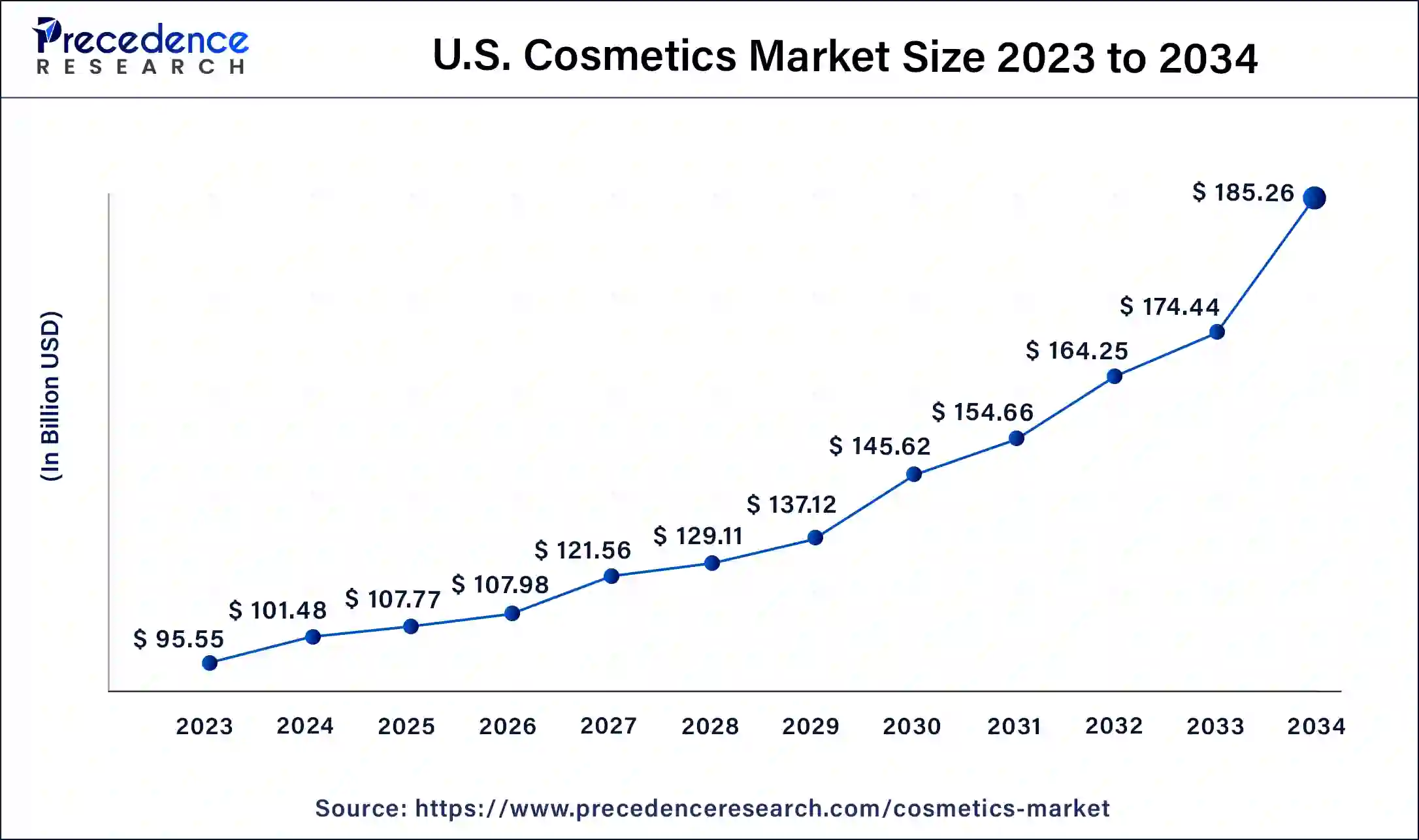
The U.S. cosmetics market size is estimated at USD 107.98 billion in 2026 and is predicted to be worth around USD 195.66 billion by 2035, at a CAGR of 6.76% from 2026 to 2035.
Key Coverage:
- historical and forecast value and volume
- regional and country forecasts
- category forecasts
- three-scenario modeling
- incremental opportunity by region
Segmentation Analysis
Skincare Anchors the Market While Fragrance, Dermocosmetics, and Men's Grooming Outgrow the Category Average
|
Product Segment
|
Share
|
CAGR (est.)
|
|
Skincare
|
~40% (~USD 172B)
|
~6.8%
|
|
Hair care
|
~20%
|
~5.5%
|
|
Color cosmetics
|
~17%
|
~6.0%
|
|
Fragrance
|
~10%
|
~8.5%
|
|
Toiletries & other
|
~13%
|
~4.5%
|
By price tier, mass products hold roughly 60% of value, masstige and premium products about 12%, and prestige products about 28%. Natural and clean-positioned products represent roughly 8-9% of sales and are growing at close to 9%. Male grooming and male skincare are expanding at about 8%, and dermocosmetics are among the highest-value emerging segments. Declining pockets include traditional department-store counters and basic bar-soap toiletries in mature markets.
The report adds segmentation by sub-category, formulation, ingredient claim, gender, age cohort, and distribution channel.
Which Forces Will Shape Cosmetics Demand and Margins Through 2030: Structural Demand Tailwinds or Cost and Tariff Pressure?
The demand base is broadening. The global population aged 60 and over is approaching 1.4 billion by 2030, and multi-step skincare routines are lifting spend per user. Gen Z and Millennial cohorts are estimated to drive 55-60% of spending growth. On the other side, raw-material and packaging inflation can account for 25-30% of mass-market cost of goods, prestige demand has weakened in some large markets, and tariffs are adding cost pressure. Prestige brands absorbed price increases of 4-6% a year in 2022-2024 with limited volume loss, but mass categories saw volume declines as consumers traded down. Pricing growth is expected to moderate to 2-4% annually.
Our analysis indicates that the demand drivers are structural, while the margin pressures are largely cyclical and uneven. Aging demographics and ritual-based skincare are long-duration forces that raise category penetration and spend per consumer regardless of the economic cycle. Input inflation and tariffs are more likely to be absorbed unevenly than to shrink the market. Prestige, with gross margins of 70-80% against 55-65% in mass, has the pricing power to pass costs through. Mass players, where cost of goods is most exposed, face a harder trade-off between defending margin and defending volume. Asia Pacific and the Middle East and Africa are expected to contribute more than half of incremental growth, shifting the demand center of gravity away from the tariff-exposed trade corridors of mature markets.
In our view, the strategic implication is that growth over the next five years will depend more on mix, premiumization, and localization than on price. With pricing power moderating, margin expansion will have to come from higher-value categories such as dermocosmetics, scalp and menopause care, and refillable formats, and from regional manufacturing that reduces tariff and logistics exposure. We believe the greatest white space lies in India (roughly 10% annual growth) and the Gulf states, where rising incomes meet lower category penetration. Companies whose portfolios lean on mass price points in mature markets appear most exposed, while those combining science-backed claims, younger-consumer relevance, and regional supply flexibility appear best placed.
The full report quantifies the impact of each driver and restraint on the 2025-2030 forecast, models consumer trade-down sensitivity by price tier and region, and tracks ingredient and packaging inflation against cost-of-goods structure. It also maps regional demand shifts and estimates the incremental revenue attached to each opportunity pocket under base, upside, and downside scenarios.
Can Prestige Brands Keep Their 70-80% Gross Margins While Mass Brands Absorb Rising Costs?
Cosmetics pricing is a two-speed market. Average selling prices run about USD 8-20 for mass skincare, USD 60–150 for prestige, and above USD 250 for luxury, a prestige-to-mass price multiple of roughly 7-8 times. Prestige gross margins typically reach 70-80%, against 55–65% for mass. Manufacturing represents 20-30% of prestige net revenue but 35-45% of mass revenue, while advertising and promotion consume 25-35% of sales. Specialty and department retailers retain 35-50% of retail price, versus 25-30% for mass retailers. Price increases of 4-6% annually in 2022-2024 were largely absorbed in prestige, where demand is comparatively inelastic, but triggered volume declines in some mass categories.
Our analysis indicates that the margin gap of roughly 15 percentage points at the midpoint reflects claims and brand equity rather than manufacturing efficiency. Prestige spends less of each revenue dollar on making the product, so a given rise in raw-material or packaging cost has a much smaller effect on its margin. Its science-backed positioning also keeps demand less sensitive to price. Mass brands face the opposite trade-off, with a heavier cost base and consumers who trade down when prices rise. Prestige's higher retailer take (35–50%) and heavy marketing spend mean its margin advantage is partly offset further down the P&L, so the headline gross margin overstates the operating-profit gap.
In our view, the strategic implication is that pricing power will be more selective over the next several years. With pricing growth expected to moderate to 2-4% annually, we believe margin expansion will depend on mix (masstige and prestige gaining share, higher-value claims), on cost structure, and on channel economics rather than list-price increases. Mass players with limited pass-through room appear most exposed, and those with ingredient-led claims that justify a premium price point appear best placed. We also see channel mix as a margin lever, since a shift of sales away from high-take retail formats can recover part of the 35-50% retailer share.
The full report quantifies ASP by category, tier, and region, breaks down the cost stack from ingredients and packaging to manufacturing, marketing, and retail margin, and estimates price pass-through and elasticity by segment. It also provides a pricing outlook with base, upside, and downside scenarios, and shows where premiumization creates the largest incremental margin pool.
The same pricing intelligence is available as a structured dataset. It can be filtered by product category, price tier, region, channel, and year, with fields for ASP, price bands, cost-stack components, retailer margin, gross margin, and observed pass-through. Analysts can benchmark price positioning across tiers and regions and model margin sensitivity to input costs, complementing the strategic view in the report.
Where is Supply Risk Concentrated in the Global Cosmetics Chain as Trade Flows Regionalize?
The cosmetics chain runs from ingredient suppliers (emollients, actives, UV filters, pigments, and fragrance compounds) through brand owners and contract manufacturers to retailers. Supply is concentrated at the ingredient end, where a small group of fragrance-compound houses controls an estimated 60-70% of supply. Contract manufacturers produce roughly a quarter of global volume, and regional capacity utilization averages about 75-80%. Asia Pacific, particularly South Korea and China, acts as the flexible manufacturing hub. Europe accounts for roughly 40% of global export value, anchored by prestige fragrance and skincare, and South Korea's exports exceeded USD 10 billion in 2024. Middle Eastern and African markets remain import-dependent, and recent tariff regimes are accelerating regional localization.
Our analysis indicates that the risk in this chain is not finished-goods capacity but ingredient concentration and trade exposure. Utilization of 75–80% implies that roughly one-fifth to one-quarter of installed capacity is spare, so brand owners can shift volume between plants and contract partners with relative ease. Fragrance compounds are different. When a handful of suppliers hold 60–70% of the market, brand owners have limited room to switch, and this concentration matters most because home fragrance is the fastest-growing category (about 8.5% annually). Trade patterns reinforce the picture. Europe's prestige-led export base depends on open access to high-value markets, while South Korea's export scale ties its manufacturing hub to the tariff regimes of its largest destinations.
In our view, the most important implication is a gradual shift from export-led supply to regional supply. The Middle East and Africa are import-dependent yet are expected to grow at about 8.0% annually, the fastest of any region. We believe this combination will draw investment in local filling, packaging, and finishing, with ingredients and formulation know-how still sourced from established hubs. Contract manufacturers appear best placed to capture this shift, since they can add regional capacity faster than brand owners building their own plants.
Companies exposed to a single manufacturing corridor, or with no second source for key fragrance and active ingredients, appear most vulnerable to tariff and supply shocks. Value should continue to concentrate at the two ends of the chain, in ingredient and formulation IP and in brand and retail ownership, while mid-chain manufacturing remains a scale-and-flexibility business.
The full report maps the cost and margin pool at each stage of the value chain, from ingredients and packaging through manufacturing, distribution, and retail. It quantifies supplier concentration by ingredient class, contract manufacturing share by category and region, and capacity, utilization, and announced additions by region. It also analyzes trade flows, import dependency, and the localization opportunity in import-dependent markets under base, upside, and downside tariff scenarios.
The same intelligence is available as a structured dataset covering manufacturing facilities, capacity, utilization, and trade flows. It can be filtered by country, region, product category, ingredient class, and year, with fields for installed capacity, utilization, capacity additions, export and import value and volume, and supplier concentration. Analysts can benchmark regional supply positions, track import-dependent markets, and model the effect of tariff or localization scenarios, complementing the strategic view in the report.
Technology & Innovation - Biotech Actives, Peptides, Microbiome Science, AI Diagnostics, and Waterless Formats Expand the Premium Pool
Leading manufacturers invest 2-3.5% of sales in R&D. Fermentation-derived and bio-identical ingredients, peptides, retinoid alternatives, AI-based skin diagnostics and personalization, and waterless or refillable formats are moving from pilot to scale. Patent activity is concentrated in delivery systems, biotech actives, and sustainable packaging.
Will Tightening Chemical, Safety, and Packaging Regulation Consolidate the Cosmetics Market Around Scaled Innovators?
Regulation is tightening on three fronts at once. Safety and registration regimes are evolving under the EU Cosmetics Regulation, the US Modernization of Cosmetics Regulation Act, and Chinese registration requirements. Chemical scrutiny is widening through restrictions on microplastics and PFAS. Extended producer responsibility rules are pushing brands toward recyclable and refillable packaging. Together these are raising reformulation, testing, and compliance costs. Market structure means the burden falls unevenly: the top 25 companies hold an estimated 55% of global value, while nearly half the market is fragmented among regional and independent brands.
Our analysis indicates that regulation is acting as a structural barrier to entry as much as a cost. Compliance work such as safety assessment, ingredient substitution, multi-jurisdiction registration, and packaging redesign is largely a fixed cost, so it weighs more heavily on a small brand than on a global portfolio that spreads it across many products and markets. This matters because digital channels have lowered the marketing barrier, with online at roughly 26% of sales. Regulation is now one of the few forces working in the opposite direction, raising the barrier to scale. Reformulation also has a commercial side. Scaled players with R&D budgets of roughly 2-3.5% of sales can turn ingredient restrictions into innovation, using biotech actives, PFAS-free and microplastic-free formulations, and waterless or refillable formats as premium claims.
In our view, the most significant implication is that compliance capability will increasingly separate winners from laggards, particularly for brands selling across multiple jurisdictions. We expect regulations to accelerate consolidation, since smaller brands with strong consumer traction but limited regulatory infrastructure become natural acquisition targets. Packaging rules are a second-order cost driver: they add to a cost base in which raw materials and packaging can already reach 25-30% of mass-market cost of goods, so mass players face the sharpest squeeze. In our assessment, this creates an opportunity for ingredient suppliers, packaging innovators, and contract manufacturers that offer compliant formulations and refill-ready formats as a service. Brands unable to demonstrate safety, traceability, and recyclability appear most exposed to delisting, market-access delays, and retailer scrutiny.
The full report maps the regulatory landscape by jurisdiction, covering safety, chemical restrictions, registration requirements, and packaging obligations. It assesses the likely impact on formulation, cost structure, and time-to-market by category, and identifies which ingredient classes and product formats face the greatest reformulation pressure. It also analyzes the commercial opportunity in compliant and sustainable products and how regulatory readiness is shaping competitive positioning and M&A.
The same intelligence can be provided as a structured regulatory dataset. It can track regulations and restrictions by jurisdiction, ingredient or substance class, product category, status, effective date, and compliance deadline, with fields for scope, affected formulations, and packaging requirements. Analysts can filter by region, category, and timeline to anticipate reformulation needs and market-access risks, complementing the strategic view in the report.
Consumer & Channel Analysis - Social Commerce and Specialty Beauty Retail Redirect Purchase Journeys
Online accounts for roughly 26% of sales and is expected to reach about 35% by 2030, a CAGR of roughly 11%. Short-video discovery is compressing brand-building cycles, and retail specialty remains the leading prestige channel. Efficacy claims, ingredient transparency, and value for money increasingly outweigh brand heritage among younger buyers. Unmet needs include inclusive shade ranges, sensitive-skin solutions, and affordable dermatological-grade products.
Key Coverage
- demographic spend shares
- channel economics
- purchase drivers
- loyalty and customer acquisition cost
- category penetration.
Competitive Landscape - Global Scale Leaders, Prestige Houses, Asian Challengers, and Digitally Native Brands Compete for Share
The competitive structure is a three-tier pyramid. The market leader holds about 10-11%, and each of the next-tier scale players holds about 3-4%. A prestige and specialty layer includes fragrance and luxury houses. Below them sit fast-growing Asian and digitally native challengers. The top 25 companies are estimated to hold 55% of global value, leaving nearly half the market fragmented among regional and independent brands.
Scale players lead on distribution reach, advertising firepower, and R&D. Specialists win on brand equity, clinical credibility, and category focus. Challengers, particularly from South Korea and China, are gaining through speed to market and social e-commerce fluency. The full report profiles strategic positioning, revenue exposure, geographic presence, technology, capacity, and activity for each company.
Tentative Leading Company Universe
| Company | HQ | Market Position | Core Strength | Major Segments | |
| 1 | L'Oréal | France | Global leader | Portfolio breadth, R&D | Skin, hair, makeup, dermatological |
| 2 | Procter & Gamble | US | Global scale leader | Mass reach, hair care | Hair, skin, personal care |
| 3 | Estée Lauder | US | Prestige leader | Prestige skincare | Skin, makeup, fragrance |
| 4 | Unilever | UK | Global scale leader | Mass and prestige mix | Skin, hair, personal care |
| 5 | LVMH Perfumes & Cosmetics | France | Luxury leader | Luxury brand equity | Fragrance, skin, makeup |
| 6 | Beiersdorf | Germany | Skincare specialist | Dermatological credibility | Skin, sun care |
| 7 | Shiseido | Japan | Asian prestige leader | Skincare science | Skin, sun care |
| 8 | Coty | US | Fragrance leader | Licensed fragrance | Fragrance, color cosmetics |
| 9 | Kao | Japan | Regional leader | Japanese mass, hair | Hair, skin |
| 10 | Chanel | France | Luxury leader | Brand exclusivity | Fragrance, makeup, skin |
| 11 | Puig | Spain | Fragrance leader | Fashion-fragrance portfolio | Fragrance, skin |
| 12 | Amorepacific | South Korea | K-beauty leader | Innovation, Asia reach | Skin, makeup |
| 13 | LG H&H | South Korea | K-beauty challenger | Premium skin, hair | Skin, hair |
| 14 | Natura &Co | Brazil | LatAm leader | Direct selling, natural | Skin, personal care |
| 15 | Henkel | Germany | Professional hair | Salon channel | Hair |
| 16 | Kenvue | US | Skincare specialist | Dermatologist-recommended | Skin |
| 17 | e.l.f. Beauty | US | Value challenger | Affordability, digital | Makeup, skin |
| 18 | Kose | Japan | Regional specialist | Prestige, dermocosmetic | Skin, makeup |
| 19 | Proya | China | Local champion | Domestic e-commerce | Skin |
| 20 | Yatsen | China | Digital challenger | Color cosmetics, social | Makeup, skin |
| 21 | Mary Kay | US | Direct selling leader | Independent consultants | Skin, makeup |
Market Share & Competitive Ranking - One Leader Holds Roughly Three Times the Share of the Nearest Competitor
Estimated 2025 global shares: L'Oréal ~10-11%; P&G beauty portfolio ~3-4%; Estée Lauder ~3-3.5%; Unilever beauty and wellbeing ~3%; LVMH perfumes and cosmetics ~2%; Beiersdorf ~2%; Shiseido ~1.5%; Coty ~1.3%. The top 5 hold about 22-24% and the top 10 about 40-45%. Share gains have favored the leader and fast-growing challengers, while several legacy prestige portfolios have lost share in China. The full report provides company ranks by category and region, with three-year share movement.
Competitive Benchmarking - Portfolio, Innovation, Channel, and Regional Execution Determine Advantage
Leaders are benchmarked on revenue (in USD and local currency), growth, operating margin (typically 15–20% for scale leaders, 20% or more for the most profitable, and low single digits for turnaround stories), R&D intensity, product breadth, channel mix, and digital penetration. The benchmark uses Leader / Strong / Moderate / Emerging ratings and identifies structural advantages.
- Portfolio: Broad portfolio leaders (L'Oréal, Unilever, P&G) contrast with fragrance specialists (Coty, Puig), prestige skin specialists (Estée Lauder, Shiseido), and clean or value challengers (e.l.f. Beauty). Gaps appear in men's grooming, scalp care, and dermocosmetics.
- Technology: Leading companies invest roughly 2–3.5% of sales in R&D. The largest maintain scientist networks numbering in the thousands and file several hundred patents annually. Asian challengers lead in formulation speed and texture innovation.
- Application and category: Skincare leadership is contested among Estée Lauder, L'Oréal, Shiseido, and Beiersdorf. Hair care is led by P&G, L'Oréal, Unilever, and Kao. Fragrance leadership is split among Coty, Puig, LVMH, and Chanel.
- Geographic: Global leaders compete across all regions, while local champions dominate at home: Proya and Yatsen in China; Kao, Kose, and Pola Orbis in Japan; Amorepacific and LG H&H in South Korea; and Natura in Latin America.
- Manufacturing and capacity: Leaders operate dozens of plants, with recent expansion in Asia Pacific and North America for localization and tariff mitigation. Many challengers outsource to contract manufacturers.
- Customer and channel: Prestige companies depend on specialty retail and travel retail. Direct sellers (Mary Kay, Oriflame, Natura) depend on consultant networks. Digital challengers rely on social commerce.
Strategic Developments - Restructuring, Localization, and Digital Investment Reveal Future Priorities
Recent moves include a large-scale prestige restructuring (with a multi-thousand-role reduction program at one leader), factory investment in North America and Asia, a major 2024 public listing of a fragrance house that valued it at roughly EUR 13 billion, and continued partnerships in AI-powered diagnostics and biotech ingredients.
M&A Landscape - Prestige Brands, Fragrance Assets, and Digital-Native Founders Command Premium Valuations
| Year | Acquirer | Target | Value (approx.) | Rationale |
| 2019 | Shiseido | Drunk Elephant | USD 845M | US skincare growth |
| 2020 | Coty | Kylie Cosmetics (51%) | USD 600M | Digital-native color |
| 2022 | Estée Lauder | Tom Ford | USD 2.8B | Luxury fragrance |
| 2023 | L'Oréal | Aesop | USD 2.5B | Premium skin and body |
| 2025 | e.l.f. Beauty | Rhode | Up to USD 1B | Celebrity-founder brand |
| 2025 | L'Oréal | Kering Beauté | ~EUR 4B | Luxury fragrance and license access |
Consolidation themes include luxury fragrance acquisitions, founder-led skincare deals, dermocosmetics, and the divestment of underperforming mass brands. The full report tracks deal values, revenue multiples, and expected next targets.
Company Profiles - Detailed Intelligence on 24 Leading Market Participants
Each profile covers headquarters, ownership, employees, and segments; global and beauty-relevant revenue, growth, and EBITDA margin; category and brand portfolio; regional footprint; manufacturing and R&D; strategic developments; and strengths, vulnerabilities, and growth opportunities. Reference points include L'Oréal at roughly EUR 43.5 billion of sales with a margin near 20%, Estée Lauder at roughly USD 14–15 billion, and Shiseido at approximately JPY 1 trillion.
Company Strategic Positioning - Which Competitors Are Best Placed for Future Growth?
The assessment classifies companies as Market Leaders (L'Oréal), Scale Leaders (P&G, Unilever), Prestige and Technology Leaders (Estée Lauder, Shiseido, Beiersdorf), Fragrance Leaders (Coty, Puig, LVMH, Chanel), Growth Leaders (e.l.f. Beauty, Amorepacific, Proya), Regional Leaders (Kao, Natura, Kose), and Emerging Challengers (Yatsen, LG H&H). Best-positioned players combine fragrance and dermocosmetic exposure, emerging-market growth, and digital execution.
Opportunity & White-Space Analysis - Dermocosmetics, Fragrance, India, and Men's Grooming Offer the Highest-Value Openings
The report identifies opportunities such as dermocosmetics (double-digit growth and tens of billions of dollars in value by 2030), Middle East fragrance, India (roughly 10% CAGR), menopause and scalp care, refillable packaging, and inclusive shade ranges. It also quantifies penetration gaps between online-heavy and offline-heavy markets.
Industry Structure, PESTLE, and Attractiveness - Strong Brand Moats, Rising External Pressure
- Five Forces: Supplier power is Medium (concentrated fragrance and specialty ingredient suppliers). Buyer power is Medium-High (large retailers and price-sensitive consumers). Threat of new entrants is High (low digital barriers, though scale requires marketing spend). Threat of substitutes is Low-Medium. Rivalry is High.
- PESTLE: Tariffs, tightening chemical regulation, aging demographics, biotech ingredients, packaging law, and climate-related sourcing risk are the most material forces.
- Attractiveness: Fragrance and dermocosmetics are Highly Attractive. Skincare and expansion in India and the Middle East are Attractive. Mass color cosmetics and basic toiletries in mature markets are Moderate. Price-sensitive mass categories facing raw-material inflation are Challenging.
Future Outlook - Science-Led Skincare, Fragrance, and Emerging-Market Expansion Will Define Winners
The market is projected to reach approximately USD 590 billion in 2030 (base), with a long-range view of USD 780–800 billion by 2035. The upside case (about 8% CAGR) assumes stronger emerging-market spending and prestige recovery; the downside case (about 4.5%) reflects prolonged trade-down and tariff escalation. Margins are expected to be stable for scale leaders, with pricing growth moderating to 2-4%. Consolidation is likely to accelerate around luxury fragrance, dermocosmetics, and Asian brands. Likely winners combine science credibility, digital fluency, and localization.
Recent Developments
- In July 2026, cosmetic giant Kao announced the launch of est Genoluxe Cream, scheduled for September 4. This skincare product is designed to optimize skin condition at the genetic level by forming a specialized, artificial skin-like film infused with beauty ingredients.
- In July 2026, SEIWA KASEI introduced Protesil™ JLH, a hybrid polymer that integrates the hair care advantages of plant protein, the smooth texture of silicone, and the hydrophobic properties of alkyl groups.
- In June 2026, Korean beauty and skincare startup KorinMi secured ₹10 crore from Lotus Herbals' innovation fund to support the expansion of its clinics and accelerate the growth of its direct-to-consumer skincare business in India. The acquired funding will facilitate entry into major urban centers including Mumbai, Bengaluru, and Hyderabad, while further enhancing its portfolio of Korean-made skincare products tailored for Indian consumers.
- In January 2024, BOLD (Business Opportunities for L'Oreal Development), L'Oreal Group's venture capital fund, announced an investment in Timeline, a consumer health company focused on aging and longevity, which has a range of topical skincare products and supplements that use its proprietary technology, Mitopure. With the recent funding, the company hoped to enable further growth in beauty, food, and health. (Source: https://www.cosmeticsdesign-europe.com)
- In July 2024, the U.S. skincare brand Curology launched its non-prescription skincare products at CVS Pharmacy, a U.S.-based retail company. Per the company, the skincare product will be offered at CVS Pharmacy's 3,800 stores nationwide and on its site, CVS.com. (Source: https://www.prnewswire.com)
- In December 2023, Estée Lauder established a partnership with the Stanford Center and made a three-year commitment to fund the latter's new Program on Aesthetics & Culture, which will fund research projects - including 'New Map of Life' post-doctoral fellowships, and other initiatives investigating understandings of longevity and vitality - for a more explicit understanding of perceptions on aging and vitality.
Cosmetics Market Segment Covered in the Report
By Category
- Skin & sun care products
- Hair care products
- Deodorants & fragrances
- Makeup & color cosmetics
By Gender
- Men
- Women
- Unisex
By Distribution Channel
- Hypermarkets/Supermarkets
- Specialty Stores
- Pharmacies
- Online Sales Channels
- Other
By Region
- North America
- Europe
- Asia-Pacific
- Latin America
- Middle East & Africa
For inquiries regarding discounts, bulk purchases, or customization requests, please contact us at sales@precedenceresearch.com
Frequently Asked Questions
Tags





Ask For Sample
No cookie-cutter, only authentic analysis – take the 1st step to become a Precedence Research client
 Get a Sample




 sales@precedenceresearch.com
 Schedule a Meeting
