



Middle East Egg Market Size is USD 7.99 Billion in 2026
Middle East Egg Market (By Product: Brown Eggs, White Eggs; By Production Category: Cage-Free, Organic, Pasture-raised; By End Use Application: B2B, B2C) Industry Size, Share, Growth, Trends 2026 to 2035.


The Middle East egg market size was estimated at USD 7.58 billion in 2025 and is expanding at A CAGR of 5.4% from 2026 to 2035. The egg market in the Middle East is mainly influenced by the increasing need for protein-rich and nutrient-dense foods, the growth of food processing industries, and rapid urbanization, especially in Saudi Arabia and the UAE.
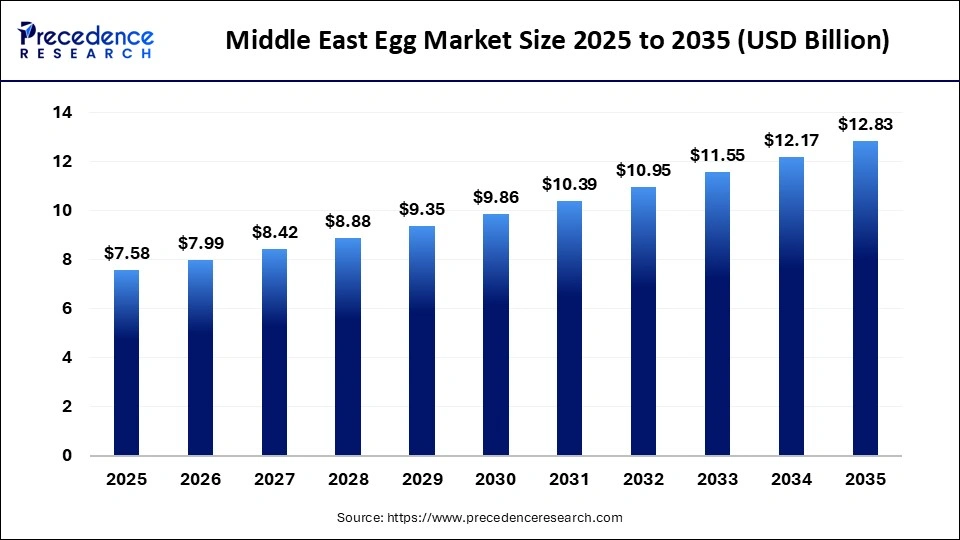
Middle East Egg Market Statical Scope
| Reports Attributes | Statistics |
| Market Size in 2025 | USD 7.58 Billion |
| Market Size in 2026 | USD 7.99 Billion |
| Market Size by 2035 | USD 12.83 Billion |
| CAGR 2026 to 2035 | 5.40% |
| Base Year | 2025 |
| Forecast Period | 2026 to 2035 |
The Middle East egg market is important due to the rising demand for affordable, high-protein nutrition and the growth of processed food industries. It plays a key role in food security, supported by significant investments in local poultry farming, advancements in technology, and strict adherence to halal standards throughout the region. The increasing focus on health and wellness, along with high-protein diets, has made eggs a common household item, leading to high consumption rates.
The growth of luxury tourism and hospitality, particularly in Dubai and Abu Dhabi, along with a rise in restaurants and cafes, significantly boosts the demand for both shell and processed egg products (liquid, powder, frozen).
Countries like Saudi Arabia, the UAE, and Egypt are investing heavily in poultry infrastructure and automation to achieve self-sufficiency, lessen reliance on imports, and secure food supply. There is a strong demand for halal-certified eggs, ensuring that products align with ethical and Islamic dietary standards, which is essential for building local consumer trust.
The increased use of modern, bio-secure, and technologically advanced farming methods is enhancing efficiency and quality. The rise of supermarkets and modern retail outlets has made eggs more available to consumers.
Middle East Egg Market, By Product, 2025 (%)
| Segments | Shares (%) |
| Brown Eggs | 60% |
| White Eggs | 40% |
- Brown Eggs - Brown eggs, with a share of 60%, are the leading type in the Middle East egg market. This segment is important because consumers prefer the better taste and nutritional benefits of brown eggs. They are also linked to premium, free-range, and organic farming, making them a valuable and profitable product.
- White Eggs - White eggs, with a share of 40%, play a vital role in the market as they provide an affordable, high-volume, and easily accessible source of protein. Their prevalence is due to lower production costs, strong demand from foodservice sectors like hotels and bakeries, and rapid urbanization that favors budget-friendly, commercially packaged options.
Middle East Egg Market, By Production Category, 2025 (%)
| Segments | Shares (%) |
| Cage-Free | 45% |
| Organic | 25% |
| Pasture-raised | 30% |
- Cage-Free - The cage-free egg segment, with a share of 45%, is significant in the Middle East because of the growing consumer interest in ethical, sustainable, and higher-quality, nutritious food. There is also a rising awareness of animal welfare. Retailers are increasingly focusing on cage-free sourcing, which aligns with global trends towards healthier lifestyles, although the shift from conventional methods is happening slowly.
- Organic - The organic segment, with a share of 25%, plays a vital role in the market, experiencing rapid growth due to increased health awareness, urbanization, and a preference for high-quality, sustainable food among affluent consumers. It acts as a preventive health option, providing antibiotic-free, natural, and nutrient-rich alternatives.
- Pasture-raised - The pasture-raised egg segment, with a share of 30%, is quickly expanding in the Middle East, fueled by heightened health consciousness, higher disposable incomes, and a growing demand for ethical, antibiotic-free products. Consumers are ready to pay more for nutritious, animal-friendly eggs, which is boosting significant revenue.
Middle East Egg Market, By End-Use Application, 2025 (%)
| Segments | Shares (%) |
| B2B | 55% |
| B2C | 45% |
- B2B - The B2B segment, with a share of 55%, is essential to the market as it leads in market revenue, driven by high-volume needs from the hospitality, industrial baking, and quick-service restaurant (QSR) sectors. It guarantees a steady, large-scale supply chain, pasteurized products, and specialized ingredients (such as egg whites/yolks) for ready-to-eat items and food production.
- B2C - The B2C (Business-to-Consumer) segment, with a share of 45%, is important in the Middle East egg market due to the rapid rise in per capita consumption, spurred by the demand for affordable, high-protein nutrition, urbanization, and increasing health-conscious trends. This segment boosts high-volume sales through modern retail and e-commerce channels.
Top Companies in the Middle East Egg Market
- Rahima Poultry Farms
- Fakieh Group
- Al Ain Farms
- Seamorgh Company
- Arabian Farms
- Algharbia Farms for Poultry Co.
- Al Jazira Poultry Farm
Segments Covered in the Report
By Product
- Brown Eggs
- White Eggs
By Production Category
- Cage-Free
- Organic
- Pasture-raised
By End Use Application
- B2B
- B2C
| Product | 2025 | 2026 | 2027 | 2028 | 2029 | 2030 | 2031 | 2032 | 2033 | 2034 | 2035 |
|---|---|---|---|---|---|---|---|---|---|---|---|
| Brown Eggs | 4.70 | 4.99 | 5.29 | 5.61 | 5.95 | 6.31 | 6.69 | 7.10 | 7.53 | 7.98 | 8.47 |
| White Eggs | 2.88 | 3.00 | 3.13 | 3.27 | 3.41 | 3.55 | 3.70 | 3.86 | 4.02 | 4.19 | 4.36 |
| Production | 2025 | 2026 | 2027 | 2028 | 2029 | 2030 | 2031 | 2032 | 2033 | 2034 | 2035 |
|---|---|---|---|---|---|---|---|---|---|---|---|
| Cage-Free | 4.17 | 4.35 | 4.55 | 4.75 | 4.96 | 5.18 | 5.40 | 5.64 | 5.89 | 6.15 | 6.41 |
| Organic | 1.90 | 2.02 | 2.16 | 2.30 | 2.45 | 2.61 | 2.79 | 2.97 | 3.16 | 3.37 | 3.59 |
| Pasture-raised | 1.52 | 1.61 | 1.72 | 1.83 | 1.95 | 2.07 | 2.20 | 2.34 | 2.49 | 2.65 | 2.82 |
Research Methodology
Related Databooks
March 2026
April 2026
April 2026
April 2026



 +1 804-441-9344
 Download Databook
 Schedule a Meeting