



North America Foam Market Size is USD 24.1 Billion in 2026
North America Foam Market (By Type: Polyurethane Foam, Polystyrene Foam, PVC Foam, Phenolic Foam, Polyolefin Foam, Melamine Foam, Other Foam Types; By Application: Packaging, Building & Construction, Furniture & Bedding, Automotive, Other Applications) Industry Size, Share, Growth, Trends 2026 to 2035.


The North America foam market size was estimated at USD 22.91 billion in 2025 and is predicted to increase from USD 24.1 billion in 2026 to approximately USD 38.03 billion by 2035, expanding at A CAGR of 5.2% from 2026 to 2035. The market is growing quickly, driven by high demand from the construction, automotive, packaging, and furniture industries.
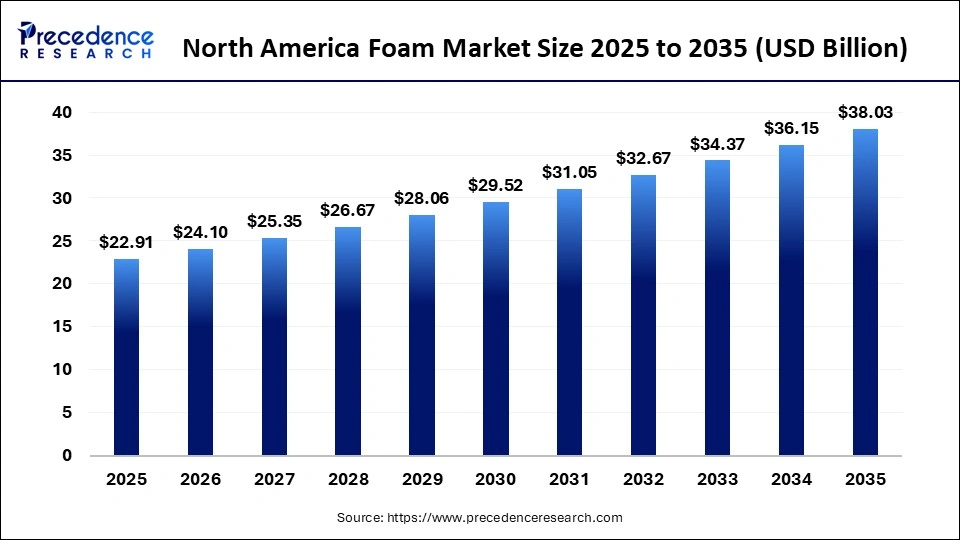
North America Foam Market Statical Scope
| Reports Attributes | Statistics |
| Market Size in 2025 | USD 22.91 Billion |
| Market Size in 2026 | USD 24.1 Billion |
| Market Size by 2035 | USD 38.03 Billion |
| CAGR 2026 to 2035 | 5.2% |
| Base Year | 2025 |
| Forecast Period | 2026 to 2035 |
Key factors behind this growth are the need for energy-efficient insulation, lightweight materials for vehicles, and sustainable packaging solutions. The building and construction sector is the largest end-user, using rigid polyurethane and polystyrene foams for insulation to meet green building standards like LEED and ENERGY STAR. There is a strong need for polyurethane and expanded polypropylene (EPP) foams, which help reduce vehicle weight and improve fuel efficiency and range in electric vehicles.
Moreover, the rise in e-commerce has significantly boosted the demand for protective and durable packaging foams. The market is gradually shifting towards eco-friendly, recyclable, and bio-based foam materials. Polystyrene (PS) Foam is commonly used for insulation and packaging, while Polypropylene (EPP) Foam is a fast-growing segment in HVAC and automotive uses. Polyurethane (PU) Foam holds the largest market share, widely used in seating, furniture, and insulation.
Major market players include Owens Corning, Huntsman Corporation, Woodbridge, Dow Inc., and ExxonMobil. The United States leads the market due to its advanced infrastructure and manufacturing capabilities, while Mexico is expected to see significant growth.
Driven by strict energy regulations, it offers important insulation and lightweight materials that help lower emissions and improve safety. Foam products, such as polyurethane and polystyrene, are essential for energy-efficient insulation in both homes and businesses, following green certifications like LEED and ENERGY STAR.
The rise in electric vehicle (EV) manufacturing has increased the need for lightweight, strong, and shock-absorbing foams, like EPP and PUR, which are used in seats, bumpers, and interior parts to improve vehicle range. This market supports high-demand sectors, including furniture, bedding, and medical uses, showing steady growth in the US market.
The foam market in North America is an important and valuable sector, driven by advanced infrastructure, strict energy regulations, and strong innovation in the automotive and packaging fields. Its importance lies in its capacity to serve high-demand, technology-focused industries by offering lightweight options, eco-friendly insulation, and sustainable materials. North America is a global leader in enforcing building codes, which boosts the need for rigid polyurethane and polystyrene foam used for energy-efficient insulation in roofs and walls.
Additionally, significant and unique defense spending in the region increases the demand for specialized, high-quality foams used in aerospace applications and armored defense materials. Also, the ongoing upgrade of aging infrastructure creates a large and ongoing need for insulation and material improvements.
North America Foam Market Share, By Type, 2025 (%)
| Segments | Shares (%) |
|
Polyurethane Foam
|
43 |
| Polystyrene Foam | 15 |
| PVC Foam | 10 |
| Phenolic Foam | 8 |
| Polypropylene Foam | 7 |
| Melamine Foam | 5 |
| Other Foam Types | 12 |
- Polyurethane Foam – It leads the market and, with a 43% share, benefits from versatility across furniture, automotive, and construction applications
- Polystyrene Foam – It is expanding rapidly and, with a 15% share, is driven by packaging and insulation demand.
- PVC Foam – It supports niche construction and industrial uses and, with a 10% share, remains limited by moderate adoption.
- Phenolic Foam – It is used for fire-resistant insulation and, with an 8% share, is constrained by specialized applications.
- Polypropylene Foam – It serves packaging and automotive needs and, with a 7% share, is limited by lower market penetration.
- Melamine Foam – It is used for insulation and cleaning applications and, with a 5% share, remains niche.
- Other Foam Types – They cover miscellaneous applications and, with a 12% share, remain fragmented across the market.
North America Foam Market Share, By Application, 2025 (%)
| Segments | Shares (%) |
| Packaging | 20 |
| Building & Construction | 20 |
| Furniture & Bedding | 35 |
| Automotive | 15 |
| Other Applications | 10 |
Top Companies in the North America Foam Market
- Arkema Group
- Armacell International S.A.
- BASF SE
- Borealis AG
- SABIC
- Japan Polypropylene Corporation
- Braskem
- Exxon Mobil Corporation
- LyondellBasell Industries Holdings B.V.
- Huntsman Corporation
- Evonik Industries AG
- Covestro AG
- Fritz Nauer AG (acquired by Recticel NV)
- Koepp Schaum GmbH
- JSP Corporation
- Polymer Technologies, Inc.
- Recticel NV
- Rogers Corporation
- SEKISUI ALVEO AG
- Synthos S.A.
- DuPont de Nemours, Inc.
- Trelleborg AB
- Zotefoams plc
- Woodbridge Foam Corporation
- Sealed Air Corporation
Segments Covered in the Report
By Type
- Polyurethane Foam
- Polystyrene Foam
- PVC Foam
- Phenolic Foam
- Polyolefin Foam
- Polyethylene Foam
- Polypropylene Foam
- Melamine Foam
- Other Foam Types
By Application
- Packaging
- Food & Beverage packaging
- Industrial protective packaging
- Consumer Electronics Packaging
- E-Commerce Mailers & Shipping
- Pharmaceuticals & healthcare packaging
- Building & Construction
- Insulation boards (walls, roofs, floors)
- Soundproofing/acoustic panels
- HVAC duct insulation
- Sealants & gap fillers
- Waterproofing membranes
- Furniture & Bedding
- Mattresses
- Upholstered furniture cushions
- Office chairs
- Foam toppers & pads
- Automotive
- Seating foam
- Interior trim & headliners
- Acoustic insulation
- Bumper & crash pads
- Air filters & HVAC foams
- Other Applications
| Type | 2025 | 2026 | 2027 | 2028 | 2029 | 2030 | 2031 | 2032 | 2033 | 2034 | 2035 |
|---|---|---|---|---|---|---|---|---|---|---|---|
| Polyurethane Foam | 27.54 | 29.05 | 30.64 | 32.31 | 34.07 | 35.93 | 37.89 | 39.96 | 42.14 | 44.43 | 46.85 |
| Polystyrene Foam | 15.49 | 16.15 | 16.83 | 17.54 | 18.28 | 19.05 | 19.86 | 20.70 | 21.57 | 22.48 | 23.42 |
| PVC Foam | 8.61 | 9.07 | 9.55 | 10.06 | 10.60 | 11.16 | 11.76 | 12.38 | 13.04 | 13.74 | 14.47 |
| Phenolic Foam | 6.89 | 7.28 | 7.70 | 8.14 | 8.60 | 9.09 | 9.61 | 10.16 | 10.73 | 11.34 | 11.99 |
| Polyolefin Foam | 8.61 | 9.11 | 9.64 | 10.21 | 10.80 | 11.43 | 12.10 | 12.80 | 13.54 | 14.33 | 15.16 |
| Polypropylene Foam | 6.89 | 7.31 | 7.75 | 8.23 | 8.73 | 9.26 | 9.82 | 10.41 | 11.04 | 11.70 | 12.40 |
| Melamine Foam | 5.16 | 5.46 | 5.77 | 6.10 | 6.44 | 6.81 | 7.19 | 7.60 | 8.03 | 8.48 | 8.96 |
| Other Foam Types | 6.89 | 7.13 | 7.38 | 7.63 | 7.89 | 8.17 | 8.45 | 8.73 | 9.03 | 9.33 | 9.65 |
| Application | 2025 | 2026 | 2027 | 2028 | 2029 | 2030 | 2031 | 2032 | 2033 | 2034 | 2035 |
|---|---|---|---|---|---|---|---|---|---|---|---|
| Packaging | 24.10 | 25.41 | 26.78 | 28.23 | 29.76 | 31.37 | 33.07 | 34.86 | 36.74 | 38.73 | 40.83 |
| Building & Construction | 22.38 | 23.64 | 24.98 | 26.39 | 27.87 | 29.44 | 31.10 | 32.85 | 34.70 | 36.65 | 38.71 |
| Furniture & Bedding | 15.49 | 16.23 | 17.00 | 17.81 | 18.65 | 19.54 | 20.47 | 21.44 | 22.45 | 23.52 | 24.64 |
| Automotive | 13.77 | 14.51 | 15.29 | 16.11 | 16.98 | 17.89 | 18.85 | 19.86 | 20.92 | 22.05 | 23.23 |
| Other Applications | 10.33 | 10.76 | 11.21 | 11.67 | 12.16 | 12.66 | 13.18 | 13.72 | 14.29 | 14.88 | 15.49 |


 sales@precedenceresearch.com
 +1 804-441-9344
 Download Databook
 Schedule a Meeting