



U.S. Lubricants Market Size is USD 24.15 Billion in 2026
U.S. Lubricants Market (By Application: Industrial, Automotive, Marine, Aerospace; By Base Oil: Group 1, Group 2, Group 3, Group 4, Group 5, Bio-Based Base Oil) Industry Size, Share, Growth, Trends 2026 to 2035.


The U.S. lubricants market size was estimated at USD 42.31 billion in 2025 and is predicted to increase from USD 43.37 billion in 2026 to approximately USD 54.16 billion by 2035, expanding at a CAGR of 2.50% from 2026 to 2035. Rising industrialization and automotive sales are boosting the demand in the U.S.
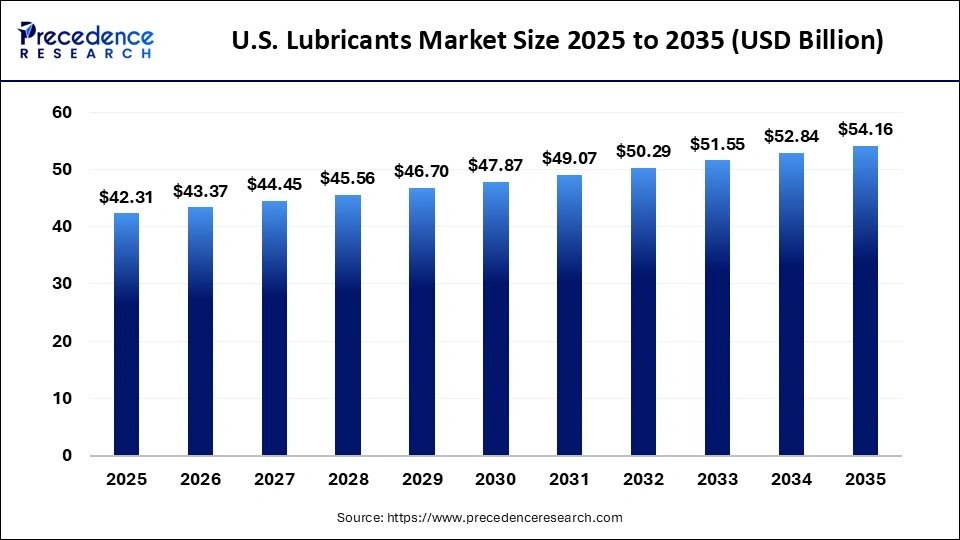
U.S. Lubricants Market Statical Scope
| Reports Attributes | Statistics |
| Market Size in 2025 | USD 42.31 Billion |
| Market Size in 2026 | USD 43.37 Billion |
| Market Size by 2035 | USD 54.16 Billion |
| CAGR 2026 to 2035 | 2.50% |
| Base Year | 2025 |
| Forecast Period | 2026 to 2035 |
The U.S. lubricants industry encompasses the production, distribution, and sale of lubricating oils and greases. These substances are essential for reducing friction, heat, and wear among moving components in machinery and equipment, thus extending their lifespan and improving operational efficiency. This market includes a diverse array of applications across various industries, encompassing automotive, industrial, marine, aerospace, construction, and agriculture.
Currently, the lubricants market in the U.S. is undergoing a significant transformation, spurred by various factors such as technological advancements and shifting consumer preferences. The demand for high-performance lubricants is escalating, as industries strive to enhance efficiency and decrease operational costs.
This trend is primarily influenced by an increased focus on sustainability and adherence to environmental regulations, which compel manufacturers to innovate and develop eco-friendly products. Moreover, the automotive sector is experiencing notable changes, with the rise of electric vehicles influencing lubricant requirements.
U.S. Lubricants Market Share, By Application, 2025 (%)
| Segments | Shares (%) |
| Automotive | 48% |
| Aerospace | 11% |
| Industrial | 32% |
| Marine | 9% |
- Automotive - The automotive segment commands a dominant position with a 48% market share, as automotive lubricants, including engine oils and transmission fluids, represent the largest segment of the lubricants market due to high maintenance demand.
- Aerospace - The aerospace segment is gaining ground and holds an 11% market share, propelled by the increasing need for specialized lubricants in aerospace applications in light of advancements in aviation technology.
- Industrial - The industrial segment occupies 32% of the market, where lubricants are utilized in industrial machinery and equipment, contributing significantly to the overall demand driven by the need for advanced machinery aimed at enhancing productivity.
- Marine - The marine segment holds 9%, involving the use of lubricants in ship engines and other maritime applications, reflecting the rising maritime traffic and the necessity for improved engine efficiency and equipment protection.
U.S. Lubricants Market Share, By Base Oils, 2025 (%)
| Segments | Shares (%) |
| Group 1 | 30% |
| Group 2 | 25% |
| Group 3 | 18% |
| Group 4 | 7% |
| Group 5 | 5% |
| Bio-based Base Oil | 15% |
- Group 1 - The Group 1 segment leads with a 30% share, as Group 1 base oils, which are refined mineral oils, are the most commonly utilized in lubricants due to their affordability and versatility.
- Group 2 - Group 2 segment holds 25%, with Group 2 base oils offering better performance and higher stability than Group 1 oils, commonly used in higher-quality automotive and industrial lubricants.
- Group 3 - Holds 18%, with Group 3 base oils, which are synthetic oils with superior properties, used in premium lubricants but with a smaller share compared to Groups 1 and 2.
- Group 4 - Holds 7%, with Group 4 base oils, such as polyalphaolefins (PAOs), being used in high-performance synthetic lubricants but accounting for a smaller share.
- Group 5 - Holds 5%, representing a niche market of specialty lubricants using synthetic oils and esters for extreme conditions.
- Bio-based Base Oil - The bio-based base oil segment is progressively gaining momentum, representing 15% of the market, as bio-based oils are increasingly adopted in environmentally sustainable lubricant formulations, driven by prevailing sustainability trends across multiple industries.
Top Companies in the U.S. Biscuits Market
- Exxon Mobil Corporation.
- BP p.l.c.
- BASF
- Chevron Corporation.
- Croda International Plc
- LIQUI MOLY
- TotalEnergies
- China Petroleum & Chemical Corporation (Sinopec)
- FUCHS
- American Refining Group
- Castrol Limited
- Phillips 66 Company.
- Valvoline Global Operations
- Petrobras
- PETRONAS Lubricants International
- Quaker Chemical Corporation
- Petrofer
Segments Covered in the Report
By Application
- Industrial
- Automotive
- Marine
- Aerospace
By Base Oil
- Group 1
- Group 2
- Group 3
- Group 4
- Group 5
- Bio-Based Base Oil
| Application | 2025 | 2026 | 2027 | 2028 | 2029 | 2030 | 2031 | 2032 | 2033 | 2034 | 2035 |
|---|---|---|---|---|---|---|---|---|---|---|---|
| Industrial | 17.77 | 18.13 | 18.49 | 18.86 | 19.24 | 19.63 | 20.02 | 20.42 | 20.83 | 21.24 | 21.66 |
| Automotive | 16.08 | 16.39 | 16.71 | 17.04 | 17.37 | 17.71 | 18.06 | 18.41 | 18.76 | 19.13 | 19.50 |
| Marine | 4.23 | 4.38 | 4.53 | 4.69 | 4.86 | 5.03 | 5.20 | 5.38 | 5.57 | 5.76 | 5.96 |
| Aerospace | 4.23 | 4.47 | 4.71 | 4.97 | 5.23 | 5.51 | 5.79 | 6.09 | 6.39 | 6.71 | 7.04 |
| Base Oil | 2025 | 2026 | 2027 | 2028 | 2029 | 2030 | 2031 | 2032 | 2033 | 2034 | 2035 |
|---|---|---|---|---|---|---|---|---|---|---|---|
| Group 1 | 7.62 | 7.55 | 7.47 | 7.38 | 7.29 | 7.18 | 7.07 | 6.94 | 6.81 | 6.66 | 6.50 |
| Group 2 | 11.85 | 12.23 | 12.62 | 13.03 | 13.45 | 13.88 | 14.33 | 14.79 | 15.26 | 15.75 | 16.25 |
| Group 3 | 10.15 | 10.54 | 10.94 | 11.35 | 11.77 | 12.21 | 12.66 | 13.13 | 13.61 | 14.11 | 14.62 |
| Group 4 | 5.08 | 5.29 | 5.51 | 5.74 | 5.98 | 6.22 | 6.48 | 6.74 | 7.01 | 7.29 | 7.58 |
| Group 5 | 4.23 | 4.34 | 4.45 | 4.56 | 4.67 | 4.79 | 4.91 | 5.03 | 5.16 | 5.28 | 5.42 |
| Bio-Based Base Oil | 3.39 | 3.43 | 3.47 | 3.51 | 3.55 | 3.59 | 3.63 | 3.67 | 3.71 | 3.75 | 3.79 |
Research Methodology
Related Databooks
March 2026
March 2026
April 2026
April 2026



 +1 804-441-9344
 Download Databook
 Schedule a Meeting