



Ethanol Market Size, Key Companies, Company Production Capacity, Manufacturing Efficiency, Capacity Utilization, Raw Material Consumption, Cost Structure, Export Trends, Company Expansion Strategies, and Competitive Landscape
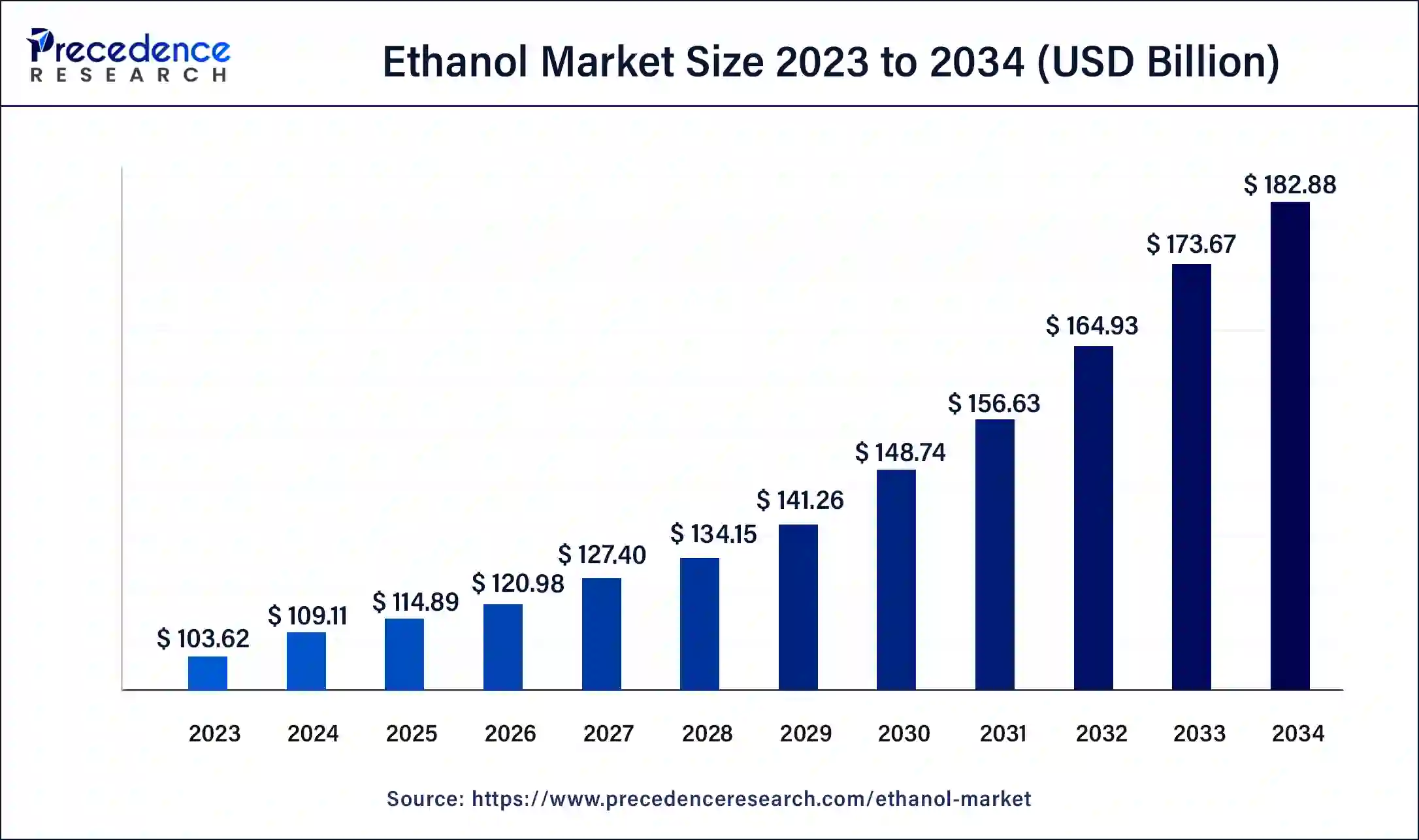
The global ethanol market was valued at USD 120.98 billion in 2026 and is projected to reach USD 191.78 billion by 2035, growing at a CAGR of 5.26% from 2026 to 2035. Market growth is driven by rising demand for biofuels, increasing adoption of ethanol-blended fuels to reduce carbon emissions, expanding use of ethanol in alcoholic beverages, pharmaceuticals, personal care products, and industrial applications, along with supportive government policies promoting renewable energy. Advancements in sustainable aviation fuel (SAF), AI-enabled production optimization, and growing investments in clean energy infrastructure are further accelerating market expansion worldwide. North America dominated the market in 2025, while Asia Pacific is expected to witness the fastest growth during the forecast period.
Source: https://www.precedenceresearch.com/ethanol-market
 Get a Sample
 Table Of Content


What is the Ethanol Market Size?
The global ethanol market size accounted for USD 120.98 billion in 2026 and is expected to reach around USD 191.78 billion by 2035, expanding at a CAGR of 5.26% from 2026 to 2035. The North America ethanol market size reached USD 48.70 billion in 2023. Growing consumption of alcoholic beverages and increasing adoption of alcohol-based hand sanitizers are major growth drivers of the ethanol market.
Ethanol Market Key Takeaways
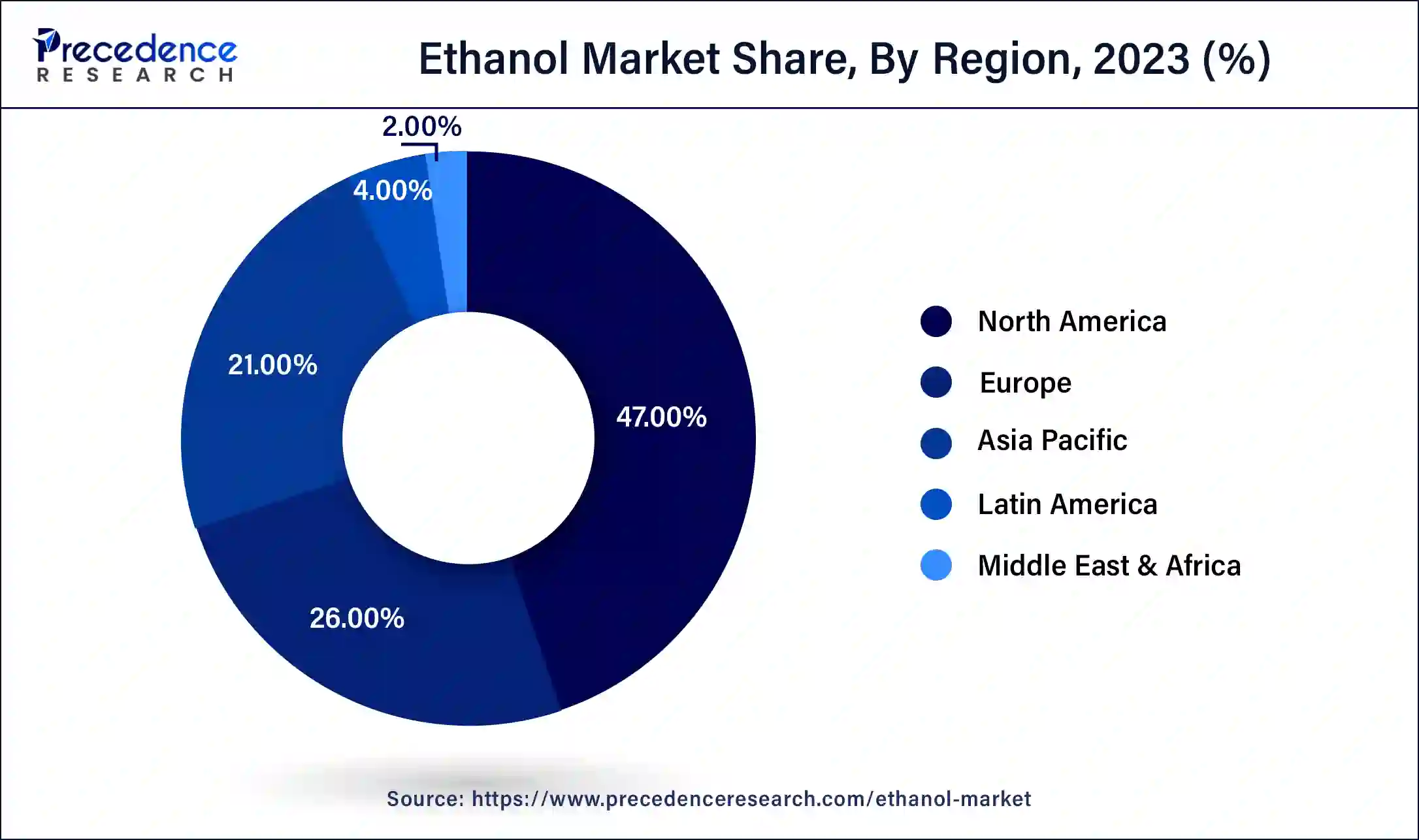
- North America has accounted revenue share of around 47% in 2025.
- Asia Pacific is expected to grow at the fastest CAGR in the market during the forecast period.
- By source, the grain-based segment captured more than 69% of revenue share in 2025.
- By source, the Sugar & molasses-based segment is expected to grow at the fastest CAGR in the market between 2026 and 2035.
- By purity, the denatured alcohol segment is expected to expand at the fastest CAGR from 2026 to 2035.
- By purity, the undenatured segment is expected to witness the fastest growth in the market with a CAGR over the forecast period.
- By application, Fuel and fuel additives segment captured more than 45% of revenue share in 2025.
- By application, the beverages application segment is expected to show the fastest growth with a CAGR over the forecast period.
Market Overview
Emerging applications of ethanol are anticipated to create potential opportunities for the key players operating in global market. Aviation industry is focusing on the research and development of ethanol blended fuels for the overall cost reduction and to reduce carbon emission. Recent applications of ethanol in ignition systems and emission control in transportation sector is expected to generate better opportunities over coming years. Further, outbreak of coronavirus disease has increased usage of ethanol-based hand sanitizers which is supporting global market growth. Centers for Disease Control and Prevention (CDC), recommended usage of ethanol as it is effective in killing microorganisms including bacteria, viruses, and fungi. Further, abundant availability of raw materials for the production of ethanol is developing countries is encouraging major companies to expand their production facility. Moreover, stringent environmental regulations for the use of biofuels are supporting ethanol production. Increasing end use applications in cosmetic industry as solvent and in many household applications are expected to boost target market growth in future.
AI in the Market
The ethanol market is revolutionized by automation with livelihood-oriented approaches in the areas of production, feedstock management, and supply chain. It increases fermentation efficiency, saves energy consumption, and controls quality to maintain product standards. Generated by precision agriculture, it maximizes crop yield and promotes the development of better strains for ethanol production. In governance, it can assess internal demand, optimize routes of transportation, and assist in building a stronger supply chain. For sustainability, AI can bring down emissions, reduce waste, and aid in accurate environmental reporting. Automating processes with data analysis guarantees the perfect combination of lower costs, reliability, and great concern for the environment.
Ethanol Market Trends
Increasing demand for clean-burning fuel
The major trend that the ethanol market holds is increasing demand for clean burning fuel which does not leave toxic residue while burning, like carbon dioxide. Ethanol is gaining popularity as a biofuel due to its clean burning properties. Growing demand for better fuel efficiency along with minimizing carbon emissions have created significant opportunities for the ethanol market. Ethanol is a more affordable and clean fuel option than any other synthetic fuel. The Brazilian government has taken an initiative to increase the tax on petroleum –based fuels to adopt biofuels like ethanol.
Ethanol offers a cost-effective solution
Ethanol is a cheaper solution than any other conventional petroleum-based fuel, making it stand out as a preferred option in many countries. Ethanol can be easily blendable, and it is produced on a large scale due to its renewable properties, unlike finite sources of oil and coal which are extiguishing and can not be generated manually. Furthermore, ethanol generated can create significant job opportunities for individuals ready to learn skills related to this sector and is propelling the ethanol market globally.
Market Scope
| Report Highlights | Details |
| Market Size in 2025 | USD 114.89 Billion |
| Market Size in 2026 | USD 120.98 Billion |
| Market Size by 2035 | USD 191.78 Billion |
| Growth Rate from 2026 to 2035 | CAGR of 5.26% |
| Largest Market | North America |
| Fastest Growing Market | Asia Pacific |
| Base Year | 2025 |
| Forecast Period | 2026 to 2035 |
| Segments Covered | Source Type, Application Type, Purity Type, and Regions |
| Regions Covered | North America, Asia Pacific, Europe, Latin America, Middle East and Africa |
Market Dynamics
Driver
Increased Implementation of Biofuel Blending Mandates
Increasingly, modern governments across the globe are commencing more and more biofuel blending regulations. Such policies facilitate the use of fuel types containing a certain number of ethanol units (starting from E10 and going higher). In addition, the growth of investment in local biofuel production sector and regulatory frameworks supporting the industry simply allow for increased consumption fuel, thus making it a driver of growth for ethanol industry.
Restraint
Feedstock Prices Unpredictability
The process of ethanol production is largely dependent on the feedstock, including corn, sugarcane, and wheat. This makes the industry very exposed to the fluctuations of agricultural commodity prices. Changes may substantially make the cost of raw materials sky-rocket as factors influencing the prices might differ from bad weather conditions and changing yields to being in direct competition with food production. Price fluctuations have negative effects on the profit margin, restrictions for supply and the ability to expand the market of ethanol production.
Opportunity
Expansion of Sustainable Aviation Fuel Market
The introduction of the sustainable aviation fuel presents new perspectives for ethanol producers. Ethanol is seen as a renewable source of advanced fuel type production. Different investments in technologies related to SAF growth and governmental incentives along with the commitment of the airlines to cut emissions gives a good outlook for ethanol utilization in the aviation market and may even allow its usage beyond the terrestrial transportation market.
Segment Insights
Source Insights
What Caused Grain Feedstock to be a Dominant in Ethanol Market?
The grain feedstock segment held over 69% of revenues in the ethanol market in 2025 due to large production of corn and wheat crops in North America. We can explain the success of grain-based feedstocks by their efficient processing technology, stable supply of raw materials and legislation focused on the production of biofuels. Grain-based biofuel has the advantage of mature supply networks and effective technologies due to a long-term experience of usage of such fuel on the market.
The sugar feedstock segment is expected to become an fastest-growing segment of the business market from 2026 to 2035 due to increased number of sugar-mixing programs in Brazil, India, and Thailand. Other contributing factors include improved efficiency of biofuel production due to improved efficiency of the sugar industry along with supported demand for biofuel products.
Purity Insights
Which Purity Segment Dominating the Market?
Denatured ethanol is anticipated to dominate the target market by purity during the forecast period 2026-2035 because of its widespread use as fuel additives, industrial solvents, cleaning products, and in the production of chemicals. The low level of regulations for denatured alcohol in comparison to beverage ethanol, as well as the increased number of uses in various industries and the growth in demand for biofuels, ensures its smooth acceptance in commerce.
The undenatured ethanol segment will witness the fastest growth during the forecast period due to the increasing demand of pharmaceutical, beverage, food, and personal care industries. Increasing consumption of high-purity ethanol for medical, premium alcoholic beverages and laboratory purposes, coupled with the implementation of stringent quality norms, is expected to contribute to the market growth.
Application Insights
Why Fuel & Fuel Additives Segment Dominating the Market in 2025?
The fuel & fuel additives application segment is expected to dominate in terms of revenue over the forecast time frame. Increasing demand form automotive sectors coupled with regulations related to environmental safety in developed as well as emerging economies is expected boost growth of the segment in the near future.
The beverages segment is estimated to have the fastest growth during 2026–2035, mainly due to increased consumption of alcoholic beverages, growth of premium beverages production, and demand for the segment in emerging economies. Increasing capital through investments in beverage production and changing preferences of consumers are aiding the demand for beverage-grade ethanol.
Regional Insights
North America Is Estimated to Be the Largest Market for Ethanol
The research report covers key trends and prospects of ethanol products across different geographical regions including North America, Europe, Asia-Pacific, Latin America, and Middle East and Africa. Geographically, ethanol market is conquered by North America owing to favorable government policies for the production and use of ethanol as biofuel, along with growing awareness regarding environmental pollution control caused due to use of conventional fuels in the countries of the region. Asia Pacific is expected to register the fast growth rate, on account of expanding ethanol manufacturing capacity, coupled with presence of leading companies in the countries of Asia Pacific. Further, availability of the abundant feedstock for ethanol production is major factor responsible for the growth of Latin America ethanol market. Brazil is expected to hold major share in terms of revenue in Latin America ethanol market in the near future owing to growing production and export of ethanol from Brazil.
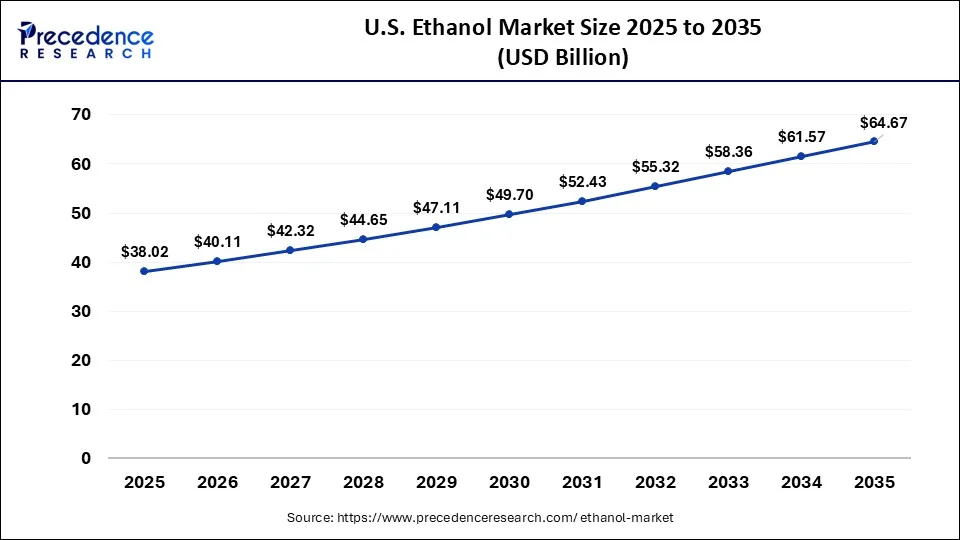
What is the U.S. Ethanol Market Size?
The U.S. ethanol market size was recorded at USD 38.02 billion in 2025 and is predicted to be worth around USD 64.67 billion by 2035, at a CAGR of 5.46% from 2026 to 2035.
Why is the Asia Pacific Region Growing Rapidly in the Ethanol Market?
Asia-Pacific is rapidly emerging as a significant player in the ethanol market, and this growth is fueled by increasing energy demands, government initiatives promoting biofuels, and a shift towards cleaner energy sources. Countries like China and India are leading players in the region, with ambitious targets being made for renewable energy adoption, which is expected to boost ethanol consumption significantly.
China Market Trends
The region's market landscape features both domestic and international players, all of whom are competing for high market share. The country also has a strong presence of a diverse range of feedstocks, such as sugarcane and cassava, enhances the region's production capabilities.
What are the Advancements in the Ethanol Market in Europe?
Europe is witnessing significant growth in the ethanol market, driven by stringent environmental regulations and a shift towards renewable energy sources. The European Union's Renewable Energy Directive (RED II) mandates increased use of biofuels, thus creating a favorable environment for ethanol production and consumption. Countries like Germany and France leading players in the region.
Germany Market Trends
The country's market landscape is characterized by a mix of established companies and new entrants, all striving to capitalize on the growing biofuel market. This dynamic environment is expected to drive further advancements in ethanol production technologies in the region.
What are the Key Trends in the Ethanol Market in Latin America?
Latin America is expected to witness significant market growth in the upcoming years, driven by various factors including environmental policies, technological advancements, and shifting consumer preferences. As nations in this region increasingly prioritize sustainability, the demand for renewable energy sources, particularly biofuels like ethanol, will be on the rise. Governments are also seen implementing incentives in order to promote the use of biofuels, which may further boost market growth. Countries like Brazil and Mexico are leading players.
Brazil Market Trends
Innovations in production processes and feedstock utilization are enhancing the efficiency and cost-effectiveness of ethanol manufacturing in the country, further strengthening the long-term ethanol market landscape. These advancements are also influencing the overall ethanol market value, as producers optimize margins and expand capacity.
How is the Middle East and Africa Region Growing in the Ethanol Market?
The Middle East and Africa region is expected to grow significantly in the upcoming years, driven by increasing energy needs and a push towards renewable energy sources. Countries like South Africa, the UAE and Kenya are leading players as they are beginning to explore biofuels as part of their energy strategies, supported by government initiatives aimed at reducing carbon emissions.
Saudi Arabia Market Trends
The region's growth is characterized by a mix of local and international companies looking to establish a strong foothold in this growing market. As awareness of the benefits of biofuels increases, the region is expected to see a gradual rise in ethanol production and consumption, opening doors for future investments and innovations.
Metformin Import-Export Trade Analysis
- According to Volza's Global Export Data, the world exported 75 Ethanol shipments between Jul 2024 to Jun 2025 (TTM) through 22 verified exporters and 24 buyers, marking a 23% YoY change.
- India is among the world's leading metformin exporters, supported by its large generic pharmaceutical industry and strong API manufacturing capabilities. The country accounted for 302 export shipments, reinforcing its position as a key supplier to regulated and emerging pharmaceutical markets.
- The United States is a leading importer of metformin, driven by its high diabetes burden and extensive demand for generic medicines. The United States lead as the top Ethanol importers, while India (302 shipments) rank as the
- largest global Ethanol exporters. Its dependence on imported APIs and finished formulations continues to support strong international trade volumes.
- Vietnam is both a major importer and exporter in the metformin trade. It ranked among the top importing countries and recorded 20,126 export shipments, reflecting its growing role as a pharmaceutical manufacturing and distribution hub.
- Germany remains an important exporter with 2,404 export shipments, leveraging its advanced pharmaceutical production capabilities and supplying metformin to markets across Europe and other regions.
Value Cain Analysis
- Feedstock Procurement: This stage covers the sourcing and acquisition of raw materials for production processes.
Key Players: Cargill and Andersons Inc. - Chemical Synthesis and Processing: Here, the raw materials are converted into the desired chemical compounds through selected chemical reactions and subsequent processing steps.
Key Players: POET, Archer Daniels Midland (ADM) - Compound Formulation and Blending: This entails the mixing and blending of different chemical compounds in specific proportions to achieve a chemical product that possesses all of the desired properties.
Key Players: LyondellBasell and Ineos - Quality Testing and Certification: Here, the characteristics of the chemical product are tested to see if they meet quality standard requirements, and certification is obtained if applicable.
Key Players: SGS, Bureau Veritas, and AmSpec Group - Distribution to Industrial Users: This involves the transportation of the finished product to industrial customers for use in their operations.
Key Players: BPCL, IOCL, and HPCL
Competitive Landscape
The ethanol industry has only a light level of consolidation having big names of the industry involved while subsequently relying also on many smaller producers operating locally. The principles of competition include the availability of feedstock, efficient production processes, policies of governments, and long-term contracts providing for moderate entry barriers for newcomers to the market.
Major players are represented by POET LLC, Archer Daniels Midland, Valero Energy, and Green Plains Inc, which have managed to strengthen their positions owing to remarkable capacity for production, modern technologies, and wide networks of distribution. The competition is accentuated through increasing capacities, cooperations, the use of new technologies, and investments in the production of eco-friendly ethanol.
Ethanol Market companies
- Flint Hill Resources LP
- Braskem
- Andersons Ethanol Group
- Archer Daniels Midland Company
- Cargill Corporation
- Aventine Renewable Energy
- HPCL Biofuels Limited
- Butamax Advanced Biofuels LLC
- Advanced Bioenergy LLC
- British Petroleum
Recent Developments
- In August 2025, Kirloskar Oil Engines Limited (KOEL) introduces new ethanol and isobutanol engine technology for generator applications, the first of its kind globally evaluated by ARAI.
(Source: https://manufacturing.economictimes.indiatimes.com) - In August 2025, Mahindra unveils E30+ Ethanol fuel-compatible engines with advanced sensors and cold-start tech, enabling real-time monitoring and fuel rail/injector heaters for cold starts.
(Source: https://www.news18.com)
Segments Covered in the Report
By Source
- Sugar & Molasses Based
- Grain Based
- Second Generation
By Purity
- Denatured
- Undenatured
By Application
- Industrial Solvents
- Fuel & Fuel Additives
- Beverages
- Disinfectant
- Personal Care
- Others
By Region
- North America
- Latin America
- Europe
- Asia-pacific
- Middle and East Africa
For inquiries regarding discounts, bulk purchases, or customization requests, please contact us at sales@precedenceresearch.com
Frequently Asked Questions
Tags





Ask For Sample
No cookie-cutter, only authentic analysis – take the 1st step to become a Precedence Research client
 Get a Sample




 sales@precedenceresearch.com
 Schedule a Meeting
