



Food Processing Equipment Market Size, Key Companies, Company Market Share, Equipment Production Volume, Sales Performance, Manufacturing Cost, Export & Import Trends, Competitive Positioning, and Market Analysis
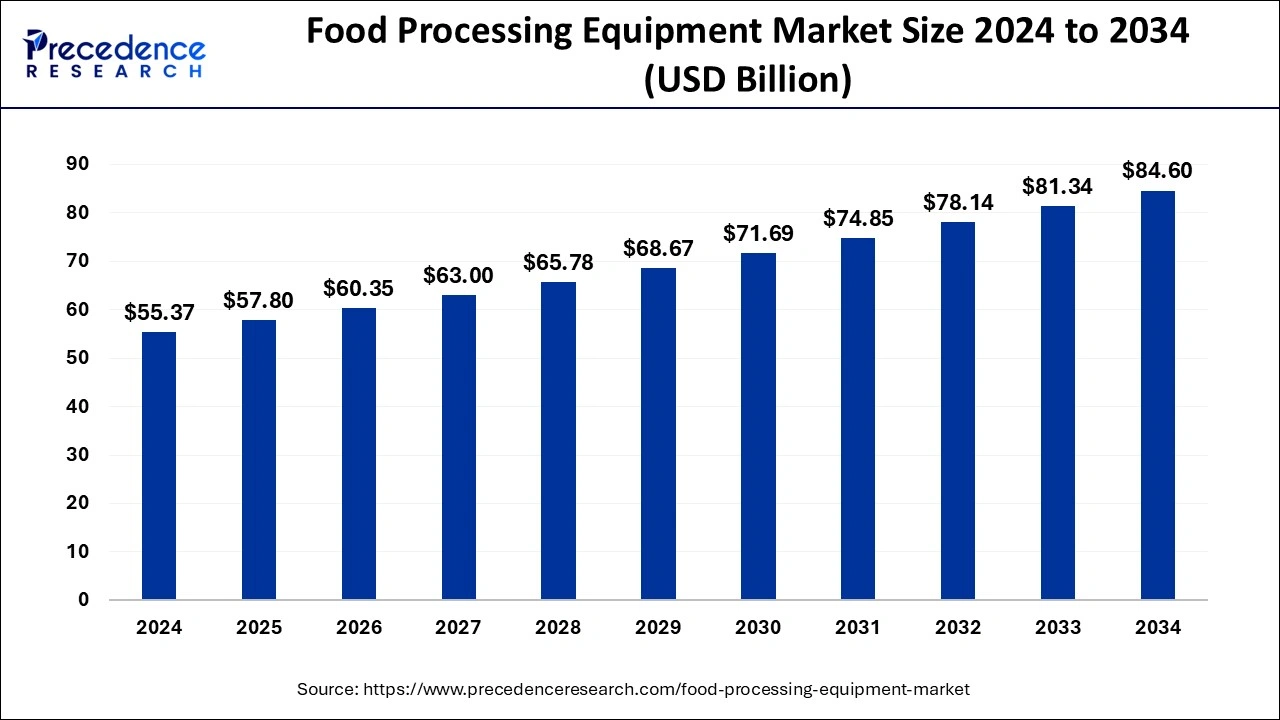
The global food processing equipment market is projected to grow from USD 60.35 billion in 2026 to USD 87.82 billion by 2035, at a CAGR of 4.27%. Growth is driven by rising demand for processed and convenience foods, increasing automation, and the adoption of AI, IoT, and smart manufacturing technologies to improve production efficiency, food safety, and sustainability. Asia Pacific leads the market due to rapid urbanization and expanding food manufacturing, while continued investments in automated and energy-efficient processing equipment are expected to support long-term market growth.
Source: https://www.precedenceresearch.com/food-processing-equipment-market
 Get a Sample
 Table Of Content


What is Food Processing Equipment Market Size?
The global food processing equipment market size accounted for USD 60.35 billion in 2026 and is predicted to reach around USD 87.82 billion by 2035, growing at a CAGR of 4.27% from 2026 to 2035. The food processing equipment market is driven by increasing demand for processed food and automation in the food processing industry.
Market Highlights
- Asia Pacific led the global market with the highest market share of 36% in 2025.
- By Type, the processing segment has held the largest market share in 2025.
- By Mode of Operation, the automatic segment registered the maximum market share in 2025.
- By Application, the meat, poultry, and seafood segment is estimated to hold the highest market share in 2025.
Advancing the Food Processing Equipment Market Through Smart Manufacturing Technologies
The food processing equipment market refers to the machinery and systems used in the processing and preservation of food products in various industries for handling, processing, and packaging. The use of this equipment enhances production efficiency, food quality, and food safety standards. The market is experiencing steady growth, primarily as a result of the overall growth in the demand for processed and convenience foods. The automation of different production processes in the food industry can be observed in terms of greater speed and cost reductions in production.
AI in the Market
The revolution in the food machinery market due to Artificial Intelligence is bringing increased efficiency to food manufacturing, safety, and sustainability. The AI-powered systems perform repetitive data tasks with maximal accuracy. It performs defect detection in real-time, ensuring that food safety standards are maintained. Predictive maintenance leads to little downtime and easy equipment life. AI can look at energy or resource utilization, minimizing waste and maximizing forecasting demand and logistics. It, too, looks to studying consumer taste for new product developments and personalized nutrition. Advanced data analytics give a consumer an edge in trusting them and give the manufacturer their competitive edge in a dynamic marketplace.
Food Processing Equipment Market Growth Factors
- Transitioning from manual to automatic processing systems leads to increased efficiency and, therefore, greater adoption of advanced machinery.
- Replacement of the outdated machinery with innovative, high-performance systems is hastening demand in mature markets.
- Rising disposable incomes and new changes in consumer food preferences are driving further development and investment into the newer processing technologies.
- Growth in the urban population in the Asia Pacific region and demand for processed out-of-home food keep being accounted for in the growing sales of equipment.
- Continuous technological improvements being observed there aim at improving throughput levels and decreasing operational inefficiencies, further fueling the growth of the market.
Market Scope
| Report Highlights | Details |
| Market Size in 2025 | USD 57.80 Billion |
| Market Size in 2026 | USD 60.35 Billion |
| Market Size by 2035 | USD 87.82 Billion |
| Growth Rate from 2026 to 2035 | CAGR of 4.27% |
| Largest Market | Asia Pacific |
| Base Year | 2025 |
| Forecast Period | 2026 to 2035 |
| Segments Covered | Type, Mode of Application, Application, and Region |
| Regions Covered | North America, Europe, Asia-Pacific, Latin America, and Middle East & Africa |
Market Dynamics
Driver
Rising Demand for Processed and Convenience Foods
The rise in consumption of processed, packaged foods and foods ready to eat is a key factor boosting the food processing equipment market. Rapid urbanization, changing lifestyles, and increased individual wealth have resulted in an increased demand for efficient food production systems. Automated equipment has become a major investment priority for food manufacturers to enhance productivity and cut labor expenses, while ensuring product consistency. These are contributing towards the long-term growth in the markets in both developed and emerging markets.
Restraint
High Capital Investment and Maintenance Costs
The sophisticated food processing equipment is costly and limiting the market. To upgrade existing production equipment, small and medium-sized food manufacturers face financial constraints. The maintenance expenses are high, the energy consumption is high, and trained operators are required to operate it, which increases the operating cost. These cost problems may be able to be resolved with the adoption of such technology, particularly in financially resource-poor areas.
Opportunity
Expansion of Smart and Sustainable Food Processing Technologies
The growing smart manufacturing and sustainable processing technologies are seen as huge markets to grow. AI, IoT, robotics technology, and predictive maintenance contribute to operational efficiency and lower downtime during production. As demand for energy-efficient equipment and green manufacturing processes increases, so do the innovations that are taking place among equipment manufacturers. The emerging economies are not spared from new space for food processing investment growth.
Segment Insights
Type Insights
What factors are driving the dominance of the processing segment in the food processing equipment market?
Depending on the type the food processing equipment market is classified into processing and pre-processing. Among these, the processing segment is expected to dominate the market during the assessment period owing to technological advancements, in terms of operations and software, enable the vendors to offer a range of functions in a single unit. In addition, for all the multifaceted manufacturing operations the global food processing equipment market continuously requires efficient and effective solutions. Furthermore, recent developments in the machine and equipment sector are anticipated to revolutionize the industry and drive the segment growth.
The pre-processing equipment is expected to have significant market revenue due to the increasing demand for ready to use food products. The pre-processing equipment is utilized in the food industry, particularly for fruit and vegetable, meat, and poultry processing. Grading, sorting, peeling, and much other equipment is used to improve the quality of the raw materials for their further processing. Moreover, the rising demand for perishable food products providing health benefits is leading to the adoption of new market trends.
Mode of Operation Insights
Why are vendors shifting from semi-automatic to automatic food processing equipment, and how is digitization influencing this transition?
Vendors used to prefer semi-automatic equipment, even though the food processing equipment market is led by the automatic segment. The vendors were opting to semi-automatic equipment owing to the lesser demand for processed foods and the more costs related to automatic machinery. Contrariwise, vendors are focusing more on automation in the process to increases the efficacy and quality of the product, due to digitization of the sector. Vendors are offering automated operational systems for the production of equipment to have a competitive advantage in the global market.
Furthermore, the semi-automatic equipmentis operated by the labor force with a lack of knowledge and partial integration of technology which is projected to witness stable growth over the projection timeframe. Therefore, it is estimated that the automatic food processing equipment segment will dominate the food processing equipment market share across the world.
Application Insights
What factors are driving the beverage application segment to become the second-largest in the global food processing equipment market?
Depending on the application, the global food processing equipment market has been categorized into dairy, meat, poultry & seafood, beverages, and bakery & confectionery. Among these, the meat, poultry, and seafood application is projected to conquer global market revenue throughout the assessment period. Furthermore, increasing consumer disposable income levels and rapid urbanization in developing regions have provisioned the demand for processed food thereby boosting the market. On the other hand, the beverage application segment is projected to be the second-largest segment with a significant growth rate over the coming years.
Regional Insights
What is the Asia Pacific Food Processing Equipment Market Size?
The Asia Pacific food processing equipment market size is valued at USD 20.81 billion in 2025 and is expected to be worth around USD 31.62 billion by 2035, at a CAGR of 4.27% from 2026 to 2035
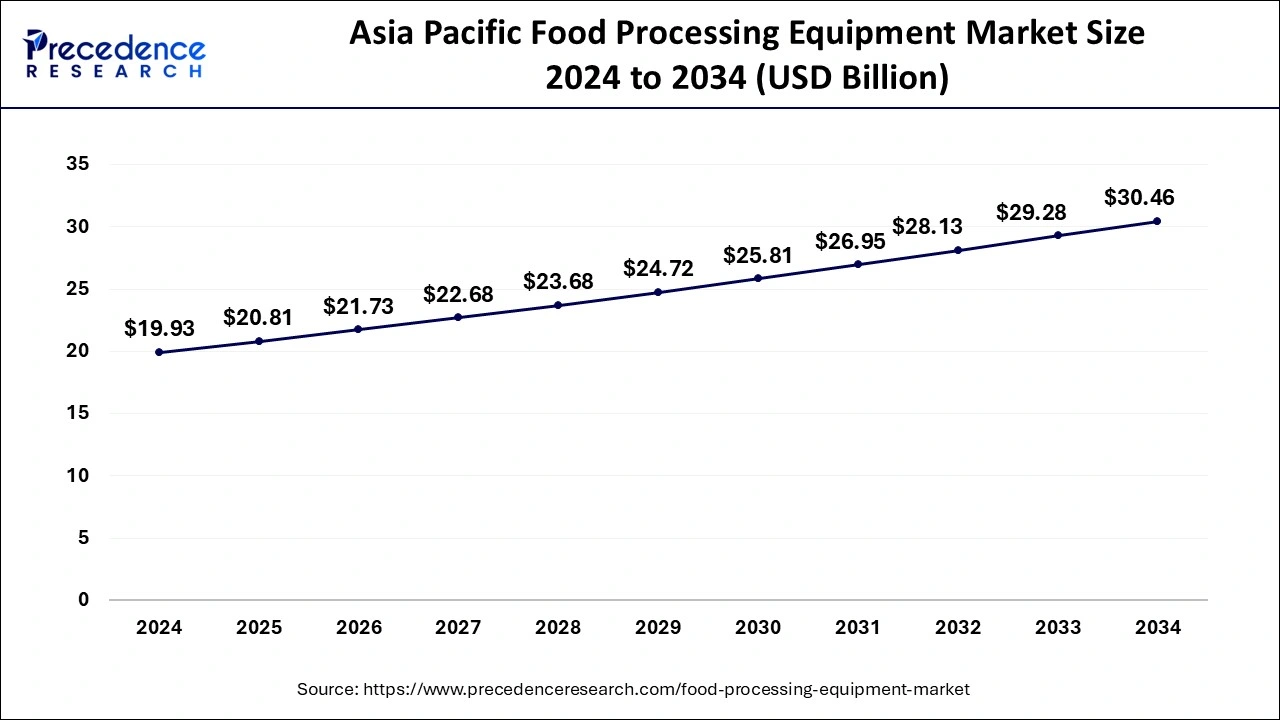
In 2025, the Asia Pacific region dominated the market holding a major share of about 36%. The growth of the region is driven by the rising demand for food due to increasing population, increasing disposable incomes, increasing demand for processed food, and changing preferences of consumers towards packaged foods due to rising awareness about their advantages.
Asia Pacific will lead the Global Food Processing Equipment Market in 2025
Asia Pacific dominated the global market in 2025, driven by the growth in processed food demand and the increasing food manufacturing industry. The demand for food production is growing faster in the region due to rapid urbanization and population growth. The governments are investing in and implementing favorable food processing policies. Automation is a tool that's being used by manufacturers to improve efficiency and food safety. The region continues to be the market leader thanks to strong growth in packaged foods consumption.
China Market Trends
China's food processing equipment market is anticipated to grow significantly, as a result of the fast industrialization in the food industry. The demand for packaged, frozen, and ready-to-eat foods has steadily increased, and equipment is being adopted. Food safety and food modernization campaigns by the government are used to seek technological improvements. Local manufacturers are putting resources into energy-efficient and automated processing systems. The surge in food exports is also contributing to market growth.
According to the Food Processing Industry Report in February 2025, the food processing sector is a key contributor to India's economy, owing to the progressive policy measures by the Ministry of Food Processing Industries (MoFPI). The sector has performed well with an impressive average annual growth rate of 7.3% from 2015 to 2022. It has significantly contributed to Gross Domestic Product (GDP), employment, and investment. As of 2024, it contributes around 8.80% and 8.39% of Gross Value Added (GVA) in Manufacturing and Agriculture respectively, 13% of India's exports and 6% of total industrial investment.
The food processing industry in India is exponentially rising due to some major reasons owing to the rapid urbanization, evolving consumer preferences, rising MSMEs and startups in rural areas, rapid advancements in technology, and supportive government framework.
In January 2025, Adani Wilmar Limited, one of India's largest FMCG food companies, has officially launched operations at its integrated food processing plant in Gohana, District Sonepat, Haryana. The commencement of operations was marked by the first dispatch of 100 metric tonnes of rice, signifying a key milestone in the company's expansion. The plant is expected to become an economic driver for the region, with projections to generate 2,000 jobs, both direct and indirect, contributing to the local economy.
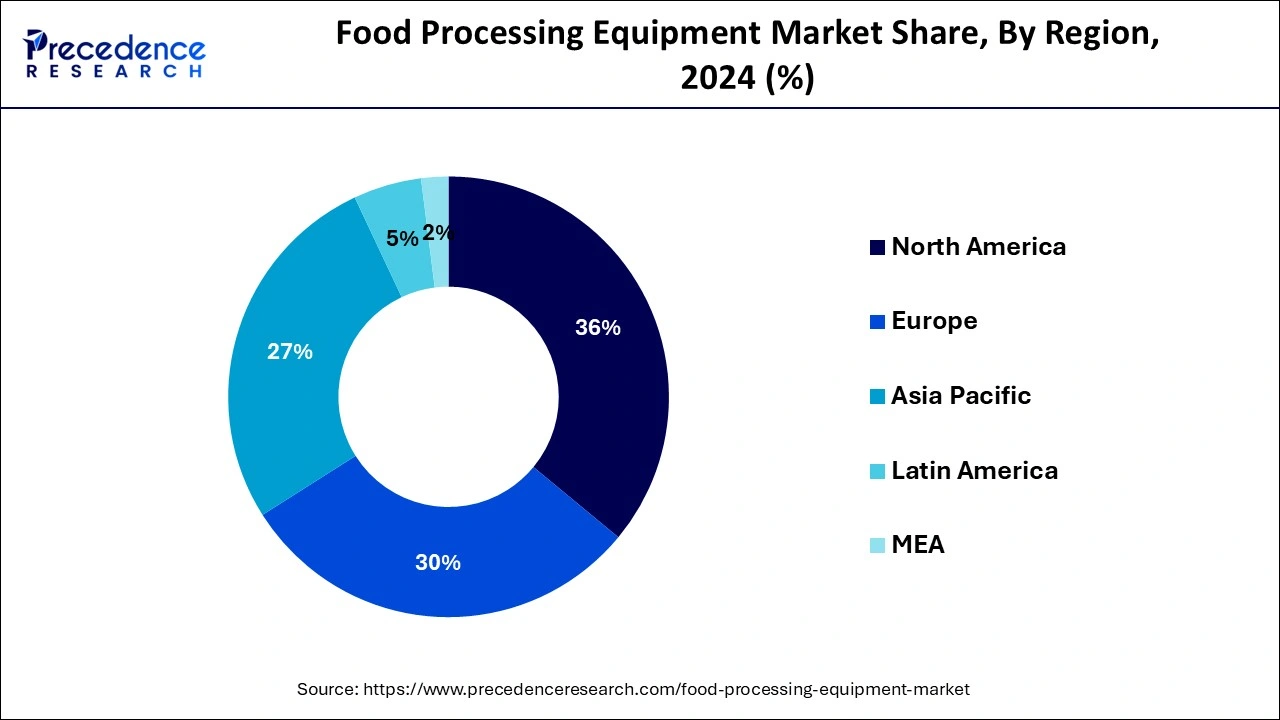
However, the Asia Pacific region is anticipated to be the fastest-growing market over the assessment period. China is anticipated to undertake enormous variations in its food and beverage sector, with a goal to address the issues such as snowballing urbanization and economic inequality.
North America is Undergoing the Fastest Growth in the Food Processing Equipment Market
North America is expected to grow at the fastest rate in the market, driven by the increasing level of automation in food manufacturing plants. Advanced convenience foods are being invested in because of the high demand for convenience foods. Food manufacturers are increasingly exploring the potential of AI, robotics, and IoT technologies to improve productivity. Equipment continuously updated for food safety reasons. Leading equipment manufacturers further drive up market growth.
U.S. Market Trends
U.S. market is anticipated to grow significantly, as the packaged and functional foods market expands, and the requirement for equipment upgrades increases. To cut down on labor costs and enhance efficiency, companies are putting into practice automated processing systems. Energy-efficient and environmentally friendly equipment is encouraged through sustainability measures. Ongoing innovation in food processing technologies helps to drive market growth.
Advancements in the Food Processing Equipment Market in Europe
Europe is expected to witness significant market growth throughout the forecast period with increasing adoption of advanced automation technologies. Food producers are turning towards hygienic food processing and production using less energy. Regulatory requirements promote ongoing upgrading of processing equipment. Consumers have high expectations for organic and premium food products, which is leading to the advancement of technology. Investment in sustainable food production also plays a role in market growth.
Germany Market Trends
Germany market is anticipated to grow significantly due to its advanced manufacturing capabilities. The country is adopting Industry 4.0 technologies in food production factories. There is growing demand for efficient food processing equipment, as the exports of processed food products grow. Businesses are shifting to automation to boost productivity and product quality. Innovation in the field of research and development activities is being pursued with vigour in the market.
Key Trends in the Food Processing Equipment Market in Latin America
Latin America is expected to witness significant growth in the market with the rising food processing industries. The demand for packaged and convenience foods is an increasing trend due to the growing urban population. Governments are promoting investments in food infrastructure. Companies are investing in the latest technology in machinery to increase productivity and product quality. The growth of exports of processed foods is helping to drive long-term market growth.
Brazil Market Trends
Brazil food processing equipment market is anticipated to grow significantly, due to the country's vast agriculture and food production industry. Expansion in the meat, dairy, and beverage industry is leading to a rise in equipment requirements. Improved productivity by manufacturers through investment in automated processing technologies. The government's policy of providing support for food export is fostering the modernization of food production facilities. Domestic consumption is also an important factor in market expansion.
Growth of the Middle East and Africa in the Food Processing Equipment Market
The Middle East and Africa region is expected to witness significant growth in the market as there is a significant increase in investments made in the region for food security and food production. Increasing urbanization is generating demand for processed and packaged food products. Governments are promoting the development/expansion of local food production to reduce imports. The use of modern processing technologies is increasing production efficiency. The expansion of the food and beverage industry plays a positive role in expanding the regional market.
Saudi Arabia Market Trends
Saudi Arabian market is anticipated to grow significantly due to the government's support for the development of the food industry. The government's Vision 2030 is promoting investments in innovative food processing facilities. Demand for packages and convenience foods is increasing, as is equipment demand. Food quality and operational efficiency are being achieved with automation technologies. The participation of the private sector is also steadily increasing and will continue to increase.
Food Processing Equipment Market Value chain
- Raw Material Sourcing (Metals, Electronics): The process of finding, evaluating, and purchasing base materials like metals and components.
Key players: Tata Steel for metals, Aditya Birla Chemicals for compounds, and SRF Limited for polymers) - Component Fabrication and Machining: The production of separate parts typically by shaping, cutting, joining, or forming raw materials.
Key players: Tetra Laval, Krones AG, and Buhler Holding AG - Testing and Certification: Subjecting products or processes to an arduous examination to validate that the criteria set are met and ensure safety, quality, and compliance.
Key players: SGS, Bureau Veritas, Intertek, TUV SUD - Installation and Commissioning: The setting up of equipment or systems to specifications (installation) and the testing and validation of said equipment or system to prove functionality and performance (commissioning).
Key players: STEER, Glatt, NETZSCH) - Product Lifecycle Management of Food Processing Equipment: The methodical management of the entire lifespan of food processing equipment-from the very beginning of its design through development, manufacturing, distribution, operation, and consummation or disposal.
Key players: Siemens, Autodesk, Rockwell Automation
Competitive Landscape
The food processing equipment market encompasses a worldwide array of food processing, packaging, automation, and industrial machinery equipment manufacturers. Some of the biggest companies with a global presence are GEA Group AG, Bühler AG, Tetra Pak International S.A., JBT Corporation, and Alfa Laval AB. The characteristics of these players are innovation, diversification, and wide distribution.
Leading Companies are spending money on the improvement of productivity and Food safety by investing in Automation, AI-based Processing systems, robotics, and energy-efficient equipment. There are several barriers to this, such as high capital costs, strict food safety laws, increased energy costs, and disruption to the supply chain for equipment manufacture and delivery. Keeping a competitive edge in this industry remains important through innovation, strategic relationships, and the development of sustainable equipment.
Food Processing Equipment Market Companies
- GEA Group AG
- Bettcher Industries Incorporated
- Anko Food Machine Company Limited
- Berkshire Hathaway Incorporated
- Atlas Pacific Engineering Company Incorporated
- Bucher Industries AG
- Hosokawa Micron Corporation
- Bibun Engineering
- Others
Recent Development
- In October 2024, Sona Machinery, the leading OEM, providing automatic and quality solutions to the grain-based distillery industry, announced the launch of its innovative Color Sorter Machine, a groundbreaking solution designed to enhance precision sorting, operational efficiency, and long-term durability in grain processing. Available globally, this innovative machine caters to agriculture and food processing businesses.
- In April 2025, Headwall Photonics, a leader in advanced hyperspectral imaging technology based in Bolton, MA, together with Laitram Machinery, a LA-based leader in automation and equipment solutions for the food processing industry, announced their strategic partnership. This collaboration signifies a pivotal step in deploying hyperspectral technology across food processing industries at an industrial scale.
- In May 2025, CPM Holdings, Inc., a diversified supplier of process equipment, unveiled their new pet food processing equipment line, which includes twin-screw extruders, advanced dryers, precision coating systems, hammermills and more, designed to deliver consistent quality, efficiency and scalability for pet food manufacturers.
Segments Covered in the Report
By Type
- Processing
- Pre-processing
By Mode of Operation
- Automatic
- Semi-automatic
By Application
- Dairy
- Meat
- Poultry & seafood
- Beverages
- Bakery & Confectionery
By Region
- North America
- Latin America
- Europe
- Asia-pacific
- Middle and East Africa
For inquiries regarding discounts, bulk purchases, or customization requests, please contact us at sales@precedenceresearch.com
Frequently Asked Questions





Ask For Sample
No cookie-cutter, only authentic analysis – take the 1st step to become a Precedence Research client
 Get a Sample




 sales@precedenceresearch.com
 Schedule a Meeting
