



Food and Beverage Processing Equipment Market Size, Production Capacity, Healthcare Infrastructure Growth, Product Utilization, Sales Analysis, and Investment Trends
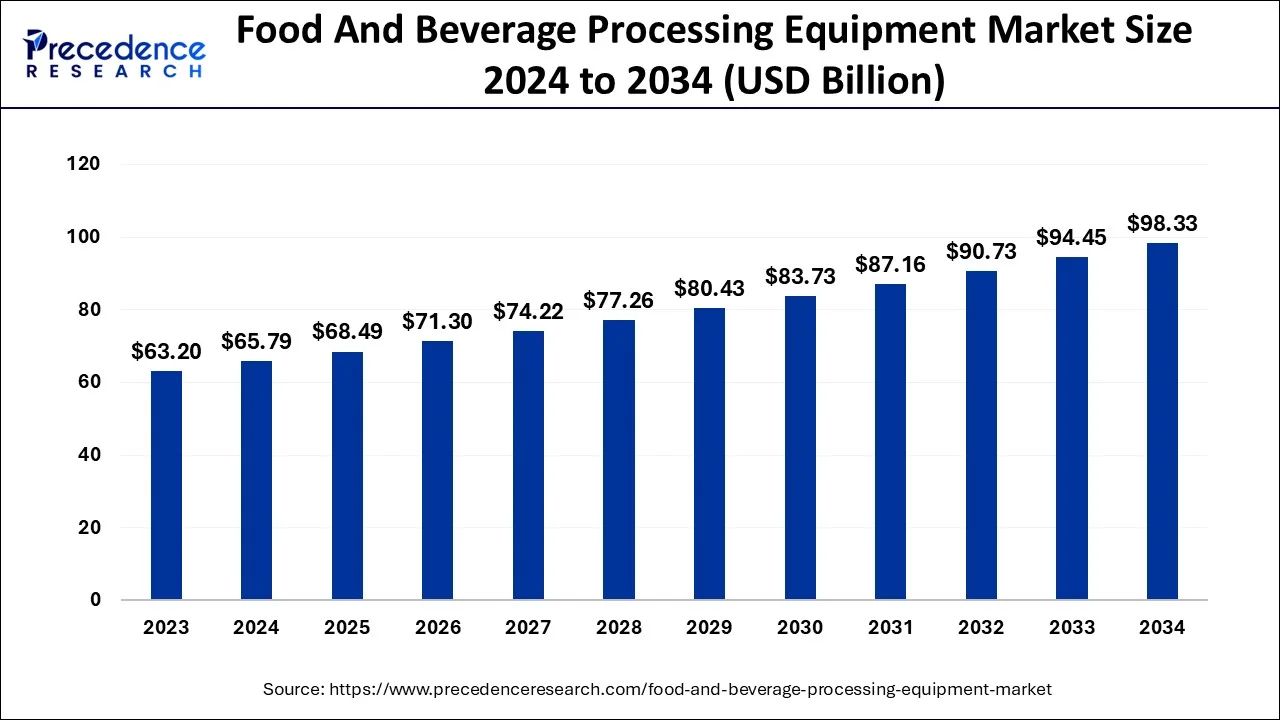
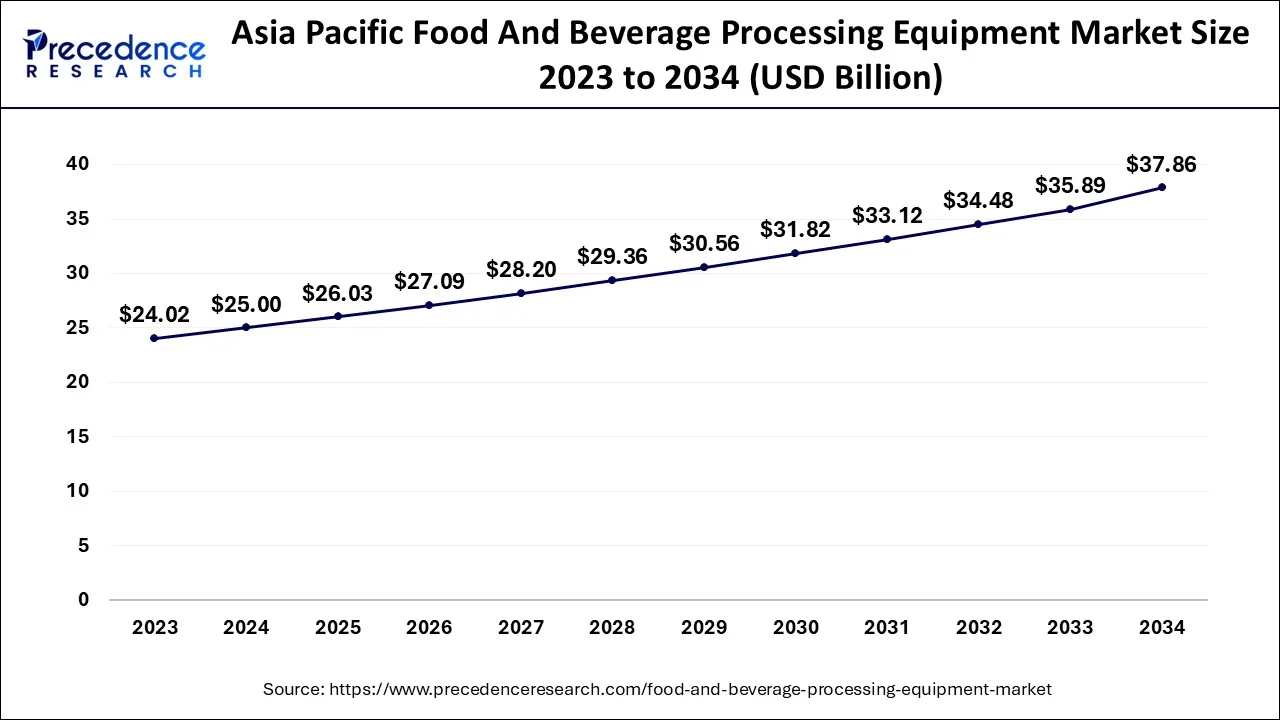
The global food and beverage processing equipment market size accounted for USD 68.49 billion in 2025 and is predicted to surpass around USD 98.33 billion by 2034, representing a healthy CAGR of 4.10% between 2025 and 2034. The Asia Pacific food and beverage processing equipment market size accounted for USD 26.03 billion in 2025 and is expanding at a CAGR of 4.24% during the forecast period. The market sizing and forecasts are revenue-based (USD Million/Billion), with 2024 as the base year.
Source: https://www.precedenceresearch.com/food-and-beverage-processing-equipment-market
 Get a Sample
 Table Of Content
Food And Beverage Processing Equipment Market Size and Forecast 2025 to 2034
The global food and beverage processing equipment market size was estimated at USD 65.79 billion in 2024 and is anticipated to reach around USD 98.33 billion by 2034, expanding at a CAGR of 4.10% from 2025 to 2034. Food and beverage processing equipment market growth driven by rising processed food demand, automation adoption, food safety regulations, and expanding manufacturing capacity worldwide.
Food And Beverage Processing Equipment Market Key Takeaways
- In terms of revenue, the food and beverage processing equipment market is valued at $68.49 billion in 2025.
- It is projected to reach $98.33 billion by 2034.
- The food and beverage processing equipment market is expected to grow at a CAGR of 4.10% from 2025 to 2034.
- By Type, the processing segment is predicted to have a larger markets share by 2034.
- Fruit juices, non-alcoholic drinks, and alcoholic drinks are all driving the market growth.
- By application, the bakery & confectionery products segment contributed more than 22% of revenue share in 2024 and is predicted to have the largest market share by 2034.
- By end-product form, the solid segment is predicted to have the largest market share from 2025 to 2034.
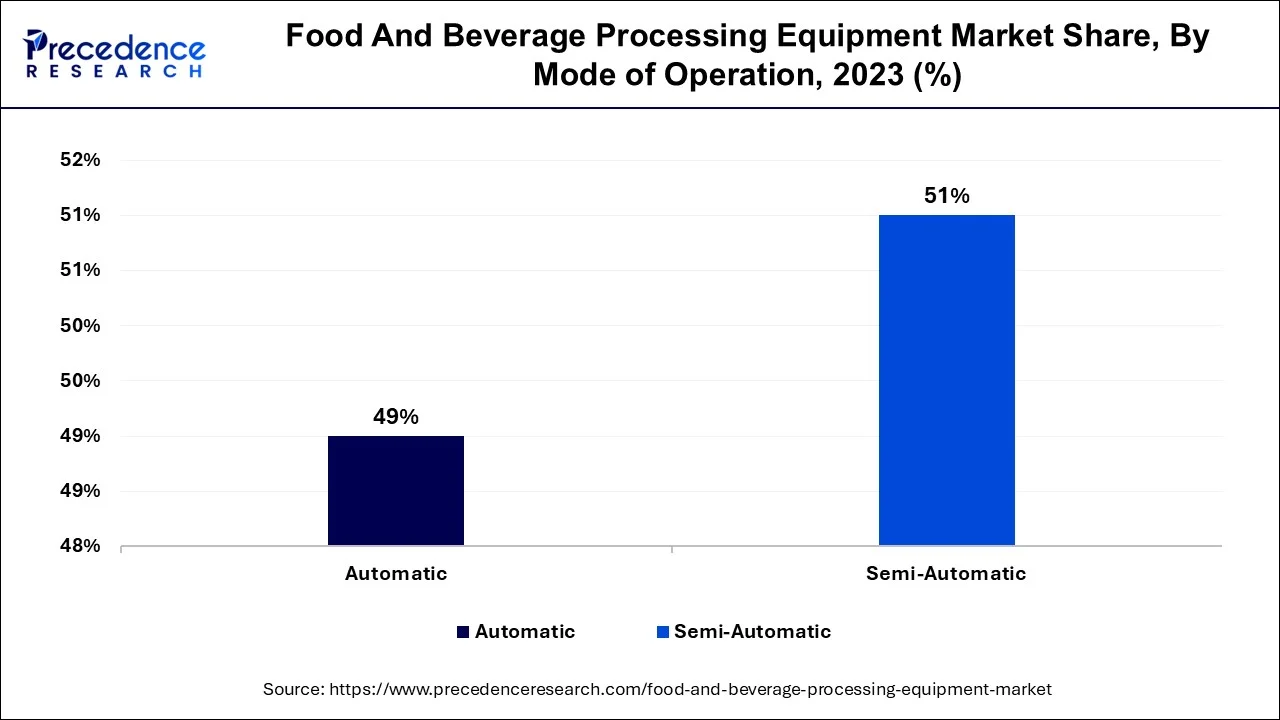
- By mode of operation, the semi-automatic segment captured more than 51% of revenue share in 2024.
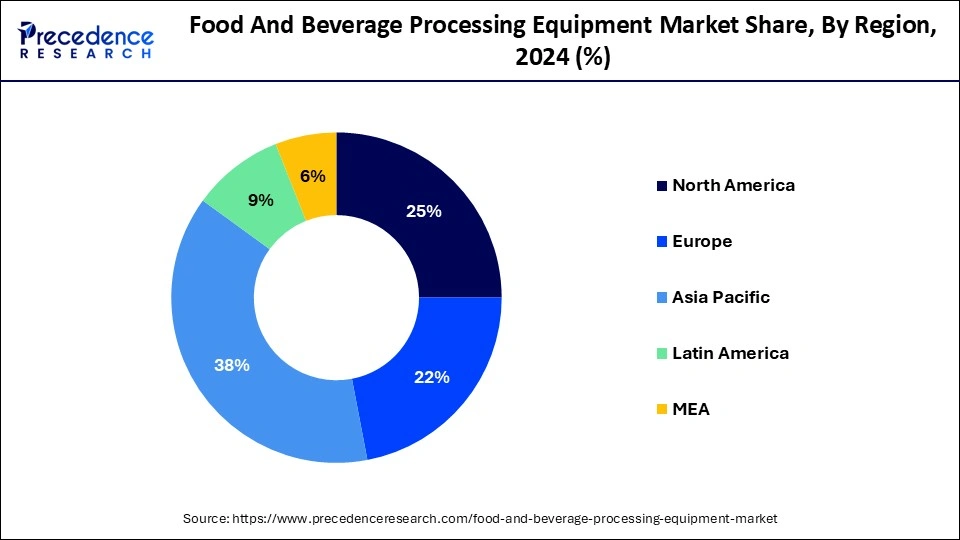
- The Asia Pacific region held the highest revenue share of around 38% in 2024.
Market Overview
The food and beverage processing equipment market involves machinery and systems that allow processing, handling, mixing, filling, packing, heating, cooling and preservation of food and beverage products. The industry helps manufacturers boost the efficiency of production while ensuring stable product quality and satisfactory food-safety standards. The overall expansion of the industry is facilitated by the rise of food and beverage production, growth of their demand, and investments in innovative manufacturing facilities. Production automation and robotics as well as smart processing technologies become more widespread as manufacturers strive to increase productivity and limit labor use, ensure efficient use of resources and flexibility of operation. The rise of the importance of food safety and hygiene pushes producers to invest in the upgrade of the existing equipment.
How Artificial Intelligence Revolutionizing the Food And Beverage Processing Equipment Market
The food and beverage processing industry is undergoing a revolution due to the advances in artificial intelligence. AI can do wonders in automating processes, predicting maintenance requirements, and ensuring quality checks in real-time. The implementation of AI-enabled system in food production enables the analysis of production processes in order to identify any issue with the equipment, improve the production process, and lower downtime. Machine learning can also be used to save energy and improve planning processes while still guaranteeing high product quality. The use of computer vision supports the process of automated inspection as it helps in detecting any problem with the product, contamination, or packaging process. Finally, AI-powered equipment ensures greater response speed of manufacturers to changing consumer demand.
Food And Beverage Processing Equipment Market Growth Factors
The increase in the demand for processed food products by consumers across many nations has led to an increase in demand for the equipment required for processing the food. Increasing demand is the most important factor responsible for the growth of the market. Rapid industrialization and urbanization in developing nations is also responsible for the growth of this market. Dual-income households or creating a hectic work life and busy schedules which increase the dependency of these couples on packaged food and beverages. There is a major shift in the eating habits of many consumers even in developing nations. As packaged and processed food and beverages are extremely convenient It is replaced by regular meals in developing as well as developed economies.
Major market players are investing a lot of amounts in order to come up with technologically advanced equipment for use in this industry. In order to increase the production capacity of this equipment there is constant research and development. The use of this equipment have increased the output or the production capacity of these industries. Doesn't increase awareness regarding the benefits of this equipment in the developing nations which are replacing the old equipment with the more advanced equipment which requires very less or no human intervention. Due to the reduced human intervention, there is no contamination of food products or beverages. The quality of food products and beverages is maintained due to automation in this industry. An increase in the demand for healthy beverages is also driving the growth of the market. Owing to all of these reasons the global food and beverage processing equipment market is expected to grow well during the forecast period.
Future Trends in Food And Beverage Processing Equipment Market
- Increase in Automation: Food and beverage sectors are getting used to robots, automated processes, and intelligent production lines in order to improve the level of efficiency, reduce dependence on labor, enhance the consistency of products, and minimize the rate of errors.
- Smart Processing: Equipment, sensors, and online monitoring powered by the Internet of Things will allow manufacturers to conduct predictive maintenance and optimize the processes and the quality of the product being produced.
- Eco-friendly Machinery: The growing demand for more environment-friendly production will push manufacturing companies to produce the machinery that helps cut down the consumption of energy, water, and waste as the use of such machines helps minimize resource use.
- Flexible Production: Manufacturing companies will invest in modular, flexible equipment suitable for producing a wide array of products in little time and helping with customization.
Food and Beverage Processing Equipment Market Outlook
- Market Overview: It is anticipated that the market will continue expanding as food manufacturers hurry to purchase integrated equipment to ensure high productivity levels as demand for processed, packaged, ready-to-eat, and healthy food keeps increasing.
- Global Expansion: Expansion has also become global in nature and can be observed in emerging countries, primarily in Asia-Pac, LATAM, and the Middle East and Africa, where the growth of food-processing capacity, cold chain, and consumption of packaged food are already noticeable.
- Sustainability Trends: Sustainability is becoming an important aspect that manufacturers take into account while creating new equipment by introducing the energy-efficient processing installations and water-efficient cleaning technologies, heat recovery, renewable energy usage, and waste reduction solutions. According to FAO, among key innovations in food processing should be efficient processing equipment and technologies, water recycling, heat recovery technologies, and energy-saving ovens and refrigeration.
- Startup Ecosystem: The emergence of startups has provided plenty of opportunities in the field of the manufacture of intelligent processing equipment, AI-based quality inspection, robotics that use IoT technologies, precision fermentation systems, and digital monitoring systems.
Market Scope
| Report Coverage | Details |
| Market Size in 2024 | USD 65.79 Billion |
| Market Size in 2025 | USD 68.49 Billion |
| Market Size by 2034 | USD 98.33 Billion |
| Growth Rate from 2025 to 2034 | CAGR of 4.10% |
| Base Year | 2024 |
| Forecast Period | 2025 to 2034 |
| Segments Covered |
|
| Regions Covered |
|
Market Dynamics
Driving Factor
Automation Demand
- The rising demand for automated systems, as well as smart systems in the food and beverage sector, is fueling the adoption of equipment. Food and beverage businesses are investing into automation options such as filling, packaging, mixing, as well as quality-control equipment to increase efficiency in manufacturing processes, secure the quality of their products, as well as satisfy the demand of consumers.
Restraint
High Investment Costs
- High initial costs related to advanced technology in food processing may hinder the growth of the sector and particularly affect the smaller and medium-sized producers. Expenses related to the installation, operation, upgrade, and employment of the highly-skilled workers will contribute to the increased operational costs.
Opportunity
Smart Processing Technologies
- Integration of Internet of Things, AI, robotic systems, and other cutting-edge devices create prospects and opportunities for the manufacturers. The smart equipment allows real-time monitoring and predictive maintenance, energy optimization, and effective quality control, thus saving costs on waste, and improving efficiency of work.
Segments Insights
Type Insights
The processing equipment segment in the food and beverage processing equipment market is expected to have larger markets share in the coming years. The processing equipment segment has dominated the market in the past. An increase in the demand for bakery products across the globe is leading to the growth of this segment. Bakery products and confectionery products especially bread is consumed in high quantity across the European and North American region. Bread is a staple food of many European countries and a great amount of bread is consumed every year by a single person in these countries. An increase in the demand for other bakery items in developing nations is also helping in the growth of this segment. Rapid industrialization and urbanization that doesn't increase in the demand for beverages in developing nations. Increased per capita income and high disposable income insert resulting in creating a demand for beverages across the developing nations.
Fruit juices, non-alcoholic drinks, and alcoholic drinks are all driving the market growth. The use of dairy products for manufacturing other products and the consumption of milk across many states in the Asia Pacific region is expected to drive market growth. Followed by the processing segment the preprocessing segment will also have a good market share during the forecast period. Preprocessing methods include washing, Sorting, peeling, cutting, slicing, grinding, blending, etc. all the raw materials or products derived from agriculture undergo these preprocesses before the final product is achieved. Drying, cooling, and freezing are the different types of processes involved in the production of the final products which have an increased shelf life.
Application Insights
On the basis of application, the bakery and confectionery segment accounted for more than 22% of revenue share in 2024 and is expected to have the largest market share in the coming years. Equipment are used for manufacturing alcoholic beverages meat and poultry products, fish and seafood products. Bakery and confectionery products how high is demand in countries like Germany, France and UK. As bread is consumed as a Staple food across the European region the market is expected to grow. on average every year one person in the European region consumes about 50 kilograms of bread. Commercial bakeries use the equipment for manufacturing loaves of bread. The equipment available for the production of this bread are able to generate large quantities in less amount of time.
Apart from bakery and confectionery products dairy products are also expected to have a good amount of market share in the forecast period. The dairy products segment has great demand in the Asia Pacific region. The equipment required for the bakery and confectionery products is ovens, cutters, blenders, and molders. Increasing demand for frozen meat products in developed nations is expected to help in the growth of the market during the forecast period. North American region and the European region have the greatest demand for meat and poultry products. Increasing demand of this product is leading to an increase in the usage of equipment needed for the processing of these food products.
End-Product Form Insights
On the basis of the end product, the solid segment is expected to have the largest market share during the forecast period. The solid segment is expected to grow due to many factors. In order to produce a solid product there is an ease of handling these products. It is extremely easy to pack the end product which is not the case for liquid or semisolid products. Transportation and storage of solid food products is extremely easy as compared to semisolid or liquid products. There is an increased risk of damage and contamination.
Mode of Operation Insights
The different modes of operation which are automatic and semi-automatic are used in this industry. The semi-automatic segment accounted for more than 51% of revenue share in 2023. Automation in these industries have led to an increase in the output of the product and the time consumed is less. Automation in this industry has also reduced the cost of operations as compared to the old machines.
The automatic segment consumes less energy compared to the semi-automatic segment so this happens to be a green option. Labor is extremely expensive in many developed nations and automation or the use of robotics in this industry has reduced the demand for human labor. All of these factors have led to the optimum utilization of all the resources in manufacturing the products.
Regional Insights
Asia Pacific Food and Beverage Processing Equipment Market Size and Growth 2025 to 2034
The Asia Pacific food and beverage processing equipment market size was estimated at USD 25 billion in 2024 and is expected to be worth around USD 37.86 billion by 2034, rising at a CAGR of 4.24% from 2025 to 2034.
As there is a growing demand for food and beverage processing equipment in the Asia Pacific region this region held the biggest revenue share of around 38% in 2024. There is an increasing focus on the development of advanced equipment which would help in increasing the production capacity of these industries. Many major market players are present in The Asia Pacific region. Growing demand for processed foods from nations like Australia, India, China, and New Zealand is driving the growth of the market. The increasing population enters demand for quick-service restaurants is growing in the Asia Pacific region and this also is a leading cause for the growth of this market. The industry is focusing on manufacturing technologically advanced and innovative equipments for generating larger outputs to satisfy the demands of the growing population.
The governments of various developing as well as developed nations have strict regulations and standards on the manufacturing and distribution of food and beverages across the globe. The equipment used in the production of this food and the processing of the beverages is also of great importance. Food processing equipment and beverages processing equipment all the processing machines that handle cook stores and packed the food products in order to offer to the market. Processing food products and beverages is extremely helpful and extend the shelf life. A wide range of food processing equipment is available for different types of food products. Equipment are available for bakery dairy beverages etc.
Equipment is designed for carrying out various processes on the food. It involves washing, separating baking mixing, and sealing food products in order to offer the final product. These industries or established in order to transform the raw materials derived from agricultural products how transform some of the already processed food products into ready-to-cook food products and beverages. Molders, blenders, cutters, kettles, vacuum pans, mixers, and ovens are the different types of equipment used in this market.
An increase in the demand for bakery products, confectionery dairy products and meat which is available in the form of processed food or convenient food it's driving the growth of the market. Major companies are investing in order to expand their businesses to different territories. Food and beverage processing equipment provides efficient production and facilitates the production of quality food products. The use of industrial robots and automation in this industry is helpful and increases the revenue generated. There's an increasing trend of ordering food online in recent years the market is expected to grow and online platforms are providing great support for the growth of this market.
Competitive Landscape
The food and drink processing equipment market is semi-consolidated, where large manufacturers operate alongside regional or specialized equipment companies. The focus of competition here is on automation, flexibility in manufacturing, customization, and energy efficiency.
Dominant companies in the area such as GEA, Tetra Pak, Bühler, Alfa Laval, and JBT are doing well due to various portfolio offers of innovative solutions along with wide distribution and processing services. Local brands are competing with the help of tailor-made equipment as well as contributions made locally.
Companies in this area engage in automation and digitization, developing energy-efficient equipment, products, and establishing partnerships to be able to compete on the market. High investment requirements, engineering labor, entry to markets due to food industry regulations in sales or customer's loyalty are among the factors preventing successful entering.
Food and Beverage Processing Equipment Market Companies
- Marel (Iceland)
- Equipamientos Cárnicos
- S.L (Spain)
- Clextral (France)
- SPX FLOW (US)
- Bigtem Makine (Turkey)
- JBT (US)
- The Middleby Corporation (US)
- Heat and ControlInc. (US)
- Alfa Laval (Sweden)
- Heat and Control, Inc. (US)
- BAADER (Germany)
- Dover Corporation (US)
- GEA Group (Germany)
- Bühler (Switzerland)
- TNA Australia Pty Ltd. (Australia)
- Bucher Industries (Switzerland)
- FENCO Food Machinery (Italy)
- Krones Group (Germany)
- Finis Food Processing Equipment B.V. (Netherlands)
- Bettcher IndustriesInc. (US)
- Anko Food Machine Co. Ltd. (Taiwan)
Recent Developments
- In May 2025, a globally famous food processing and packaging solutions company known as Tetra Pak introduced their state-of-the-art customer innovation center in Bangkok. This new center was launched to help businesses transform their journey from a basic level to the industrial revolution in the food and beverage market. This initiative helps Thai businesses to scale faster, optimize their production rate as per consumers' demand on a global scale.
Segments Covered in the Report
By Type
- Pre-Processing
- Sorting & Grading
- Cutting, Peeling, Grinding, Slicing, and Washing
- Coating
- Drying, Cooling, and Freezing
- Thermal
- Homogenization
- Filtration
- Pressing
- Mixing & Blending
- Processing
- Forming
- Extruding
By Mode of Operation
- Automatic
- Semi-Automatic
By End-Product Form
- Solid
- Liquid
- Semi-Solid
By Application
- Bakery & Confectionery Products
- Meat & Poultry
- Dairy Products
- Non-Alcoholic Beverages
- Alcoholic Beverages
- Fish & Seafood
- Other Applications (fruits, vegetables, ready-to-eat meals, sauces, and dressings)
By Geography
- North America
- Europe
- Asia-Pacific
- Latin America
- Middle East & Africa (MEA)
For inquiries regarding discounts, bulk purchases, or customization requests, please contact us at sales@precedenceresearch.com
Frequently Asked Questions





Ask For Sample
No cookie-cutter, only authentic analysis – take the 1st step to become a Precedence Research client
 Get a Sample




 sales@precedenceresearch.com
 Schedule a Meeting
