



Halal Ingredients Market Size, Key Companies, Company Product Portfolio, Manufacturing Output, Raw Material Cost, Consumer Demand, Supply Chain Analysis, Company Market Share, and Competitive Landscape
Halal Ingredients Market (By Type: Food Ingredients, Beverage Industry, Cosmetic Industry, Pharmaceutical; By Product: Personal Care Products, Color Cosmetics; By Distribution Channels, Online, Offline) - Global Industry Analysis, Size, Trends, Leading Companies, Regional Outlook, and Forecast 2025 to 2034
Source: https://www.precedenceresearch.com/halal-ingredients-market
 Get a Sample
 Table Of Content


What is the Halal Ingredients Market Size?
The global halal ingredients market size is accounted at USD 364.09 billion in 2025 and predicted to increase from USD 375.37 billion in 2026 to approximately USD 479.22 billion by 2034, growing at a CAGR of 3.10% from 2024 to 2034.
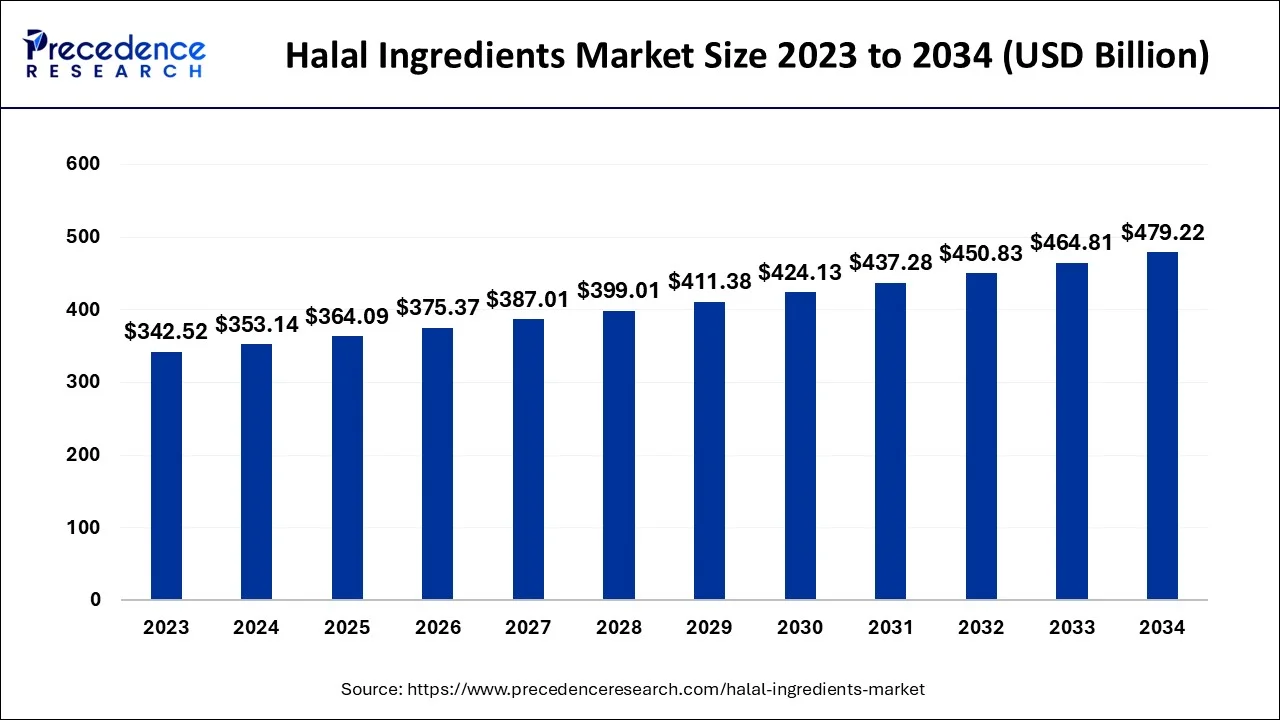
Halal Ingredients Market Key Takeaways
- Based on type, the food and beverages segment has garnered 61% revenue share in 2024 and expanding growth at a CAGR of 5% from 2025 to 2034.
- The Middle East region is expected to drive growth at the CAGR of 8% over the forecast period.
- The online distribution channel segment is expected to reach at a CAGR of 8% over the forecast period.
- The ingredients for the cosmetics segment is growing faster at a CAGR of 7.2% between 2025 to 2034.
Market Overview
With growing population belonging to the Muslim community the requirement of halal products is also growing in terms of food and beverages. The supply of functional food products and beverages has driven the market during the current forecast period. Rising awareness regarding the health care sectors and the various beneficial factors that body obtains from such food products as help to boost the market during the forecast period. These products are gaining momentum in the food, health care and pharmaceutical industry due to they are varied applications in these sectors. The market also sees a bright future as a result increasing requirement of health supplements and dietary products that are provided from these food sources. As a result of the rapid organization and development that the countries are experiencing, the requirement of high nutrition content food which is provided with convenience is rising. The new train to value of the food holds an important place in the life of the busy people in these urban countries. Quick snacking instead of lengthy main course system has taken over the lifestyle of the people residing on these countries.
The uniformity of the products supplied by the halal ingredients market is sometimes questionable as a result of the heavy demand that is experience by the market due to the growing population of the Muslim community and also the other communities which prefer to go by these methods. Hence the quality that the halal ingredients market is expected to supply to the consumers as hampered and a uniform experience is lacking and the current market which hampers of the market during the forecast period. The presence of certification regarding the halal food products and beverages is also a matter of concern as a result of the increasing malpractices that are experienced in order to fulfill the growing demands. The cosmetic and beauty products industry has also been affected by such uniformity issues which have declined its sales.
The lack of standardization has also been a drawback for the halal ingredients market which makes it uncertain for the buyers to have a perfect product. The safety and quality of the products are the primary concerns that the consumer looks for when utilizing such specific type of products. The strict guidelines laid down by the government regarding the standardization of the halal ingredient products has hampered the growth of the market pertaining to the heavy loss of materials in case the products do not fall into the specified rules. Similarly, the cosmetic products beauty products and the perfume industry have also suffered due to the standardization guidelines imposed on them. Additionally, the cost of these Halal ingredient products is high due to the increasing demand by the population and their benefits that the world is becoming aware of. These products are labelled as exclusive due to the specific procedures carried out in order to prepare them. The pharmaceutical sector too has challenges in order to comply with the safety and standardization guidelines which have to be followed strictly. The products have to be labelled accordingly and quality has to remain uncompromised at all costs. Hence the cost rises marginally for these additional procedures.
Halal Ingredients Market Growth Factors
The major growth factors for the halal ingredients market include the use population residing in the Muslim dominated countries that demand heavy supply of the halal ingredient products as a result of their religious practices and rules. The population of these countries is increasing day by day which increases the amount of functional food and beverages which are consumed on a daily basis. As a result of their high disposable income the purchasing power of the people is more which makes it possible for them to purchase high end costly products from the Halal ingredient products market.
The halal ingredient market also has a heavy supply to the cosmetic industry which uses the raw materials for the production of various applicants and perfumes along with numerous beauty products which receives high demand from the market. The flavour industry also helps to boost the market size as a result of the ongoing R&D which makes it possible for them to introduce new and innovative flavours in order to attract the younger generation having an extremely busy life style. The huge number of people belonging to the working class demands the supply of functional food and beverages which can be used as snacking food products in order to save time. The heavy supply of Halal raw materials to the pharmaceutical industry has also proved to be a driving force for the market as a result of the numerous medicines that are made from these materials. Due to the increasing health awareness among the people after the occurrence of the pandemic, the demand for the beneficial effects of the halal ingredient products has seen a gradual rise. The uniformity that is maintained by the halal ingredient market has helped people to gain confidence on the product supplied by the companies without having a second thought. The standardization rules set by in the government and the international market has also forced the companies to deliver quality products without compromising in the religious and social beliefs of the people. The certification system that has been adopted by the halal ingredients market has additionally help to boost the market by developing a trust among the consumers regarding the authenticity of the ingredients and the products manufactured by the company. With the increasing awareness regarding the health care sector after the occurrence of the pandemic the use of health supplements and nutritive products has increased to a great extent. The use of the halal ingredients into these nutritive supplements and health products is vast as a result of the high beneficial properties that they contain along with the cleanliness that is followed by the industries. The demands and supply of these nutritive products are seen a gradual rise with the increasing number of geriatric populations who mainly require the use of such supplements in order to maintain their health.
Recent Trends in Halal Ingredients Market
| Trend | Brief Description |
| Rising Global Demand | Halal is seen as a mark of quality and safety by both Muslim and non-Muslim consumers. |
| Strict Certification | Stronger halal laws and traceability rules in Asia and GCC countries. |
| Plant-Based Shift | Growing use of natural, plant-derived, and clean-label ingredients. |
| Beyond the Food Sector | Expanding into cosmetics, pharma, and personal care. |
| Tech integration | Blockchain is used for halal traceability and supply chain transparency. |
| R&D Innovation | Focus on biotech and fermentation for halal proteins and enzymes. |
| Sustainable Sourcing | Emphasis on eco-friendly and ethical ingredient production. |
| Regional Growth | Asia Pacific and the Middle East are driving global market expansion |
| Brand Expansion | Companies are widening halal-certified product portfolios. |
| E-commerce Boost | Online sales and global halal expos are increasing accessibility. |
Market Outlook
- Industry Growth Overview: The halal ingredients market is witnessing strong global growth as consumers become more conscious of certified and ethically made goods. Steady growth is being driven by growing demand from consumers, both Muslim and Non-Muslim, who identify halal with quality, safety, and purity. To reach a larger market, sectors including food, drink, cosmetics, and pharmaceuticals are using halal-certified ingredients.
- Sustainability Trends: As manufacturers shift to ethical production methods and environmentally friendly sourcing, sustainability has emerged as a major concern in the halal ingredients market. Sustainable agriculture, traceable supply chains, and energy-efficient manufacturing techniques that respect environmental and halal values are being incorporated by numerous businesses. The growing overlap between clean label organic and halal trends indicates that consumers prefer goods that are both environmentally friendly and compliant with their faith.
- Startup Ecosystem: The halal ingredients startup ecosystem is expanding as creative businesses enter the market to close product gaps in the food, personal care, and pharmaceutical industries. Startups are concentrating on halal-compliant, cruelty-free cosmetics plant plant-based proteins, and natural flavorings. These new players are expanding swiftly thanks to strategic partnerships with established manufacturers and certification organizations.
Market Scope
| Report Coverage | Details |
| Market Size by 2025 | USD 364.09 Billion |
| Market Size by 2026 | USD 375.37 Billion |
| Market Size by 2034 | USD 479.22 Billion |
| Growth Rate from 2025 to 2034 | CAGR of 3.10% |
| Base Year | 2024 |
| Forecast Period | 2025 to 2034 |
| Segments Covered | Type, Product, Distribution Channels, Geography |
Segments Insights
Type Insights
On the basis of type, the food and beverages market has dominated largest revenue share 61% in 2023 and expected to grow at a CAGR of 4% from 2024 to 2034. Industries I have their main attention towards the research and development regarding the products applied by the halal ingredients market in order to compete with the needs and requirements expressed by the people. Multiple marketing strategies are being adopted in order to publicize the health benefits of the halal ingredients products. The specific standardization guidelines which are followed by the companies have also help to boost the opportunities for the market.
The ultimate quality that is supplied by the halal ingredient market in order to maintain their strong presence in the society as a result of the increasing demand from the Muslim dominator countries helps the market to show a significant growth during the forecast period.
Application Insights
By application, the market is for the divided into cosmetics, pharmaceuticals and the food and beverages industry. In this segment the cosmetic sector has shown a considerable growth. As far as the market revenue is concerned the food and beverages market is still ruling the segment as a result of the high demand it faces as a result of its health benefits and cleanliness that it offers. The introduction of new flavours into the industry as health to keep the halal ingredient products into the fashion for longer period of time which has mainly attracted the younger generation who prefer quick snacks rather than complete meals having a proper main course. The factor of obtaining Halal certificate has become very important in order to prove the standardization of the products to the consumers.
Distribution Channel Insights
By distribution channel, the supermarkets and hypermarkets have dominated the segment as a result of the clan in Ness they provide the customers with along with the standardization process that are followed flawlessly. These outlets mostly provide certified Halal ingredient products which ensure the customer of its authenticity and quality. In order to avoid health risks in relation to cleanliness these outlets are preferred more as compared to the local retailers. The local vendors too have showcased huge returns pertaining to the sales on a daily basis and the affordability of the products that supports the disposable income of the consumers.
Geography Insights
The Middle Eastern sector has provided the biggest market for the halal ingredients during the recent years. The rapid growth in the population belonging to the Middle East countries has increased the consumption of food products belonging to the halal ingredients market. That to support provided to this Halal ingredients market from the government in terms of their facilities, policies, terms, conditions and sales helps to expand the market throughout the country without any hassle. In 2022, Germany held 17.1% market share in the Europe region and growing at a CAGR of 4.1% over the forecast period. In the GCC Countries the Turkey market accounted 21.2% market share in 2023 and it is projected to reach at a CAGR of around 6% from 2024 to 2034.
The other countries which support the growth of the halal ingredients market are Iran, Iraq, Afghanistan, UAE and Saudi Arabia which also has a majority of Muslim population and are primarily known as Muslim countries. Hence the demand and supply in these regions have seen a tremendous growth during the forecast period which has helped the market to have a strong foot hold in these particular regions. The rapid economic development in these countries has also help to increase the disposable income present with the people that help to boost the market for the halal ingredients during the forecast period. Malaysia market accounted 24% market share in the South Asia Halal ingredients market and expected to grow at a CAGR of 5% from 2024 to 2034.
Value Chain Analysis
- Raw Material Procurement: Only confirmed vendors who adhere to halal certification requirements are used to source raw materials. Using more natural and plant-based resources promotes transparent supply chains and guarantees sustainability, safety, and ease of compliance
- Retail Sales and Marketing: Transparency in certification and authenticity are key components of retail marketing. Consumer awareness and demand for certified food, cosmetics, and personal care products are increasing thanks to halal labels, digital campaigns, and specialized retail sections.
- Waste Management and Recycling: Manufacturers are adopting practices to minimize waste and promote recycling. Efforts included reusing byproducts, reducing water consumption, and ensuring disposal processes align with halal and environmental guidelines.
Recent Developments
- In May 2025, Biokar Diagnostics launched a new Halal‑certified range of dehydrated culture media, starting with four formulations. (Source: https://www.solabia.com)
- In June 2025, Eevia Health Plc received HALAL certification from Halal Quality Control Group for its production processes and selected product lines. (Source: https://news.cision.com)
Halal Ingredients Market Companies
- Barentz B.V.
- Symrise
- Ashland
- Purecircle Ltd
- Halagel
- ADM
- Kerry
- DowDupont
- Solvay S.A.
- Koninklijke DSM N.V.
- Cargill
- BASF
Key market developments
- In September 2018, Al-Hur Beauty which is an all-natural halal beauty brand, introduced itself in Malaysia. This company is located in the UAE. With the view to spread its business and expand its brand this step was taken into consideration. The company mainly focuses to supply authentic cosmetic products with a reliable quality that comply with the international halal certifications standard.
- In December 2018, a well-known US-based meat alternative supplier was granted halal certification from Islamic Food and Nutrition Council of America. It is known as Impossible Foods which is popular for the quality products that it delivers.
Segments covered in the report
By Type
- Food Ingredients
- Sauces and marinades
- Thickening agents
- Sugar substitutes
- Flavors
- Other
- Beverage Industry
- Coffee
- Tea
- Concentrated beverages and juices
- Soft drinks
- Health and nutritional drinks
- Cosmetic Industry
- Body and skin care
- Oral care
- Fragrance
- Hair care
- Pharmaceutical
- Active Pharma Ingredients
- Excipients
By Product
- Personal Care Products
- Color Cosmetics
By Distribution Channels
- Online
- Offline
By Geography
- North America
- U.S.
- Canada
- Europe
- U.K.
- Germany
- France
- Asia-Pacific
- China
- India
- Japan
- South Korea
- Malaysia
- Philippines
- Latin America
- Brazil
- Rest of Latin America
- Middle East & Africa (MEA)
- GCC
- North Africa
- South Africa
- Rest of the Middle East & Africa
For inquiries regarding discounts, bulk purchases, or customization requests, please contact us at sales@precedenceresearch.com
Frequently Asked Questions





Ask For Sample
No cookie-cutter, only authentic analysis – take the 1st step to become a Precedence Research client
 Get a Sample




 sales@precedenceresearch.com
 Schedule a Meeting
