



Hybrid Electric Vehicle Market Size, Key Companies, Company Market Share, Vehicle Production Volume, Sales Performance, Export & Import Analysis, Technology Adoption, Competitive Positioning, and Demand Trends
Hybrid Electric Vehicle Market (By Type Full Hybrids, Mild Hybrids, Plug-in Hybrids, Others; By Application: Battery, Electric Motor, Transmission; By Power Source: Stored Electricity HEVs, On-Board Electric Generator HEVs; By Powertrain: Series Hybrid Electric Vehicles, Parallel Hybrid Electric Vehicles, Combined Hybrid Electric Vehicles; By Vehicle: Hybrid Electric Passenger Cars, Commercial Hybrid Electric Vehicles, Hybrid Electric Two Wheelers, Other HEVs (Golf Cart, etc.)) - Global Industry Analysis, Size, Trends, Leading Companies, Regional Outlook, and Forecast 2026 to 2035
Source: https://www.precedenceresearch.com/hybrid-electric-vehicle-market
 Get a Sample
 Table Of Content


What is Hybrid Electric Vehicle Market Size?
The global hybrid electric vehicle market size is accounted for USD 119.08 billion in 2025, and is projected to hit USD 143.73 billion by 2026, and is anticipated to reach around USD 745.8 billion by 2035, growing at a CAGR of 20.14% from 2026 to 2035
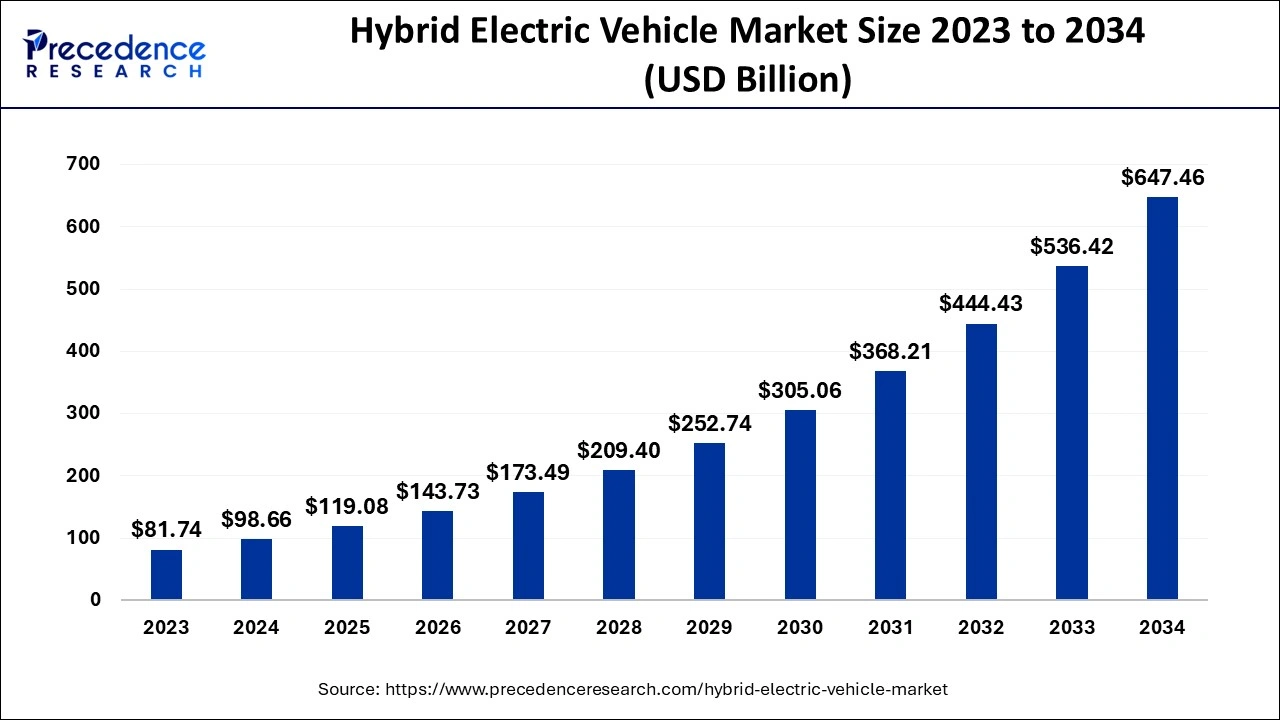
Market Highlights
- Gasoline hybrid vehicles projected to surpass a value of over US$ 130 million by 2035.
- Stored electricity HEVs is growing at a CAGR of 6% from 2026 to 2035
- U.S hybrid electric vehicle is expected to grow at a CAGR of 8.2% through 2035.
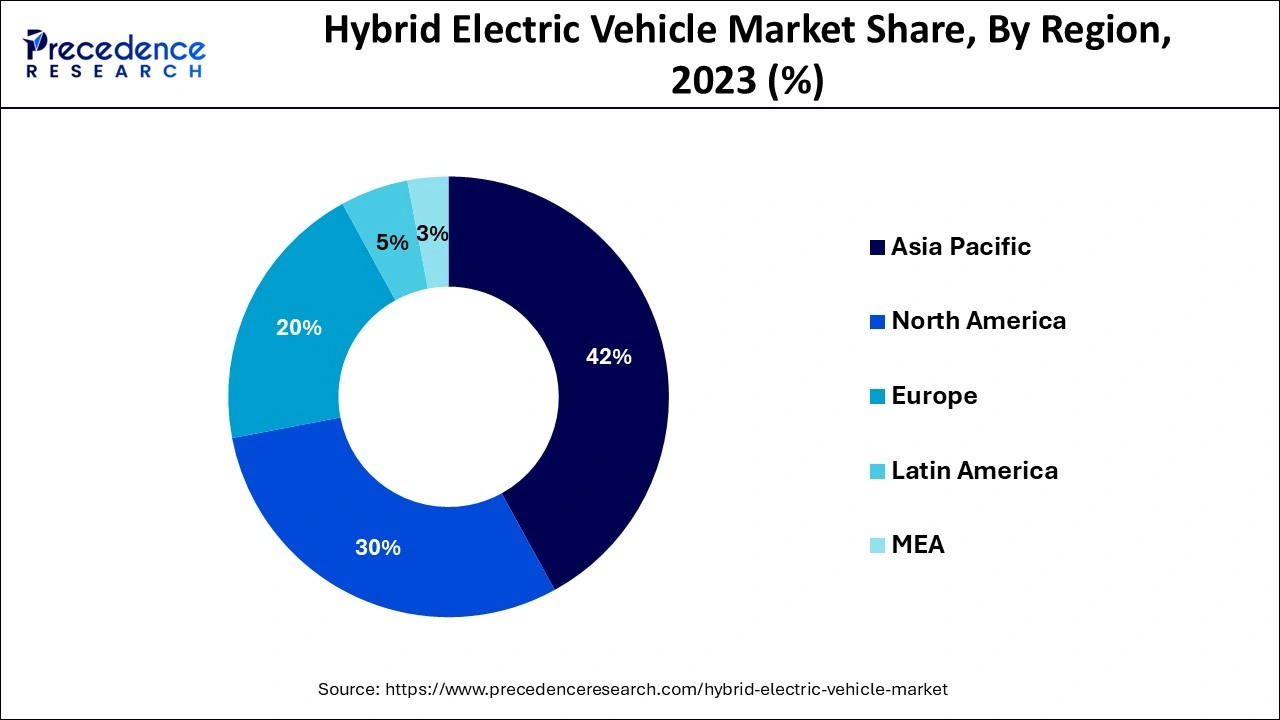
- Asia Pacific region had garnered revenue share of around 42% in 2025.
- In 2023, the European region accounted 20% revenue share.
Artificial Intelligence in Hybrid Electric Vehicle Market
Artificial intelligence is going into the HEV market to boost efficiency, safety, and sustainability. AI-powered energy management optimizes the power distribution in order to increase fuel efficiency and reduce emissions. Battery management systems go ahead and forecast battery degradation, regulate temperature, and balance cells with the goal of helping to extend the batteries' life. AI is even offering driving experience options enhanced by adaptive control, ADAS, and increasingly autonomous features, as well as personalized settings. Reduced downtime and costs are achieved with predictive maintenance and expedited diagnosis. The other AI applications include demand forecasting, precision assembly, defect detection, and supply chain optimization, further reducing waste and energy consumption.
Market Overview
The COVID-19 scourge has smothered the extension of the mixture vehicle industry by causing persistent lockdowns and closures of assembling units, bringing about a reduction underway levels of these vehicles. Moreover, store network difficulties have prompted crossover vehicle cost increments. In any case, deals of half breed electric vehicles expanded after June 2020, when the lockdown in many nations was taken out. Makers will make big appearance new models to tempt purchasers, subsequently the projected period is anticipated to be confident. Toyota conveyed 338,000 half and half vehicles in the United States in 2020, representing 16% of complete US deals, and it means to present new crossover electric vehicle types in 2022.
One of the fundamental reasons quite affecting the gathering of HEVs is rising air defilement levels achieved by vehicle exhaust releases, as well as extended normal mindfulness among the general populace about rising pollution levels. This can similarly be credited to rising urbanization, extended individual purchasing power, and further created road associations. Close to that, expresses generally through the world are approving serious defilement rules and proficiency rules, as well as giving purchase grants, related inspirations, charge discounts, and utility rate diminishes. Hence, the overall usage of HEVs is growing. Besides, different top automakers are supporting their inclinations in imaginative work (R&D) activities to make novel vehicles with calm undertakings, world class execution engines, and further developed mileage.
Hybrid Electric Vehicle Market Growth Factors
The execution of extreme contamination and eco-friendliness norms, as well as government motivators to empower the buy and utilization of half and half vehicles, are a portion of the essential drivers driving the market's development. As open attention to discharges has developed, administrative associations have executed more severe emanation guidelines.
The rising severity of vehicle contamination guidelines is inciting OEMs to create cross breed and electric vehicles. In contrast with fuel and diesel vehicles, cross breed vehicles create less nursery emanations. Legislatures in the United States and Europe are chipping away at diminishing discharge limitations to lessen the ozone depleting substance impact, as well as expanding vehicle eco-friendliness. For instance, the US Department of Transportation has laid out vehicle Corporate Average Fuel Economy (CAFE) models. The rising rigidity of vehicle contamination guidelines is inciting OEMs to create half and half and electric vehicles. In contrast with gas and diesel vehicles, mixture vehicles create less nursery discharges.
Moreover, with legislatures carrying out severe measures as regulation and motivators, as well as extended drives for the establishment of public charging stations for electric vehicles, the market viable is probably going to quickly create. Batteries are a significant part of a vehicle since they supply capacity to various electrical parts that are fundamental for legitimate activity. The expanded entrance of electrical parts and engine frameworks in the vehicle business is anticipated to produce up interest for vehicle batteries. Besides, the expanded coordination of green advancements, like half and half and all-electric drive frameworks, builds the requirement for car batteries. Besides, the expense of a vehicle battery is quickly falling.
- Rigorous emission regulations force OEMs to produce hybrid and electric vehicles.
- Government incentives and support, such as subsidies, tax benefits, and establishment of public charging networks.
- Enhanced environmental awareness increases such demand for eco-friendly mobility solutions.
- Declining battery prices boost the emerging battery technologies with the consequence of efficiency and affordability.
- Improved installation of green technologies to further reinforce the market potential of hybrid vehicles.
Market Scope
| Report Coverage | Details |
| Market Size in 2025 | USD 119.08 Billion |
| Market Size in 2026 | USD 143.73 Billion |
| Market Size by 2035 | USD 745.8 Billion |
| Growth Rate from 2026 to 2035 | CAGR of 20.14% |
| Base Year | 2025 |
| Forecast Period | 2026 to 2035 |
| Segments Covered | Type, Application, Power Source, Powertrain, Vehicle, and region |
| Regions Covered | North America, Europe, Asia-Pacific, Latin America and Middle East & Africa |
Market Dynamics
Drivers
Environmental Concerns and Regulations
Emerging awareness regarding environmental issues such as climate change and air pollution lines the road for greener choices in transportation from the consumer's and government's point of view. Strict emission norms compel automobile manufacturers to treat HEVs as an effective means for curbing the emissions of greenhouse gases. In a way, such environmental pressures are the ones that promote the creation and dissemination of HEVs for market growth, as both regulatory bodies and environmentally conscious consumers view this as a solution for sustainable mobility.
Restraint
Limited Charging Infrastructure
Though bringing more charging networks into existence, a few locations continue to be the blacks, thus imposing a range limit for users of hybrid electric vehicles. Scarcity of charging stations creates range anxiety amongst users, and they eventually turn potential buyers and fleet operators into detractors of adopting HEVs. Because of the shortage of charging stations, the market growth has been retarded, itself postponing the substitution of conventional fuel-based automobiles into hybrid and electric variants.
Opportunity
Technological Advancements
Battery technology improvement, which makes room for power enhancement, life extension, and cost reduction, keeps on making hybrid electric vehicles more attractive. Efficient energy storage means high performance for vehicles, minimal charging time, and reduced overall cost. With speeding improvements to battery chemistry, power control systems, and regeneration technologies, manufacturers can make HEVs further competitive, more reliable, and easy to use, further increasing the acceptance and market potential of HEVs.
Segment Insights
Type Insights
During the projection time frame, the total hybrid class is supposed to have the greatest portion of the overall industry by volume. During the projection time frame, the gentle half and half industry is supposed to create at the quickest CAGR. The extension of the total mixture market might be credited to expanded eco-friendliness and lower discharges because of steady innovative progressions.
- Mild Hybrids
A "mild" cross breed framework is quite possibly of the latest development in mixture innovation. A gentle crossover framework, as the name shows, won't regularly push the vehicle exclusively on electric power. All things considered, the framework is utilized to give a minuscule lift to the vehicle's fuel motor, for the most part while beginning from a halt, and to assist with eliminating the heaviness of force hungry frameworks, for example, cooling, on the gas motor. Gentle mixtures, which are much of the time accessible as 48 volt electric frameworks, needn't bother with to be connected. All things being equal, the batteries are re-energized utilizing a blend of gas motor power and energy gathered when the vehicle brakes (otherwise called regenerative slowing down).
- Complete Hybrids
Full crossover vehicles, as gentle half and halves, incorporate both a gas motor and an electrical part. The electrical part of a total cross breed vehicle, then again, can deal with fundamentally more prominent responsibility than that of a gentle mixture. Most complete cross breeds can go a brief distance on electric power alone. This is more normal at lower city speeds, in spite of the fact that it is one justification for why a total mixture's City MPG figure might be more prominent than its Highway MPG rating (where in standard gas fueled vehicles, the inverse is valid).
- Plug-In Hybrids
Every one of the half breed vehicles we've covered up to this point charge their batteries completely inside. The critical differentiation with module crossovers is that their batteries might be charged both inside and outside. Accordingly, module half and halves commonly have longer all-electric reaches than complete mixtures. Module crossovers are essentially an extension between full half and half and totally electric cars.
Technology Insights
As far as specialized progress, the auto area has seen sensational changes lately. OEMs are relying upon electrical parts to meet changing client needs in view of their result proficiency and lightweight, making vehicle zap an eco-friendly other option. Moreover, zap is the following stage, with the heft of carmakers zeroing in on crossover fuelled vehicle improvement to meet the changing requirements of end clients and policymakers to meet green portability measures. Besides, crossover vehicles offer a more eco-friendly transportation decision than gas fuelled cars. At the point when the brakes are utilized, regenerative slowing down innovation returns energy to renew the battery. Subsequently, it disposes of the requirement for outer electric foundation. The regenerative stopping mechanism is the most common half breed vehicle innovation. The use of regenerative slowing mechanisms, as well as the lower cost of miniature and gentle crossovers when contrasted with PHEV, will increment interest for equal mixtures.
The creating air defilement levels on account of exhaust releases from vehicles, close by growing normal mindfulness among the larger part about rising tainting levels, address one of the key factors quite affecting the gathering of HEVs. This can in like manner be credited to fast urbanization, expanding purchasing power of individuals, and further creating road associations. Crossover vehicles should be more eco-friendly, have more prominent power, and produce less contamination. These vehicles gather electrical energy from various sources, including regenerative stopping mechanisms and motors. They can save energy by switching off the motor when the vehicle is left, inactive, or when the energy of the electric engine is adequate to move the vehicle without the guide of the ICE.
Application Insights
Considering application, the market is bifurcated into passenger cars and commercial vehicles. The business vehicle area holds the greatest part of the general business during the guess time span. The factors that can be credited to the rising interest for electric vehicles and the rising undertakings being embraced by OEMs, as well as states, are filling the interest for this part.
Regional Insights
Asia Pacific Hybrid Electric Vehicle Market Size and Growth 2026 to 2035
The Asia Pacific hybrid electric vehicle market size is evaluated at USD 60.37 billion in 2026 and is predicted to be worth around USD 317.55 billion by 2035, rising at a CAGR of 20.3% from 2026 to 2035
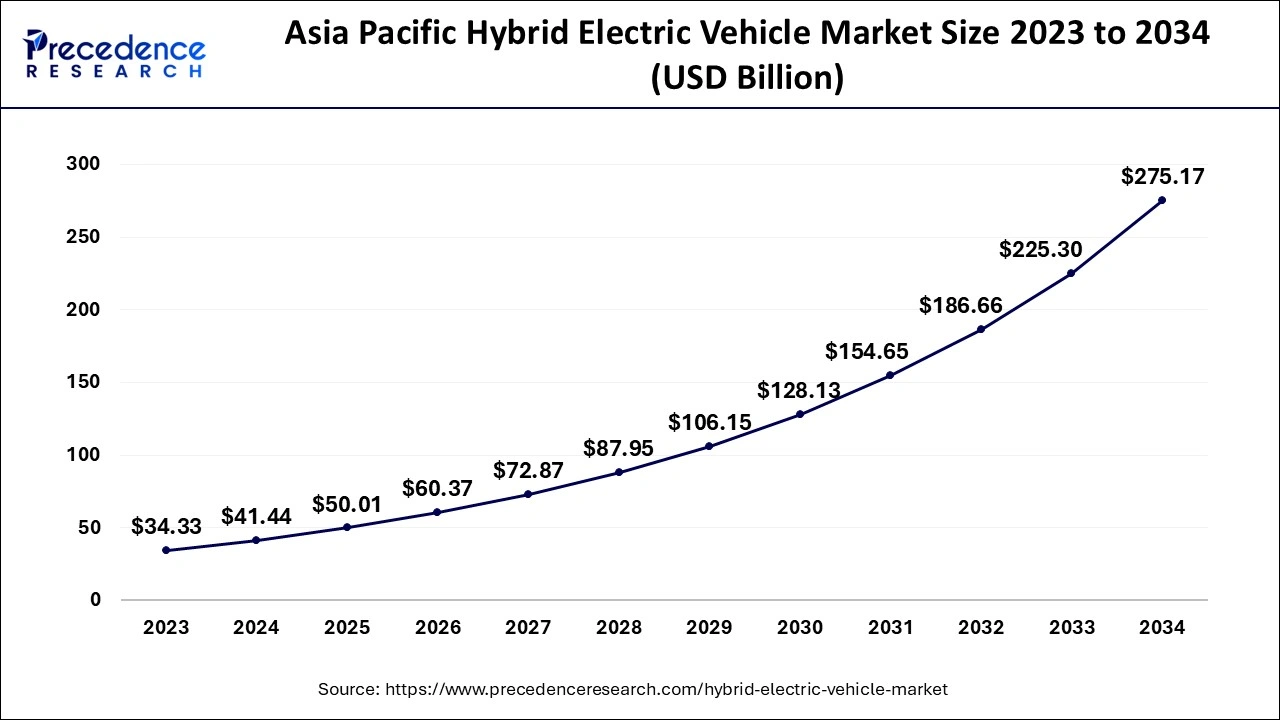
The Asia Pacific market is anticipated to grow quickly all through this projection period in nations like Japan, China, and South Korea. The deals of half breed cars have flooded. The Pacific region is home to key part like Honda, Tyota, BYD, Nissan, Hyundai, and Kia. This likewise adds to showcase development. China has noteworthy assembling capacities. They likewise have the ability to oblige client interest. China is a key part in the cross breed vehicle industry. The Chinese government embraced six serious contamination control norms to empower crossover autos to oversee contamination.
China Market Analysis
In Asia Pacific, China led the market owing to the, increasing environmental awareness, government policies, and innovations in battery technology. Also, the advent of Plug-in Hybrid Electric Vehicles (PHEVs) is significant with sales rising due to their flexibility in handling long trips and the surge in availability of affordable electric cars from market players. China has implemented different policies such as tax breaks, subsidies, and procurement contracts to boost the adoption of HEV.
The European and North American business sectors are likewise bringing issues to light about the use of mixture vehicles, which has added to an expansion in overall interest. Germany has Europe's biggest electric vehicle market. Tesla overwhelms the electric vehicle industry in the United States. The auto business forecast in developing nations like India, Mexico, Brazil, and Morocco has modified significantly, as has the creation and deals forthcoming. Besides, the greater part of the world's greatest automakers have creation offices in these countries since they have plentiful unrefined components, producing cordial regulation, and a financially savvy work.
Moreover, end clients in these countries are inclining toward top of the line innovation empowered cars that are both savvy and eco-friendly. Besides, states in non-industrial nations are establishing regulations to empower the offer of high-voltage cross breed vehicles, as most would consider being normal to offer a chance for market members to zero in on these nations and get an upper hand.
In North America, the U.S. dominated the market by holding the largest market share due to stringent environmental regulations, increasing fuel efficiency, and government incentives. Moreover, consumers are also showing a higher preference for HEVs because of their cost savings and environmental benefits, particularly with the growing availability of charging infrastructure.
Latin America is expected to grow at a notable rate over the forecast period. The growth of the region can be attributed to the ongoing government incentives for green transportation, surge in fuel prices, and rising environmental awareness. Furthermore, innovations in battery technology and strategic partnerships are also contributing to the positive market expansion soon in the region.
The European and North American business sectors are likewise bringing issues to light about the use of mixture vehicles, which has added to an expansion in overall interest. Germany has Europe's biggest electric vehicle market. Tesla overwhelms the electric vehicle industry in the United States. The auto business forecast in developing nations like India, Mexico, Brazil, and Morocco has modified significantly, as has the creation and deals forthcoming. Besides, the greater part of the world's greatest automakers have creation offices in these countries since they have plentiful unrefined components, producing cordial regulation, and a financially savvy work.
Moreover, end clients in these countries are inclining toward top of the line innovation empowered cars that are both savvy and eco-friendly. Besides, states in non-industrial nations are establishing regulations to empower the offer of high-voltage cross breed vehicles, as most would consider being normal to offer a chance for market members to zero in on these nations and get an upper hand.
What Drives the Market in North America?
The market in North America is expected to grow at a notable rate in the upcoming period, primarily driven by increasing environmental awareness and stringent government regulations aimed at reducing greenhouse gas emissions. Rising fuel prices and consumer demand for more fuel-efficient vehicles are further boosting adoption. Additionally, technological advancements in battery efficiency and supportive infrastructure, such as expanding charging networks, are accelerating market growth in the region.
What Makes Europe a Significant Region in the Market?
Europe is a significant region in the market due to strict environmental regulations and ambitious emission-reduction targets, which drive demand for cleaner and more energy-efficient solutions. High consumer awareness and preference for sustainable products further support market growth. Additionally, the presence of leading manufacturers and continuous technological innovation in the region strengthens Europe's position as a key market player.
What Opportunities Exist in Latin America?
Latin America presents significant opportunities for the hybrid electric vehicle market due to increasing government incentives and policies promoting clean energy and sustainable transportation. Growing urbanization and rising fuel costs are driving consumer interest in fuel-efficient vehicles. Additionally, improving charging infrastructure and investments by automakers in the region create a favorable environment for HEV adoption.
What Potentiates the Market in the Middle East & Africa?
The hybrid electric vehicle market in the Middle East & Africa is expected to grow at a steady rate throughout the forecast period. This growth is driven by increasing environmental awareness, supportive government incentives for electric and hybrid vehicles, and rising fuel prices, which encourage consumers to look for more fuel-efficient alternatives. Shift toward sustainable transportation solutions is further supported by advancements in hybrid technology, the introduction of new hybrid models, and growing consumer knowledge of hybrid vehicle reliability. Saudi Arabia, the UAE, South Africa, and Turkey are leading players in the region due to substantial investments being made in charging and vehicle infrastructure, favorable government policies promoting hybrid and electric vehicles, and a growing middle-class population with rising disposable incomes.
Value Chain Analysis
• Component Sourcing
This stage involves the procurement of key components such as lithium-ion batteries, nickel metal hydride batteries, electric motors, inverters, and control units.
Key Players: CATL, Panasonic, Denso
• Manufacturing Process
Here, automakers integrate electric engines and systems into full and mild hybrid platforms. The production process includes powertrain assembly, battery installation, and software calibration.
Key Players: Toyota, Hyundai, Honda
• Distribution & Aftersales
In this stage, hybrid vehicles are distributed to automaker dealer networks and fleet channels. Aftersales services include battery diagnostics and maintenance of the powertrain.
Key Players: Ford, Uber, Toyota
Hybrid Electric Vehicle Market Companies
- ZF
- Delphi
- BorgWarner
- Continenta
- Schaeffler
- Ford
- Toyota
- Continental
- Volvo
- Honda
- Hyundai
- Daimler
- Nissan
Recent Developments
- In June 2025, BYD launched the Seal 05 DM-i hybrid sedan in Poland and Slovakia, marking the Chinese new energy vehicle (NEV) maker's second plug-in hybrid electric vehicle (PHEV) model introduced in Europe. The Seal 05 DM-i boasts advantages such as ultra-long range, a comfortable cabin, and spacious trunk space, Li said, noting that BYD is confident in its market performance in Europe.
(Source: https://cnevpost.com) - In June 2025, Hyundai launches an $18,000 compact EV in Japan to penetrate the EV-wary market. With the Inster, Hyundai will tackle the problem with an approach akin to the low-price strategy of China's leading EV maker BYD.
(Source: https://www.business-standard.com) - In February 2025, Lynk & Co. launched a 08 Plug-In Hybrid SUV with a 200km Electric Range in Europe. Swedish Chinese automaker introduces its third European model featuring an extensive electric range and fast charging, scheduled to arrive in June 2025 with prices starting at €52,995.
(Source: https://www.autocarpro.in) - Both the Indian and Brazilian states are pondering different inspirations, including as diminishing the public authority consumption rate on CNG creamer and module vehicles. There are other hybrid electric transportation possibilities. The endeavour is supposed to cost the Indian government USD 446 million. To expose issues of the benefits of crossbreed vehicles, the Brazilian government is shipping off new advertisements and information gatherings.
- The European Union, collectively with the US Environmental Protection Agency, has made inflexible transmission rules. In view of these essentials, the cross variety vehicle industry is seeing a critical improvement famous for cream vehicle use.
- The Mumbai Metropolitan Area Development Authority, a division of India, as of late marked an arrangement with Tata Motors. As per the arrangement, 25 Tata Starbus Electric diesel transports would be out and about soon.
- The Indian subcontinent and China are both piece of the APAC locale, and their public transportation systems are sometimes neglecting to live up to assumptions or overburdened. In like manner, the public authority is placing assets into progress practices by making the cross variety vehicle market free close to the completion of the general assumption in 2023.
- The Indian and Brazilian governing bodies are choosing for various kinds of inspirations including cutting down the cost rate on CNG hybrid and module vehicles. In like manner, hybrid electric transportation decisions are available. The Indian government should place US$ 445 million in the endeavour. The Brazilian government is doing furthermore promoting and educational gatherings to spread the benefits of utilizing combination cars.
- The European Union, in organization with the United States Environmental Protection Agency, has laid out extreme discharge principles. Because of these norms, the mixture vehicle industry is seeing a critical development popular for half breed vehicles.
Segments covered in the report
By Type
- Full Hybrids
- Mild Hybrids
- Plug-in Hybrids
- Others
By Application
- Battery
- Electric Motor
- Transmission
By Power Source
- Stored Electricity HEVs
- On-Board Electric Generator HEVs
By Powertrain
- Series Hybrid Electric Vehicles
- Parallel Hybrid Electric Vehicles
- Combined Hybrid Electric Vehicles
By Vehicle
- Hybrid Electric Passenger Cars
- Commercial Hybrid Electric Vehicles
- Hybrid Electric Two Wheelers
- Other HEVs (Golf Cart, etc.)
By Region
- North America
- Latin America
- Europe
- Asia-pacific
- Middle and East Africa
For inquiries regarding discounts, bulk purchases, or customization requests, please contact us at sales@precedenceresearch.com
Frequently Asked Questions





Ask For Sample
No cookie-cutter, only authentic analysis – take the 1st step to become a Precedence Research client
 Get a Sample




 sales@precedenceresearch.com
 Schedule a Meeting
