






 Request Consultation
In Canada, SaaS has become essential for businesses, helping companies scale, innovate, and reduce IT costs. However, as adoption grows, firms face rising subscription prices and USD currency exposure, making better SaaS management, cost control, and vendor optimization increasingly important.
Over the past decade, Software as a Service (SaaS) has transitioned from a convenient IT delivery model into the operational backbone of modern enterprises. In Canada, this transformation has been especially significant. Organizations across technology, financial services, healthcare, manufacturing, retail, and public services are embedding SaaS solutions deep into their core operating models to enhance agility, reduce capital expenditure, improve scalability, and accelerate innovation.
For Canadian businesses, however, the most significant structural concern extends beyond vendor pricing models: currency exposure. A substantial proportion of SaaS subscriptions are billed in U.S. dollars, while the majority of revenues for domestic organizations are generated in Canadian dollars. When the Canadian dollar weakens against the U.S. dollar, effective subscription costs rise, even if the vendor has not adjusted base pricing.
The Rise of Canada’s SaaS Ecosystem
Canada has emerged as a globally competitive SaaS innovation hub. With more than 600 SaaS companies operating domestically and internationally, the ecosystem is no longer nascent, it is mature, diversified, and export-driven.
Organizations have demonstrated Canada’s ability to build scalable SaaS platforms that compete internationally. Their success reflects broader ecosystem strengths, including access to venture capital, strong AI research clusters in Toronto, Montreal, and Vancouver, government-backed innovation programs, and proximity to the U.S. market.
What differentiates Canada is not just the number of companies, but the quality of innovation. Many Canadian SaaS firms are AI-enabled, data-driven, and globally oriented from inception. This has positioned the country as a serious player in vertical SaaS, fintech platforms, marketing automation, and enterprise collaboration tools.
What is the Software Market Size?
The global software market size was calculated at USD 823.92 billion in 2025 and is predicted to increase from USD 921.14 billion in 2026 to approximately USD 2,468.93 billion by 2035, expanding at a CAGR of 11.60% from 2026 to 2035.
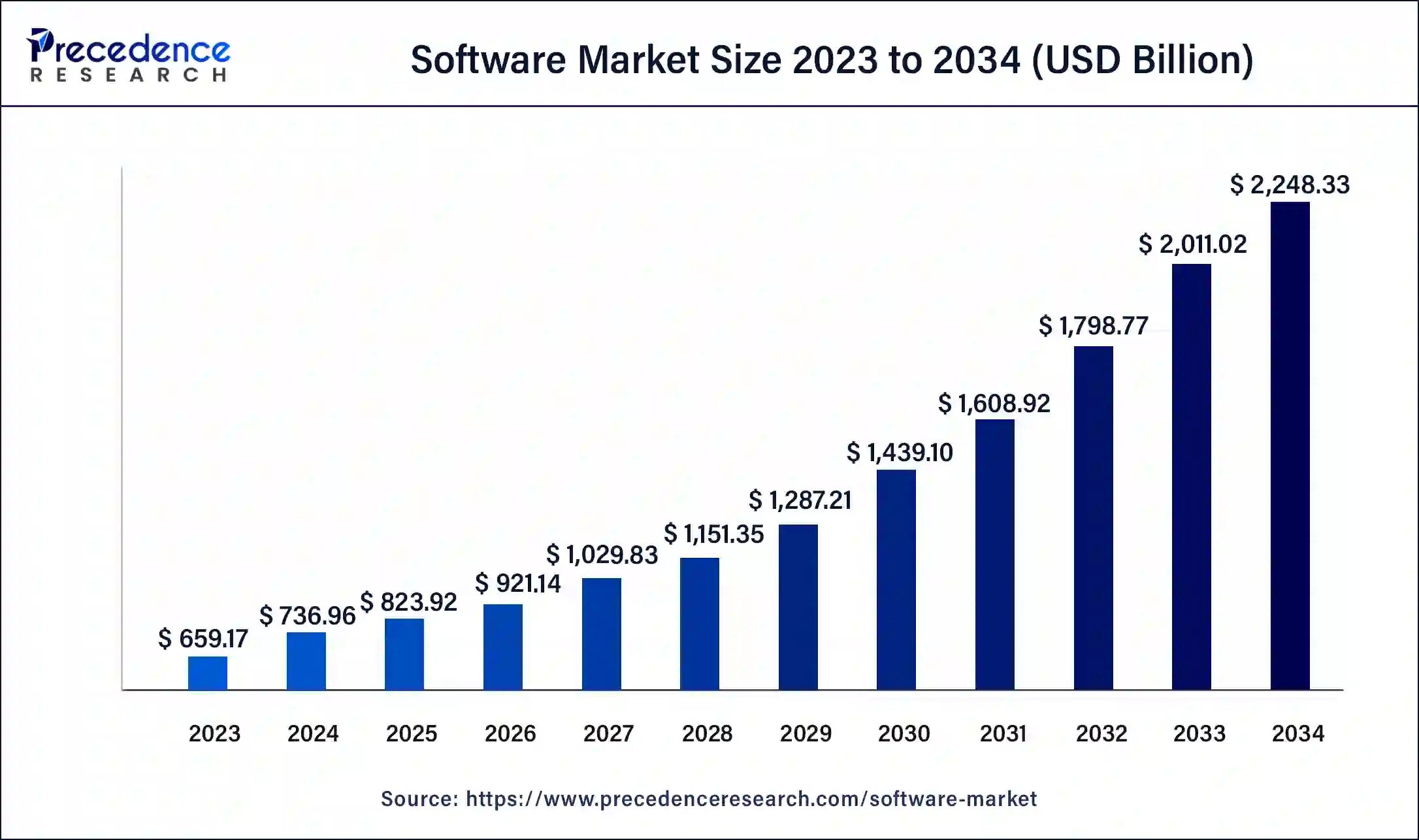
Market Highlights
- North America contributed more than 44% of the revenue share in 2025.
- By enterprise size, the large enterprises segment held a major market share in 2025.
- By vertical, the IT & telecom segment captured the largest market share in 2025.
Key Canadian SaaS Company Examples
Shopify
- Shopify started as a platform for small retailers but has scaled into an enterprise-grade solution serving international brands like Allbirds and Gymshark. The platform integrates payments, logistics, and AI-powered analytics, enabling businesses to manage operations end-to-end. Shopify’s global expansion showcases how Canadian SaaS companies can scale internationally while maintaining innovative product development.
Hootsuite
- Hootsuite provides social media marketing and monitoring solutions for enterprises and SMEs worldwide. Its SaaS tools help organizations manage multi-channel campaigns, schedule posts, and analyze engagement metrics efficiently. Hootsuite exemplifies Canada’s ability to create SaaS platforms that address global digital marketing needs while maintaining compliance with data privacy regulations.
Vidyard
- Vidyard offers a video-based sales and marketing platform that helps businesses create, host, and track video content for customer engagement. The platform integrates with CRM and marketing automation tools, allowing enterprises to measure ROI from video campaigns. Vidyard demonstrates Canada’s growing expertise in niche, vertically focused SaaS products with high-value business applications.
Wave
- Wave provides cloud-based accounting, invoicing, and payroll solutions specifically designed for SMEs. Its SaaS platform allows small businesses to manage finances efficiently without investing heavily in IT infrastructure. Wave highlights the democratization of enterprise-grade SaaS tools for smaller organizations and emphasizes the scalability of Canadian SaaS solutions.
Emerging AI SaaS Startups
- Canada hosts numerous early-stage SaaS companies leveraging AI for workflow automation, predictive analytics, and vertical-specific solutions. These startups attract venture capital funding from seed to Series B rounds, focusing on healthtech, fintech, logistics, and marketing technology. They illustrate the future growth direction of the Canadian SaaS ecosystem, where AI-driven innovation is becoming a competitive differentiator.
SaaS Adoption Across Canadian SMEs and Large Enterprises
SME Adoption: SaaS as a Growth Enabler
Small and medium-sized enterprises (SMEs) in Canada have been among the most enthusiastic adopters of SaaS solutions. The shift away from on-premise infrastructure has been driven by financial pragmatism and operational flexibility.
Instead of investing heavily in hardware, maintenance, and IT staff, SMEs leverage SaaS to access enterprise-grade capabilities through subscription models. The benefits are structural:
- Reduced upfront capital expenditure
- Faster implementation timelines
- Scalability aligned with business growth
- Predictable operating costs
- Minimal infrastructure management
For many SMEs, SaaS has effectively democratized technology access. Cloud-based accounting, CRM, payroll systems, collaboration platforms, and digital marketing tools are now standard operating components rather than competitive advantages. SaaS has enabled SMEs to compete with larger organizations by leveling the technological playing field.
Adoption and Pricing Pressures
To understand the maturity and challenges of the Canadian SaaS landscape, the following data provides a concise overview:
| Metric | Data Point | Business Implication |
| Estimated SaaS Companies in Canada | 600+ | Mature innovation ecosystem |
| Active Homegrown SaaS Firms | 200+ | Strong domestic innovation pipeline |
| Typical Annual SaaS Price Inflation | 10–15% | Growing margin pressure |
| Majority of SaaS Billing Currency | USD | Exposure to exchange rate volatility |
| SME SaaS Penetration | High and accelerating | Cloud-first operations becoming standard |
| Enterprise Consolidation Trend | Increasing | Vendor rationalization underway |
The Emerging Challenge: SaaS Inflation and Currency Exposure
Success in SaaS adoption has introduced a new and increasingly complex financial challenge: SaaS inflation. As Canadian organizations deepen their reliance on cloud-based platforms, overall software expenditures are rising from multiple directions. This escalation is not limited to straightforward annual price increases; rather, it reflects a layered cost structure that compounds over time and introduces significant financial complexity into budgeting and forecasting processes.
Several structural drivers are contributing to SaaS inflation. Vendors commonly implement annual price increases, often in the range of 10–15%, as part of standard contract renewals. In addition, many SaaS providers employ tiered pricing structures that automatically push customers into higher-cost plans as new features are introduced or usage thresholds are exceeded. Expansion-based billing models, whether calculated per user seat, per transaction, per API call, or based on data storage further amplify costs as organizations scale. Add-on modules, premium integrations, advanced analytics capabilities, and security enhancements frequently increase total subscription value beyond the original contract scope.
2024 CAD vs USD Pricing Comparison
The pricing sensitivity becomes evident when comparing CAD and USD subscription rates:
| SaaS Product | CAD 2024 Price | USD 2024 Price |
| Canva | $20.44 | $14.95 |
| Zoom | $27.39 | $19.99 |
| Microsoft 365 | $15.03 | $10.99 |
| Slack | $9.93 | $7.25 |
| Lucidchart | $13.64 | $9.95 |
Strategic Responses: Moving from Reactive to Structured Governance
Organizations that approach SaaS management strategically, rather than reactively consistently achieve stronger cost control, operational clarity, and vendor leverage. A structured governance model enables enterprises to optimize value while minimizing redundancy and financial leakage.
Vendor Optimization and Consolidation
- Negotiating multi-year enterprise agreements – Secures pricing stability and stronger discounts in exchange for longer contractual commitments.
- Bundling licenses for volume discounts – Aggregates user counts across departments to improve purchasing leverage and reduce per-seat costs.
- Consolidating overlapping platforms – Eliminates duplicate tools with similar functionalities to streamline operations and lower subscription expenses.
- Standardizing tools across departments – Promotes uniform technology usage to enhance integration, simplify IT management, and strengthen vendor negotiation power.
Investment and Innovation
Investment activity in the Canadian SaaS sector remains robust, reflecting the maturity and global competitiveness of the ecosystem. Venture capital, private equity, and institutional investors are actively targeting high-potential SaaS companies, particularly those that incorporate AI and address industry-specific needs. There is a strong focus on platforms that deliver vertical-specific solutions in sectors such as healthtech, fintech, and logistics, where specialized functionality drives differentiated value for customers.
Cybersecurity and identity management platforms are also attracting significant investment, driven by increasing enterprise and regulatory demand for secure, compliant cloud environments. Similarly, SaaS providers offering workflow automation, productivity optimization, and operational efficiency solutions are capturing investor attention as organizations prioritize digital transformation and cost-effective scaling. ESG-focused and compliance technology solutions are gaining traction as companies seek to align operational systems with regulatory and sustainability mandates.
Artificial intelligence, once considered an optional enhancement, has become a core differentiator in the SaaS market. Companies integrating predictive analytics, automation, and generative AI capabilities into their platforms are achieving higher valuations and stronger investor interest. In Canada, AI-enabled SaaS solutions are increasingly viewed as essential tools for competitive advantage, driving both innovation adoption and capital inflows across the sector.
SaaS providers have become the backbone of modern Canadian business not merely because of convenience, but because they enable scalability, innovation, and operational resilience.
However, the maturity of the ecosystem now demands discipline. The next phase of SaaS growth in Canada will not be defined solely by adoption, but by optimization, governance, and strategic oversight.
About the Authors

Aditi Shivarkar
Aditi, Vice President at Precedence Research, brings over 15 years of expertise at the intersection of technology, innovation, and strategic market intelligence. A visionary leader, she excels in transforming complex data into actionable insights that empower businesses to thrive in dynamic markets. Her leadership combines analytical precision with forward-thinking strategy, driving measurable growth, competitive advantage, and lasting impact across industries.



Aman Singh
Aman Singh with over 13 years of progressive expertise at the intersection of technology, innovation, and strategic market intelligence, Aman Singh stands as a leading authority in global research and consulting. Renowned for his ability to decode complex technological transformations, he provides forward-looking insights that drive strategic decision-making. At Precedence Research, Aman leads a global team of analysts, fostering a culture of research excellence, analytical precision, and visionary thinking.

Piyush Pawar
Piyush Pawar brings over a decade of experience as Senior Manager, Sales & Business Growth, acting as the essential liaison between clients and our research authors. He translates sophisticated insights into practical strategies, ensuring client objectives are met with precision. Piyush’s expertise in market dynamics, relationship management, and strategic execution enables organizations to leverage intelligence effectively, achieving operational excellence, innovation, and sustained growth.