



Predictive Analytics Market Size, Key Companies, Company Market Share, User Adoption, Technology Deployment, Revenue Growth, Competitive Positioning, and Demand Forecast
Predictive Analytics Market (By Solution: Customer Analytics, Financial Analytics, Marketing & Sales Analytics, Network Analytics, Risk Analytics, Supply Chain Analytics, Web & Social Media Analytics, Others; By Service: Deployment/ Installation, Support & Maintenance, Training & Consulting; By Enterprise Size: Small & Medium Enterprises, Large Enterprises; By Component: Solution, Services; By Deployment Type: On-Premise, Cloud; By End-Use: Aerospace & Defense, Automotive & Transportation, BFSI, Healthcare, IT & Telecommunication, Media & Entertainment, Retail & Ecommerce, Others) - Global Industry Analysis, Size, Trends, Leading Companies, Regional Outlook, and Forecast 2026 to 2035
Source: https://www.precedenceresearch.com/predictive-analytics-market
 Get a Sample
 Table Of Content


What is Predictive Analytics Market Size?
The global predictive analytics market size is estimated at USD 17.49 billion in 2025, and is projected to surpass USD 21.24 billion by 2026, and is anticipated to reach around USD 113.46 billion by 2035, expanding at a CAGR of 20.56% from 2026 to 2035.
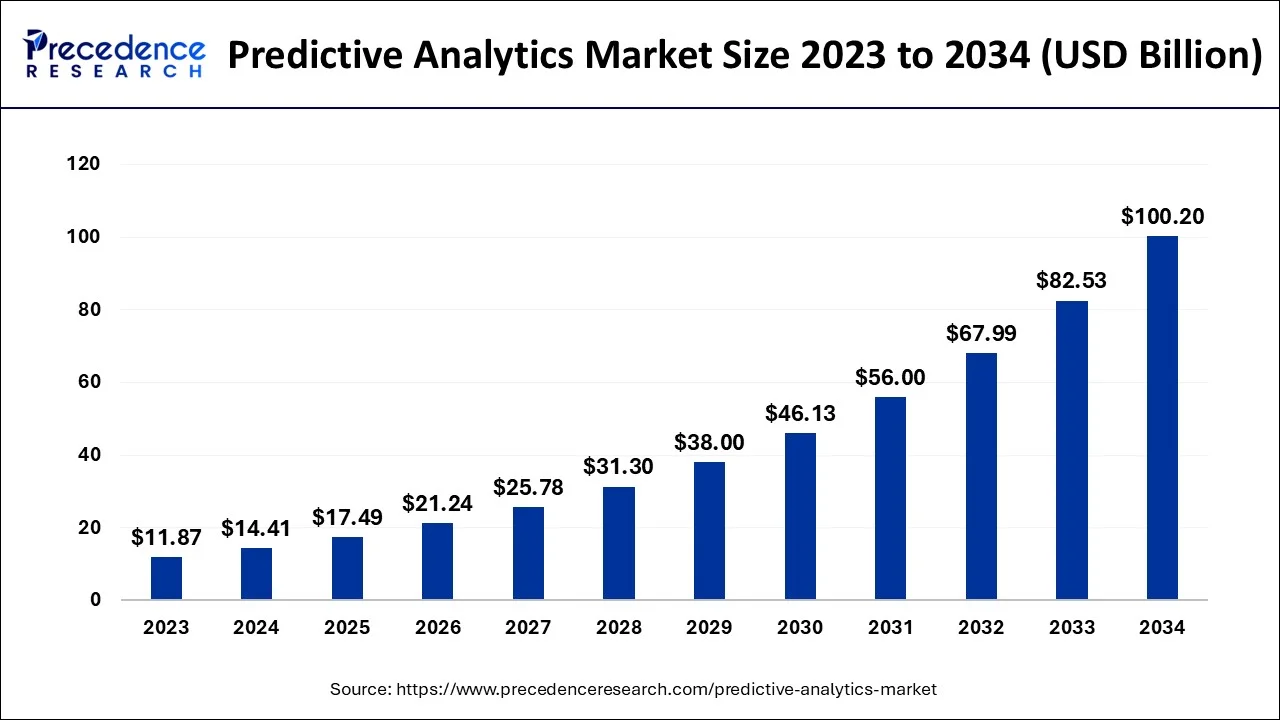
Market Highlights
- North America has registered for 46% of the total revenue share in 2025.
- Asia Pacific is projected to reach at a CAGR of 23.4% from 2026 to 2035
- The large enterprise size segment has captured 59% revenue share in 2025.
- By component, the solution segment has accounted 63% revenue share in 2025.
- The BFSI segment is expected to reach at a CAGR of 15.9% from 2026 to 2035.
Market Overview
The predictive analytics market is expanding as a result of enterprises being more aware of the generated data that can be utilized to anticipate future events utilizing predictive analytic solutions. The amount of data collected has dramatically increased as a result of rising internet usage and the availability of several methods for obtaining it. High-speed internet services have increased and advanced as a result all over the world. Additionally, as integrated and linked technologies become more widely used, manufacturers of predictive analytics solutions now have a platform on which to capitalize on the internet's extraordinary expansion. Globalization, along with economic development in other nations, is a major factor in the increased production of data worldwide.
Companies are increasingly using teams of analysts and data scientists to handle and analyses the data that has been acquired as a result of the exponential growth in organizational data. As a result, businesses are increasingly implementing predictive analytics solutions to make the best use of the data that is now accessible for forecasting future trends. Furthermore, the rapid adoption of these solutions is being fueled by their great revenue-generating potential. Customers' conventional purchasing experiences have been enhanced by e-commerce. The main elements enhancing a company's sales include targeted online/social media advertising, email marketing, and consumer perception research. Retailers now concentrate on real-time research of consumer buying behavior due to the growing popularity of connected gadgets. The results of real-time analytics may also be used to create tailored offers to improve client experience.
How is AI Influencing the Predictive Analytics Industry?
AI is nowadays changing predictive analytics from static, manual reporting into the dynamic, real-time, and thus, highly accurate forecasting, enhancing operational efficiency by 20–30%. By leveraging NLP, machine learning, and neural networks, AI detects complex patterns, automates data preparation, and even adapts to new data, allowing industries to shift from reactive to proactive strategies.
Unlike conventional, static methods, AI allows continuous, real-time updates to forecasts driven by live data, like shifting market indicators or supply chain bottlenecks. AI manages labor-intensive tasks such as data cleaning, deduplication, and formatting, decreasing manual effort and lowering human error.
Predictive Analytics Market Growth Factors
The expansion of the worldwide predictive analytics market is being driven by the need for sophisticated analytics for operational efficiency. Data now serves as a valuable resource for improving operations, production, and efficiency. Enterprises may gain a competitive edge by using predictive analytics to make strategic choices in an efficient, precise, and timely manner. Process optimization, scam detection, failure point identification, client retention techniques, fraud prevention, and strategic decision-making are a few of the crucial use cases for predictive analytics. Operational and cost-reduction benefits are offered by predictive analytics systems. During the anticipated term, all of these elements will fuel market expansion.
Market Outlook
- Industry Outlook: The predictive analytics market is poised for rapid growth from 2025 to 2034, driven by the growing need for data-driven decision-making, enabling organizations to forecast trends, optimize operations, and gain a competitive advantage across industries.
- Global Expansion: The market is growing worldwide because organizations increasingly rely on data, AI, and machine learning to anticipate trends, reduce risks, and improve business outcomes.
- Major Investors: The major investors in the market include large technology companies, venture capital firms, private equity investors, and governments that are funding AI- and data-driven innovation across industries.
Market Scope
| Report Coverage | Details |
| Market Size in 2025 | USD 17.49 Billion |
| Market Size in 2026 | USD 21.24 Billion |
| Market Size by 2035 | USD 113.46 Billion |
| Growth Rate from 2026 to 2035 | CAGR of 20.56% |
| Largest Market | North America |
| Fastest Growing Market | Asia Pacific |
| Base Year | 2025 |
| Forecast Period | 2026 to 2035 |
| Segments Covered |
Solution, Service, Enterprise Size, Component, Deployment Type, End-Use, and Region |
| Regions Covered |
North America, Europe, Asia-Pacific, Latin America and Middle East & Africa |
Market Dynamics
Drivers
- Big data and other related technologies are being more widely used - Utilizing cutting-edge technologies, such the cloud, the Internet of Things, big data analytics, mobile, and social media, has sparked innovation and change, which has fueled the development in the commercial ecosystem. A new method to doing business has replaced the traditional approach thanks to digital technology. For instance, online services are now widely used in the banking and finance industry, which has led to an increase in online endeavors and websites. Usabilla (Netherlands) said in a blog post from June 2020 that the top 100 companies are 50% more likely to treat consumer empowerment as a crucial factor in company success. According to the blog, 92% of executives had used cutting-edge digital transformation techniques to improve their consumers' experiences.
- The growing use of predictive modeling tools - Interactive visualization and automation has helped to accelerate the use of predictive tools in recent years. The methods of creating and analyzing predictive models used by enterprises to execute operations like customer analytics, risk reporting, threat management, and product innovation are accelerated by these technologies. A growing number of businesses are also automating their sales funnel from lead generation to client base by doing predictive analyses on vast amounts of customer data. The use of predictive modeling techniques for email marketing, social media advertising, and consumer cognitive analysis has maintained growth in revenue and improved customer retention over time.
Key Market Challenges
- Modifications to regional data laws necessitating a time-consuming redesign of prediction models - Predictive analytics provides decision-makers with a clear data interpretation and a wider picture to enhance overall business performance. The predictive model modification enables interaction with both software and services, depending on the level and kind of study. It takes specialized knowledge to customize already-available analytics solutions that are designed for certain data sets. There is a scarcity of competent professionals since predictive analytics is still in its infancy. This is yet another important factor that restricts industry growth.
Key Market Opportunities
- The growing use of linked and integrated technology and increased internet usage - The amount of data created has greatly increased as a result of the internet's widespread use and the accessibility of several methods to obtain it. The development and growth of high-speed internet services would be aided by this. Global data creation is being accelerated by factors including globalization and economic expansion. Every contact a customer makes has now turned into a significant data point that can be analyzed to disclose user behavior due to the increase in touchpoints and the requirement for data collection to understand consumer behavior. Businesses are now using data scientists and analysts to process the data they have been collecting due to the exponential growth in personal and organizational data.
- Increasing adoption of the cloud - It is a significant trend that is gaining traction in the predictive analytics industry. Organizations should utilize the cloud if they want to cut expenses, minimize risk, and achieve database scalability. The usage of the cloud is widespread in business and serves as a vital conduit for digital empowerment, fostering innovation and expansion for an organization. A platform for acting as a storage hub and delivering computing is provided by cloud strategies.
Segment Insights
Solution Insights
Solutions for predictive risk analytics are essential to the market's overall expansion. In 2025, the market sector dominated the whole world. The increased use of various risk analytics systems for predicting dangers and taking precautions may be credited with the segment's rise. Additionally, the need for data integration, growing emphasis on creating sophisticated risk strategies, and growing data volume all work together to support sector growth. Over the projection period, the consumer analytics segment is expected to have the greatest CAGR. Consumer intelligence is a systematic and sophisticated analytical method that businesses are increasingly using to analyse customer behavior. Businesses utilize this information to improve their total income creation and make critical business decisions. Additionally, customer analytics, which includes methods like predictive modeling and data visualization, aids businesses in boosting customer lifetime value (CLV), gaining customer loyalty, and keeping hold of current clients.
Service Insights
Over the projection period, a significant CAGR is expected in the service category. Predictive analytics solutions are increasingly being deployed across a variety of business verticals, which is projected to raise the need for pre-and post-deployment services. This is the key factor driving the growth of the service market.
Over the projection period, it is expected that the deployment/installation services category would see a substantial CAGR. This is due to the increasing use of predictive analytics tools on cloud platforms.
Over the course of the projection period, the training and consulting category is expected to experience phenomenal market growth. Transferring sufficient knowledge about how the solution works to employees is facilitated by training and consulting services. It aids businesses in overcoming the difficulty of finding skilled workers. As a result, these services assist firms in improving their overall performance and revenue creation, fueling the segment's rise throughout the anticipated term.
Enterprise Size Insights
In 2025, Large enterprises controlled the world market. These businesses are employing predictive analytics solutions more frequently to forecast future trends using current historical data. Large businesses are also creating long-term business plans based on forecasted results. Additionally, the predictive analysis of enormous historical data gives businesses a competitive edge and aids in improving their overall performance.
The category for small and medium-sized businesses is anticipated to have the greatest CAGR between 2026 and 2035. The segment's growth is greatly attributed to small and medium-sized businesses increased use of cloud computing and predictive analytics. These businesses need predictive analytics solutions to improve operational performance while lowering overall operating expenses. Increased funding for the creation and expansion of small and medium-sized businesses throughout the world is also considering boosting the segment's growth.
End-Use Insights
According to estimates, the BFSI industry will significantly contribute to the expansion of the predictive analytics market. Due to improved regulatory compliance procedures, major businesses in the BFSI sector are increasingly adopting advanced financial analytics solutions. The demand for predictive analytics products from the BFSI vertical is expected to increase during the projected period as a result of the global regulatory environment becoming more complicated. Additionally, due to regulatory obligations, risk management practices including credit risk management, capital planning, and insurance risk management are becoming more and more significant. Additionally, BFSI organizations are undergoing a digital transformation thanks to the use of predictive analytics technologies. It provides a better customer experience and aids in adjusting to shifting consumer behavior.
The worldwide market is expected to develop fastest in the retail and e-commerce segment. Predictive analytics solutions are in high demand in the retail and e-commerce sectors due to consumer preferences for a customized and personalized purchasing experience. In addition, the market is anticipated to rise as a result of developments in technologies like artificial intelligence (AI), augmented reality (AR), and machine learning. Additionally, the demand for predictive analytics technology has increased due to the quick uptake of social media, expanding internet penetration, and increased usage of data-intensive platforms.
Regional Insights
U.S. Predictive Analytics Market Size and Growth 2026 to 2035
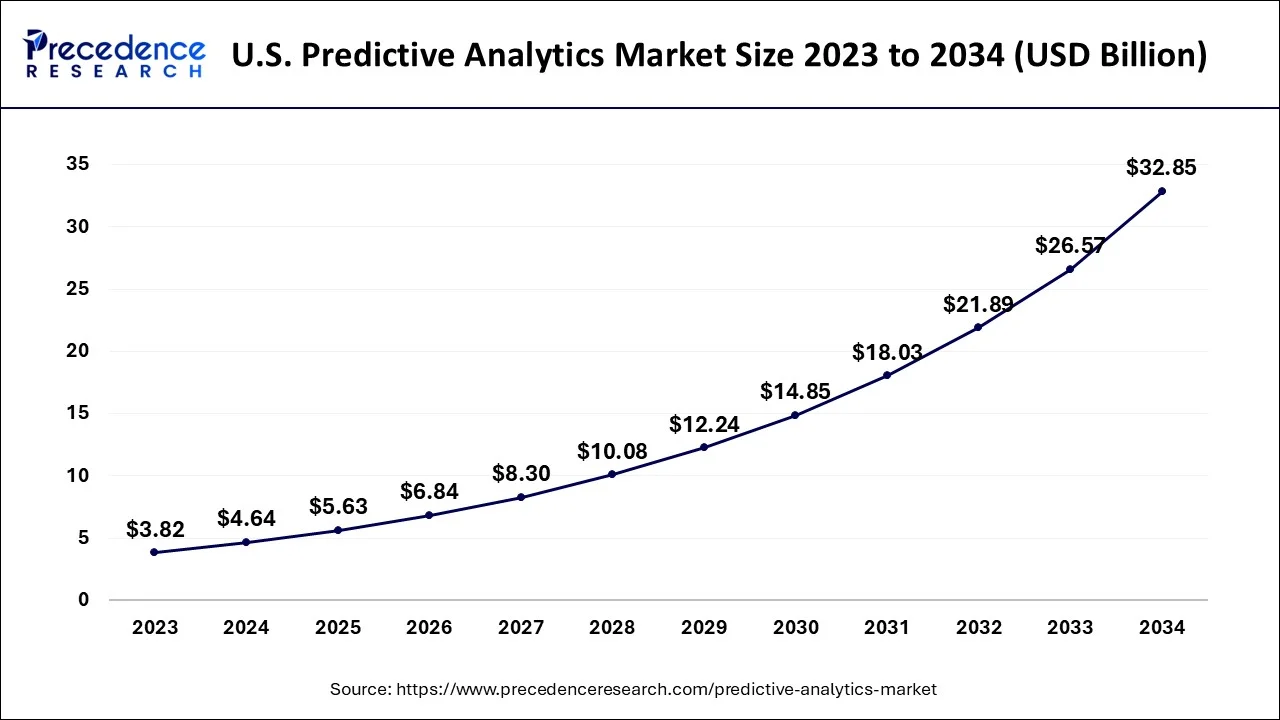
The U.S. predictive analytics market size is evaluated at USD 6.84 billion in 2026 and is predicted to be worth around USD 37.12 billion by 2035, rising at a CAGR of 20.76% from 2026 to 2035.
North America. This can be linked to developments in technology and the prominence of market participants, notably in the United States. Additionally, venture capitalists' investment of new competitors is expected to lessen competitiveness in the industry. Growing advancements in the processes and techniques used to create predictive analytics solutions are predicted to present significant business prospects for established businesses. Additionally, there is a high demand for these solutions due to growing knowledge of predictive analytics techniques and their significance.
The market as a whole is dominated by North America. This can be linked to developments in technology and the prominence of market participants, notably in the United States. Additionally, venture capitalists' investment of new competitors is expected to lessen competitiveness in the industry. Growing advancements in the processes and techniques used to create predictive analytics solutions are predicted to present significant business prospects for established businesses. Additionally, there is a high demand for these solutions due to growing knowledge of predictive analytics techniques and their significance.
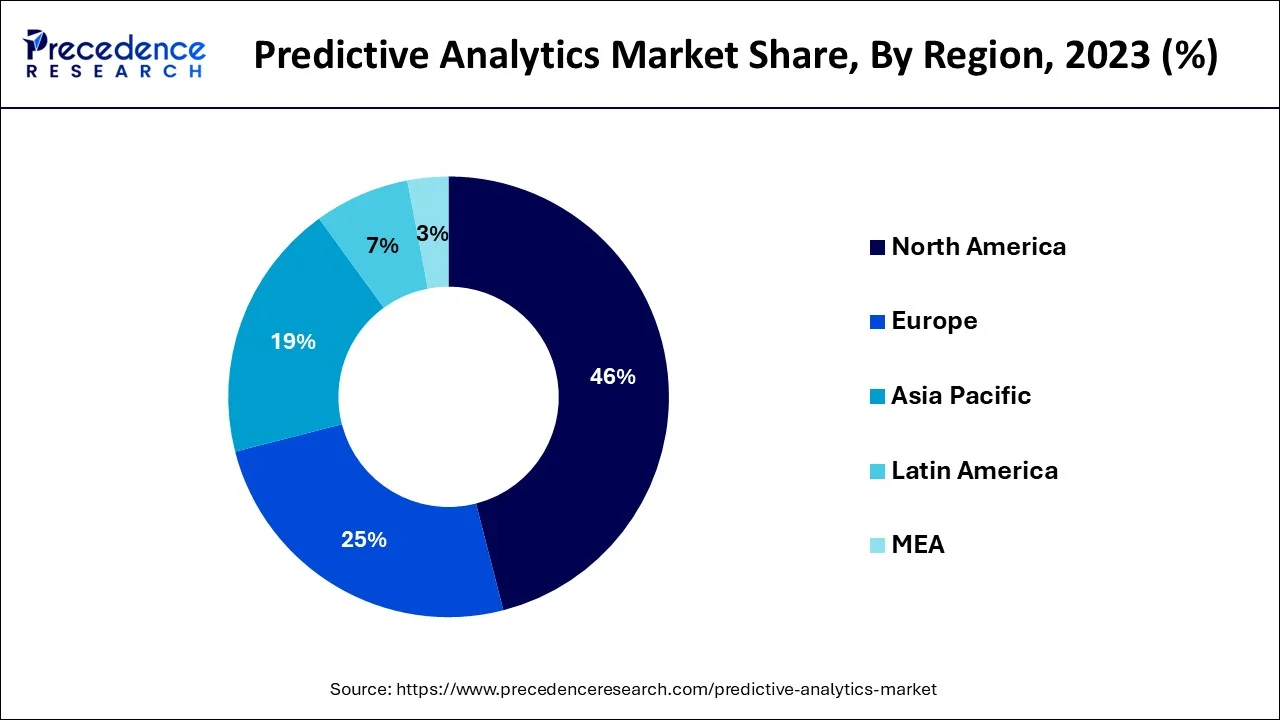
Over the projection period, Asia Pacific is anticipated to have the greatest CAGR. The rapid implementation and use of advanced predictive analytics solutions are responsible for the regional market's rapid expansion. Additionally, the Asia Pacific market's greater potential encourages solution and service providers to increase their presence there. Additionally, it is anticipated that the market in the area would be driven by rising attention to and investments in emerging technologies like artificial intelligence, internet of things (IoT), and machine learning.
What Are the Key Trends Driving the Predictive Analytics Market in Europe?
The European predictive analytics market is expected to witness significant growth over the forecast period. Governmental measures contributing to digitalization processes in Europe, as well as a growing availability of huge amounts of structured and unstructured data, are only intensifying the growth of the market. Major industries such as healthcare, finance, retail, and manufacturing sectors are at the frontline of adoption by adopting predictive analytics to streamline their operation, manage risks, and be innovative.
Increased demand for customized services and the imperative to act to prevent the possibility of organizations failing to invest in predictive solutions, which provide immediate results and enhance strategic planning. Moreover, there is a rise in the investment made in big data infrastructure and analytics capabilities, such that it is giving the predictive analytics vendors a lot of growth opportunities.
What Made North America the Dominant Region in the Predictive Analytics Market?
North America dominated the market with the largest share in 2024. This is mainly due to its early adoption of advanced data analytics technologies, strong digital infrastructure, and high availability of skilled data professionals. The presence of major technology companies and analytics solution providers accelerated innovation and large-scale deployment across industries. Additionally, heavy investments in AI, machine learning, and big data by both private enterprises and government sectors boosted market growth. Widespread use of predictive analytics in healthcare, finance, retail, and manufacturing further strengthened the region's leadership.
The US is the leader in the market with a large base of companies using predictive analytics for various purposes such as customer churn, risk scoring, supply chain optimization, and clinical decision support. This is enabled by generous funding and an abundance of talent. Canada mainly focuses on applying predictive analytics in healthcare, utilities, and government services, with a strong emphasis on privacy and public trust. Both countries have vibrant ecosystems of cloud providers, analytics platforms, and consulting firms, which help transition models from the lab to real-world applications.
What Makes Asia Pacific the Fastest-Growing Region in the Market?
China is a major contributor to the market within Asia Pacific due to its rapid digital transformation and large-scale adoption of big data, AI, and cloud technologies. Strong government initiatives to support AI development and smart infrastructure have accelerated the adoption of predictive analytics across industries. Additionally, the presence of a vast consumer base and expanding sectors such as e-commerce, manufacturing, and finance drives significant demand for predictive analytics solutions.
What Potentiates the Market in the Middle East & Africa?
The predictive analytics market in the Middle East & Africa (MEA) is driven by growing adoption across energy, telecom, finance, and government modernization initiatives, particularly in affluent Gulf countries and key African hubs. Large national programs and sovereign fund–backed pilots focus on resource optimization, smart cities, and fraud detection, creating high-visibility use cases. Meanwhile, private-sector firms, especially in banking and telecom, are leveraging predictive customer insights to boost retention and revenue growth.
The UAE is a key player in the market due to increasing adoption of predictive solutions in sectors like utilities, transportation, and public safety. South Africa leads sub-Saharan Africa in using enterprise analytics in industries such as finance, telecommunications, and mining, focusing on credit risk, customer churn, and predictive maintenance. Egypt and Morocco are investing in developing their analytics capabilities in telecommunications and public services mainly through partnerships with international vendors.
What Opportunities Exist in Latin America?
Latin America offers significant opportunities in the predictive analytics market due to expanding digital transformation across banking, retail, telecom, and e-commerce sectors. Growing use of mobile platforms and digital payments creates demand for fraud detection, customer behavior analysis, and risk management solutions. Additionally, government initiatives in smart cities, public safety, and infrastructure modernization are opening new avenues for the adoption of analytics.
Brazil is a major contributor to the Latin American predictive analytics market due to its large economy and rapid adoption of digital technologies across banking, retail, and telecom sectors. The country's strong fintech ecosystem and widespread use of digital payments drive demand for fraud detection and customer analytics solutions. Additionally, government and enterprise investments in cloud computing, AI, and data-driven decision-making support continued market growth.
China Predictive Analytics Market Trends
China's predictive analytics market is growing rapidly as businesses across sectors such as finance, retail, healthcare, and manufacturing increasingly leverage data-driven insights to improve decision-making, forecasting, and operational efficiency. Rising adoption of big data platforms, cloud computing, and advanced machine learning technologies is fueling demand for predictive analytics solutions that can uncover patterns, predict trends, and optimize performance.
Latest Government Initiatives in the Predictive Analytics Industry:
According to India's AI Growth Strategy 2025, the Modi government has started the IndiaAI Dataset Platform to offer seamless access to high-quality, non-personal datasets. This platform has the largest amount of anonymised data, empowering Indian startups as well as researchers to develop advanced AI applications.
Top Companies in the Predictive Analytics Market & Their Offerings
- General Electric Company: GE Vernova provides advanced AI or ML-based predictive analytics via its SmartSignal and Proficy CSense software, aiming at industrial asset management and process optimization. These tools use digital twins to forecast equipment failures, lower unplanned downtime, and improve performance for energy, manufacturing, and aviation sectors.
- Schneider Electric SE: Schneider Electric SE provides a comprehensive suite of predictive analytics solutions mainly built on its EcoStruxure IoT-derived architecture, designed to improve operational efficiency, sustainability, and asset reliability across industries, data centers, and buildings.
- NTT Data Corporation: NTT Data Corporation offers a comprehensive suite of services along with solutions in the predictive analytics market, aiming on transforming raw data into actionable, forward-looking insights to enhance business outcomes. They combine artificial intelligence, machine learning, and even advanced data mining techniques to offer solutions that include need forecasting, predictive maintenance, and risk management.
Predictive Analytics Market Companies
- BM Corporationn
- SAP ERP
- Microsoft Corporation
- Siemens AG
- General Electric Company
- Schneider Electric SE
- NTT Data Corporation
- Oracle Corporation
- SAS Institute, Inc
- Tableau Software, Inc
Recent Developments
- In February 2024, Wipro Limited announced Wipro Enterprise Artificial Intelligence (AI)-Ready Platform, which gives clients a way to develop fully integrated, customized global AI environments. Wipro Enterprise AI-Ready Platform incorporates dynamically managed resources that leverage predictive analytics to respond to different workloads. (Source: https://www.wipro.com)
- In October 2024, Oracle announced Oracle Analytics Intelligence for Life Sciences, an AI-enabled cloud platform to help generate insights more efficiently by integrating disparate sets of data into one intelligent workspace. This platform enables healthcare researchers to integrate disparate data sources, allowing the user to respond to multidisciplinary research questions and gain insight from a single workspace.(Source: https://www.oracle.com)
- In June 2023, Nextira was acquired by Accenture, an Amazon Web Services Premier Partner whose main focus is the creation of immersive experiences, cloud-native innovation, and predictive analytics. Under this acquisition, Accenture Cloud Nextira will offer its talent in AI, machine learning, and data analytics, thus adding value to Accenture in offering its services to clients to give them new solutions with a step ahead in predicting outcomes across all business lines.
(Source: https://newsroom.accenture.com) - Teradata announced in September 2021 that Tesco PLC is enhancing its partnership with Teradata by integrating Vantage into its data platform. Vantage can help Tesco break down data silos and query all of their data in real time, whether it's on-premises, in the cloud, on several clouds, or any combination of those, to get a complete picture of their business.
- In August 2021, Altair revealed that it had acquired S-FRAME Software, a platform for structural analysis that is used by engineers all around the world to assess a structure's capacity to withstand outside loads (including wind, water, and snow) and adhere to design code requirements.
Segments Covered in the Report
By Solution
- Customer Analytics
- Financial Analytics
- Marketing & Sales Analytics
- Network Analytics
- Risk Analytics
- Supply Chain Analytics
- Web & Social Media Analytics
- Others
By Service
- Deployment/ Installation
- Support & Maintenance
- Training & Consulting
By Enterprise Size
- Small & Medium Enterprises
- Large Enterprises
By Component
- Solution
- Services
By Deployment Type
- On-Premise
- Cloud
By End-Use
- Aerospace & Defense
- Automotive & Transportation
- BFSI
- Healthcare
- IT & Telecommunication
- Media & Entertainment
- Retail & Ecommerce
- Others
By Region
- North America
- Europe
- Asia-Pacific
- Latin America
- Middle East & Africa (MEA)
For inquiries regarding discounts, bulk purchases, or customization requests, please contact us at sales@precedenceresearch.com
Frequently Asked Questions
Tags





Ask For Sample
No cookie-cutter, only authentic analysis – take the 1st step to become a Precedence Research client
 Get a Sample




 sales@precedenceresearch.com
 Schedule a Meeting
