






 Request Consultation
AI humanoid robots blend AI, sensors, and human-like bodies to work in human spaces. They learn, interact, and assist across healthcare, industry, and services, raising ethical needs while promising safer, smarter collaboration.
Artificial Intelligence (AI) enabled humanoid robots represent one of the most ambitious frontiers in robotics, combining machine intelligence with human-like physical form and interaction capabilities. Designed to operate in environments built for humans, humanoid robots integrate perception, cognition, motion, and social intelligence into a unified system. This research article examines the technological foundations, system architecture, application domains, ethical considerations, and future directions of AI humanoid robots. The study highlights how advances in AI, sensing, actuation, and computing are converging to transform humanoids from experimental prototypes into functional socio-technical agents.
Introduction
Humanoid robots are robotic systems designed with a body structure that resembles the human form, including a head, torso, arms, and legs. The motivation behind humanoid design stems from the need for robots to operate seamlessly in human-centric environments, such as homes, hospitals, factories, and public spaces. The integration of AI enables these robots to perceive, learn, reason, and adapt, moving beyond pre-programmed automation. Recent progress in AI has significantly expanded the cognitive and interactive capabilities of humanoid robots. As a result, humanoids are increasingly viewed as potential collaborators rather than mere tools.
Taxonomy of the AI Humanoid Robots
AI humanoid robots are complex cyber-physical systems that integrate AI algorithms, human-like morphology, and adaptive interaction capabilities. A systematic taxonomy is essential to classify these robots based on their intelligence, embodiment, functionality, autonomy, and interaction paradigms. This taxonomy provides a structured framework to understand technological diversity, application readiness, and developmental maturity. The classification presented below organizes AI humanoids across multiple dimensions rather than a single linear hierarchy, reflecting their multidisciplinary nature.
Taxonomy Based on Physical Embodiment
Full-body Humanoid Robots
These robots have a complete human form, including the head, torso, arms, hands, and legs, and are designed for use in bipedalism and whole-body manipulation in human-like conditions. Humanoids with full bodies are appropriate in work where mobility, balance, and movement through space are required. They are embedded with sophisticated control algorithms and powerful performance. They are perfect research platforms and possess up-end applications due to their complexity.
Partial Humanoid Robots
Partial humanoids only recreate certain parts of the human body, like arms, upper torso, or even facial features. These robots are primarily designed for manipulation, expression, or interaction rather than locomotion. Their applications are typically industrial collaborative robots (cobots), service desks, and social robotics. Their intelligence is typically focused on sense and communication and offers superior advantages due to their limited physical complexity, resulting in lower costs and higher reliability.
Virtual or Digital Humanoids (Embodied AI Avatars)
Such types of humanoids are present in virtual or augmented space and do not have a physical body. They completely depend on AI in terms of cognition, interaction, and learning. Digital humanoids have found extensive applications in customer service, training, and simulation-based training. Although they are not physically actuated, they allow deployment, which is scalable and low-cost. They often serve as precursors to the development of physical humanoids.
Taxonomy Based on Cognitive Intelligence
Reactive Humanoid Robots
Reactive humanoids work according to set rules of stimulus-response, thereby lacking memory and learning skills. These systems are dependable and rigid and would work efficiently in a structured environment. Perception and immediate action are restricted to intelligence. They represent the class of early humanoid prototypes.
Adaptive Learning Humanoids
These robots leverage machine learning (ML) to enhance performance over time. They learn through data generated through interaction, demonstration, and reinforcement. The process of adaptation provides customization and optimization of the environment. Nevertheless, the learning process is normally confined to specific tasks. This type is the most common type of AI humanoids.
Reasoning and Cognition Humanoids
Cognitive humanoids possess a high level of context planning and reasoning. They combine symbolic reasoning and data-driven learning models. Key characteristics are memory, goal representation, and decision-making. Such systems can generalize their knowledge across different tasks. They form a new horizon towards general-purpose humanoids.
Taxonomy Based on Autonomy
Teleoperated Humanoids
Teleoperated robots are operated by human operators. AI helps to stabilize, enhance perceptions, and smooth motions. These anthropomorphic robots are primarily deployed in dangerous settings, such as during disaster management. They possess low autonomy, high safety, and control. They are transitional systems to autonomy.
Semi-autonomous Humanoids
Semi-autonomous humanoids can execute pre-programmed tasks independently, but need human intervention in cases of exceptions. AI is the control of navigation, manipulation, and interaction in limited contexts. There is reliable and ethical control by human oversight. This type prevails in the real world and achieves a balance between autonomy and safety.
Fully Autonomous Humanoids
Fully autonomous humanoids can perceive, make decisions, and act without any outside influence. They manage uncertainty, a dynamic environment, and various goals. State-of-the-art AI technology enables the planning and fixing of mistakes. Two significant challenges are ethical governance and safety assurance. These systems are still to a great extent experimental.
Taxonomy Based on Applications
Industrial Humanoids
These humanoids are focused on precision, strength, and reliability, designed for use in manufacturing, logistics, and maintenance. Their tools and machinery are human-operated. AI concentrates on perception, manipulation, and task optimization. The focus is on human-robot collaboration. The operation must be safety certified.
Medical Humanoids
These humanoids are useful in patient care, rehabilitation, and helping the elderly. The key needs are emotional intelligence and safety. AI provides personalization and adaptive help with human behavior. Compliance in a physical manner makes human interaction safe. Ethical and regulatory restrictions are imminent, restricting widespread use of humanoids in medical settings.
Service and Social Humanoids
Service and social humanoids deal with human beings in the hospitality and retail sectors, as well as information services. Other distinctive characteristics are social intelligence, natural language processing (NLP), and expressive behavior. Service humanoids are comparatively attractive, leading to an enhanced user acceptance. Such robots do not value physical strength as much as they allude to communication. Adaptability to culture is necessary.
Research and Educational Humanoids
These humanoids are used as experimental platforms, allowing humans to study AI, neuroscience, and robotics. It emphasizes flexibility and programmability. They favor cognitive, locomotor, and interaction model experimentation. Educational humans help in practical learning. They are frequently used as test platforms with emerging startups.
Taxonomy Based on Human-Robot Interactions
Non-Social Humanoids
These robots have limited interaction with human beings and are dedicated to implementing non-social tasks. Communication is reduced to the status indicators and commands. They lack emotional or social stimuli. They are prevalent in the industry and research environments. Productivity is more important than eloquence.
Socially Interactive Humanoids
Social humanoids can engage in conversations, identify emotions, and make appropriate responses. The models of AI make sense of speech, facial expressions, and body language. Some of the performance metrics include trust and acceptance. The purpose of these robots is to have a long-term human interaction. Ethical designs are essential to prevent manipulation.
Taxonomy Based on Learning Paradigm
Learning Humanoids under Supervision
These humanoids are trained on labelled examples or human demonstrations. The process of learning is controlled and predictable. The quality of data is critical to performance. This is a paradigm that is extensively applied to perception and recognition. Scalability is limited.
Humanoids of Reinforcement Learning
Reinforcement learning (RL) enables humanoids to learn interactively through trial and error. Skills are acquired through rewards. This paradigm applies to locomotion and manipulation. During learning, safety limitations are a must. The transfer from simulation to reality is usual.
Continuous and Self-Supervised Learning Humanoids
These systems are self-taught through experience without labels of any kind. Experience grows with time. They learn to fit into new assignments and settings. There is still a problem of catastrophic forgetting. This paradigm is a key to long-term autonomy.
Artificial Intelligence (AI) Robots Market Size and Forecast 2025 to 2034
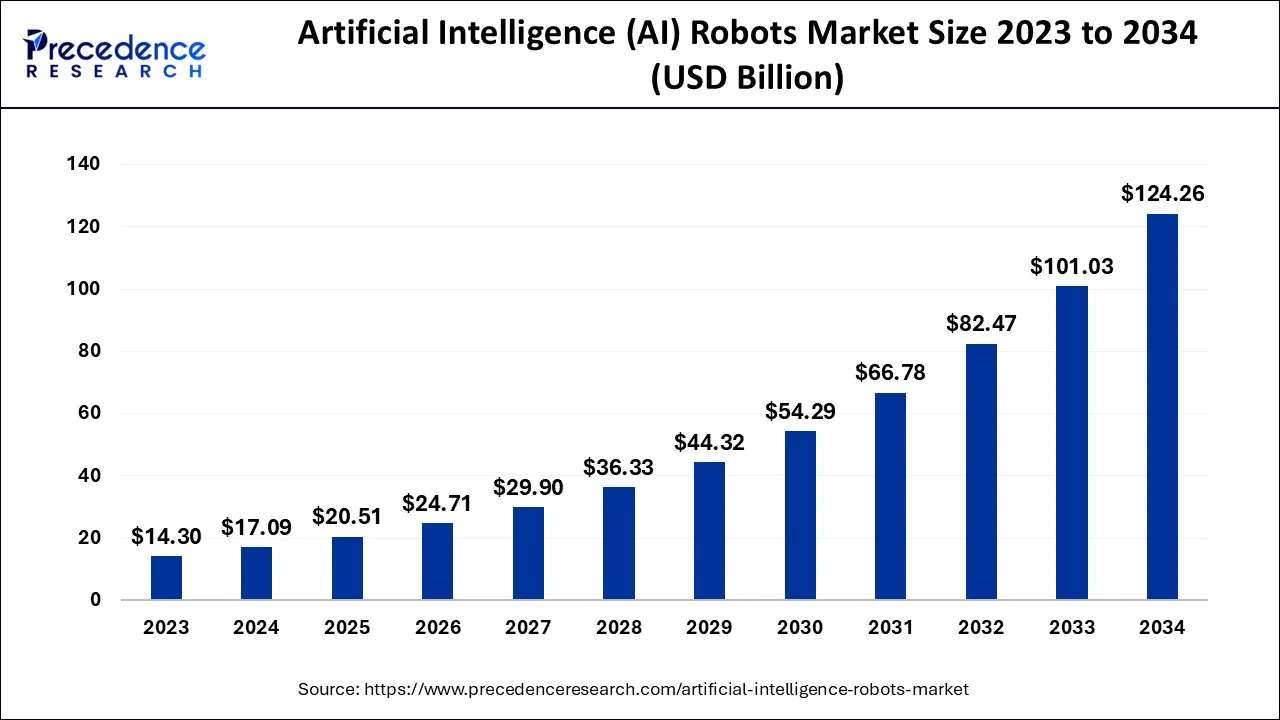
The global artificial intelligence (AI) robots market size was estimated at USD 17.09 billion in 2024 and is predicted to increase from USD 20.51 billion in 2025 to approximately USD 124.26 billion by 2034, expanding at a CAGR of 22.16% from 2025 to 2034.
Artificial Intelligence (AI) Robots Market Key Takeaways
- In terms of revenue, the global artificial intelligence (AI) robots market was valued at USD 17.09 billion in 2024.
- It is projected to reach USD 124.26 billion by 2034.
- The market is expected to grow at a CAGR of 22.16% from 2025 to 2034.
- North America dominated the global market with the largest market share of 33.14% in 2024.
- Asia-Pacific is expected to expand at the fastest CAGR of 21.9% between 2025 and 2034.
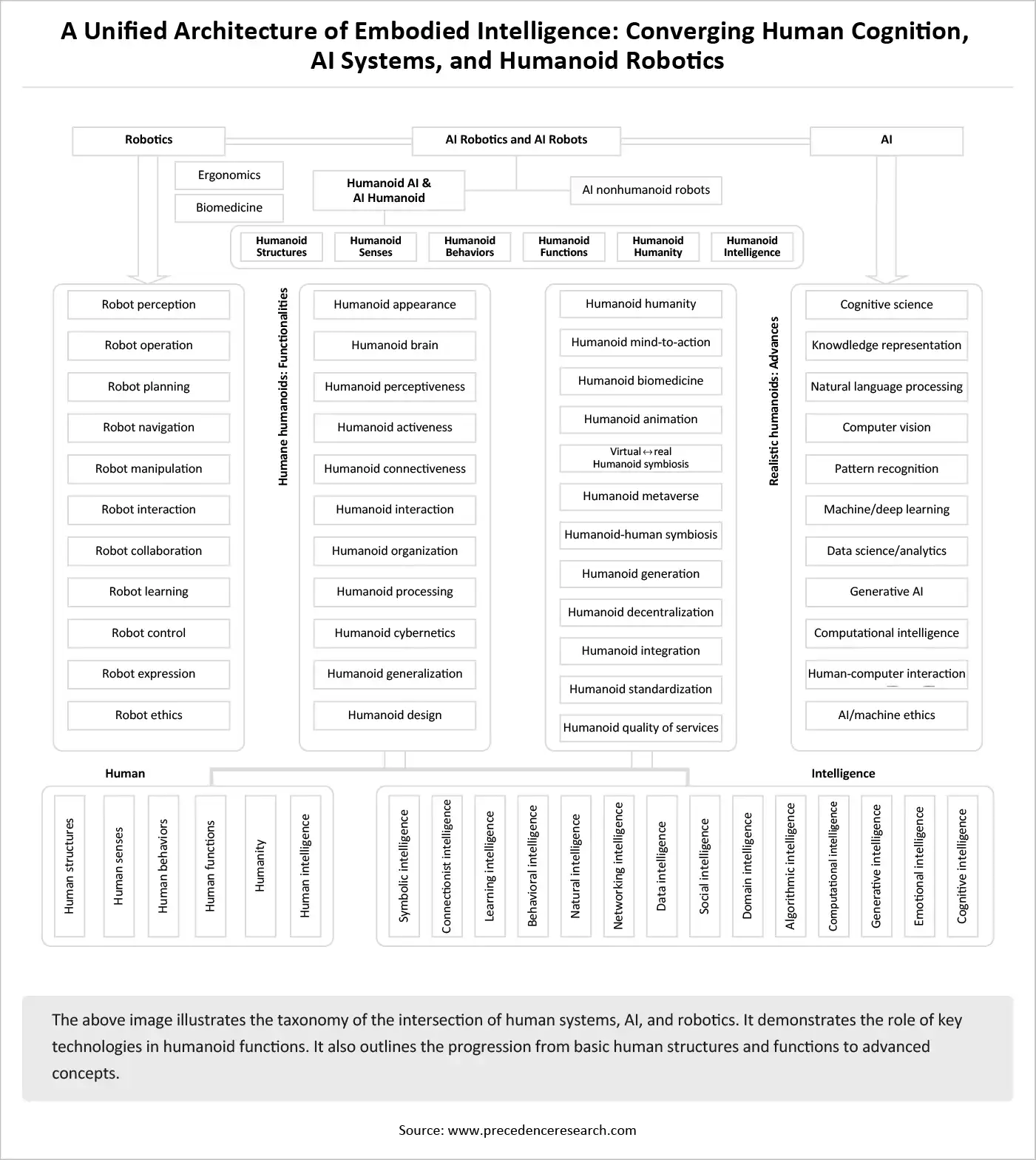
A Unified Architecture of Embodied Intelligence: Converging Human Cognition, AI Systems, and Humanoid Robotics
Core Technologies Driving AI Humanoid Robots
- AI and ML: AI forms the cognitive core of humanoid robots, enabling perception, decision-making, and learning. Deep learning (DL) models process visual, auditory, and tactile data to recognize objects, faces, gestures, and speech. Reinforcement learning enables robots to acquire motor skills through trial-and-error interactions with the environment. Large-scale neural models are also enhancing natural language understanding and conversational abilities. Together, these AI technologies enable humanoids to exhibit adaptive and context-aware behavior.
- Perception Systems: Perception in humanoid robots is achieved through multimodal sensor fusion. Computer vision systems use cameras and depth sensors to understand spatial layouts and object geometry. Microphones support speech recognition and sound localization. Tactile sensors embedded in hands and skin-like surfaces provide feedback for safe and precise manipulation. The integration of these sensory streams allows humanoids to form a coherent representation of their surroundings.
- Actuation and Locomotion: Humanoid locomotion requires advanced actuation systems capable of balance, agility, and energy efficiency. Electric motors, series elastic actuators, and hydraulic systems are commonly used to replicate human-like motion. Control algorithms manage dynamic stability during walking, climbing, and object manipulation. Whole-body control frameworks coordinate multiple joints simultaneously. Achieving a natural, robust locomotion remains one of the most complex engineering challenges.
- Cognitive Architecture and Control: Cognitive architectures integrate perception, planning, memory, and action. Hierarchical control systems allow high-level reasoning to guide low-level motor execution. Task planning algorithms enable humanoids to sequence actions toward defined goals. Real-time feedback loops ensure adaptability to unexpected environmental changes. This layered architecture mirrors aspects of human cognition and motor control.
Echoes in Stone, Shadows in Code: The Eternal Dialogue of Human Representation
The story of human communication is not merely a tale of words; it is the story of how humanity has sought to replicate itself in its thoughts, emotions, and identities beyond the limitations of the body. Long before circuits and algorithms, the earliest forms of proto-visualization were already alive in the chiseled surfaces of stone and the flickering fires of caves.
In ancient Egypt, hieroglyphics were not simple markings, but living symbols carefully etched to embody meaning, give form to memory, and carry voices across time. Each glyph was more than a character. It was an avatar of human intention, a surrogate presence capable of communicating even when the speaker was absent. Parallel to this, the mysterious inscriptions of the Harappan civilization remind us that human beings, across geographies, felt a profound need to externalize their inner world. Though undeciphered, Harappan symbols stand as ghostly precursors of digital avatars: enigmatic, coded expressions of human experience, suspended between presence and absence.
Even further back, in the shadows of prehistory, our ape-like ancestors began their transformation not only through the use of tools but also through the expression of their emotions. The etchings on cave walls, hunts, rituals, and the cycles of life were not just pictures; they were the first attempts to project identity beyond the self. In these primitive inscriptions lies the essence of what we now call “virtual humans”: a desire to duplicate existence, preserve the self, and make thought and emotion tangible in another form.
Fast forward to our present, and this ancient impulse takes shape in astonishing new ways. Virtual humans, lifelike avatars trained on ML models, are not carved in stone, but in code. They learn to speak, listen, emote, and mirror the subtleties of human interaction. Just as hieroglyphs acted as symbolic representations of human presence, today’s avatars act as digital surrogates, bridging minds and machines. The bridge has changed, but the yearning behind it is the same: to transcend the limits of time, body, and distance.
Why, then, can we say that ancient writings were humanity’s first virtual humans? Because they carried fragments of identity outside the flesh. The glyph, the symbol, and the inscription were all vessels of the human spirit, given form in a medium that could endure. Hieroglyphs were not passive marks; they were active presences, capable of telling stories and holding conversations across centuries. The Harappan script, though silent to us now, surely performed the same role for those who once understood it: a proto-avatar, encoding not just sound but meaning, culture, and memory.
In today’s digital landscape, the pursuit has merely shifted its medium. AI imbues virtual humans with learning, adaptability, and contextual awareness. They can carry on a conversation, convey empathy, and respond with nuances once thought exclusive to biological life. Where inscriptions once mediated between two humans, virtual humans now mediate between human and machine, extending our agency into new, intangible domains.
Seen in this continuum, the arc from ape to avatar is less a leap than a steady unfolding. From the scratch of flint on stone to the pulse of neural networks, humanity has always sought to mirror itself, to archive its essence, and to build companions of its own making. Virtual humans are not a rupture from the past but its latest chapter, a digital reincarnation of an ancient longing to project the self into eternity.
Ethical, Social, and Safety Considerations
The deployment of AI humanoid robots raises significant ethical and societal questions. Issues include data privacy, surveillance, job displacement, and algorithmic bias. The anthropomorphic nature of humanoids can blur boundaries between machines and humans, raising concerns about emotional attachment and manipulation. Safety standards are crucial in preventing physical harm in shared environments. Responsible design, governance, and regulation are essential to ensure beneficial outcomes.
Role of AI-based Tools in Cyber Defence
- ML: ML algorithms analyze large volumes of network traffic, logs, and behavioral data to identify anomalies and suspicious activities. Supervised learning models classify known threats, while unsupervised learning detects unknown or novel attack patterns. ML enables continuous improvement as systems learn from new incidents. This adaptability significantly reduces detection latency. ML is widely used in intrusion detection systems (IDS) and security information and event management (SIEM) platforms.
- DL: DL models process high-dimensional data such as network flows, malware binaries, and user behavior sequences. Neural networks excel at identifying subtle correlations that are invisible to traditional analytics. These models enhance malware detection, phishing identification, and threat classification accuracy. However, they require significant computational resources and high-quality training data. DL is particularly effective against polymorphic and fileless attacks.
- NLP: NLP is used to analyze unstructured textual data, including threat intelligence reports, vulnerability disclosures, and dark web communications. AI systems extract actionable insights from vast textual sources. NLP enables the automated ingestion of threat intelligence and contextual understanding. This capability accelerates incident response and strategic decision-making. It also supports analyst augmentation.
- RL: RL enables autonomous decision-making by learning optimal defence strategies through interaction with the environment.
Application Domains of AI Humanoid Robots
- 1. Healthcare: Humanoid robots are utilized in hospitals and primary care facilities for patient assistance, rehabilitation, and companionship. They can help monitor patients' health, aid in physical therapy, and provide emotional support, improving the overall patient experience.
- 2. Education: In educational settings, humanoid robots serve as teaching assistants or tutors, offering personalized learning experiences. They can engage students in interactive lessons, assist with language learning, and provide support for children with special needs.
- 3. Manufacturing and Industry: Humanoid robots are employed in manufacturing as cobots to assist human workers with assembly tasks, quality control, and material handling. Their flexibility allows them to work alongside humans in dynamic production environments.
- 4. Service Industry: In retail and hospitality, humanoid robots can interact with customers, provide information, and assist in sales processes. They enhance the customer experience by delivering services with a personal touch.
- 5. Public Safety and Security: Humanoids are deployed in law enforcement and security applications to assist with surveillance, crowd management, and disaster response. Their presence can enhance safety in public spaces and emergencies.
- 6. Research and Development: As advanced platforms for research, humanoid robots are used in studies related to human-robot interaction, cognitive development, and robotics technology. They serve as testbeds for developing new algorithms and interaction models.
- 7. Entertainment: In the entertainment industry, humanoid robots are used as performers in plays, movies, and exhibitions. They can engage audiences through dance, storytelling, and interactive experiences, creating captivating entertainment options.
- 8. Social Companionship: In a social environment, humanoid robots are designed to provide companionship to individuals, particularly the elderly or those living alone. They can engage in conversations, play games, and offer emotional support, contributing to mental well-being.
- 9. Virtual Environments: Digital humanoids or avatars are increasingly used in virtual and augmented reality (VR/AR) applications for training, simulations, and customer service. They allow for immersive experiences that can enhance learning and user engagement.
- These application domains demonstrate the versatility of AI humanoid robots and their potential to enhance various aspects of human life by solving real-world challenges and improving interaction in human-centric environments.
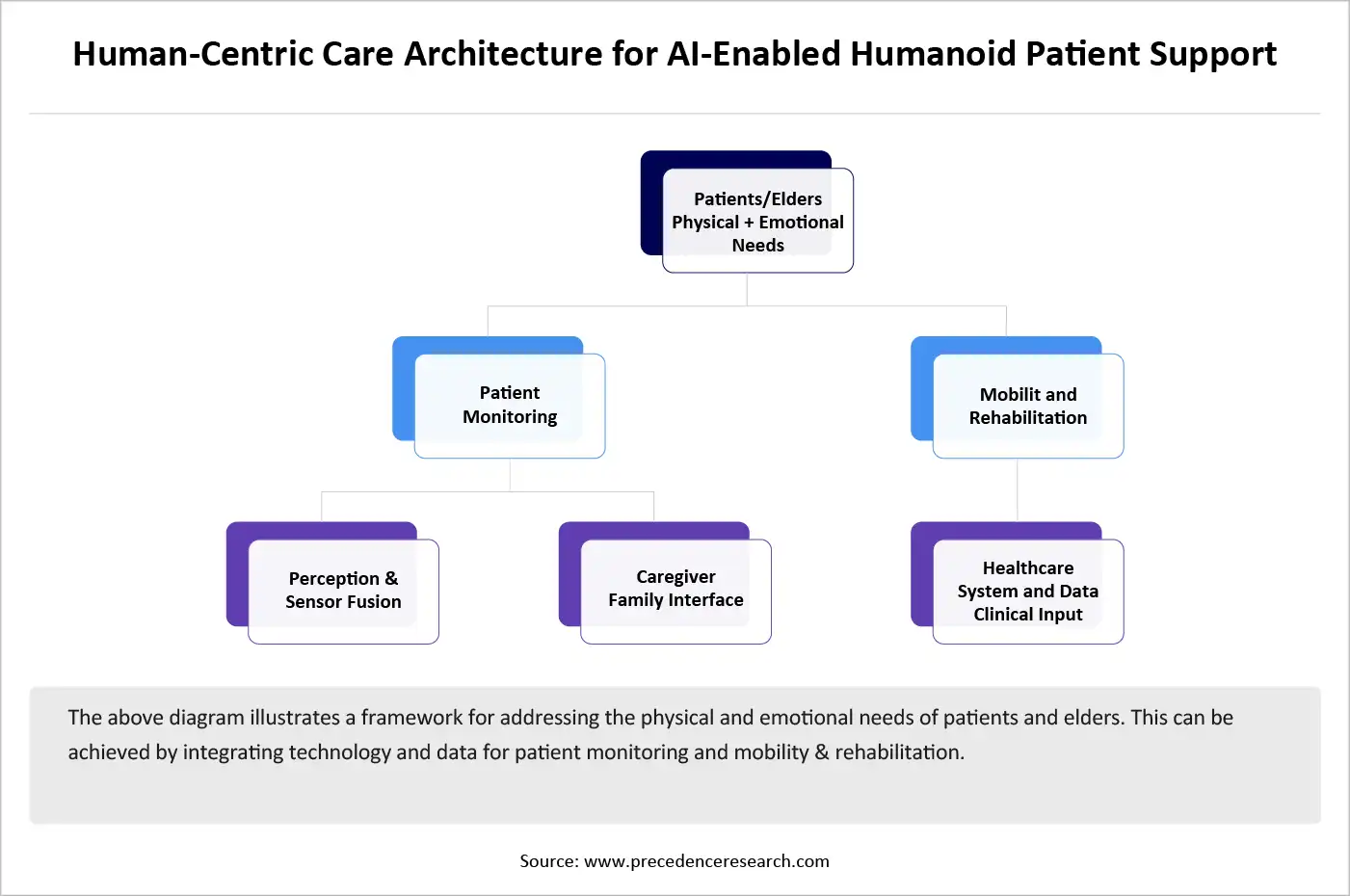
Human-Centric Care Architecture for AI-Enabled Humanoid Patient Support
Future Directions
The future of humanoid robots, which are based on AI, consists of better integration of physical intelligence and cognitive AI. Autonomy will be boosted by the development of neuromorphic computations, embodied AI, and self-learning machines. They can also be supplied with improved materials and actuators, which will allow safe and more efficient movement. The interactions between humans and humanoids will be facilitated in a more streamlined manner by having the same autonomy. Finally, the development of humanoid robots can lead to the creation of general-purpose agents that can make a significant contribution in various areas.
Conclusion
AI humanoid robots represent a convergence of AI algorithms, robotics, and human-centered design. While still in a developmental phase, their potential impact on society, industry, and daily life is profound. Continued research, ethical foresight, and interdisciplinary collaboration will determine how these systems are integrated into human environments. With responsible development, AI humanoid robots can augment human capabilities and redefine the future of work and interaction.
About the Authors

Aditi Shivarkar
Aditi, Vice President at Precedence Research, brings over 15 years of expertise at the intersection of technology, innovation, and strategic market intelligence. A visionary leader, she excels in transforming complex data into actionable insights that empower businesses to thrive in dynamic markets. Her leadership combines analytical precision with forward-thinking strategy, driving measurable growth, competitive advantage, and lasting impact across industries.



Aman Singh
Aman Singh with over 13 years of progressive expertise at the intersection of technology, innovation, and strategic market intelligence, Aman Singh stands as a leading authority in global research and consulting. Renowned for his ability to decode complex technological transformations, he provides forward-looking insights that drive strategic decision-making. At Precedence Research, Aman leads a global team of analysts, fostering a culture of research excellence, analytical precision, and visionary thinking.

Piyush Pawar
Piyush Pawar brings over a decade of experience as Senior Manager, Sales & Business Growth, acting as the essential liaison between clients and our research authors. He translates sophisticated insights into practical strategies, ensuring client objectives are met with precision. Piyush’s expertise in market dynamics, relationship management, and strategic execution enables organizations to leverage intelligence effectively, achieving operational excellence, innovation, and sustained growth.