






 Request Consultation
Introduction
The worldwide semiconductor manufacturing industry entered 2026 more concentrated at the leading edge. TSMC alone thus generated $122.0 billion in revenue in fiscal 2025, up 35.9% year-over-year, and has committed $265 billion in total U.S. investment, while only two other firms, Samsung and Intel, are even attempting to compete at the 2-nanometer node. Precise "market share" percentages for the foundry industry are primarily calculated and published by commercial market-research firms.
Key Takeaways
- According to TSMC's own SEC filings, TSMC generated $122 billion in revenue for fiscal year 2025, up 35.9% year-over-year in USD terms, with Q4 2025 revenue of $33.73 billion and a 62.3% gross margin, both company records.
- Advanced technologies accounted for 74% of TSMC's total 2025 wafer revenue, up from 69% in 2024; meanwhile, high-performance computing overtook smartphones as TSMC's largest end-market platform at 55% of Q4 2025 revenue.
- TSMC's 2nm (N2) process entered high-volume production in Q4 2025, with capacity reaching nearly 90,000–100,000 wafers per month across Taiwan facilities by early 2026, and even output reported fully booked through 2028.
- TSMC's capital expenditure has more than doubled in two years, from $28.9 billion in 2024 to $40.9 billion in 2025, and the firm raised its 2026 capex guidance mid-year from an initial $52–$56 billion range to $60–$64 billion.
- Intel's total company revenue was $52.9 billion in fiscal 2025, approximately flat with 2024, as its 18A process node entered high-volume manufacturing in October 2025; Intel Foundry reported a $2.4 billion operating loss in Q1 2026, as per industry reporting.
- TSMC is committing an additional $100 billion to its Arizona operations in mid-2026, bringing its total declared U.S. investment to $265 billion, the largest single foreign direct investment commitment in U.S. history, to support at least four more 2nm-and-below fabs plus advanced packaging facilities.
- China's SMIC continued producing 7-nanometer chips for Huawei smartphones despite lacking access to EUV lithography instruments under US export controls, with quarterly revenue stated around $2.49 billion in Q4 2025.
- Samsung's Device Solutions division, which involves both memory and foundry or System LSI businesses, posted record quarterly revenue and then operating profit in Q4 2025, driven mainly by the memory business's need for HBM (high-bandwidth memory) rather than foundry alone.
- The global foundry industry remains highly concentrated at the leading edge: only three firms, such as TSMC, Samsung, and Intel, currently function or are pursuing sub-3nm production, while mature-node and specialty foundries such as GlobalFoundries, UMC, and SMIC compete on expense, reliability, and specific process specializations rather than leading-edge performance.
- The US CHIPS and Science Act was signed in August 2022, appropriating $52.7 billion in federal funding, with TSMC Arizona thus receiving a finalized award of up to $6.6 billion in direct funding.
Visual Intelligence: 15 Data Stories on Global Semiconductor Manufacturing
Global Semiconductor Manufacturers: Most Recent Quarterly Revenue, As Reported
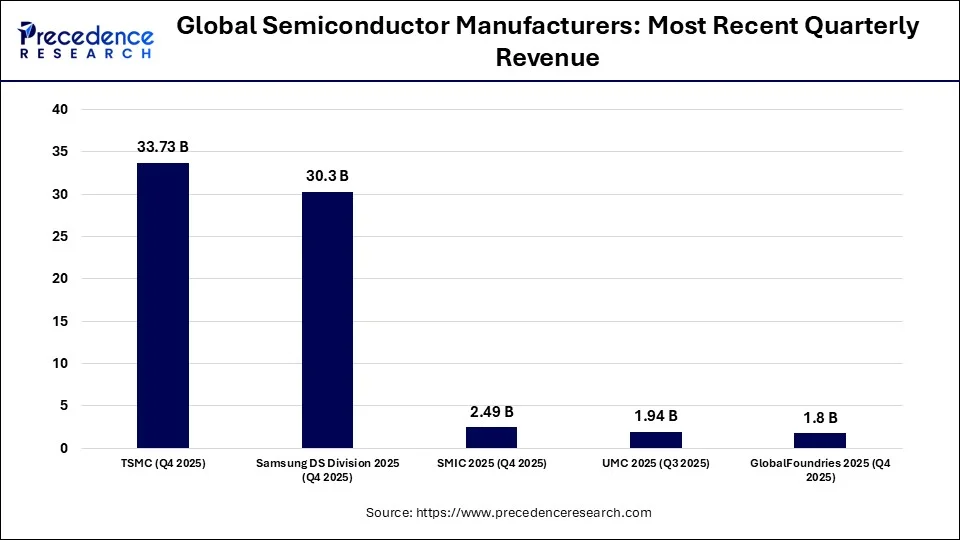
This chart compares the most recently reported quarterly revenue for five major semiconductor manufacturers, based on each firm's own earnings disclosures. TSMC reached a record fourth-quarter revenue of $33.73 billion because of surging global demand for artificial intelligence (AI) hardware and high-performance computing chips. Samsung's DS division posted massive memory revenues of $30.8 billion in specific segments like DRAM and HBM, primarily due to an unprecedented upcycle driven by artificial intelligence infrastructure demand.
The figure of $2.49 billion represents Semiconductor Manufacturing International Corporation (SMIC)’s revenue for the fourth quarter, driven by strong domestic demand from China's local chip push. The figure of $1.94 billion represents the quarterly revenue stated by semiconductor manufacturer United Microelectronics Corp (UMC) in its financial results, driven by steady wafer shipments and demand for mature semiconductor nodes. The figure of $1.80 billion for semiconductor producer GlobalFoundries refers to its recent quarterly revenue.
Key Insight: TSMC's quarterly revenue exceeds the combined quarterly revenue of SMIC, UMC, and GlobalFoundries by more than 5 times. A concentration level that helps explain why TSMC alone is committing $265 billion to U.S. manufacturing capacity while its smaller competitors pursue far more modest and specialty-focused expansion plans.
Source: Multiple (see below): "Company official earnings releases and earnings calls," Q3–Q4 2025.
TSMC's FY2025: Record Revenue, Record Margins
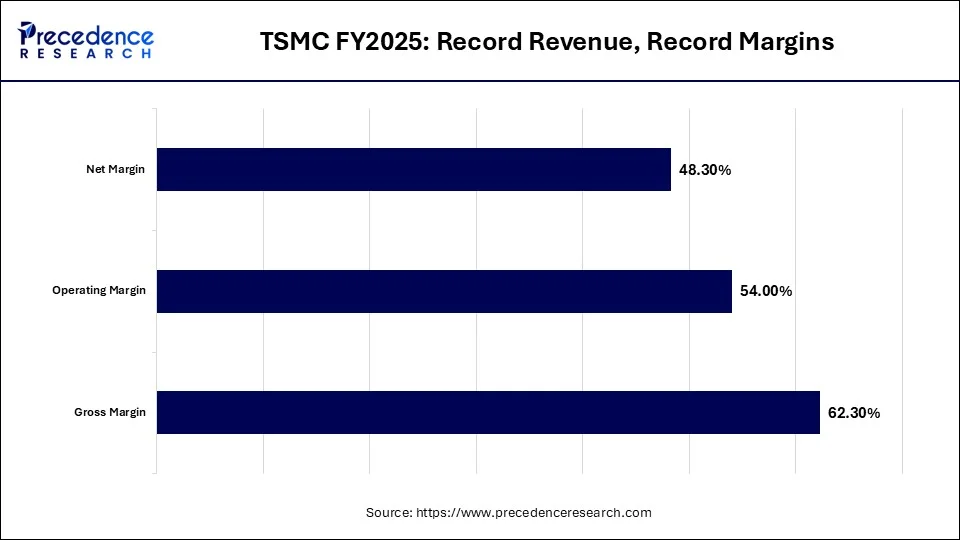
This chart summarizes TSMC's fiscal 2025 full-year revenue and its Q4 2025 gross, operating, and net profit margins, based on the firm's own SEC filing.
- Taiwan Semiconductor Manufacturing Company reported a record fiscal 2025 net revenue of $122 billion, driven mainly by an explosion in global demand for artificial intelligence and even high-performance computing (HPC) chips.
- A gross margin of 62.3% means that a firm keeps 62.3 cents of every dollar in revenue after paying for direct production expenses.
- An operating margin of 54% means that for every dollar of revenue a company makes, it keeps 54 cents as operating profit after paying for variable and even fixed day-to-day operational costs.
- A net profit margin of 48.3% means a firm keeps nearly half of every dollar or rupee it earns as actual profit after paying all expenses.
Key Insight: A 62.3% gross margin at this scale of revenue is extraordinary for a capital-intensive manufacturing business. It reflects TSMC's pricing power as the only firm currently capable of reliably manufacturing the most advanced AI accelerator chips at volume, enabling it to pass rising costs on to customers with few alternative suppliers.
Source: TSMC (TWSE: 2330, NYSE: TSM) — "SEC Form 6-K, Q4 2025 earnings release," January 15, 2026.
TSMC's Full-Year 2025 Wafer Revenue by Technology Node
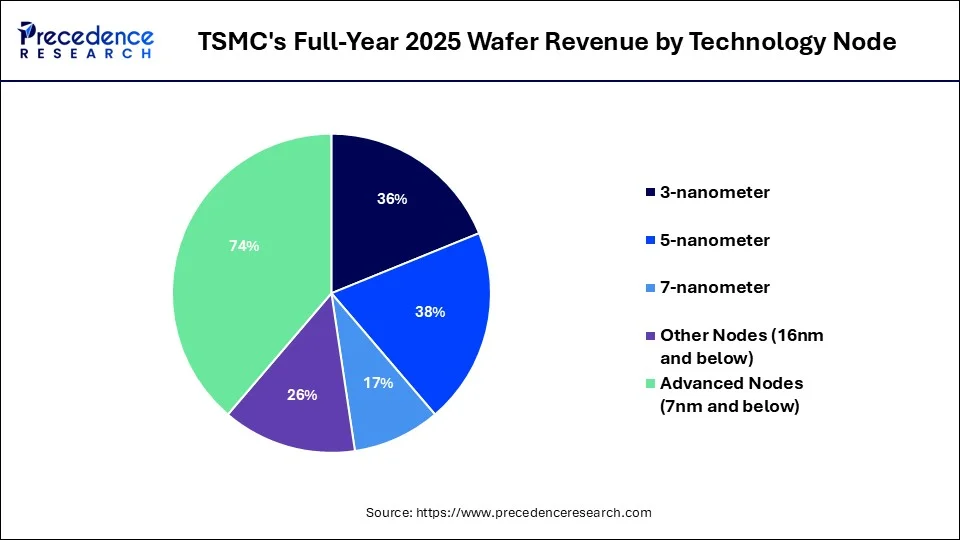
This chart breaks down TSMC's 2025 wafer revenue by process technology node, based on the firm's own Q4 2025 earnings call transcript. Advanced process nodes (7-nanometer and below) thus reached 74% of TSMC's wafer revenue in 2025, driven by an unprecedented surge in demand for AI infrastructure, high-performance computing (HPC), and even next-generation mobile processors.
Key Insight: The five-percentage-point jump in advanced-node share happened even as TSMC's overall revenue grew nearly 36%, which means the need for TSMC's most advanced, highest-margin nodes grew faster than the firm's already-rapid overall growth rate, a dynamic almost entirely attributable to AI accelerator need.
Source: TSMC- "Q4 2025 earnings call transcript," January 2026.
HPC Is Now TSMC's Largest End-Market, Ahead of Smartphones
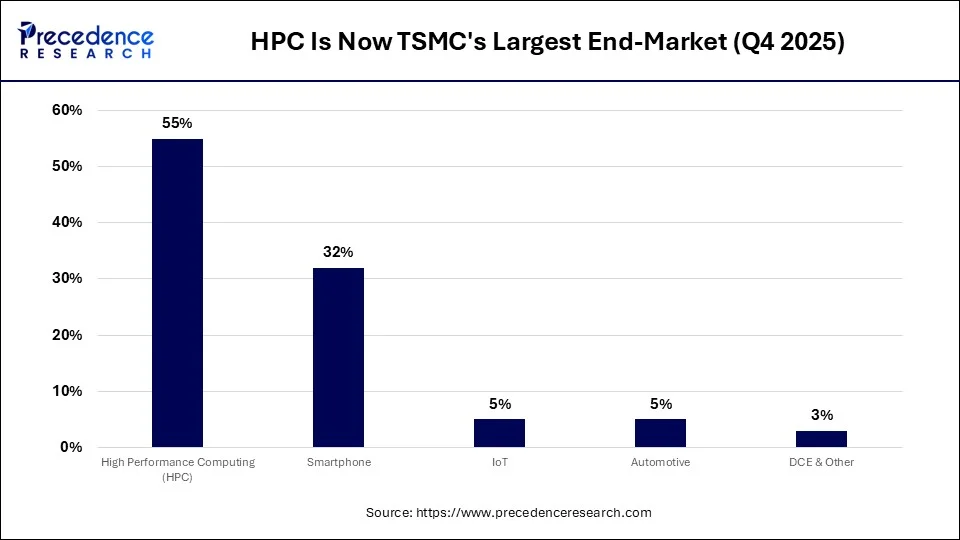
This chart shows TSMC's Q4 2025 revenue breakdown by end-market platform, based on the company's own earnings call.
- TSMC's net revenue in Q4 2025 was driven by massive, continuous demand for AI chips and advanced cloud infrastructure.
- TSMC's smartphone sector generated 32% of its net revenue in the fourth quarter of 2025 because of a strong seasonal rebound and broad-based need for high-end mobile processors.
- In TSMC's Q4 2025 earnings report, the Internet of Things (IoT) platform accounted for 5% of total wafer revenue as explosive expansion in High-Performance Computing (HPC) and smartphones completely overshadowed it.
- In TSMC's Q4 2025 results, the automotive platform led 5% of total net revenue because automotive chip demand experienced a slight sequential pullback, while explosive growth in AI and smartphones dominated total output.
- In TSMC's Q4 2025 reporting, DCE (Digital Consumer Electronics) and a few minor segments represent a tiny fraction of total revenue, typically around 1% to 3% combined, and the sequential shift reflects minor cyclical inventory adjustments or normalization in traditional consumer appliances such as smart TVs and set-top boxes, contrasting sharply with the massive AI-based surge in HPC.
Key Insight: HPC is overtaking smartphones as TSMC's largest platform; thus, it represents a structural shift in the company's business. Smartphones drove TSMC's growth for over a decade, but AI accelerators and data center demand have now become the primary engine, with direct implications for how TSMC allocates its massive capex budget toward specific node types along with packaging technologies.
Source: TSM "Q4 2025 earnings call transcript," January 2026.
TSMC's Capex More Than Doubled in Two Years: $28.9B to a Guided $60–$64B
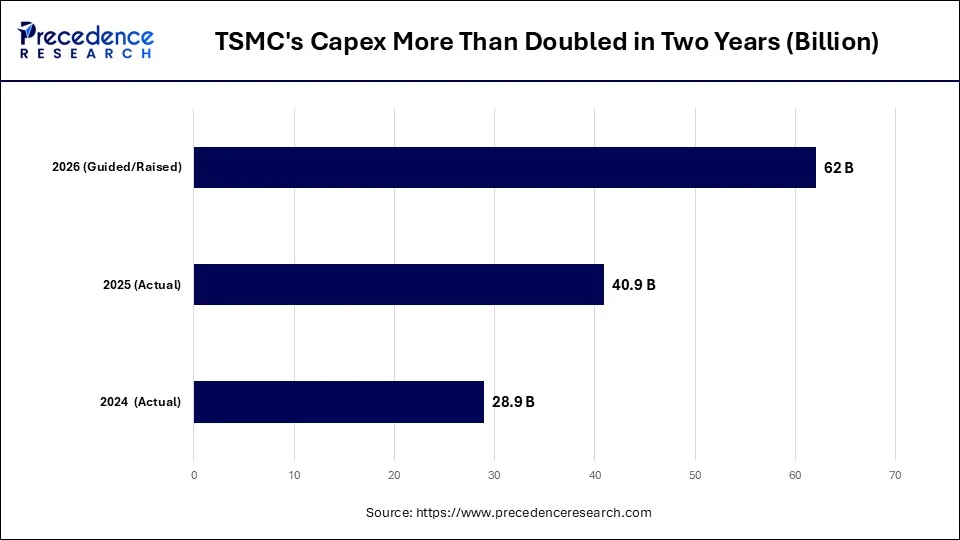
This chart traces TSMC's actual capital expenditure for 2024 and 2025, alongside its 2026 guidance, which surged mid-year from an initial $52–$56 billion range. In 2024, TSMC recorded a capital expenditure of $28.9 billion as spending leveled off as the firm successfully digested prior multi-year investments and then transitioned from intensive fab construction into harvesting revenue from established advanced nodes.
TSMC spent $40.9 billion on capital expenditure in 2025 to aggressively build and expand extreme manufacturing capacity for the latest AI accelerators and advanced semiconductor nodes. TSMC's high 2026 capital expenditure guidance of nearly $62 billion is driven by surging global need for artificial intelligence processors and the massive expense of expanding advanced manufacturing.
Key Insight: TSMC's own CFO explicitly stated that capital expenditure over the next three years would be "even more significantly higher" than the previous three years, a multi-year step-change in the scale of capital the firm believes it needs to deploy to keep pace with demand.
Source: TSMC - "CFO Wendell Huang, Q4 2025 and Q2 2026 earnings calls," January and July 2026.
TSMC's $265 Billion Arizona Commitment
This highlight summarizes TSMC's total announced US investment following its mid-2026 commitment of an additional $100 billion for expanded Arizona operations. TSMC's total declared U.S. investment commitment after adding $100 billion more for at least four additional Arizona fabs at 2nm and below, plus advanced packaging, is the largest foreign direct investment commitment in U.S. history.
Key Insight: The decision to route an additional $100 billion specifically into Arizona, rather than diversifying further into a few countries or regions, thus reflects both the CHIPS Act's original incentive structure and TSMC's own assessment that its largest customers, which include major U.S. technology firms, most value geographic proximity and reduced geopolitical risk for their most advanced chip supply.
Source: TSMC - "CEO C.C. Wei, Q2 2026 earnings conference," July 2026.
The 2nm Race: TSMC, Samsung, and Intel Compared
| TSMC | Samsung | Intel |
| High-volume production began in Q4 2025 | Prioritizing yield improvement over volume expansion | Entered high-volume manufacturing in October 2025 |
| Capacity reached approximately 90,000–100,000 wafers/month across Taiwan fabs by early 2026 | 2nm shipments and HBM4-related logic supported Q4 2025 revenue growth | Yields improving at approximately 7% monthly |
| Output fully booked through 2026 | Growth driven by Chinese automakers, electric vehicles, and automotive chips | KeyBank estimates 65–75% yields |
| N2P enhancement and A16 (1.6nm) node targeted for H2 2026 | Estimated 15% chip share for the 3nm process | |
| Reported $2.4B operating loss in Q1 2026 |
This comparison summarizes the current status of each of the three companies pursuing leading-edge 2-nanometer semiconductor manufacturing.
TSMC (N2/N2P)
High-volume production began in Q4 2025. The capacity reached nearly 90,000- 100,000 wafers per month.
Samsung (SF2/SF2P)
It is prioritizing yield improvement over volume expansion. 2-nm shipments and HBM4-related logic designs supported Q4 2025 founry revenue growth.
Intel (Intel 18A)
It entered high-volume manufacturing in October 2025. Its yields are improving nearly 7% monthly, per KeyBanc Capital Markets estimate.
Key Insight: The gap between TSMC's 2nm output already being "fully booked through 2028" and Intel Foundry's 18A yields still trailing TSMC's mature 3nm process states just how far ahead TSMC's execution currently is; both Samsung and Intel are explicitly prioritizing yield stabilization over aggressive volume growth. A tacit acknowledgment that chasing TSMC on capacity alone would be pointless without first closing the yield and reliability gap.
Source: Multiple (see below) — "TSMC Q4 2025 earnings materials; industry reporting on Samsung Foundry and Intel 18A," 2025–2026.
Intel's Foundry Turnaround Bet: 18A in High-Volume Production
According to its SEC Form 10-K filing, Intel recorded full-year 2025 total company revenue of $52.9 billion. The firm successfully transitioned the Intel 18A manufacturing process into high-volume production during 2025, positioning it as a key node for external foundry customers.
Key Insight: Intel's essentially flat total revenue in a year when TSMC grew 36% underscores the stakes of Intel's foundry turnaround. The firm is simultaneously trying to fix the internal manufacturing supply constraints while building an external foundry business to compete with TSMC and Samsung, a dual mandate few other semiconductor firms attempt at once.
Source: Intel Corporation - "Form 10-K, fiscal year 2025," 2026.
Samsung's Device Solutions Division: Memory Powers a Record Quarter
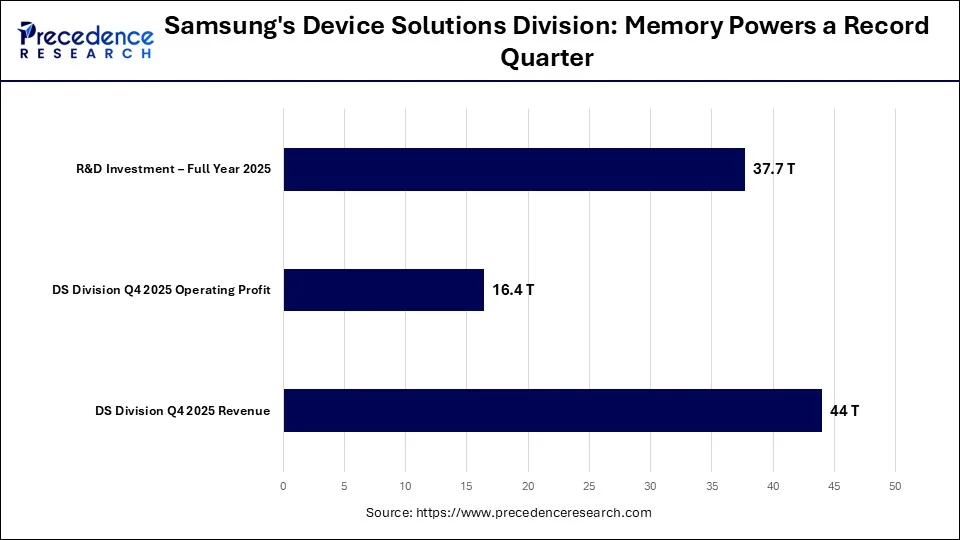
In the fourth quarter of 2025, Samsung's Device Solutions (DS) division reported a quarterly revenue of KRW 44.0 trillion and an operating profit of KRW 16.4 trillion, along with a record company-wide full-year R&D investment of KRW 37.7 trillion.
Q4 2025 Device Solutions (DS)- It has KRW 44.0 trillion in revenue and an operating profit of KRW 16.4 trillion. The surging AI-related memory demand has driven the Memory Business to achieve all-time highs in quarterly revenue and operating profit due to high-end products such as HBM. Full-Year 2025 R&D Investment: KRW 37.7 trillion is setting a new historical record for the company.
Key Insight: Samsung's own earnings language explicitly credits the Memory business with setting the division's all-time revenue as well as profit records, boosted by HBM sales; this distinction matters because it means Samsung's overall DS Division financial strength does not necessarily translate into foundry competitiveness against TSMC, where Samsung continues to prioritize yield improvement over aggressive expansion.
Source: Samsung Electronics — "Official Q4 and FY2025 earnings announcement," 2026.
GlobalFoundries and UMC: The Mature-Node Specialists
This chart compares Q3 2025 quarterly revenue for GlobalFoundries and UMC, two firms that deliberately compete on mature and then specialty process nodes rather than the leading edge.
- GlobalFoundries successfully leveraged its unique three-continent manufacturing footprint to capture reshoring demand. Despite a slight 3% YoY revenue dip, its product mix optimization enabled its gross margin to expand to 26%. Its quarterly revenue is $1.688B.
- UMC leaned heavily into highly differentiated specialty processes, such as embedded non-volatile memory (eNVM) along with high-voltage power chips. Its gross margin reached 29.8% for the quarter, thus reflecting stabilizing utilization rates across its mature fabs. Its quarterly revenue is $1.94B.
Key Insight: Both companies' revenue scales to nearly $1.7–1.9 billion per quarter, an order of magnitude smaller than TSMC's quarterly revenue, which reflects a coherent strategic choice rather than simple underperformance. It is a mature-node manufacturing business for automotive, industrial, and communications infrastructure customers that requires far less capital investment per unit of revenue than leading-edge logic, enabling both firms to remain solidly profitable at a fraction of TSMC's scale.
Source: GlobalFoundries; UMC - "Q3 2025 earnings calls, as reported by AnySilicon," November 2025.
SMIC: China's National Champion Grew 71% Despite Export Controls
- SMIC’s fourth-quarter 2022 revenue reached nearly $1.5 billion, driven by resilient legacy chip production and even sustained domestic demand despite broader industry corrections.
- SMIC reported a Q4 2025 revenue of $2.49 billion, driven mainly by strong domestic demand from China's aggressive push for semiconductor localization.
Key Insight: SMIC's ability to grow 71% over three years while explicitly lacking access to EUV lithography equipment. The tool required for the most advanced sub-7nm processes, which demonstrates that Chinese domestic need and government support have been sufficient to drive substantial growth even at technologically constrained process nodes, though the firm remains years behind TSMC and Samsung at the true leading edge.
Source: SMIC (HKEX: 0981) - "Quarterly results, as reported in industry earnings coverage," 2022–2025.
Mapping the Semiconductor Manufacturing Value Chain
- Chip Design: Engineers create the logic, architecture, and even circuit blueprints for the chip. Fabless design firms include Qualcomm, NVIDIA, and AMD.
- Wafer Fabrication: Pure silicon is sliced into thin discs called wafers. Millions of microscopic circuits are now etched onto these wafers using intense light and chemicals inside cleanrooms. This is the most expensive and also technologically demanding stage in the entire supply chain. A tiny handful of giant foundries, such as TSMC and
- Samsung, and also single-source equipment makers, like ASML, control the majority of advanced node production. Assembly Packaging: While less capital-heavy than fabrication, this back-end process is heavily clustered in specific hubs across Asia.
- Test & Assembly: Finished chips are soldered onto printed circuit boards (PCBs), memory modules, and even sub-assemblies. The microprocessor powers management, storage, and input-output systems.
- End Products: Fully integrated electronic modules are placed inside final enclosures and even shipped to consumer or industrial markets. Smartphones, automobiles, medical hardware, and AI servers.
Key Insight: The stark contrast between the design stage and the fabrication stage is the single most important structural fact about the modern semiconductor industry. It explains why chip design innovation has remained relatively distributed along with competitive, while chip manufacturing has become one of the most concentrated, capital-intensive, and even geopolitically significant industries in the world.
Source: Synthesized from official sources - "TSMC, Samsung, and Intel public disclosures on foundry and packaging operations," 2025–2026.
Global Semiconductor Manufacturers: Side-by-Side Comparison
- TSMC: Headquarters in Hsinchu Science Park, Hsinchu, Taiwan. Over $100 billion USD for the first time in the company's history.
- Samsung: Headquarters in Suwon-si, Gyeonggi-do, South Korea. Most recent revenue in 2025: $30 billion USD.
Key Insight: Only two firms in this comparison which is TSMC and Samsung, currently have 2nm technology in any stage of production, while Intel's 18A nearly equivalent to a "2nm-class" node under Intel's own naming convention, only recently entered high-volume manufacturing, meaning the "leading edge" of semiconductor manufacturing is currently a three-company race, with SMIC, UMC, and GlobalFoundries competing in an entirely different, mature-node segment of the same overall industry.
Source: Multiple - "TSMC, Samsung Electronics, Intel Corporation, SMIC, UMC, and GlobalFoundries official disclosures," 2025–2026.
The CHIPS Act: Reshoring Semiconductor Manufacturing to the U.S.
This infographic summarizes the scale of the US CHIPS and Science Act's funding and TSMC's specific award, based on the legislation itself and official Commerce Department announcements.
- The CHIPS and Science Act allocates a total of $52.7 billion to boost domestic semiconductor manufacturing, research, and even workforce development.
- The $39 billion allocation for manufacturing incentives in the CHIPS and Science Act is programmed to offset the extreme capital costs of building or modernizing domestic semiconductor fabrication facilities.
- TSMC Arizona's direct funding is more than $6.6 billion to build three greenfield fabrication plants in Phoenix, Arizona.
Key Insight: TSMC's $6.6 billion CHIPS Act award is a small fraction of the firm's own $265 billion total Arizona commitment which illustrating that federal incentive funding, while politically significant in allowing the initial decision to invest in the U.S., represents only a modest share of the actual capital TSMC itself is deploying, with the overwhelming majority of Arizona's buildout supported by TSMC's own balance sheet.
Source: U.S. Government; TSMC - "CHIPS and Science Act (Pub. L. 117-167); TSMC Arizona press release," 2022–2024.
U.S. Export Controls and the China Semiconductor Landscape
This comparison summarizes the interaction between US export controls, SMIC's domestic production response, and Chinese government support for the domestic semiconductor industry.
- The U.S. restricts direct sales of advanced accelerators, such as NVIDIA and AMD graphics processors, and key chipmaking tools demanded for sub-14nm fabrication. Washington coordinates with allies such as the Netherlands to block extreme ultraviolet (EUV) lithography systems, while tightening regulatory frameworks and even annual operational approvals.
- China's top foundry, SMIC, bypassed a lack of EUV machines by pushing deep ultraviolet (DUV) multiple-patterning techniques into 7nm and then reportedly 5nm production. These workarounds suffer from low production yields and even significantly higher costs compared to global competitors such as TSMC.
Key Insight: SMIC's continued revenue growth despite lacking EUV access suggests that export controls have been more effective at limiting China's access to the true leading edge than at constraining the country's broader semiconductor manufacturing growth. China's domestic need as well as government support have proven sufficient to sustain substantial mature-and-legacy-node growth even under current restrictions.
Source: Multiple - "U.S. Bureau of Industry and Security export control framework; industry reporting on SMIC and Chinese semiconductor policy," 2025–2026.
Quick-Reference Data Tables
Table 1: Global Semiconductor Manufacturers at a Glance
| Company | HQ | Most Recent Revenue | Leading-Edge Node |
| TSMC | Hsinchu, Taiwan | $122.0B (FY2025) | 2nm (N2), HVM since Q4 2025 |
| Samsung (DS Division) | Suwon, South Korea | ~$30B (Q4 2025, incl. memory) | 2nm (SF2) |
| Intel | Santa Clara, CA, U.S. | $52.9B (FY2025, total company) | 18A, HVM since Oct. 2025 |
| SMIC | Shanghai, China | $2.49B (Q4 2025, quarterly) | 7nm (mature yield ramp) |
| UMC | Hsinchu, Taiwan | $1.94B (Q3 2025, quarterly) | Mature/specialty nodes |
| GlobalFoundries | Malta, NY, U.S. | $1.69B (Q3 2025, quarterly) | Mature/specialty nodes |
Source: TSMC, Samsung Electronics, and Intel Corporation official earnings releases and SEC/regulatory filings; SMIC, UMC, and GlobalFoundries quarterly results as reported in official earnings calls, 2025–2026.
TSMC Capital Expenditure Trajectory
| Year | Capital Expenditure | Status | % to Advanced Process Tech | |
| 2024 | $28.9 billion | Actual | Not separately disclosed in cited source | |
| 2025 | $40.9 billion | Actual | Not separately disclosed in cited source | |
| 2026 (initial guidance) | $52–$56 billion | Guided (Jan. 2026) | 70–80% | |
| 2026 (revised guidance) | $60–$64 billion | Guided (July 2026) | 70–80% | |
Source: TSMC CFO Wendell Huang, Q4 2025 and Q2 2026 earnings calls; Industrial Info Resources reporting on TSMC capex guidance.
Recent Developments
Seven of the most consequential developments shaping global semiconductor manufacturing over the past 18 months, prioritized by recency and business impact:
| Date | July 16, 2026 |
| Organization | TSMC |
| Development | TSMC declared an additional $100 billion investment in Arizona for at least four more 2-nanometer-and-below fabs and even advanced packaging facilities, at its Q2 2026 earnings conference. |
| What Changed | The commitment brought TSMC's total declared US investment to $265 billion and came alongside raised guidance: full-year 2026 revenue growth was raised to "slightly above 40%" in USD terms, and 2026 capex guidance was raised to $60–$64 billion from an initial $52–$56 billion. |
| Why It Matters | It represents one of the largest single corporate capital commitments in U.S. history and confirms TSMC's confidence that AI-driven need will remain durable enough to justify the expansion. |
| Business Significance | TSMC also raised Q3 2026 revenue guidance to $44.6–$45.8 billion, up 12% sequentially at the midpoint and nearly 37% year-over-year. |
| Source | TSMC CEO C.C. Wei, Q2 2026 earnings conference, reported by Tom's Hardware, July 16, 2026 |
TSMC - January 15, 2026
| Date | January 15, 2026 |
| Organization | TSMC |
| Development | TSMC reported Q4 2025 and full-year 2025 results, with Q4 revenue of $33.73 billion (up 25.5% year-over-year) and full-year 2025 revenue of $122.0 billion (up 35.9% in USD terms). |
| What Changed | The advanced technologies (7nm and below) thus reached 74% of full-year 2025 wafer revenue, up from 69% in 2024, while HPC grew to become the firm's largest platform segment. |
| Why It Matters | It confirmed TSMC's fourth consecutive record quarter and even set the base for the firm's subsequently raised 2026 guidance. |
| Business Significance | TSMC's initial 2026 capex guidance of $52–$56 billion was issued along with these results, before being raised further at the Q2 2026 earnings call. |
| Source | TSMC, SEC Form 6-K, Q4 2025 earnings release, January 15, 2026 |
Intel Corporation - October 2025
| Date | October 2025 |
| Organization | Intel Corporation |
| Development | Intel's 18A process node entered high-volume manufacturing, a central milestone in the firm's multi-year foundry turnaround strategy. |
| What Changed | Industry reporting citing KeyBanc Capital Markets estimated 18A yields improving nearly 7% monthly but still in the 65–75% range, below TSMC's mature 3nm process yields. |
| Why It Matters | It represents Intel's most concrete evidence yet that its IDM 2.0 strategy, rebuilding leading-edge internal production capability while also courting external foundry customers, is progressing, even as the foundry business remains unprofitable. |
| Business Significance | Intel Foundry stated a $2.4 billion operating loss in Q1 2026 according to industry reporting, thus underscoring the scale of investment still needed before the business reaches profitability. |
| Source | Industry reporting citing KeyBanc Capital Markets estimates, April 2026 |
Samsung Electronics - Q4 2025 (reported early 2026)
| Date | Q4 2025 (reported early 2026) |
| Organization | Samsung Electronics |
| Development | Samsung's Device Solutions division reported record quarterly consolidated revenue of KRW 44.0 trillion and even operating profit of KRW 16.4 trillion, driven mainly by the Memory business. |
| What Changed | The Memory business set an all-time high for quarterly revenue and operating profit, boosted by expanded HBM (high-bandwidth memory) sales and even favorable market pricing. |
| Why It Matters | It demonstrates that Samsung's overall semiconductor division strength in this period was concentrated in memory rather than foundry, where the firm continues prioritizing 2nm (SF2) yield improvement over aggressive capacity expansion. |
| Business Significance | Samsung disclosed full-year 2025 R&D investment of KRW 37.7 trillion, a firm record, reflecting continued heavy investment across both its memory and even foundry businesses. |
| Source | Samsung Electronics, official Q4 and FY2025 earnings announcement, news.samsung.com |
US Department of Commerce/TSMC - November 2024
| Date | November 2024 |
| Organization | US Department of Commerce/TSMC |
| Development | The US Department of Commerce, along with TSMC Arizona, signed a non-binding preliminary memorandum of terms for up to $6.6 billion in direct CHIPS Act funding, alongside TSMC's announcement of a third Arizona fab. |
| What Changed | The third fab brought TSMC's total capital expenditure commitment for the Phoenix and Arizona site to more than $65 billion at the time, before the subsequent 2026 growth to $265 billion total. |
| Why It Matters | It represented one of the four largest CHIPS Act manufacturing incentive awards, alongside those to Samsung, Intel, and Micron. |
| Business Significance | TSMC Arizona's first fab began 4nm production in the first half of 2025; meanwhile, the second fab (2nm and 3nm capable) aimed production beginning in 2028, a timeline subsequently accelerated to 2027 because of strong AI demand. |
| Source | TSMC Arizona press release, April 8, 2024; US CHIPS Program Office award announcements |
GlobalFoundries - Q3 2025 (reported November 2025)
| Date | Q3 2025 (reported November 2025) |
| Organization | GlobalFoundries |
| Development | GlobalFoundries reported Q3 2025 revenue of $1.688 billion, nearly flat sequentially and down 3% year-over-year, with net income of $249 million. |
| What Changed | Automotive and communications infrastructure or data center markets continued growing strongly, while mobile and consumer end-markets remained softer. |
| Why It Matters | It illustrates the divergent demand picture across the foundry industry in 2025; AI and infrastructure-related need drove growth at the leading edge, while wider consumer electronics demand remained comparatively weak. |
| Business Significance | GlobalFoundries guided for Q4 2025 revenue of roughly $1.8 billion and indicated capex would rise to support Fab 1 expansion in Dresden, Germany, with major capacity additions planned for 2027. |
| Source | GlobalFoundries Q3 2025 earnings call, covered by AnySilicon, November 18, 2025 |
SMIC - 2025 (full year)
| Date | 2025 (full year) |
| Organization | SMIC |
| Development | SMIC's quarterly revenue grew to nearly $2.49 billion in Q4 2025, up from $1.5 billion in Q4 2022, a 71% increase over three years despite continued US export restrictions on advanced chipmaking equipment. |
| What Changed | The growth was driven by higher wafer shipments and higher average selling prices, including continued 7nm system-on-chip production for Huawei smartphones. |
| Why It Matters | It demonstrates that Chinese domestic need and government policy support have sustained meaningful growth at SMIC even without access to EUV lithography equipment required for the most advanced sub-7nm processes. |
| Business Significance | SMIC's 7nm yields reportedly remain below industry-leading standards but continue enhancing, according to industry reporting. |
| Source | Industry earnings coverage of SMIC quarterly results, reported by Evertiq, March 12, 2026 |
Key Companies & Organizations
Leading-Edge Manufacturers
- Taiwan Semiconductor Manufacturing Company, headquartered in Hsinchu, Taiwan, is the global leading-edge foundry leader with $122.0B in FY2025 revenue.
- Samsung Electronics and Device Solutions Division, Suwon, South Korea, deals with memory and foundry or System LSI businesses.
- Intel Corporation, headquartered in Santa Clara, CA, U.S. Integrated device manufacturer pursuing an IDM 2.0 foundry strategy in the 18A process node.
Mature-Node & Specialty Foundries
- United Microelectronics Corporation/UMC, headquartered in Hsinchu, Taiwan, deals with mature and specialty process nodes.
- GlobalFoundries Inc., headquartered in Malta, NY, US. It is a specialty foundry with fabs in the US, Germany, and Singapore.
- Semiconductor Manufacturing International Corporation/SMIC, Shanghai, China, which is China's largest domestic foundry.
- Hua Hong Semiconductor, Shanghai, China. It deals with specialty and mature-node Chinese foundry. Tower Semiconductor, Israel. It deals with analog and specialty process foundry.
- Vanguard International Semiconductor Corporation (VIS), Taiwan. It has a mature-node foundry, affiliated with Powerchip.
- Powerchip Semiconductor Manufacturing Corporation (PSMC), Taiwan. It has a mature-node foundry.
Key Equipment & Materials Suppliers
- ASML Holding N.V., Netherlands. It is the sole global supplier of extreme ultraviolet (EUV) lithography systems.
- Applied Materials, Inc., U.S. It is a semiconductor fabrication equipment company.
Government & Regulatory Bodies
- U.S. Department of Commerce, CHIPS Program Office.
- U.S. Bureau of Industry and Security (BIS) export control enforcement.
- Taiwan government (semiconductor industry policy)
- Chinese government domestic semiconductor policy and investment funds.
Questions Answered in This Blog
- Which firms dominate global semiconductor manufacturing, and how large is the revenue gap between them?
- What share of TSMC's revenue now comes from advanced process nodes versus older technology?
- How much revenue did TSMC generate in fiscal 2025, and how fast is it growing?
- Why has High-Performance Computing now overtaken smartphones as TSMC's largest end-market?
- What is TSMC's $265 billion Arizona investment commitment, and what will it fund?
- How do TSMC, Samsung, as well as Intel compare in the race to 2-nanometer semiconductor manufacturing?
- How much is TSMC spending on capital expenditure, and how has that changed over the past several years?
- What is the status of Intel's 18A process node, and how is Intel Foundry performing financially?
- How do GlobalFoundries and UMC compete differently than Samsung, TSMC, and Intel?
- How has SMIC grown despite U.S. export controls on advanced chipmaking equipment?
- How is Samsung's Device Solutions division performing, and is that success coming from memory or foundry?
- What are the stages of the semiconductor manufacturing value chain, and why is fabrication the most concentrated stage?
- How do U.S. export controls affect China's semiconductor manufacturing industry?
- Which stock exchanges are the major semiconductor producers listed on?
- How much funding does the U.S. CHIPS Act provide, and how much has TSMC received?
What Additional Questions Can Our Full Research Report Answer?
This blog draws on public, government, and institutional data. A commissioned research report can go further, combining primary interviews, proprietary market modeling, and competitive benchmarking to answer questions such as: Which firms are best positioned to capture share as TSMC's 2nm capacity remains fully booked through 2028, potentially creating overflow demand for competitors?
- How might Samsung's decision to prioritize 2nm yield enhancement over volume expansion affect its long-term competitive position relative to TSMC's aggressive capacity buildout?
- What is the realistic timeline for Intel Foundry to reach yield parity with TSMC's mature nodes, and then what would that mean for Intel's external foundry customer wins?
- How exposed is each major foundry's revenue to a potential slowdown in AI accelerator demand, given how concentrated recent growth has been in HPC or AI applications?
- What is the total addressable market for advanced packaging such as CoWoS and similar technologies, specifically, disaggregated from wafer fabrication revenue?
- What is the realistic scenario range for further U.S. CHIPS Act-style funding or incentive programs in a few countries such as the EU Chips Act, Japan, and India, reshaping the global manufacturing footprint?
- Which semiconductor equipment suppliers (ASML, Applied Materials, and others) are best positioned to benefit from the sustained multi-year capex escalation TSMC has signaled?
- What customer concentration risk does TSMC face given how much of its HPC revenue growth is tied to a small number of major AI chip designers such as NVIDIA, AMD, Broadcom, and hyperscalers' custom silicon?
- How might further tightening or loosening of U.S. export controls affect SMIC's growth trajectory alongside China's broader semiconductor self-sufficiency timeline?
- How do wafer pricing trends differ across leading-edge versus mature-node segments, and what does that mean for margin trajectories at GlobalFoundries, UMC, and even SMIC specifically?
- What geopolitical risk does Taiwan's concentration of leading-edge manufacturing capacity pose to the wider technology supply chain, and how quickly could TSMC's non-Taiwan capacity, such as Arizona, Japan, realistically absorb disruption?
- Which firms are best positioned to benefit from continued specialty or mature-node demand growth in automotive and industrial applications, given GlobalFoundries' and UMC's strategic focus there?
- How might Samsung's foundry customer wins in automotive, for example, discussions with Chinese automakers such as BYD, reshape its competitive position outside the mobile and consumer electronics segments where it has traditionally competed?
- How do labor availability and skilled workforce constraints affect the realistic timeline for TSMC's, Samsung's, and even Intel's US fab construction and ramp-up plans?
- Which fabless chip designers face the greatest single-supplier concentration risk given TSMC's growing supremacy, and what alternative sourcing strategies are they pursuing?
- What is the realistic capital expenditure trajectory for Samsung and Intel over the next three years if both firms attempt to match TSMC's pace of advanced-node investment?
- What is the realistic long-term outlook for China's domestic semiconductor equipment industry to substitute for restricted foreign tools, given current export control constraints?
- What collaboration or joint-venture structures are emerging between foundries and hyperscale cloud manufacturers for custom AI silicon manufacturing commitments?
- How does the profitability trajectory of Intel Foundry compare to the early years of TSMC's own foundry business, and what does that historical comparison suggest about Intel's timeline to profitability?
- How might a slowdown in global smartphone demand affect the relative significance of TSMC's HPC versus smartphone platform segments over the next several years?
References
All sources cited throughout this report, in order of first appearance:
| Source / Organization | Title | Date | URL | Supports |
| TSMC (Taiwan Semiconductor Manufacturing Co. Ltd.) | Form 6-K, TSMC Reports Fourth Quarter EPS of NT$19.50 | January 15, 2026 | https://www.sec.gov/Archives/edgar/data/1046179/000104617926000008/a4q25e_withguidancexfinal.htm | Q4 2025 and FY2025 revenue, margins, technology node mix |
| TSMC | Q4 2025 Earnings Call Transcript | January 2026 | https://investor.tsmc.com/english/encrypt/files/encrypt_file/reports/2026-01/51d09df96cd89ac19d65af39032b038dc2896a24/TSMC%204Q25%20Transcript.pdf | Technology node revenue mix, platform/end-market revenue mix |
| TSMC | 4Q25 Management Report | January 2026 | https://investor.tsmc.com/english/encrypt/files/encrypt_file/reports/2026-01/00fe50f72b38d74e6b9b066398f020f337cd4e9d/4Q25%20Management%20Report.pdf | Detailed Q4 2025 financial figures in NT dollars |
| TSMC | Form 6-K, TSMC Reports First Quarter EPS of NT$13.94 | April 17, 2025 | https://www.sec.gov/Archives/edgar/data/1046179/000104617925000035/a1q25e_withguidancexfinal.htm | Q1 2025 revenue and guidance |
| Tom's Hardware | TSMC Commits Another $100 Billion to Arizona for at Least Four More 2nm Fabs | July 16, 2026 | https://www.tomshardware.com/tech-industry/tsmc-commits-another-100-billion-to-arizona-for-at-least-four-more-2nm-fabs | $265B total US commitment, revised capex and revenue guidance |
| TSPA Semiconductor (Substack) | TSMC's $100 Billion Arizona Bet Is Reshaping the Global Chip Supply Chain | July 22, 2026 | https://tspasemiconductor.substack.com/p/tsmcs-100-billion-arizona-bet-is | Context on TSMC's capex allocation and multi-year investment framing |
| Industrial Info Resources | Chipmaker TSMC Projects 2026 Capex Will Reach $52 Billion-$56 Billion | January 20, 2026 | https://www.industrialinfo.com/iirenergy/industry-news/article/chipmaker-tsmc-projects-2026-capex-will-reach-52-billion-56-billion--352061 | 2024 and 2025 actual capex figures; initial 2026 guidance |
| TSMC Arizona / TSMC Corporate | TSMC Arizona and U.S. Department of Commerce Announce Up to US$6.6 Billion in Proposed CHIPS Act Direct Funding | April 8, 2024 | https://pr.tsmc.com/english/news/3122 | CHIPS Act award details, third Arizona fab announcement |
| Consumer Electronics Daily | CHIPS Act: Semiconductor Investment & Fab Buildout 2026 | May 13, 2026 | https://consumerelectronicsdaily.com/chip-supply/chips-act-semiconductor-investment/ | CHIPS Act total funding figures, award recipient details |
| Intel Corporation | Form 10-K, fiscal year 2025 | 2026 | https://www.sec.gov/Archives/edgar/data/50863/000005086326000011/intc-20251227.htm | Intel FY2025 total company revenue and segment commentary |
| byteiota | TSMC Dominates 71% of Chip Foundry Market in 2026 | April 27, 2026 | https://byteiota.com/tsmc-dominates-71-of-chip-foundry-market-in-2026/ | Intel 18A yield estimates (KeyBanc Capital Markets), Intel Foundry Q1 2026 operating loss |
| Samsung Electronics | Samsung Electronics Announces Fourth Quarter and FY 2025 Results | 2026 | https://news.samsung.com/global/samsung-electronics-announces-fourth-quarter-and-fy-2025-results | Samsung DS Division Q4 2025 revenue, operating profit, R&D investment |
| Design-Reuse | Global Foundry Revenue Surged to $41.7 Billion in Q2 2025, with TSMC Capturing a Record 70 Percent Market Share | 2025 | https://www.design-reuse.com/news/202529294-global-foundry-revenue-surged-to-41-7-billion-in-q2-2025-with-tsmc-capturing-a-record-70-percent-market-share/ | Context on Samsung Foundry, UMC, and GlobalFoundries Q2 2025 performance |
| AnySilicon | Global Foundry Earnings Q3 2025: Growth Diverges as AI, Specialty Nodes and 2nm Ramps Reshape the Market | November 18, 2025 | https://anysilicon.com/news/global-foundry-earnings-q3-2025-growth-diverges-as-ai-specialty-nodes-and-2nm-ramps-reshape-the-market/ | GlobalFoundries and UMC Q3 2025 revenue, net income, utilization |
| Semiecosystem (Mark LaPedus) | Q1 '25 Foundry Earnings: Hit or Miss? | May 14, 2025 | https://marklapedus.substack.com/p/q1-25-foundry-earnings-hit-or-miss-b51 | GlobalFoundries Q1 2025 revenue and net income |
| Evertiq | AI Demand Lifts Top Foundries' Q4 Revenue, Samsung Gains Share | March 12, 2026 | https://evertiq.com/news/2026-03-12-ai-demand-lifts-top-foundries-q4-revenue-samsung-gains-share | SMIC, UMC, GlobalFoundries Q4 2025 quarterly results context |
| The Motley Fool | Ranked: Global Semiconductor Manufacturers by Revenue | August 13, 2026 | https://www.fool.com/research/semiconductor-manufacturers-by-revenue/ | SMIC three-year revenue growth trajectory (Q4 2022 to Q4 2025) |
About the Authors

Aditi Shivarkar
Aditi, Vice President at Precedence Research, brings over 15 years of expertise at the intersection of technology, innovation, and strategic market intelligence. A visionary leader, she excels in transforming complex data into actionable insights that empower businesses to thrive in dynamic markets. Her leadership combines analytical precision with forward-thinking strategy, driving measurable growth, competitive advantage, and lasting impact across industries.



Aman Singh
Aman Singh with over 13 years of progressive expertise at the intersection of technology, innovation, and strategic market intelligence, Aman Singh stands as a leading authority in global research and consulting. Renowned for his ability to decode complex technological transformations, he provides forward-looking insights that drive strategic decision-making. At Precedence Research, Aman leads a global team of analysts, fostering a culture of research excellence, analytical precision, and visionary thinking.

Piyush Pawar
Piyush Pawar brings over a decade of experience as Senior Manager, Sales & Business Growth, acting as the essential liaison between clients and our research authors. He translates sophisticated insights into practical strategies, ensuring client objectives are met with precision. Piyush’s expertise in market dynamics, relationship management, and strategic execution enables organizations to leverage intelligence effectively, achieving operational excellence, innovation, and sustained growth.