






 Request Consultation
Cyclosporiasis is a food and waterborne intestinal infection caused by the Cyclospora cayetanensis parasite. Learn about its symptoms, transmission, diagnosis, treatment, prevention, and the record US outbreak in 2026.
Cyclosporiasis is an intestinal illness generally caused by the microscopic parasite Cyclospora cayetanensis, spread via food or water contaminated with infected stool. It rarely makes national headlines until 2026, when the United States experienced its largest cyclosporiasis outbreak on record, with more than 18,000 confirmed cases recorded to the CDC by early August, over four times the prior annual record.
This guide draws entirely on official CDC clinical guidance, Health Alert Network notices, state health department data, and peer-reviewed research to explain what cyclosporiasis actually is, how it spreads, what the symptoms look like and eventually how long they last, why it can be surprisingly hard to diagnose, and what treatment includes, alongside a clear picture of the historic outbreak currently unfolding.
Key Takeaways
- Cyclosporiasis is an intestinal illness caused by the microscopic parasite Cyclospora cayetanensis, spread by eating food or drinking water contaminated with infected stool, not through casual person-to-person contact.
- The United States is thus experiencing its largest cyclosporiasis outbreak on record in 2026: as of early August, CDC had received reports of 18,445 laboratory-confirmed domestically obtained cases, more than four times the prior record of 4,700 cases set in 2019.
- Symptoms typically begin about one week after exposure, thus ranging from 2 days to 2 weeks or more, and most commonly include watery diarrhea, loss of appetite, weight loss, nausea, bloating, and fatigue; without treatment, symptoms can last weeks to months and may relapse.
- Because Cyclospora oocysts must mature in the environment for one to two weeks before becoming infectious, direct person-to-person transmission is thus considered unlikely, even within households or healthcare settings.
- Trimethoprim-sulfamethoxazole (TMP-SMX), taken for 7 to 10 days, is the CDC-recommended first-line treatment for confirmed cyclosporiasis in immunocompetent adults and children over 2 months old.
- Diagnosis can be difficult: standard "ova and parasite" stool exams usually miss Cyclospora, so healthcare professionals must specifically request testing, and CDC recommends collecting at least three stool specimens on different days for the best sensitivity.
- In the 2026 outbreak, 9% of confirmed case-patients with available information were hospitalized worldwide, and no deaths were reported in CDC's national July 14 update, though Michigan health officials later reported two deaths within that state's outbreak cluster.
- Fresh produce eaten raw, including cilantro, raspberries, basil, snow peas, and leafy greens such as mesclun mix and iceberg lettuce, has been associated with past and current US cyclosporiasis outbreaks.
- For patients allergic to sulfa drugs, no well-established alternative treatment has been identified; according to published research, a healthcare professional must weigh options on a case-by-case basis.
Case patients in the 2026 US outbreak thus ranged in age from 2 to 95 years, with a median age of 44, and 56% were female, according to CDC's Health Alert Network notice.
What Is Cyclosporiasis?
Source: US Centers for Disease Control and Prevention (CDC) - ""Clinical Overview of Cyclosporiasis"," Accessed August 2026.
Cyclospora cayetanensis is a microscopic, single-celled protozoan parasite that infects the small intestine of humans, thus causing a foodborne and waterborne diarrheal illness known as cyclosporiasis. It shares common symptoms with a few stomach bugs, such as watery, sometimes explosive diarrhea, fatigue, cramping, and weight loss. Cyclospora possesses unique biological and epidemiological traits, and further, these features distinguish it significantly from more familiar bacterial or viral intestinal pathogens such as E. coli, Salmonella, or Norovirus.
Key Insight: CDC's classification of Cyclospora as a "coccidian" parasite, distinct from the bacteria, worms, or viruses most people associate with foodborne illness, explains why it behaves so differently. It can't simply pass directly from one person to the next the way norovirus or E. coli often can, as the organism needs time outside the human body to become infectious.
How Cyclosporiasis Spreads: The Transmission Pathway
This process diagram traces how Cyclospora oocysts move from an infected person's stool through environmental maturation to contaminating food or water and causing a new infection. Cyclospora cayetanensis moves from an infected person's stool to a new host via an indirect environmental cycle, as the parasite's oocysts must mature outside the human body before they can cause a new infection.
Key Insight: The one-to-two-week maturation requirement is the single most important fact for understanding cyclosporiasis outbreaks. It means contamination almost always traces back to a point earlier in the food supply chain, such as field conditions, irrigation water, or handling before produce reaches a store, not to something that happened at the dinner table or in a restaurant kitchen that day.
2026 Is the Largest Cyclosporiasis Outbreak on U.S. Record by a Wide Margin
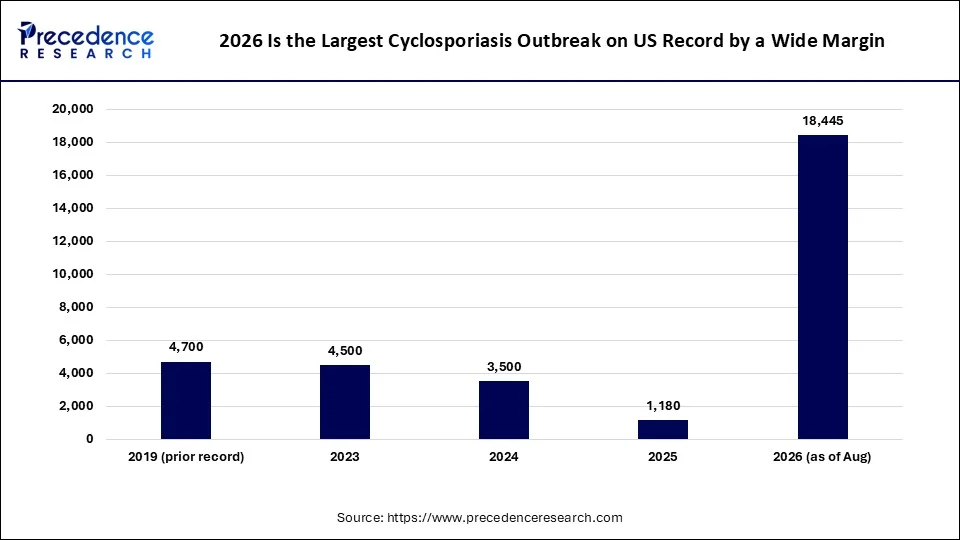
Source: US Centers for Disease Control and Prevention (CDC) - "Cyclospora Case Data", Updated regularly, accessed August 2026.
2026 has become the worst year on record for cyclosporiasis in the United States, boosted by a massive multi-state outbreak associated with contaminated iceberg lettuce. According to ongoing CDC surveillance data updated through August 2026, the U.S. has recorded 18,445 laboratory-confirmed, domestically acquired cases.
Key Insight: A jump from roughly 1,180 cases in the same period of 2025 to over 18,000 in 2026 is large enough that it cannot be explained by improved testing awareness alone; CDC's own reporting attributes much of the rise to an ongoing multistate outbreak associated with iceberg lettuce, layered on top of cases not connected to that specific source.
Symptom Timeline: From Exposure to Recovery
Source: US Centers for Disease Control and Prevention (CDC) - "Symptoms of Cyclosporiasis" and "Clinical Overview of Cyclosporiasis", Accessed August 2026.
This timeline traces the typical course of cyclosporiasis from initial exposure through symptom onset, the untreated disease course, and recovery with treatment. Cyclosporiasis is an intestinal illness caused by the microscopic parasite Cyclospora cayetanensis, which follows a highly variable clinical course that often lasts much longer than typical food poisoning. The standard and most effective treatment is a 7- to 10-day course of the antibiotic combination trimethoprim-sulfamethoxazole (TMP-SMX), such as Bactrim or Septra.
Patients primarily notice a distinct reduction in symptoms within 2 to 3 days of starting the antibiotic. Full recovery of the digestive tract generally occurs within 7 to 10 days, which significantly cuts short the natural, protracted course of the illness and prevents relapses. Supportive hydration is critical throughout recovery.
Key Insight: The tendency for symptoms to "wax and wane" in a relapsing pattern if left untreated is one of cyclosporiasis's more distinctive and frustrating features. Patients sometimes feel they are recovering, only to have diarrhea and fatigue return days or weeks later, which is part of why the CDC emphasizes seeking confirmed diagnosis and treatment rather than waiting for symptoms to resolve on their own.
Cyclosporiasis Symptoms: Most Common to Less Common
Source: US Centers for Disease Control and Prevention (CDC) - "Domestically Acquired Cyclosporiasis Cases in Multiple U.S. States, 2026" Health Alert Network notice, July 14, 2026.
This chart ranks cyclosporiasis symptoms from most to least commonly reported, based on CDC's clinical guidance and the July 2026 Health Alert Network notice. C. cayetanensis causes cyclosporiasis. It’s a tiny parasite that cannot be seen without a microscope. It mostly lives off people and other primates. Cyclosporiasis spreads via the fecal-oral route; germs from contaminated poop get into your mouth. The main symptom is loud, watery diarrhea. A few Cyclospora symptoms may include loss of appetite, bloating, including burping and farting, extreme tiredness, and low-grade fever.
Key Insight: Vomiting and fever are symptoms many people associate most strongly with a stomach "bug," but they are actually among the least common features of cyclosporiasis; the illness is defined much more by prolonged, thus frequent, watery diarrhea combined with fatigue and appetite loss, which is one reason it can be mistaken for other conditions if a clinician doesn't specifically consider it.
Who's Affected: 2026 Outbreak Demographics
Source: US Centers for Disease Control and Prevention (CDC) - "Health Alert Network notice, 'Domestically Acquired Cyclosporiasis Cases in Multiple U.S. States, 2026 ', July 14, 2026.
This chart shows the sex distribution of confirmed case-patients in CDC's July 2026 domestic outbreak update.
Cyclospora Domestic Outbreak: For the massive 2026 domestic surge tracked, the overall confirmed case profile recorded a distribution of 56% female and 44% male. The massive 2026 surge was largely tied to fresh, raw vegetables and leafy greens, specifically processed iceberg lettuce, as well as herbs and berries. Public health data consistently show that adult women tend to consume salads, raw vegetables, and fresh produce at higher rates than men. As the Cyclospora parasite cannot be easily washed off and is resistant to routine chemical sanitizers, anyone eating these raw items is directly exposed.
Key Insight: A wide age range, from 2 to 95 years, combined with a fairly even sex split confirms that cyclosporiasis is not concentrated in any single demographic group during an outbreak. Anyone who eats the contaminated food source, regardless of age or sex, is at risk, which is consistent with a foodborne rather than behaviorally associated transmission pattern.
Foods Linked to Past U.S. Cyclosporiasis Outbreaks
Source: US Centers for Disease Control and Prevention (CDC); Michigan Department of Health and Human Services - "Cyclospora Case Data"; outbreak investigation notices," 2026.
This infographic summarizes the categories of fresh produce most frequently linked to US cyclosporiasis outbreaks over the past three decades.
Over the past three decades, U.S. outbreaks of cyclosporiasis, an intestinal infection that is caused by the parasite Cyclospora cayetanensis, have occurred. They have been most frequently associated with specific categories of delicate, hard-to-clean fresh produce imported from tropical or subtropical regions.
Fresh Herbs: It frequently includes basil, cilantro, and parsley. These herbs are usually consumed raw and handled extensively during harvesting and packaging. Leafy Greens: It encompasses mesclun lettuce, spinach, romaine, and also pre-packaged bagged salad mixes. Large multi-state events, which include recent massive distributions of processed iceberg lettuce, have heavily contributed to seasonal spikes.
Key Insight: Every food category associated with outbreaks shares a common feature: it's mainly eaten raw and unwashed or lightly washed rather than cooked. Meanwhile, cooking reliably kills Cyclospora oocysts, so outbreaks concentrate almost entirely in fresh, minimally processed produce rather than in foods that are heated before eating.
Diagnosis: Why Stool Testing for Cyclospora Is Tricky
Source: CDC; American Society for Microbiology - "Clinical Overview of Cyclosporiasis"; "Cyclospora Detection and Reporting From Clinical Samples", 2026.
This diagram explains three reasons cyclosporiasis is more difficult to diagnose than many other intestinal infections, based on CDC and American Society for Microbiology clinical guidance.
Traditional routine ova and parasite (O&P) exams, standard stool cultures, and many commercial multi-pathogen gastrointestinal PCR panels do not automatically screen for Cyclospora. Thus, healthcare providers must explicitly request specific testing. Further, standard laboratory stains (like trichrome) fail to detect the parasite. Microscopic diagnosis requires complex specialized techniques, like modified acid-fast staining or ultraviolet (UV) fluorescence microscopy, where the oocysts naturally glow.
Key Insight: The demand for a specifically requested test, rather than one that's automatically included in routine stool workups, means cyclosporiasis diagnosis depends heavily on a clinician's index of suspicion. CDC explicitly advises providers to consider it in anyone with diarrhea lasting more than a few days, mainly during outbreak periods or after relevant travel or produce consumption.
Treatment: The CDC-Recommended Antibiotic Protocol
Source: US Centers for Disease Control and Prevention (CDC) - "Health Alert Network notice, "Domestically Acquired Cyclosporiasis Cases in Multiple U.S. States, 2026", July 14, 2026.
The CDC's recommended first-line treatment for confirmed cyclosporiasis is oral trimethoprim-sulfamethoxazole (TMP-SMX), which is commonly sold as Bactrim, Septra, or Cotrim. High-quality clinical data and randomized controlled trials show that a standard course of TMP-SMX achieves greater than a 90% cure rate in clearing Cyclospora parasites from the body and also resolving gastrointestinal symptoms.
Key Insight: The 7-to-10-day treatment course is generally longer than the antibiotic regimens utilized for many common bacterial infections, reflecting how persistent a Cyclospora infection can be in the small intestine. CDC's guidance also explicitly notes that longer courses may be required for immunocompromised patients, since their immune systems have a harder time clearing the parasite even with appropriate medication.
What If You're Allergic to Sulfa Drugs?
Source: National Library of Medicine (PMC) - "Widespread Foodborne Cyclosporiasis Outbreaks Present Major Challenges," Accessed August 2026.
This highlight addresses treatment options for patients who cannot take TMP-SMX due to sulfa allergy, based on published clinical research. For individuals who cannot take trimethoprim-sulfamethoxazole (TMP-SMX) because of a true sulfonamide allergy, clinical research supports alternative non-sulfa regimens depending on the specific infection or prophylaxis indication, most notably for Pneumocystis jirovecii pneumonia [PJP], toxoplasmosis, or general bacterial infections.
Key Insight: The absence of a well-established alternative treatment is a genuine gap in cyclosporiasis clinical management for the subset of patients who are sulfa-intolerant; care becomes more individualized and may rely more heavily on supportive treatment such as hydration and symptom management while a clinician evaluates less-studied options.
Severity Snapshot: Most Cases Did Not Require Hospitalization
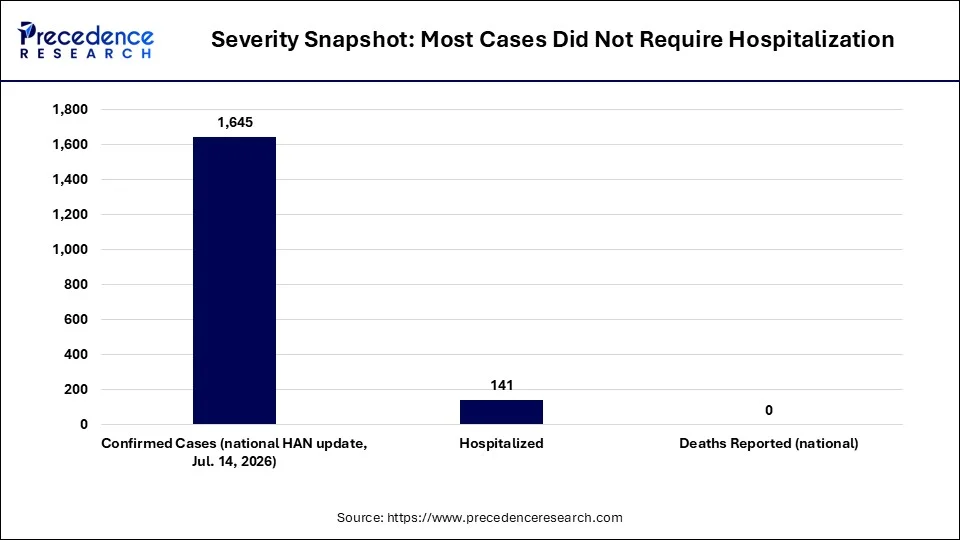
Source: US Centers for Disease Control and Prevention (CDC) - "Health Alert Network notice, "Domestically Acquired Cyclosporiasis Cases in Multiple U.S. States, 2026"," July 14, 2026.
This chart shows the reported case, hospitalization, and death counts from the CDC's national July 2026 Health Alert Network update on the domestic outbreak.In its July 14, 2026, Health Alert Network (HAN) Health Advisory regarding the domestic outbreak of cyclosporiasis, the CDC reported the following initial tracking numbers:
- Reported Cases: 1,645 confirmed domestic cases with more than 5,100 additional cases requiring further analysis.
- Hospitalizations: 141, representing approximately 9% of patients with available information.
Key Insight: A 9% hospitalization rate with zero nationally reported deaths as of that specific July update indicates that, for most people, cyclosporiasis is unpleasant and potentially prolonged. It is not typically life-threatening with appropriate care; i.e., the two deaths later reported specifically within Michigan's outbreak cluster by state officials are a reminder that outcomes can still be serious in some cases, mainly among vulnerable individuals, even though they remain uncommon.
Prevention: Reducing Your Risk
Source: U.S. Centers for Disease Control and Prevention (CDC) - "Preventing Cyclosporiasis," Accessed August 2026.
The CDC recommends practicing safe food handling, washing hands and produce thoroughly, and cooking food properly, among other measures, to reduce the risk of cyclosporiasis.
- Wash hands: Scrub hands with soap and water for 20 seconds before and after handling raw produce. This helps prevent spreading germs or transferring the parasite from your hands to food.
- Rinse produce: Wash fresh fruits and vegetables under clean running water before eating, cutting, and even cooking. Use a clean brush for firm items such as melons.
Key Insight: CDC's own guidance is refreshingly honest that washing produce, while a reasonable general food-safety habit, does not fully eliminate risk. Cyclospora oocysts can resist common washing and disinfection, meaning prevention ultimately depends more on food-supply-chain safety, such as proper water sources and hygiene during farming and processing, than on anything an individual consumer can fully control at home.
Historical U.S. Outbreaks: A Recurring Pattern Since 1996
Source: Multiple (see below) - "CDC outbreak investigation archives; American Society for Microbiology; National Library of Medicine (PMC)," 1996-2026.
This timeline traces major U.S. cyclosporiasis outbreaks from the first broadly documented event in 1996 to the record-setting 2026 outbreak.
- In 1996, the first major US outbreak saw nearly 3,000 cases traced to Guatemalan raspberries.
- In 2013, a multistate outbreak was linked to bagged salad mix and fresh cilantro.
- In 2018, an outbreak was linked to McDonald's salads and De Monte vegetable trays.
- In 2019, there were 4,700 cases, the prior annual record before 2026.
- In 2026, there are 18,000+ cases in the largest outbreak in U.S. record, linked to iceberg lettuce.
Key Insight: Nearly every major outbreak in this thirty-year history traces back to a different specific produce item: Guatemalan raspberries in 1996, bagged salad and cilantro in 2013, McDonald's salads and vegetable trays in 2018, iceberg lettuce in 2026. There is no single "culprit" food category that, if avoided permanently, would remove risk, which is why ongoing surveillance along with rapid outbreak investigation remain central to the public health response each time cases rise.
When to See a Healthcare Provider
Source: CDC; Texas Department of State Health Services - "Symptoms of Cyclosporiasis"; Cyclospora Health Advisory, Accessed August 2026.
The CDC recommends considering and testing for possible cyclosporiasis in patients who present with prolonged or relapsing watery diarrhea, mainly during the peak season from May through August.
Patients with watery diarrhea that lasts for more than 24 hours or keeps returning. It is an illness occurring during the traditional cyclosporiasis season, generally from May through August.
Patients involved in public health investigations or regional outbreaks associated with contaminated fresh produce, like imported bagged iceberg lettuce. Situations where routine ova and parasite stool examinations are unreliable, requiring clinicians to specifically request a Cyclospora test, such as modified acid-fast staining or PCR.
Key Insight: The consistent theme across all five warning signs is duration and severity rather than any single dramatic symptom. Meanwhile, cyclosporiasis is easy to dismiss early on as an ordinary stomach bug that will pass in a day or two, but diarrhea persisting beyond that window, mainly with fatigue or recent relevant travel or food exposure, is exactly the pattern CDC and even state health departments ask clinicians to specifically test for.
Quick-Reference Data Tables
The tables below present the same core figures from the sections above in plain, sortable Word-table format for quick reference and reuse.
Table 1: Cyclosporiasis at a Glance
| Category | Detail |
| Cause | Cyclospora cayetanensis (microscopic parasite) |
| Transmission | Contaminated food or water; not casual person-to-person contact |
| Incubation period | About 1 week (range: 2 days to 2+ weeks) |
| Most common symptom | Watery diarrhea, often frequent |
| Untreated duration | Days to weeks/months; may relapse |
| First-line treatment | Trimethoprim-sulfamethoxazole (TMP-SMX), 7–10 days |
| 2026 US cases (as of Aug.) | 18,445 laboratory-confirmed domestic cases |
Source: CDC, "Cyclosporiasis" clinical overview, symptoms, and case data pages (cdc.gov/cyclosporiasis), accessed August 2026.
Table 2: 2026 Outbreak Snapshot (National HAN Update, July 14, 2026)
| Metric | Value |
| Confirmed domestic cases (as of HAN notice) | 1,645 |
| States reporting cases | 34 |
| Age range of case-patients | 2–95 years (median 44) |
| Percent female | 56% |
| Hospitalized | 141 (9%) |
| Deaths reported nationally (as of notice) | 0 |
Source: CDC Health Alert Network notice HAN00531, "Domestically Acquired Cyclosporiasis Cases in Multiple U.S. States, 2026," July 14, 2026. Figures reflect this specific notice date and have since grown substantially as the outbreak continued; see Table 1 and Section 3 for more current national totals.
Recent Developments
Five of the most consequential developments in the 2026 cyclosporiasis outbreak and related public health response, prioritized by recency and significance:
U.S. Centers for Disease Control and Prevention (CDC) - August 2026 (ongoing)
| Date | August 2026 (ongoing) |
| Organization | US Centers for Disease Control and Prevention (CDC) |
| Development | CDC reported 18,445 laboratory-confirmed cyclosporiasis cases obtained in the United States since May 1, 2026, compared with 1,180 cases in the same period of 2025. |
| What Changed | The case count includes both the ongoing multistate outbreak associated with iceberg lettuce and cases not connected to that specific source; multiple jurisdictions reported increases compared with the same period in 2025. |
| Why It Matters | It confirmed 2026 as the largest cyclosporiasis outbreak on US record, thus surpassing the prior annual record of 4,700 cases set in 2019 by a factor of roughly four. |
| Significance | CDC notes daily case counts are preliminary and that the true number of infections is likely higher, since some people recover without seeking medical care or testing. |
| Source | CDC, "Cyclospora Case Data," cdc.gov/cyclosporiasis/cases |
Source CDC, "Cyclospora Case Data," cdc.gov/cyclosporiasis/cases
US Centers for Disease Control and Prevention (CDC)- July 14, 2026
| Date | July 14, 2026 |
| Organization | US Centers for Disease Control and Prevention (CDC) |
| Development | CDC issued a Health Alert Network (HAN) notice warning of a sharp increase in domestically obtained cyclosporiasis cases, which includes a large outbreak cluster in the Midwest. |
| What Changed | As of the notice, 1,645 laboratory-confirmed domestic cases had been recorded across 34 states, with more than 5,100 additional cases undergoing further analysis to confirm domestic acquisition. |
| Why It Matters | It offered formal clinical guidance to healthcare providers nationwide on testing, specifically requesting Cyclospora testing rather than relying on routine stool exams and treatment (7–10 days of TMP-SMX). |
| Significance | Case-patients with available information ranged in age from 2 to 95 years (median 44), were 56% female, and even 9% were hospitalized; no deaths had been reported nationally as of this notice. |
| Source | CDC, Health Alert Network notice HAN00531, "Domestically Acquired Cyclosporiasis Cases in Multiple U.S. States, 2026" |
Source CDC, Health Alert Network notice HAN00531, "Domestically Acquired Cyclosporiasis Cases in Multiple U.S. States, 2026"
Michigan Department of Health and Human Services (MDHHS)- July 2026
| Date | July 2026 |
| Organization | Michigan Department of Health and Human Services (MDHHS) |
| Development | MDHHS recorded a large cyclosporiasis outbreak cluster in southeast Michigan, eventually totaling more than 14,500 cases and 356 hospitalizations, with lettuce or salad greens identified as a potential (though not definitively confirmed) source. |
| What Changed | MDHHS issued multiple public health bulletins and even updated prevention recommendations for both healthcare providers and the general public as case counts grew. |
| Why It Matters | It represented one of the largest single-state foodborne illness outbreaks in recent US history, thus becoming the epicenter of the broader 2026 national surge. |
| Significance | State health officials confirmed two deaths as part of the Michigan outbreak cluster, a serious outcome that remains uncommon but underscores that cyclosporiasis can occasionally be severe, mainly in vulnerable individuals. |
| Source | Michigan Department of Health and Human Services, Infectious Disease Outbreaks dashboard, michigan.gov/mdhhs |
American Society for Microbiology (ASM) - July 16, 2026
| Date | July 16, 2026 |
| Organization | American Society for Microbiology (ASM) |
| Development | ASM published clinical laboratory guidance on Cyclospora detection and even reporting, emphasizing the demand for specialized stool collection, staining, and multiple specimens to enhance diagnostic sensitivity during the ongoing outbreak. |
| What Changed | It reinforced that conventional ova and parasite examinations usually fail to detect Cyclospora, and that modified acid-fast or modified safranin staining, or PCR-based testing, thus, should be used when available. |
| Why It Matters | It offered laboratories nationwide updated technical guidance as testing volume increased sharply during the 2026 outbreak. |
| Significance | ASM noted that before 2026, the highest number of annual US cases on record was 4,700 in 2019, underscoring the historic scale of the current outbreak. |
| Source | ASM.org, "Cyclospora Detection and Reporting From Clinical Samples" |
Source ASM.org, "Cyclospora Detection and Reporting From Clinical Samples"
CDC - 2023–2024
| Date | 2023–2024 (context) |
| Organization | CDC |
| Development | Foodborne illness outbreaks attributed to Cyclospora cayetanensis in 2022, 2023, and 2024 frequently could not be traced to a specific confirmed food source, despite active investigation. |
| What Changed | Of four foodborne illness outbreaks attributed to Cyclospora in 2023, three were inconclusive in determining a specific food source, thus, a pattern also seen in 2022 and 2024. |
| Why It Matters | It illustrated a persistent public health challenge: because Cyclospora is difficult to isolate and identify (it cannot be cultured like bacteria or viruses), thus, traceback investigations to a specific grower or supplier frequently fail even when an outbreak is clearly linked to a general produce category. |
| Significance | This detection difficulty is part of why cyclosporiasis is now considered an "important neglected parasitic infection" by CDC, despite being a nationally notifiable disease. |
| Source | Food Safety Magazine, "CDC Reports Up to 7,000 Cyclosporiasis Cases Across U.S., Identifies Large Midwestern Outbreak Cluster" |
Source Food Safety Magazine, "CDC Reports Up to 7,000 Cyclosporiasis Cases Across U.S., Identifies Large Midwestern Outbreak Cluster"
Key Organizations & Agencies
Public Health & Regulatory Agencies
- U.S. Centers for Disease Control and Prevention (CDC) is the national agency for surveillance, outbreak investigation, and clinical guidance.
- U.S. Food and Drug Administration (FDA) collaborates with the CDC on outbreak investigation and food traceback.
- Michigan Department of Health and Human Services (MDHHS) is the lead investigator of the largest 2026 outbreak cluster.
- North Carolina Division of Public Health and Minnesota Department of Health are conducting state-level case tracking and reporting.
- Texas Department of State Health Services (DSHS) handles issues related to clinician testing guidance.
Professional & Scientific Organizations
- American Society for Microbiology (ASM) provides laboratory detection and testing guidance.
- Council for State and Territorial Epidemiologists (CSTE) provides clinician support during outbreaks.
Research & Reference Sources
- National Library of Medicine (PMC/PubMed Central) is a source of peer-reviewed clinical research on cyclosporiasis.
Questions Answered in This Guide
- What is cyclosporiasis, and what causes it?
- How large is the 2026 US cyclosporiasis outbreak compared to previous years?
- How does cyclosporiasis spread, and then why is person-to-person transmission unlikely?
- What are the most common symptoms of cyclosporiasis, and how soon do they appear?
- Which foods have been associated with cyclosporiasis outbreaks in the United States?
- How long do cyclosporiasis symptoms last without treatment?
- Who is most affected by cyclosporiasis, based on recent outbreak data?
- What is the standard treatment for cyclosporiasis?
- Why is cyclosporiasis difficult to diagnose, and then what testing is needed?
- What treatment options exist for people allergic to sulfa drugs?
- How severe is cyclosporiasis, and how often does it require hospitalization?
- How can I reduce my risk of getting cyclosporiasis?
- When should I see a healthcare professional for possible cyclosporiasis?
- What is the history of cyclosporiasis outbreaks in the United States?
- Is cyclosporiasis the same as other intestinal parasites such as Giardia or Cryptosporidium?
Questions for Further Research
This guide draws on current CDC and public health data. Ongoing outbreak investigations and clinical research may eventually answer additional questions, including:
- What specific agricultural or supply-chain factors thus, have been identified in the ongoing investigation into the source of the 2026 iceberg lettuce-linked outbreak?
- What is the realistic timeline for developing a well-studied alternative treatment for cyclosporiasis patients who are sulfa-intolerant?
- How does the genetic clustering methodology, such as temporal-genetic clustering, that the CDC has developed improve outbreak source identification compared to traditional epidemiological methods alone?
- What specific water treatment or agricultural practices have proven most effective at preventing Cyclospora contamination of fresh produce at the farm level?
- How do cyclosporiasis rates and food source patterns differ between the United States and countries where the parasite is endemic?
- What is the true under-reporting rate for cyclosporiasis, thus, given that many infected people may recover without seeking care or being tested?
- How might climate change and shifting growing regions affect the seasonality and geographic distribution of future cyclosporiasis outbreaks?
- How does the cost and accessibility of PCR-based Cyclospora testing compare across different regions and even healthcare settings in the US?
- How effective are current FDA and state-level food safety inspection protocols at preventing Cyclospora-contaminated produce from reaching consumers?
- What immune system factors explain why some infected individuals remain asymptomatic while others develop severe, prolonged illness?
References
| Source / Organization | Title | Date | URL | Supports |
| US Centers for Disease Control and Prevention (CDC) | Cyclospora Case Data | Updated regularly, accessed August 2026 | https://www.cdc.gov/cyclosporiasis/cases/index.html | 2026 and historical US case counts |
| US Centers for Disease Control and Prevention (CDC) | Cyclosporiasis (homepage) | Accessed August 2026 | https://www.cdc.gov/cyclosporiasis/index.html | General overview, treatment summary |
| US Centers for Disease Control and Prevention (CDC) | Clinical Overview of Cyclosporiasis | Accessed August 2026 | https://www.cdc.gov/cyclosporiasis/hcp/clinical-overview/index.html | Transmission pathway, incubation period, diagnostic detail |
| US Centers for Disease Control and Prevention (CDC) | Symptoms of Cyclosporiasis | Accessed August 2026 | https://www.cdc.gov/cyclosporiasis/signs-symptoms/index.html | Symptom onset timing and duration |
| US Centers for Disease Control and Prevention (CDC) | Domestically Acquired Cyclosporiasis Cases in Multiple U.S. States, 2026 (HAN00531) | July 14, 2026 | https://www.cdc.gov/han/php/notices/han00531.html | 2026 outbreak case counts, demographics, hospitalization rate, treatment guidance |
| Michigan Department of Health and Human Services (MDHHS) | Infectious Disease Outbreaks | Accessed August 2026 | https://www.michigan.gov/mdhhs/keep-mi-healthy/infectious-diseases/infectious-disease-outbreaks | Michigan outbreak case, hospitalization, and death counts |
| North Carolina Division of Public Health | Cyclosporiasis Cases in North Carolina | Accessed August 2026 | https://www.dph.ncdhhs.gov/programs/epidemiology/communicable-disease/foodborne-illnesses/cyclosporiasis/cases | State-level case count comparison, 2024–2025 |
| Minnesota Department of Health | Cyclosporiasis Statistics | July 13, 2026 | https://www.health.state.mn.us/diseases/cyclosporasis/stats.html | State-level demographic detail, historical case range |
| American Society for Microbiology (ASM) | Cyclospora Detection and Reporting From Clinical Samples | July 16, 2026 | https://asm.org/guideline/cyclospora-detection-and-reporting-from-clinical-s | Laboratory testing guidance, historical case record context |
| Food Safety Magazine | CDC Reports Up to 7,000 Cyclosporiasis Cases Across U.S., Identifies Large Midwestern Outbreak Cluster | July 15, 2026 | https://www.food-safety.com/articles/11627-cdc-reports-up-to-7-000-cyclosporiasis-cases-across-us-identifies-large-midwestern-outbreak-cluster | Outbreak traceback challenges, historical outbreak source detection rate |
| National Library of Medicine (PMC) | Widespread Foodborne Cyclosporiasis Outbreaks Present Major Challenges | Accessed August 2026 | https://www.ncbi.nlm.nih.gov/pmc/articles/PMC2639931/ | Symptom duration, sulfa-allergy treatment gap, 1996 outbreak history |
| National Library of Medicine (PMC) | Retrospective Evaluation of an Integrated Molecular-Epidemiological Approach to Cyclosporiasis Outbreak Investigations — United States, 2021 | 2023 | https://www.ncbi.nlm.nih.gov/pmc/articles/PMC10540164/ | Genetic cluster methodology for outbreak investigation |
| CNN | Tracking the Largest Cyclosporiasis Outbreak in the US | July 21, 2026 | https://www.cnn.com/2026/07/21/health/cyclospora-cases-count | 2023 and 2024 comparison case counts, laboratory test positivity trends |
| Texas Department of State Health Services (DSHS) | Cyclospora Health Advisory | Accessed August 2026 | https://dshs.texas.gov/news-alerts/cyclospora-health-advisory-july-17-2017 | Clinician testing recommendations |
About the Authors

Aditi Shivarkar
Aditi, Vice President at Precedence Research, brings over 15 years of expertise at the intersection of technology, innovation, and strategic market intelligence. A visionary leader, she excels in transforming complex data into actionable insights that empower businesses to thrive in dynamic markets. Her leadership combines analytical precision with forward-thinking strategy, driving measurable growth, competitive advantage, and lasting impact across industries.



Aman Singh
Aman Singh with over 13 years of progressive expertise at the intersection of technology, innovation, and strategic market intelligence, Aman Singh stands as a leading authority in global research and consulting. Renowned for his ability to decode complex technological transformations, he provides forward-looking insights that drive strategic decision-making. At Precedence Research, Aman leads a global team of analysts, fostering a culture of research excellence, analytical precision, and visionary thinking.

Piyush Pawar
Piyush Pawar brings over a decade of experience as Senior Manager, Sales & Business Growth, acting as the essential liaison between clients and our research authors. He translates sophisticated insights into practical strategies, ensuring client objectives are met with precision. Piyush’s expertise in market dynamics, relationship management, and strategic execution enables organizations to leverage intelligence effectively, achieving operational excellence, innovation, and sustained growth.