



Language Translation Software Market Trends, Companies, Revenue / Sales Performance, Subscriber Growth, Pricing Strategies, Cloud Adoption, Infrastructure Expansion, Competitive Landscape, and Industry Outlook
Language Translation Software Market (By Application: Document Translation, Website Translation, Mobile App Translation, Real-Time Translation, Subtitling and Captioning; By Deployment Type: Cloud-Based, On-Premise, Hybrid; By End-User: Education, Travel and Tourism, E-commerce, Healthcare, Legal; By Technology: Machine Translation, Human Translation, Translation Memory, Statistical Translation, Neural Machine Translation) - Global Industry Analysis, Size, Trends, Leading Companies, Regional Outlook, and Forecast 2026 to 2035
Source: https://www.precedenceresearch.com/language-translation-software-market
 Get a Sample
 Table Of Content


What is the Language Translation Software Market Size?
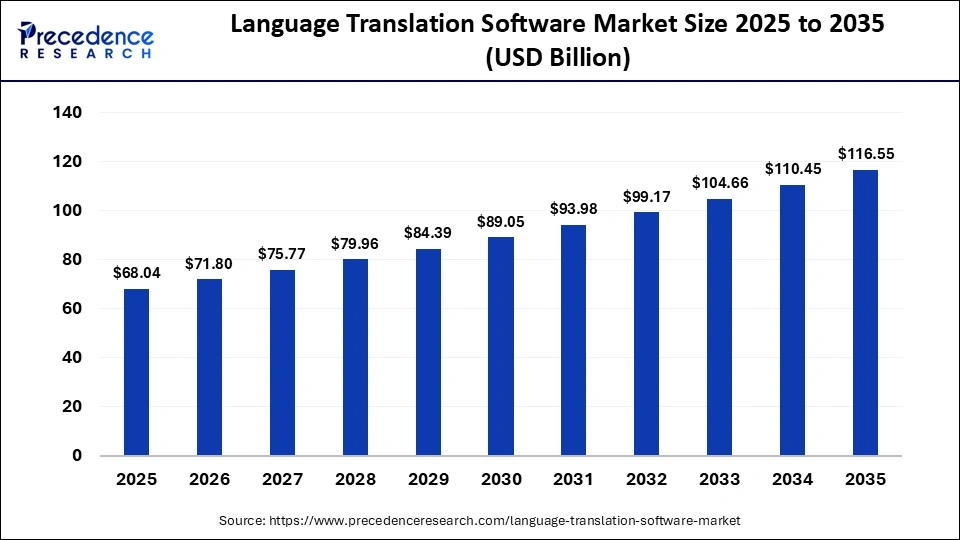
The global language translation software market size was calculated at USD 68.04 billion in 2025 and is predicted to increase from USD 71.80 billion in 2026 to approximately USD 116.55 billion by 2035, expanding at a CAGR of 5.53% from 2026 to 2035. The burgeoning world of alphanumeric communication and cross-border business is spurring the demand for language translation software. The market expansion is further encouraged by the growing use of AI-based tools in businesses, education, and customer services.
Market Highlights
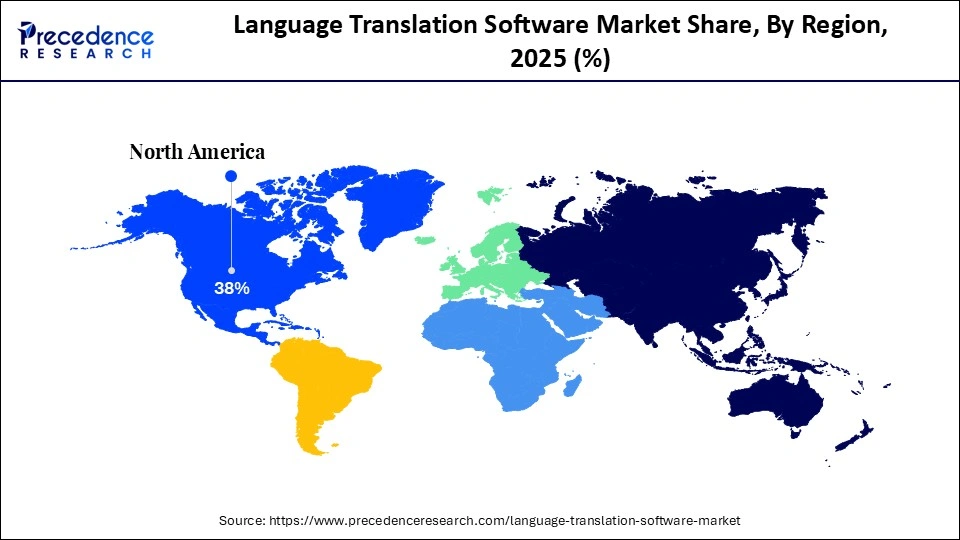
- North America dominated the global language translation software market with the largest market share of 37% in 2025.
- Europe is expected to grow at the fastest CAGR in the market during the forecast period.
- By application, the document translation segment held a dominant position in the market in 2025.
- By application, the real-time translation segment is expected to grow at the fastest CAGR in the market between 2026 and 2035.
- By deployment type, the cloud-based segment led the global market in 2025.
- By deployment type, the hybrid segment is expected to grow with the highest CAGR in the market during the studied years.
- By end use, the education segment dominated the global market in 2025.
- By end use, the travel and tourism segment is expected to expand rapidly in the language translation software market in the coming years.
- By technology, the neural machine translation segment held a major revenue share in the market in 2025.
- By technology, the human translation segment is expected to gain the highest market share between 2026 and 2035.
Language Translation Software: Pangloss of Language Barriers in a Connected Multiverse
The market is expanding rapidly, with more organizations moving into faster, more accurate, and scalable multilingual communication solutions. Language translation software platforms enable real-time translation of text, voice, and videos to facilitate international collaboration and customer interaction. User base in industries is broadening with increasing internet penetration and the creation of digital content. Neural machine translation is being continuously made better, such that the quality of translation and its contextual accuracy are improved.
Impact of AI on the Language Translation Software Market
Artificial intelligence (AI) transforms the current translation software at its core, neural networks, and deep learning models that recognize context, tone, and intent. AI-based systems are constantly learning using large amounts of multilingual data, which increases the accuracy over time. Voice and conversational translation are possible using speech recognition and natural language processing. Adaptive translations based on the needs of a particular industry and user preferences are also being assisted by the integration of generative AI.
Language Translation Software Market Trends
- Technological Advancements: Neural machine translation and large language models are improving in terms of fluency and understanding the context heavily. The use of multimodal translation, text, speech, and image is on the rise. There are also new offline and edge-based translation features being developed to facilitate low connectivity.
- Cloud-Based Solutions: Translation software is now offered on a pay-as-you-use basis, based on cloud technology, and it does not require significant infrastructure investments to be available. These platforms promote ongoing changes, real-time working, and integration with enterprise systems. Worldwide availability and affordability are also provided through the cloud deployment.
- Digital Communication and Globalization: The process of globalization is putting pressure on the need to ensure smooth multilingual interaction among businesses, governments, and individuals. Online communication, social media, and telecommunication spaces are exposing more cross-lingual contacts. Translator software is emerging as a requirement that facilitates inclusive communication in a digital economy with more connections.
Market Scope
| Report Coverage | Details |
| Market Size in 2025 | USD 68.04 Billion |
| Market Size in 2026 | USD 71.80 Billion |
| Market Size by 2035 | USD 116.55 Billion |
| Market Growth Rate from 2026 to 2035 | CAGR of 5.53% |
| Dominating Region | North America |
| Fastest Growing Region | Europe |
| Base Year | 2025 |
| Forecast Period | 2026 to 2035 |
| Segments Covered | Application, Deployment Type, End-User, Technology, Region |
| Regions Covered | North America, Europe, Asia-Pacific, Latin America, and Middle East & Africa |
Financial Data Language Translation Software Market
| Number | Company | Location | Services | Target Audience | Pros |
| 1 | X-doc AI | Singapore | AI-driven language translation of financial documents | Multinational corporations, financial & legal firms | 99% accuracy, 100+ languages, enterprise-grade security |
| 2 | Microsoft Power BI | Redmond, Washington, USA | Business intelligence & data visualization | Financial analysts, BI teams, enterprise users | Powerful visualization, extensive data connectivity, interactive |
| 3 | Workday Adaptive Planning | Pleasanton, California, USA | Financial planning, budgeting, and forecasting (FP&A) | FP&A teams, mid-to-enterprise businesses | Comprehensive FP&A, user-friendly, collaborative |
| 4 | OneStream Software | Rochester, Michigan, USA | Unified financial consolidation, reporting, and planning | Large global enterprises, complex organizations | Unified platform, robust consolidation, highly scalable |
| 5 | Advanced Excel/Google Sheets | Cloud-Based | Custom financial modelling, ad-hoc analysis, and reporting | Finance professionals, small to medium businesses | Extremely flexible, universally accessible, low cost |
Formula: EBIDTA = Net Income + Interest Expense + Taxes + Amortization Expense
All are taken from the annual report
| Company | Revenue | Operating expense | Depreciation and amortization | EBIDTA |
| Microsoft | $281.72B | $153.20B | NA | $162.68B |
| Oracle | $57.40B | $39.72B | NA | $23.85 |
| IBM | $67.53B | $56.68B | NA | $15.88B |
| Amazon | $637.96B | $243.08B | $243.08B | $52.08B |
| Alphabet | $350.00B | $91.30B | NA | $133.30B |
Segmental Insights
Application Insights
Which Application Segment Dominated the Language Translation Software Market?
The document translation segment dominated the market in 2025 because of its popularity in the legal, business, healthcare, and academic markets. Translation software is essential in organizations that need to handle huge amounts of reports, contracts, manuals, and regulatory documents within a short period of time. High adoption can be achieved due to the capability of consistent and accurate results with formatting at scale. Further digitization of enterprise documentation also underlines the segment's leadership.
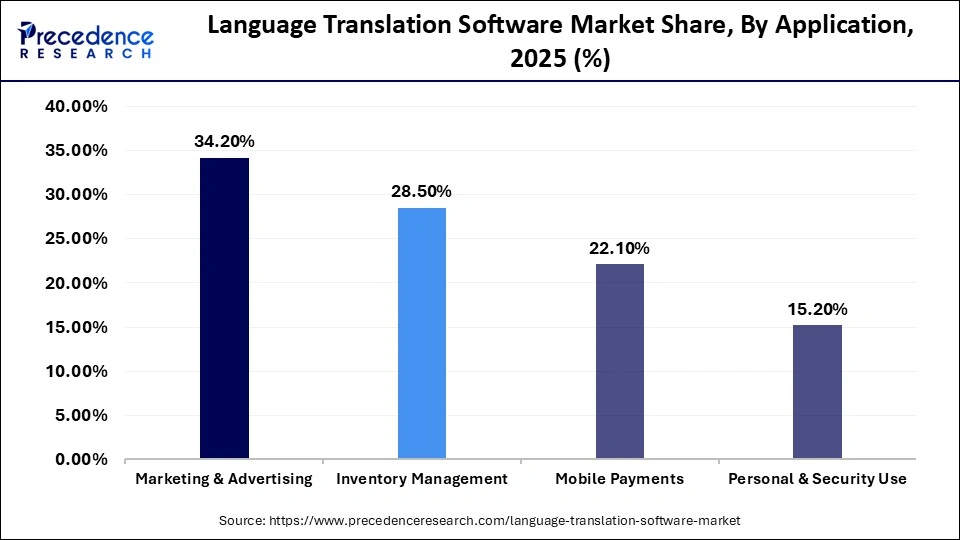
The real-time translation segment is expected to show the fastest growth over the forecast period, due to the growing demand for multilingual communications. Video conferencing, live chat, and voice applications are leading to fast migration within the business and consumer platforms. AI and the progress of speech recognition whitewashed speed and context precision. This segment is still growing faster with the growth of remote work and global collaboration.
Deployment Type Insights
Why Did the Cloud-Based Segment Dominate the Market?
The cloud-based segment held the largest revenue share of the language translation software market in 2025, because it is scalable, flexible, and easily integrated with already established digital platforms. Cloud solutions are favored by enterprises that need real-time updates, centralized language models, and reduced initial infrastructure expenses. The continuous improvement of cloud platforms is also possible due to the use of AI models, training, and data analytics. Cloud platforms enable users to access data from anywhere and at any time.
The hybrid segment is expected to grow at the fastest CAGR in the market between 2026 and 2035, driven by maintaining a balance between the ability to scale and the ability to control data, combining the benefits of both cloud and on-premise. This is particularly attractive to industries that deal with sensitive or controlled information. Hybrid solutions are more secure and, at the same time, do not lack cloud-based AI processing. The increasing issues of data privacy are contributing to the swift growth of the segment.
End-User Insights
How the Education Segment Dominated the Language Translation Software Market?
The education segment accounted for the highest revenue share of the market in 2025, because of the emergence of online education and global academic cooperation. Translators assist with the multilingualism of course materials, scholarly articles, and international interaction among students. Schools are becoming more dependent on AI-powered translation to make educational institutions more accessible and inclusive. The growth of online learning systems has remained a growing trend globally.
The travel and tourism segment is expected to witness the fastest growth in the market over the forecast period, because global travel is recovering and diversifying. Multilingual reservation systems, instant support, and customized content make the translation software improve customer experiences. Translation applications on mobile phone devices are turning out to be a necessity for both travelers and service providers. Demand in this segment is being increased by the growing international tourism.
Technology Insights
Why Did the Neural Machine Translation Segment Lead the Market?
The neural machine translation segment led the language translation software market in 2025, due to its accuracy, contextual knowledge, and fluency, which makes it turn out to be the best in the market. Deep learning models are used to create translations that are close to natural human language. Ongoing education based on massive multilingual data enhances long-term performance. Neural models have become popular in enterprises to carry out textual and speech translation.
The human translation segment is expected to expand rapidly in the market in the coming years, driven by high accuracy, culturally sensitive, and industry-related content. It is especially important in legal applications, medical applications, and creative applications where accuracy is important. Hybrid workflows with the use of AI and human skills are becoming a more frequent occurrence. The increased focus on quality and localization is helping the segment to expand rapidly.
Regional Insights
How Big is the North America Language Translation Software Market Size?
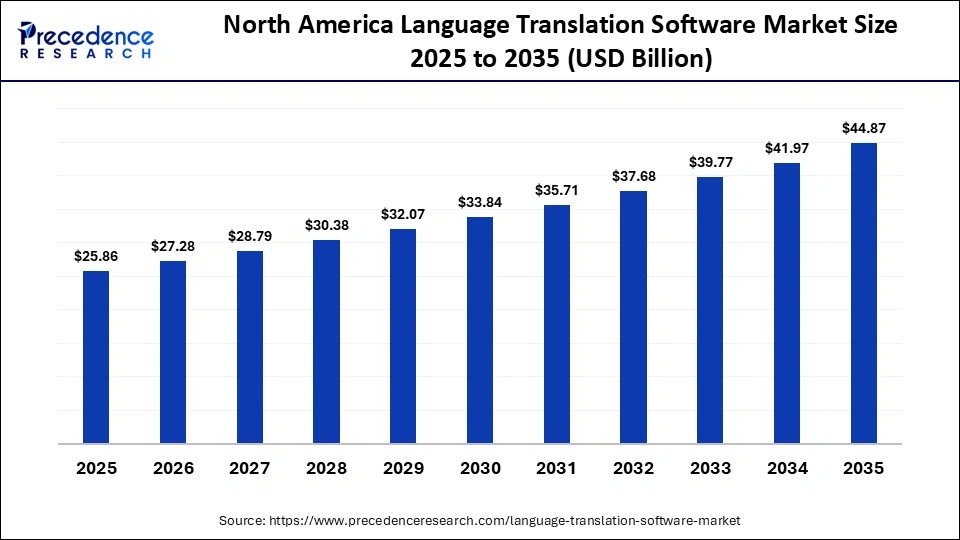
The North America language translation software market size is estimated at USD 25.86 billion in 2025 and is projected to reach approximately USD 44.87 billion by 2035, with a 5.67% CAGR from 2026 to 2035.
Why North America Dominated the Language Translation Software Market?
North America dominated the market in 2025 as the region has a robust digital base and is one of the first to embrace AI-powered technologies. Global technology companies offering translation services for enterprise, education, and customer interaction industries are highly present in the region. The growing demand for multilingual communication in various sectors, such as business, healthcare, and finance, guarantees continuous growth. Further automated improvements in neural machine translation also strengthen the regional leadership.
What is the Size of the U.S. Language Translation Software Market?
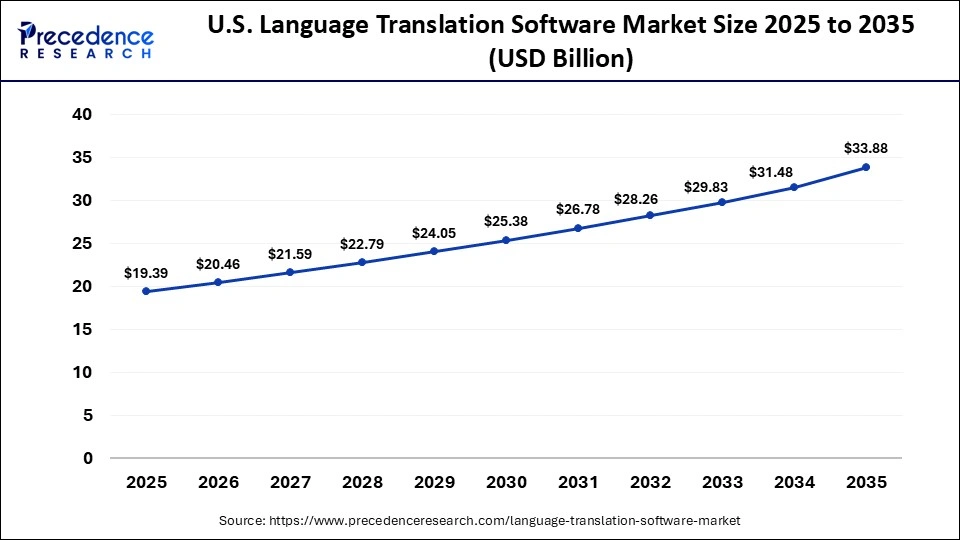
The U.S. language translation software market size is calculated at USD 19.39 billion in 2025 and is expected to reach nearly USD 33.88 billion in 2035, accelerating at a strong CAGR of 5.74% between 2026 and 2035.
U.S. Country Level Analysis
The U.S. witnesses the highest adoption of language translation software due to the high technology base and widespread use in corporate and government services. U.S. enterprises are dependent on real-time and document translation in their international operations. Canada's market is steadily growing due to the presence of a multilingual population and a high focus on digital education. The demand for language solutions is escalating due to the increased cross-border trade and immigration. Adoption of high cloud rates encourages scalable deployment. Current investments in AI still bring more competitiveness to the region.
Will Europe Grow in the Language Translation Software Market?
Europe is expected to grow at a considerable CAGR in the upcoming period, driven by the rapid digitalization and the increased cross-border communication. The growing demand for real-time translation solutions is owing to the increasing internet penetration and the growth in mobile usage. The use of AI-based instruments in businesses and governments that facilitate regional and global interactions is increasing. An expansive market is further boosted by increasing e-commerce, online education, and travel.
Country Level Analysis
Germany holds a majority regional share because of a large user population and rapidly growing demand for AI-powered language technologies. It is progressing well with the launch of large enterprises and education demands. It is becoming one of the high-growth markets with the help of a multilingual population and the increasing digital services. The German government has recently launched a new multilingual AI benchmarking initiative to advance equitable access to language technologies by highlighting the present and future potential of LLMs.
How is Asia-Pacific Growing in the Language Translation Software Market?
Asia-Pacific is expected to witness the fastest growth during the predicted timeframe. This is because the government, education, and business are adopting digital tools quickly. Asia-Pacific has a lot of languages, so people need tools that can help them communicate in many languages. The market for language translation software keeps growing because international trade is increasing and people are consuming more content. Government bodies and regulatory authorities make suitable regulations to support the use of language translation software across various industries.
Country Level Analysis
Large-scale digital platforms and business communication requirements are the main drivers of China's robust adoption at the national level. India is becoming more popular because of its multilingual populace and the growing use of translation software in public services and education. Japan contributes with enterprise-focused solutions that prioritize contextual relevance and accuracy. Translation software is being used more by Southeast Asian nations to facilitate travel, e-commerce, and regional cooperation.
Who are the Major Players in the Global Language Translation Software Market?
The major players in the language translation software market include SDL Trados Studio, MemoQ, Wordfast, Smartling, Lionbridge, TransPerfect, RWS Holdings, Systran, Google Translate, Microsoft Translator, Amazon Translate, DeepL Translator, iTranslate, Babylon Software, Linguee, ABBYY Language Solutions, Text United, MateCat, Crowdin, and POEditor.
Recent Developments
- In February 2026, Voiseed launched its new next-generation Voiseed Studio for creators to create multilingual voiceovers more efficiently. The solution was redesigned using UX/UI, offering an enhanced workflow and a brand new credit system. It offers a more intuitive experience for teams working on AI dubbing, localization, and voice production.
- In January 2026, ChatGPT announced the introduction of a standalone web-based translation platform, ChatGPT Translate, that supports more than 50 languages and emphasizes context-aware, AI-driven translations. The tool features a dual-pane interface similar to Google Translate and DeepL, with automatic language detection, selectable source and target languages, and instant translation output.
- In November 2025, Catsy announced the launch of its AI-powered multi-language translation capacity within its PIM platform, offering culturally-aware, fully-localized product content across more than 95 languages. The software tool interprets industrial terminology, regional compliance requirements, and local buyer behavior, ensuring product content feels natural and accurate.
Segments Covered in the Report
By Application
- Document Translation
- Website Translation
- Mobile App Translation
- Real-Time Translation
- Subtitling and Captioning
By Deployment Type
- Cloud-Based
- On-Premise
- Hybrid
By End-User
- Education
- Travel and Tourism
- E-commerce
- Healthcare
- Legal
By Technology
- Machine Translation
- Human Translation
- Translation Memory
- Statistical Translation
- Neural Machine Translation
By Region
- North America
- Europe
- Asia-Pacific
- Latin America
- Middle East & Africa
For inquiries regarding discounts, bulk purchases, or customization requests, please contact us at sales@precedenceresearch.com
Frequently Asked Questions





Ask For Sample
No cookie-cutter, only authentic analysis – take the 1st step to become a Precedence Research client
 Get a Sample




 sales@precedenceresearch.com
 Schedule a Meeting
