



Cancer Cell Diagnostics (CCDx) Debuts Whole-Cell Genomic Profiling to Redefine Liquid Biopsy
Published: 28 Jul 2026
Author: Towards Healthcare



Cancer Cell Diagnostics announced the commercial launch of its CellSight DNA comprehensive genomic profiling test. This test is built on an essentially distinct source material from conventional liquid biopsy.
Most blood-based cancer tests analyze cell-free circulating tumor DNA, the short, degraded fragments that cancer sheds into the bloodstream. CCDx uses different strategies. The CellSight platform applies a proprietary, patent-pending enrichment process to isolate intact circulating tumor cells (CTCs) from a standard blood draw, removing DNA directly from those cells. This enables physicians to access genomic data drawn from complete tumor biology rather than fragmented remnants.
"We profile more than 500 genes and report tumor mutational burden (TMB) and microsatellite instability (MSI) status from a single blood draw," said Tifiny McDonald, Chief Executive Officer of CCDx. "Because our technology works from intact circulating tumor cells rather than cell-free circulating tumor fragments, the CellSight™ platform is designed to provide oncologists with a more comprehensive profile of the tumor. Furthermore, because CellSight™ recovers whole cells, we have a clear path to utilize the same sample well beyond DNA sequencing."
CellSight DNA is the inaugural assay released on this platform. The next-generation sequencing panel identifies comprehensive classes of genomic modifications, involving single nucleotide variants, insertions and deletions, copy number variations, microsatellite instability (MSI) status and cancer mutational burden (TMB). Molecular testing is achieved in the company's CLIA-certified laboratory in Jupiter, Florida.
In investigative validation performed under standard operating events, CellSight DNA demonstrated a limit of identification of 5% for single nucleotide variants. Analytical sensitivity larger than 99%, and the positive predictive value was greater than 97%. Typical insertions and deletions were qualitatively identified in the tested set. CCDx engineered the CellSight platform for long-term extensibility. Because the isolation technology preserves whole cells, the same enriched material helps future applications in RNA, protein, functional analysis, and multiomics. This exclusive ability enables the organizations to aggressively increases its menu as the science matures.
According to Towards Healthcare, the Bio Burden Testing Market is projected to experience significant growth, with estimates suggesting the market size will increase from USD 2.03 billion in 2026 to approximately USD 6.82 billion by 2035, representing a compound annual growth rate (CAGR) of 14.44% from 2026 to 2035, driven by, bioburden testing offers a measure of the pollutants present on a healthcare device or piece of tools, just before the concluding sterilization technology. Advances in traditional membrane filtration deliver increased precision, faster time to output, improved data integrity compliance, and more control over the production process.
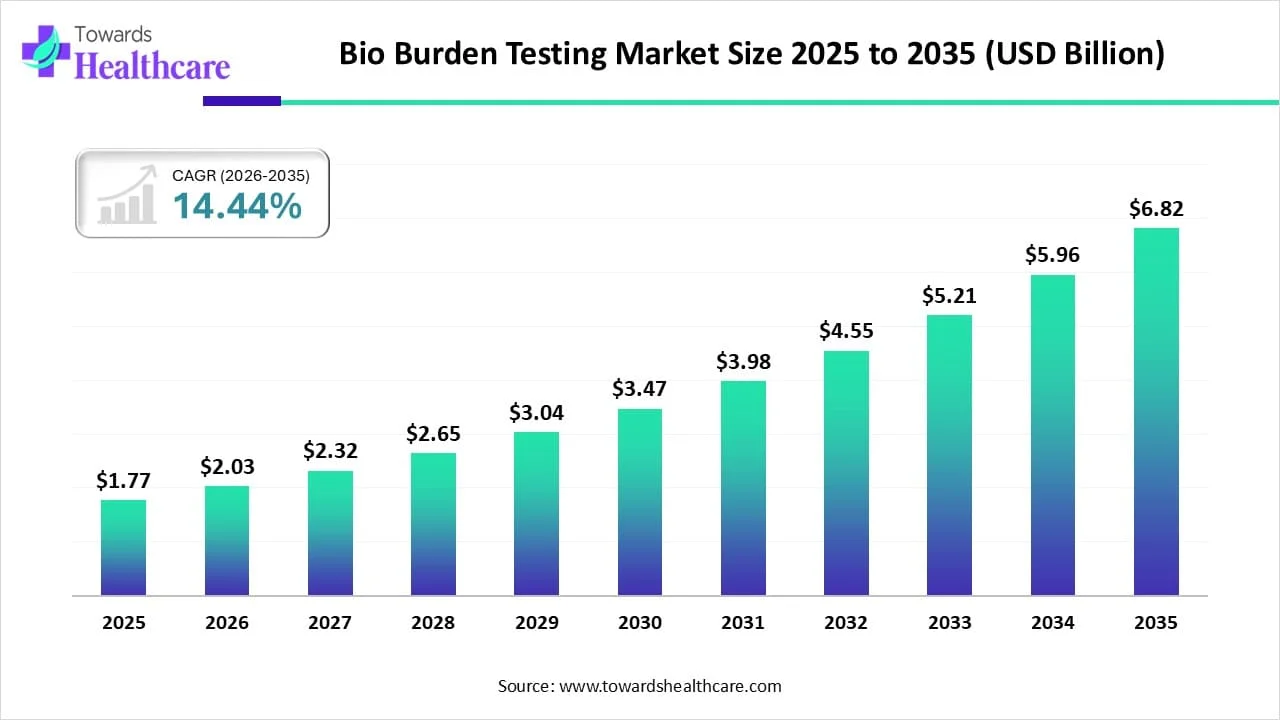
Bioburden is a significant step to microbiological safety, confirming that the product is clean and free of bacteria during the production process. It gives data on both the expected microbial load of the product and the presence of particular organisms, allowing intervention before a polluted product. Bioburden testing, also referred to as rapid microbial testing, is a significant quality control process. It is simple and faster to quantify microbial contamination. It supports confirming that sterilization technologies are efficient and prevents contamination-related failures.
About Cancer Cell Diagnostics (CCDx)
Cancer Cell Diagnostics is a precision oncology company based in Jupiter, Florida. Its CellSight platform isolates intact circulating cancer cells from peripheral blood, allowing comprehensive genomic profiling and downstream molecular and multiomic analyses. Functioning as a CLIA-certified laboratory, the organization is focused on providing physicians a more complete molecular understanding of every patient's cancer.
A recent report by Towards Healthcare highlights that the bio burden testing Market is growing, as bioburden testing is in the greatest position because it offers insight into the level and intensity of sterilization required and informs the choice of sterilization processes. Bioburden testing is a significant component for healthcare device manufacturing to safeguard the safety of the product and the consumer. Bioburden testing supports ensuring that the right sterilization processes are chosen, both in terms of removing contaminants and preventing the use of methods which may be inappropriate or incompatible with the tools. Bioburden testing may also be performed through the most probable number (MPN) process, where the sample is monitored in a controlled environment for a seven-day incubation period, and pollutant growth levels are measured.