



Roche US Subdivision Genentech Announced Production Increase in the United States
Published: 25 Aug 2026
Author: Towards Healthcare



Novel solution in Hillsboro, Oregon for the assembly of injectable therapeutics and delivery tools will also develop end-to-end U.S. therapeutic production strength.
Genentech, a member of the Roche Group, announced plans to spend around $750 million on a advance tools fill-finish production solution at its 75-acre campus in Hillsboro, Oregon. The spending will bring novel end-to-end device filling abilities to the site and increase capacity to help the future pipeline of novel medicines in Roche and Genentech.
The spending is expected to create 250 high-wage production jobs and around 200 construction jobs in Oregon during site advancement, with commercial operations projected to begin in 2031.
The new facility will support the production of well-developed drug delivery tools, like pre-filled syringes and autoinjectors. These tools play a progressively significant role in how therapeutics are delivered and offer patients more convenient ways to receive management outside of a hospital setting. Intended for flexibility, the solution is capable of both high- and low-volume tool filling in the wide range of Roche and Genentech’s portfolio, allowing the site to respond to transforming production requirements as the portfolio emerges.
The Hillsboro spending follows the new topping out of Genentech’s advanced production facility in Holly Springs, North Carolina, a solution strategically intended to help worldwide manufacturing of the organization's future portfolio of metabolic therapeutics, involving next-generation management for obesity.
Roche and Genentech’s present U.S. footprint involves 13 manufacturing sites, 15 research and development sites, and around 25,000 employees in 24 locations across eight states.
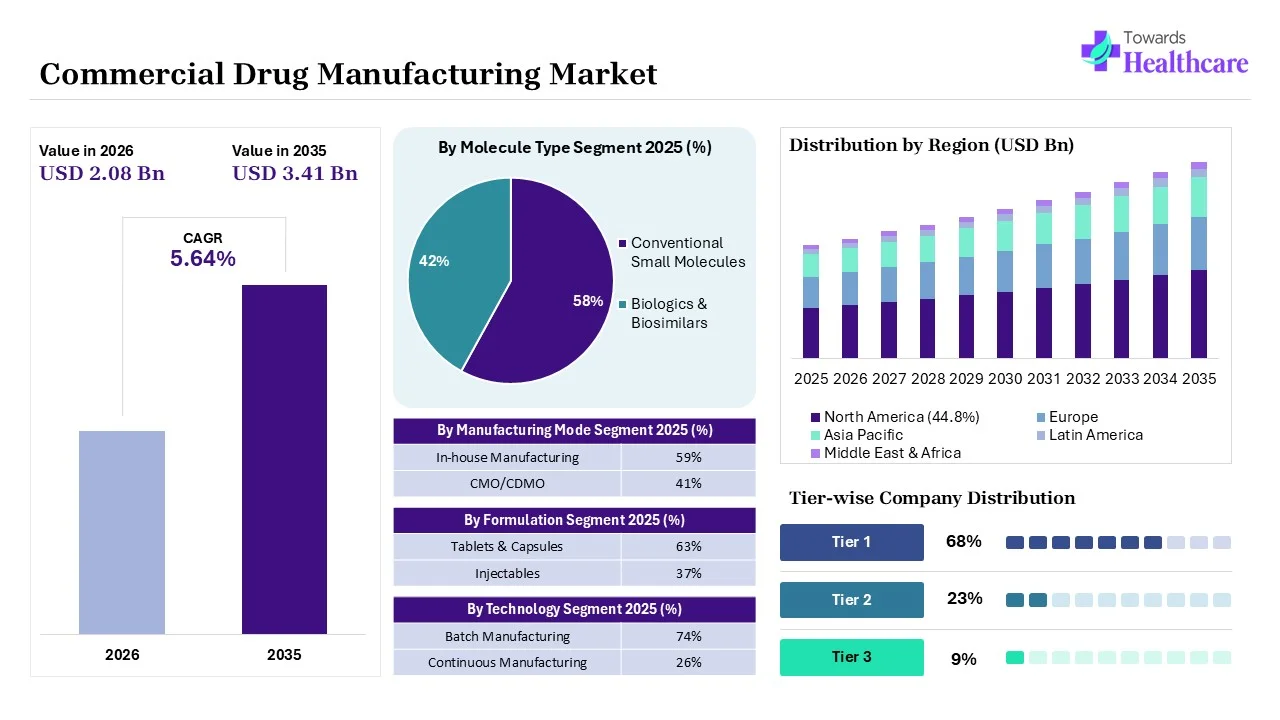
The global commercial drug manufacturing market size was estimated at USD 10.24 billion in 2025 and is predicted to increase from USD 10.78 billion in 2026 to approximately USD 17.07 billion by 2035, expanding at a CAGR of 5.64% from 2026 to 2035. Commercial manufacturing is the technology of manufacturing finished products at an increased volume, designed for public application. This includes a meticulously defined manufacturing process, from sourcing raw materials to packaging the final drug. The objective is to confirm a consistent supply of healthcare products that meet strict regulatory and safety needs. It plays a significant role, allowing pharmaceutical organizations to meet market expectations, preserve profitability, and confirm public health results. Commercial production is the large-scale manufacturing of therapeutic products for public distribution. It starts after healthcare approval and significantly focuses on making safe, efficient, and consistent finished products. Commercial drug therapeutics refers to the large-scale manufacturing of pharmaceutical products for public distribution. It contrasts with small-scale clinical trial production or custom compounding.
About Roche
Roche is a medical care organization uniquely placed to avoid, stop, and cure diseases by uniting leading science and technology in diagnostics, digital solutions, and medicines. Roche was founded in Basel, Switzerland, in 1896 and leading provider of transformative therapeutics and diagnostics for millions of patients in over 150 countries around the world. It is intended to tackle medical care complexities which place significant strain on patients, families, communities and medical care systems. Across its Diagnostics and Pharmaceutical divisions, Roche focuses on regions including oncology, neurology, cardiovascular and metabolic diseases, ophthalmology, infectious diseases and immunology with the goal of offering real and positive transformation for patients, the patients they love and the professionals who care for them. Genentech in the United States is a fully owned subsidiary of the Roche Group. Roche is the shareholder in Chugai Pharmaceutical, a major innovator in the Japanese therapeutic antibody market.
A recent report by Towards Healthcare highlights that the commercial drug manufacturing market is growing, as a commercial manufacturing network is another major advantage. Modern facilities help pharmaceutical companies maintain consistent production while meeting strict quality requirements. Efficient processes can also reduce delays and support large-scale demand. Regulatory compliance plays an equally important role. Companies must maintain documented quality systems, follow manufacturing standards, and meet the requirements of different markets. Continuous processes can reduce manufacturing footprint, shorten production cycles, improve process consistency, and increase operational efficiency. Commercial production is significant in bringing safe, efficient, and high-quality drugs to sectors. It refers to the large-scale manufacturing of pharmaceutical products, manufactured once they have successfully passed clinical trials and received government approval. Unlike healthcare production, which focuses on small batches for testing, commercial manufacturing is related to producing therapeutics for widespread distribution, ensuring patients receive the necessary treatments reliably and effectively.