



Bio-Rad Releases New Quality Control Kits for Cell and Gene Therapy
Published: 16 Jul 2026
Author: Towards Healthcare



Bio-Rad Laboratories announced the launch of its Vericheck droplet digital PCR (ddPCR) kit portfolio, which is intended for quality control workflows in cell and gene therapy advancement and other pharmaceutical uses.
The kits are compatible with the organization’s QX700 technology. The portfolio includes kits for mycoplasma detection, empty-full capsid, replication-competent lentivirus, and residual DNA quantification for Chinese hamster ovary and E coli.
The QX700 platform enables seven-color multiplexing, and it has the capacity to process up to 384 reactions in around two and a half hours, according to Bio-Rad. The processes require minimal input volume and are characterised by continuous loading ability and software for data clarification. By integrating the platform with the Vericheck kits, scientists generate results for product advancement, product safety, and quality.
In the advancement and production of well-developed therapeutics, quality control testing is applied to ensure the safety and efficiency of the product. The advanced kits offer validated workflows designed to enhance confidence in vector characterization and contamination ide, involving replication-competent virus testing, and residual host cell DNA quantification.
“The expansion of our range of Vericheck ddPCR Kits offers validated workflows with unmatched precision and sensitivity, combined with the power of the QX700 platform, enabling scalable, streamlined workflows and faster time to actionable results,” says Stephen Kulisch, vice president of marketing of the digital biology group at Bio-Rad, in a release.
Bio-Rad states which expanded of the platform is part of a commitment to support the advancement of safe and effective production for well-developed medicines.
According to Towards Healthcare, the digital PCR market is projected to experience significant growth, with estimates suggesting the market size will increase from USD 8.55 billion in 2026 to approximately USD 19.07 billion by 2035, representing a compound annual growth rate (CAGR) of 9.33% from 2026 to 2035, driven by digital polymerase chain reaction (dPCR) shows a transformative development in molecular diagnostics, providing improved sensitivity, specificity, and absolute quantification of nucleic acids.
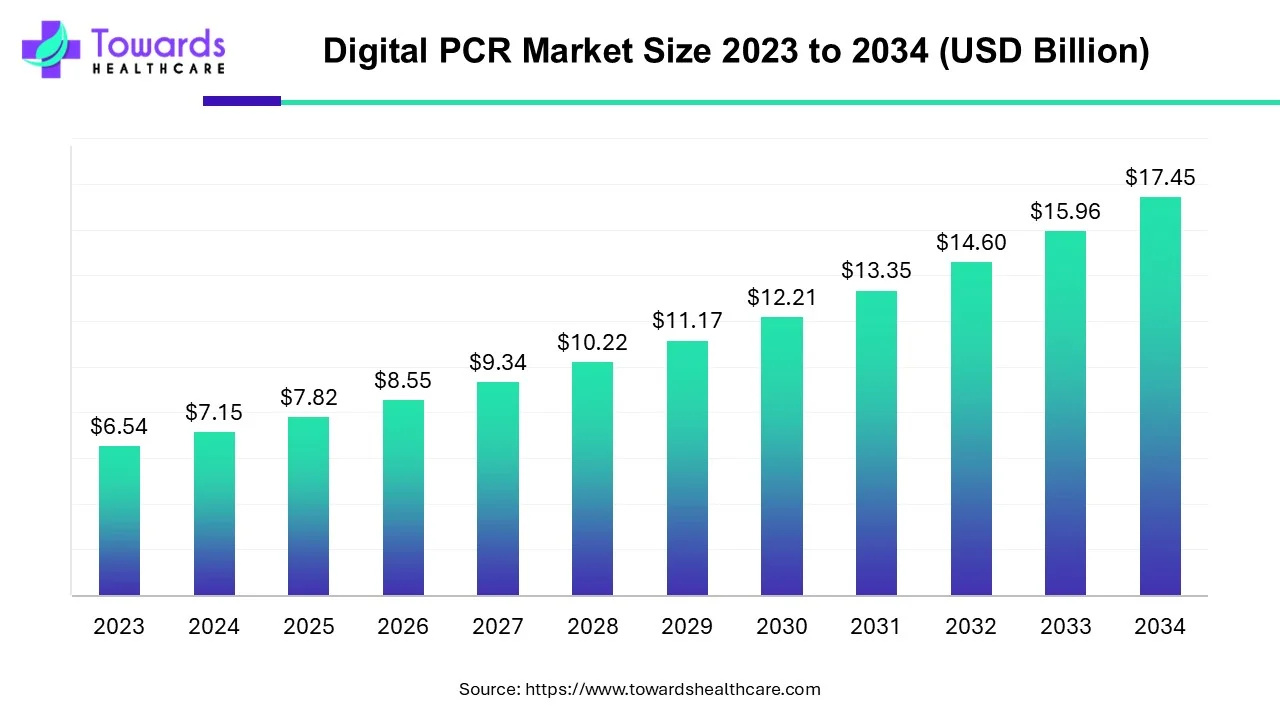
Major applications of dPCR are specifically in infectious disease diagnostics, genetic screening, and oncology. dPCR demonstrated superior performance in pathogen identification, liquid biopsy for tumor prognosis, and prenatal genetic testing, surpassing conventional PCR technology in precision and reproducibility. dPCR offers significant benefits over traditional PCR-based processes. Significant advantages are absolute quantification, which does not need external reference standards, therefore lowering variability and enhancing consistency in results. dPCR exhibits advanced resistance to inhibitors generally found in biological samples, making it a superior choice for multifaceted matrices like blood, tissue, and environmental samples.
About Bio-Rad
Bio-Rad Laboratories, Inc. is a front-runner in progressing, producing, and marketing a wide range of products for the life science research and healthcare diagnostics markets. Based in Hercules, California, Bio-Rad operates a global network of research, development, production, and sales operations with around 7,400 employees and $2.6 billion in revenues in 2025. Their consumer involves universities, research institutions, hospitals, and biopharmaceutical companies, as well as clinical, food safety, and environmental quality laboratories. This company develops novel, high-quality products that advance science and save lives.
Forward-Looking Statements
This release is deemed to contain some forward-looking statements in the meaning of the Private Securities Litigation Reform Act of 1995. These forward-looking statements include, without restriction, statements the company makes regarding products and expectations related to products. Forward-looking declarations generally identified by the use of forward-looking terminology like "plan", "believe," "expect," "anticipate," "may," "will," "intend," "estimate," "continue," or similar expressions or the negative of those terms or expressions, though not all forward-looking statements contain these words.
Such statements include risks and uncertainties, which could cause actual results to vary materially from those expressed in or indicated by the forward-looking statements. These challenges and uncertainties involve worldwide economic and geopolitical conditions, the capability to develop and market novel or enhanced products, companies' capability to compete efficiently, international legal and government challenges, supply chain risks, and product quality and liability challenges.
A recent report by Towards Healthcare highlights that the digital PCR market is witnessing growth because dPCR is widely utilized to identify circulating tumor DNA (ctDNA). It allows highly sensitive identification of rare cancer-related mutations. Recent developments in digital PCR (dPCR) technology have potentially enhanced its sensitivity, affordability, and precision. These novelties increased the process's capabilities and uses, with novel platforms and assays allowing faster and more precise genetic analysis in oncology, pathogen surveillance, and clinical diagnostics.
Development in dPCR has widened its use in a wide range of healthcare and research applications. As scientists continue to incorporate dPCR in research and healthcare testing, emphasized that it should be considered in the broader continuum of genetic advancement, which involves qPCR, NGS, microarrays, and capillary electrophoresis.