



DNA Script and Leading Healthcare Solutions Provider Awarded Up to $26M by ARPA-H to Advance Cell-Free DNA Bioproduction
Published: 07 Aug 2026
Author: Towards Healthcare



FLASH program, in collaboration with GE HealthCare, to support development of faster, distributed DNA manufacturing for next-generation therapies.
DNA Script, a pioneer in DNA synthesis providing scientists with rapid, on-demand access to high-quality DNA, announced that in partnership with prime awardee GE HealthCare, they have been awarded up to $26 million in funding for a four-year enterprise from the Advanced Research Projects Agency for Health (ARPA-H). The award supports the development of the flexible automation for scalable health (FLASH) program, focused on the development of scalable cell-free DNA bioproduction capabilities and powered in part by DNA Script's enzymatic DNA synthesis (EDS) technology and SYNTAX platform.
Led by GE HealthCare, the FLASH program's aim is to advance a modular, automated platform for the rapid, distributed manufacturing of high-fidelity DNA to support research and strengthen future uses in particular medicines, vaccines, and other genetic health solutions. DNA Script’s EDS technology supports this aim by enabling rapid and more flexible DNA manufacturing workflows.
DNA Script is including its EDS technology and acting as the technical services integrator for the project. The Organization has adapted its solutions to incorporate GE HealthCare’s proprietary DNA scaling technology, completing DNA Script’s EDS technology, to ultimately deploy the integrated platform in U.S. medical research centers, universities, and government agencies.
John Schiel, Program Manager, ARPA-H, said: “ARPA-H solutions are designed to address hard problems with bold, practical approaches. Projects like FLASH exemplify how scalable, platform-based technologies can transform the way health solutions are developed, produced, and delivered.”
Marc Montserrat, Chief Executive Officer, DNA Script, commented: “Our enzymatic DNA synthesis platform is ideally suited for the on-demand manufacturing model FLASH is pioneering. Collaborating with GE HealthCare on an ARPA-H program of this scale shortens the path from research bench to patient bedside for next-generation therapies, personalized vaccines, and the broader genetic-medicine pipeline.”
John Nelson, Senior Biosciences Principal and FLASH program lead, GE HealthCare’s Healthcare Technology and Innovation Center, added: “GE HealthCare’s Technology & Innovation Center drives exploratory and translational research focused on addressing healthcare challenges through federal funding, academic collaboration, and private-sector research and development. As personalized and time-sensitive genetic medicines continue to advance, there is a growing need for manufacturing approaches that are faster, more flexible, and more accessible. Our vision for the FLASH program is to develop new DNA-based medicines on demand quickly, safely, and at scale.”
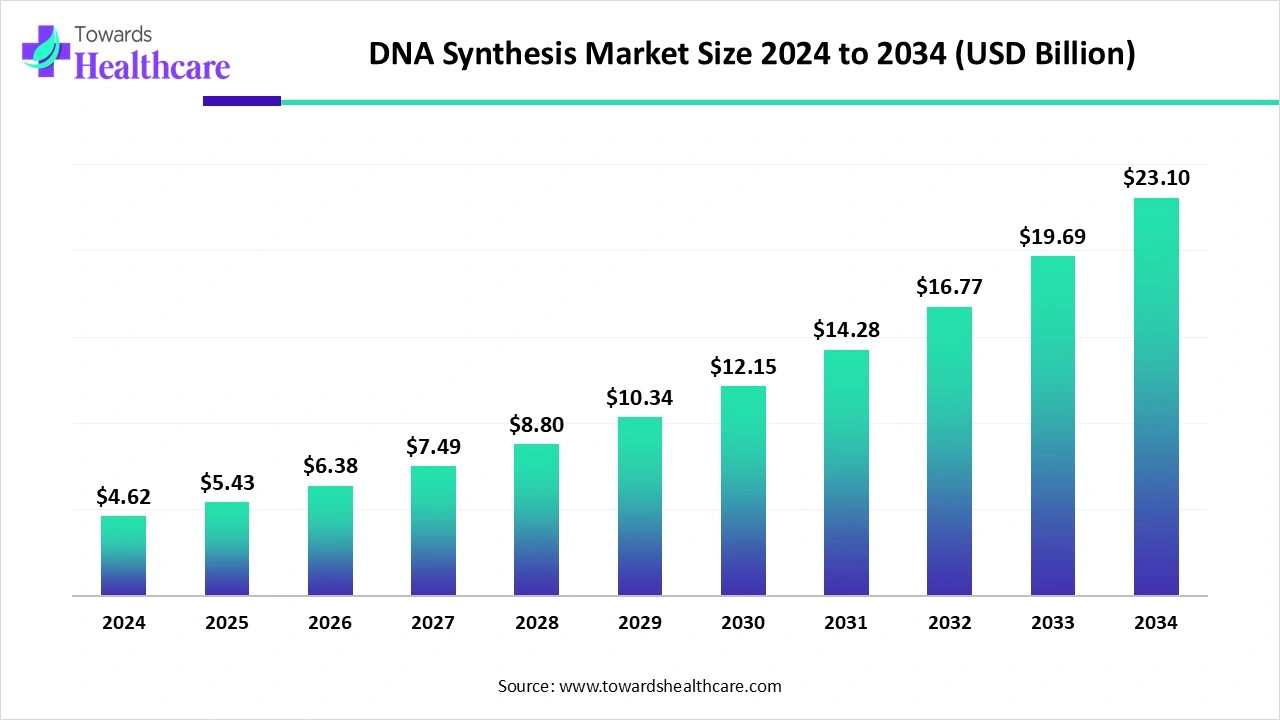
According to Towards Healthcare, the DNA synthesis market is projected to experience significant growth, with estimates suggesting the market size will increase from USD 6.37 billion in 2026 to approximately USD 27.03 billion by 2035. Estimated to grow at a CAGR of 17.42% starting from 2026 to 2035. DNA synthesis is applied to engineer microorganisms for the manufacturing of significant substances. Bacteria are engineered to produce biopharmaceuticals, biofuels, or manufacturing enzymes. These strategies not only improve manufacturing effectiveness but also reduce the requirement for traditional resource-intensive processes. DNA synthesis plays a significant role in synthetic biology; a sector focused on designing and constructing novel biological parts and technology. Synthetic biologists use DNA synthesis to create new organisms or redesign existing ones for particular purposes, such as environmental clean-up or sustainable agriculture. Developments in DNA synthesis technology are expected to drive further innovation in the different sectors. DNA synthesis stands as a significant tool at the advanced edge of scientific research and biotechnology. By enabling scientists to create and manipulate DNA sequences with accuracy, this technology is creating novel possibilities in genetic research, targeted medicine, and synthetic biology.
About DNA Script
DNA Script is a ground-breaking biotechnology organization focused on revolutionizing DNA synthesis via enzymatic technology. Their mission is to quicken scientific discovery and innovation by offering fast, precise, environmentally sustainable, and on-demand DNA synthesis services, involving the SYNTAX platform and custom synthesis services. They collaborate globally to address healthcare challenges, support research, and develop advanced genetic tools, aiming to make synthetic DNA accessible and customizable for researchers worldwide.
A recent report by Towards Healthcare highlights that the DNA Synthesis Market is growing as Synthetic DNA is increasingly used for gene therapies due to its fast production and improved scalability compared to traditional plasmid-based methods. Synthetic DNA is produced enzymatically, providing significant benefits such as lower manufacturing timelines, higher purity, and the removal of bacterial sequences and antibiotic resistance genes. DNA synthesis is needed by the cell for the processes of replication, repair, and lesion bypass. The present chapter looks at the structural-functional characteristics of the molecular machinery, in the form of an enzyme complex called DNA polymerase, involved in DNA synthesis. DNA synthesis allows scientists to create and research genes in a controlled environment. This ability is significant for understanding gene function, discovering genetic diseases, and advancing therapies.