



Freed Launches Clinical Evidence, Ad-Free Clinical Answers That Know the Patient in the Room
Published: 31 Aug 2026
Author: Towards Healthcare



Freed, the AI-based scribe trusted by more than 26,000 physicians and institutions in 100+ specialties, announced the launch of Clinical Evidence, which lets a provider ask a healthcare question and get back an answer grounded in the published healthcare literature and cited to its sources. The answers are sharpened by that patient's context and carry no advertising of any kind.
Each answer draws on more than 50 trusted healthcare sources, from peer-reviewed journals to government clinical guidance, linking out to every one so physician read source material directly.
When Freed launched its AI scribe in 2023, it gave physicians their evenings back by removing after-hours charting. Freed then increased in the rest of the workflow with coding, visit prep, healthcare letters, and an AI-driven front desk. Clinical Evidence is the next chapter, and it transforms Freed from capturing what happened in the visit to helping in care delivery.
The questions that never get asked
Clinicians raise roughly one clinical question for every two patients they observe. They pursue related half of them. That's the finding of a systematic review of 72 research articles published in JAMA Internal Medicine, which pooled 7,012 questions raised by physicians right after patient visits. When clinicians do go looking, they're good at it, discovering answers 78% of the time. The challenge is the half they never pursue.
The two challenges the review identified were lack of time and doubt that a valuable answer is present. And the authors noted the pattern has stayed significantly stable over decades, despite the arrival of one online evidence resource after another.
What it does
Clinical Evidence lives in the sidebar of the note the physician is already working on. Because it sits inside the scribe, the visit and note context in Freed sharpens the answer. A pediatrician enquiring about weight-based dosing gets an answer that accounts for this patient's weight. A psychiatrist enquiring about tapering stratergies gets an answer shaped by what's previously documented. There is no second tab, no retyping the case, and no copying the answer back into the chart.
Each answer carries connected citations. Freed doesn't publish the evidence and doesn't search the open web for it either. Answers are drawn from a defined set of 50+ sources physicians trust, involving PubMed, Cochrane, FDA, CDC, NIH, and NEJM. Practicing physicians decide which sources are in scope and evaluate the answers that come back. Patient data stays inside Freed's HIPAA boundary, with identifying details removed before any external query.
Freed’s Clinical Evidence surfaces strategies, recommendations, and research to help a physician's judgment. It does not make clinical decisions or recommend management.
Freed took a different position. Clinical Evidence carries no ads and no sponsored placement.
"Clinicians shouldn't have to wonder who paid for the answer on their screen, and they shouldn't have to accept a generic answer for a specific patient," said Erez Druk, co-founder and CEO of Freed. "We built this the way a clinician would build it. Real sources, chosen by people who see patients, with the citation right there so you can check our work. The answer belongs to the clinician, not to whoever bought the space."
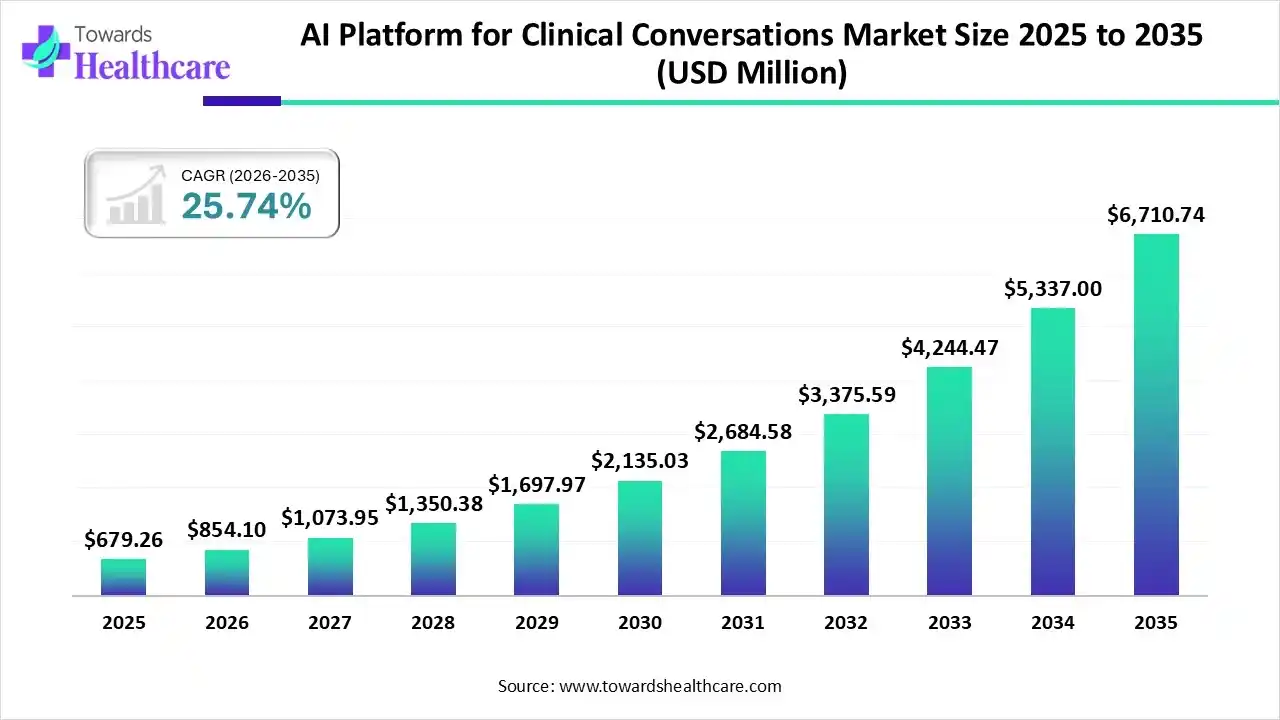
According to Towards Healthcare, the AI platform for clinical conversations market is projected to grow significantly, with estimates indicating the market size will increase from USD 854.10 million in 2026 to approximately USD 6710.74 million by 2035, expanding at a CAGR of 25.74% from 2026 to 2035. Conversational AI-based technologies are simplifying search, with advantages for patients, physicians, and healthcare organizations too. Conversational AI technology is a type of artificial intelligence that simulates human conversation, applying natural language processing (NLP) algorithms. With machine learning and generative AI, conversational AI systems like AI chatbots and virtual assistants understand and respond to human language in a manner that feels natural.
About Freed
Freed is an AI-driven technology scribe and front desk built for the specific requirements of small and independent practices. Its ambient AI scribe listens to physician-patient encounters and generates EHR-ready healthcare notes, codes, and letters, saving hundreds of thousands of substitute hours each month in a user base of 27,000-plus clinicians and 1,800 administrations. The platform integrates AI documentation, chat with healthcare evidence, coding assistance, and EHR integration in a single platform, with live US-driven human support. Freed is backed by Sequoia Capital, named to the CB Insights Digital Health 50 in 2025, and headquartered in San Francisco.
A recent report by Towards Healthcare highlights that the AI platform for clinical conversations market is growing, as AI-driven technology assists in decision-making by providing real-time recommendations based on healthcare guidelines or developments, lowering the likelihood of healthcare mistakes. AI-based enables better data-driven decisions in healthcare technology. In a digitalized health care environment, the quality of decision-making relies on the availability and precision of underlying information.