



India Launches PM RAHAT for Cashless Road Accident Treatment
Published: 11 Aug 2026
Author: Deepa Pandey



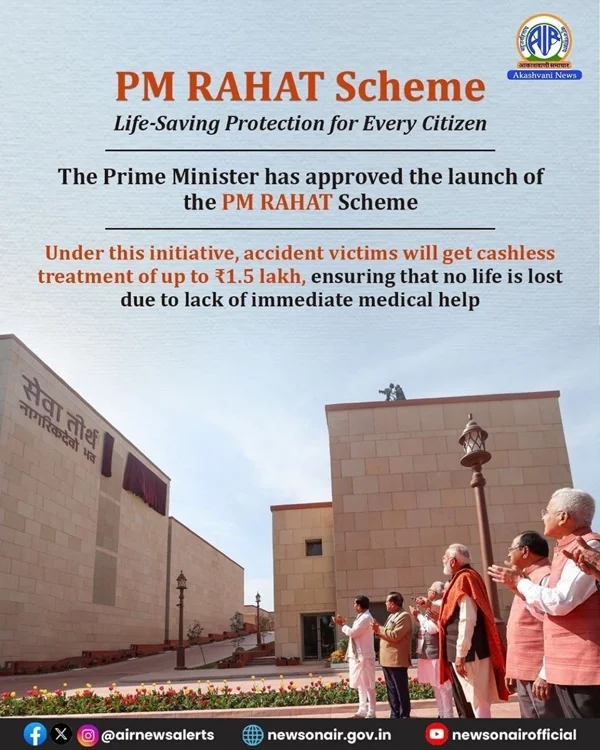
On 15 February 2026, the Government of India announced the PM RAHAT Scheme, offering cashless medical care up to Rs 1.5 lakh to qualified victims of traffic accidents for seven days from the accident data. Prime Minister Narendra Modi approved the program, which covers eligible victims of traffic accidents regardless of the type of road. Hospitals will be compensated under the program via the Motor Vehicle Accident Fund. The initiative's goal is to stop and prevent emergency medical care after an automobile accident from being postponed due to financial issues. According to studies, when victims of traffic accidents arrive at a hospital within the first hour, approximately 50% of fatalities could be avoided. The government has emphasized the need for prompt treatment in minimizing preventable deaths.
The program establishes a government-backed system that allows qualified accident victims to obtain essential medical care without having to pay for it up front. The program's goal is to increase accessibility to emergency treatment while giving hospitals a way to get paid for covered costs. PM RAHAT could facilitate quicker admission and medical intervention for victims of traffic accidents by linking financial aid with hospital-based emergency care. Additionally, the initiative is an attempt to improve cooperation between governmental organizations and medical professionals in handling severe traffic accidents.
Impact on the Healthcare Industry
By lowering the cost of medical care, the following accidents PM RAHAT could improve India's emergency healthcare system: Any delay may have an impact on patient outcomes because serious trauma cases may require diagnostic tests, emergency surgery, blood transfusion, close monitoring, and extended hospital stays. Healthcare providers may be able to provide priority to urgent care if eligible victims are not required to make arrangements for quick payment. Families coping with unforeseen medical costs after severe traffic accidents may also benefit financially from the program.
The program might raise demand for emergency medical services and infrastructure for trauma care. To effectively handle accident-related admissions, hospitals may need to bolster their emergency rooms, trauma beds, operating rooms, intensive care units, and diagnostic capabilities. Emergency physicians, nurses, paramedics, and other professionals with trauma management training may become more in demand. Hospitals' involvement in the program might be supported by the reimbursement system, which would give them a formal procedure for collecting eligible treatment costs.
PM RAHAT might also promote improved coordination throughout India's emergency care system. Accident victims frequently need quick hospital treatment, emergency evaluation, and transportation. A more seamless transition from accident response to treatment could be achieved by linking financial assistance with hospital care. This strategy may eventually lead to advancements in the provision of trauma care as well as the overall structure of emergency medical services.
Impact on the Ambulance Services Market
The global ambulance services market size is calculated at USD 51.37 billion in 2025 and is predicted to increase from USD 56.46 billion in 2026 to approximately USD 130.43 billion by 2035, expanding at a CAGR of 9.77% from 2026 to 2035.
According to Precedence Research, the market for ambulance services is expanding due to rising traffic accidents, rising demand for emergency medical transportation, and advancements in healthcare infrastructure. In 2025, the emergency services sector held 63% of the market, and throughout the forecast period, Asia Pacific is anticipated to see robust expansion.
The prompt hospital transportation is a crucial component of efficient road accident care; the PM RAHAT program is pertinent to this market. The project could facilitate quicker passage via the emergency care pathway by providing eligible victims with financial access to the following hospital treatment. Coordination between ambulance drivers, emergency responders, and hospitals may become more crucial.
Additionally, the legislation might increase demand for improved emergency transportation capabilities. The need for sophisticated life support vehicles, patient monitoring equipment, qualified paramedics, and effective dispatch infrastructure may increase for ambulance companies. These services may become more crucial in ensuring that wounded individuals get to appropriate medical facilities without needless delays as India's accident response system gets stronger.
Impact on the Inpatient Services Market
The global inpatient services market size accounted for USD 3.20 trillion in 2025 and is predicted to increase from USD 3.39 trillion in 2026 to approximately USD 5.68 trillion by 2035, expanding at a CAGR of 5.90% from 2026 to 2035.
According to Precedence Research, in 2025 emergency admissions accounted for 60% of the inpatient services market, making them the largest sector. The need for hospital care brought on by accidents, acute illnesses, and other ailments requiring emergency medical attention supports the business. In 2025, the public insurance segment accounted for 45% of the market, demonstrating the role that publicly funded healthcare funding plays in facilitating access to inpatient services.
The qualified victims of traffic accidents can receive reimbursed treatment for up to seven days. The new government program directly relates to inpatient care; inpatient facilities play a crucial role in the healing of patients with severe injuries since they may require hospitalization, surgery, close observation, or rigorous monitoring. For those who might normally be worried about the cost of hospitalization, cashless coverage may make these services more accessible.
About the Government of India
PM RAHAT was established by the Indian government through the Ministry of Road Transport and Highways to offer financial support for emergency medical care in the wake of qualified traffic accidents. The Motor Vehicle Accident Fund reimburses qualified hospitals for seven days for cashless treatment up to 1.5 lakh
The program's goal is to eliminate one of the practical obstacles that may hinder emergency care: the requirement to make financial arrangements right away following an accident. By establishing a government-backed compensation system, hospitals have a clear way to recoup qualifying costs while qualified patients can access covered medical treatments.
The government's larger initiative to enhance emergency assistance for victims of traffic accidents includes PM RAHAT as well. The entire treatment process can be enhanced via quicker hospital access, financial aid for medical care, and improved cooperation between governmental authorities and healthcare professionals. If carried out successfully, the initiatives might meet the need for hospital-based treatments and emergency transportation while bolstering India's trauma care ecosystem.