



Nvidia Strikes Landmark $20 Billion Deal for Groq Assets, Deepening Its Grip on AI Inference
Published: 26 Dec 2025
Author: Precedence Research



Nvidia has agreed to acquire key assets from Groq, a startup known for designing high-performance artificial intelligence accelerator chips, in a cash deal valued at $20 billion, according to Alex Davis, CEO of Disruptive, a firm that led Groq’s most recent funding round.
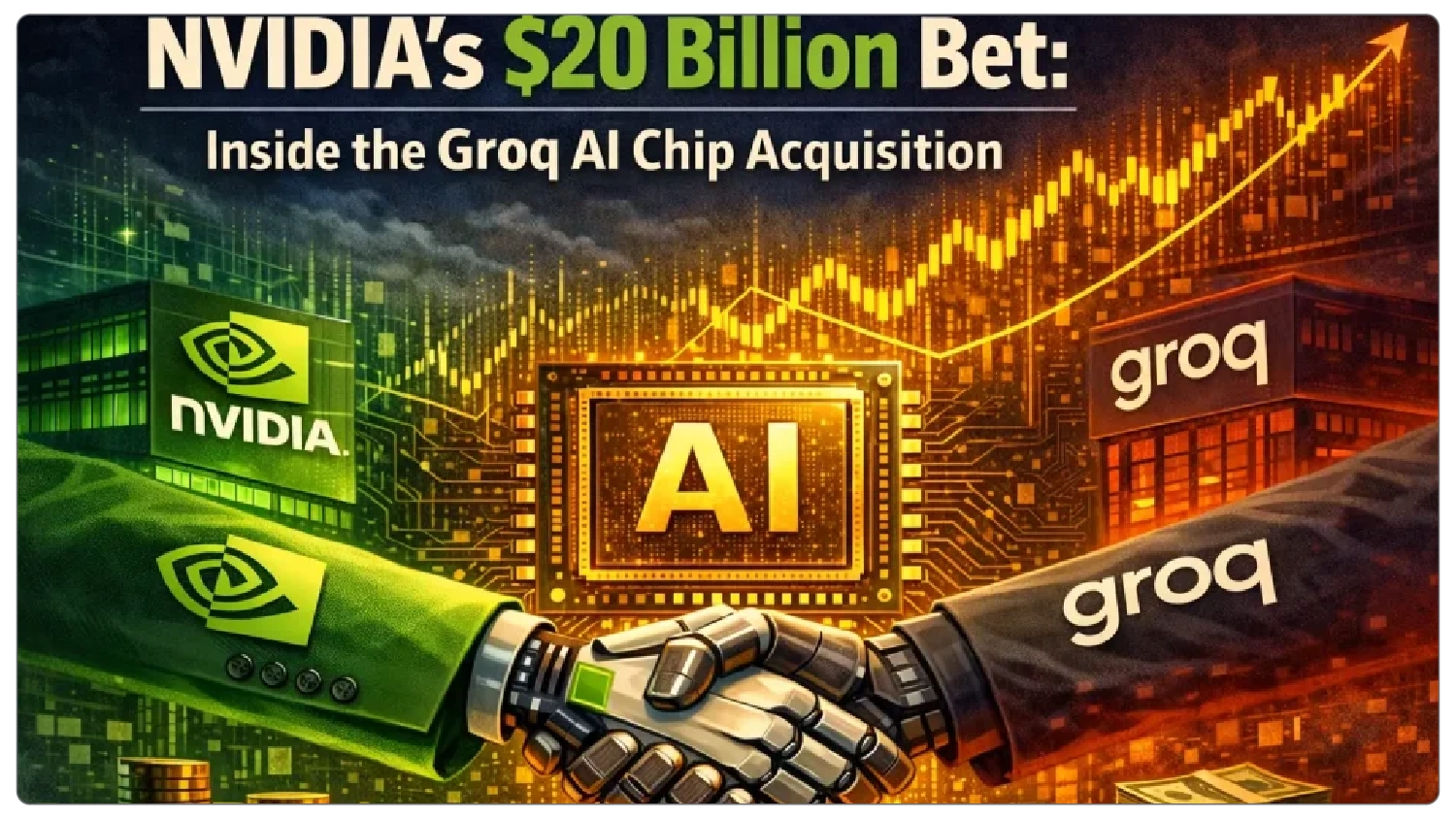
The transaction marks the largest deal in Nvidia’s history and underscores the company’s aggressive push to expand its dominance in AI infrastructure, particularly in inference and real-time workloads. While Nvidia will license Groq’s core technology and bring over much of its leadership and talent, it will not acquire Groq as a company outright.
Groq raised $750 million just three months ago at a valuation of approximately $6.9 billion. That financing round included major institutional investors such as BlackRock and Neuberger Berman, alongside strategic and private investors including Samsung, Cisco, Altimeter, and 1789 Capital. Since Groq’s founding in 2016, Disruptive alone has invested more than $500 million into the company.
In a public statement, Groq confirmed that it has entered into a non-exclusive licensing agreement with Nvidia covering its inference technology, though financial terms were not disclosed. As part of the deal, Groq founder and CEO Jonathan Ross, company president Sunny Madra, and other senior leaders will join Nvidia to help integrate and scale the licensed technology. Groq will continue operating as an independent company, with its chief financial officer, Simon Edwards, stepping into the role of CEO.
Nvidia CFO Colette Kress declined to comment on the transaction. However, Nvidia CEO Jensen Huang addressed employees in an internal message, saying the agreement would significantly expand Nvidia’s capabilities. He wrote that Nvidia plans to integrate Groq’s low-latency processors into its AI factory architecture, broadening the platform’s reach across inference and real-time AI applications. Huang emphasized that while Nvidia is licensing Groq’s intellectual property and hiring its talent, it is not acquiring Groq as a standalone entity.
According to Davis, Nvidia is effectively obtaining all of Groq’s assets, with one major exception: Groq’s cloud computing business. Groq confirmed that GroqCloud is not part of the transaction and will continue operating without disruption.
The scale of the deal far exceeds Nvidia’s previous largest acquisition, its roughly $7 billion purchase of Israeli chip designer Mellanox in 2019. Nvidia’s financial position has strengthened dramatically in recent years, with cash and short-term investments reaching $60.6 billion by the end of October, compared with $13.3 billion in early 2023.
This Groq agreement follows a similar, though smaller, move by Nvidia earlier this year, when it spent more than $900 million to hire the CEO and staff of AI hardware startup Enfabrica and license that company’s technology. Nvidia is not alone in this strategy. Other major technology firms, including Meta, Google, and Microsoft, have increasingly turned to licensing deals and talent acquisitions to secure top AI expertise without fully buying companies.
Nvidia has also ramped up investments across the AI ecosystem, backing companies involved in cloud infrastructure, AI model development, and energy-efficient data centers. The company has supported firms such as Crusoe, Cohere, and CoreWeave, and has signaled its willingness to deploy enormous capital to secure long-term AI supply and partnerships. In recent months, Nvidia announced intentions to invest heavily in OpenAI and entered into a multibillion-dollar partnership with Intel.
Groq, meanwhile, has been positioning itself as a major player in AI inference hardware, targeting $500 million in revenue this year amid surging demand for chips that accelerate large language model inference. According to Davis, the company was not seeking a sale when Nvidia approached it.
Founded in 2016, Groq was created by a team of former engineers including Jonathan Ross, who previously helped develop Google’s tensor processing unit, a custom AI chip designed as an alternative to Nvidia’s GPUs. Early filings show Ross and Douglas Wightman, a former Google X engineer, as the company’s original principals. Wightman departed Groq in 2019.
The deal highlights Nvidia’s strategy of combining capital, talent, and licensed technology to reinforce its leadership in AI, while reshaping the competitive landscape for specialized chipmakers focused on inference and real-time computing.