



Data Center Market Size, Key Companies, Company Market Share, User Adoption, Technology Deployment, Revenue Growth, Competitive Positioning, and Demand Forecast
Data Center Market (By Component: Solution, Services; By Type: Colocation, Hyperscale, Edge, Others; By Enterprise Size: Large Enterprises, Small & Medium Enterprises (SMEs); By End User: BFSI, IT & Telecom, Government, Energy & Utilities, Others) - Global Industry Analysis, Size, Trends, Leading Companies, Regional Outlook, and Forecast 2026 to 2035
Source: https://www.precedenceresearch.com/data-center-market
 Get a Sample
 Table Of Content


What is the Data Center Market Size?
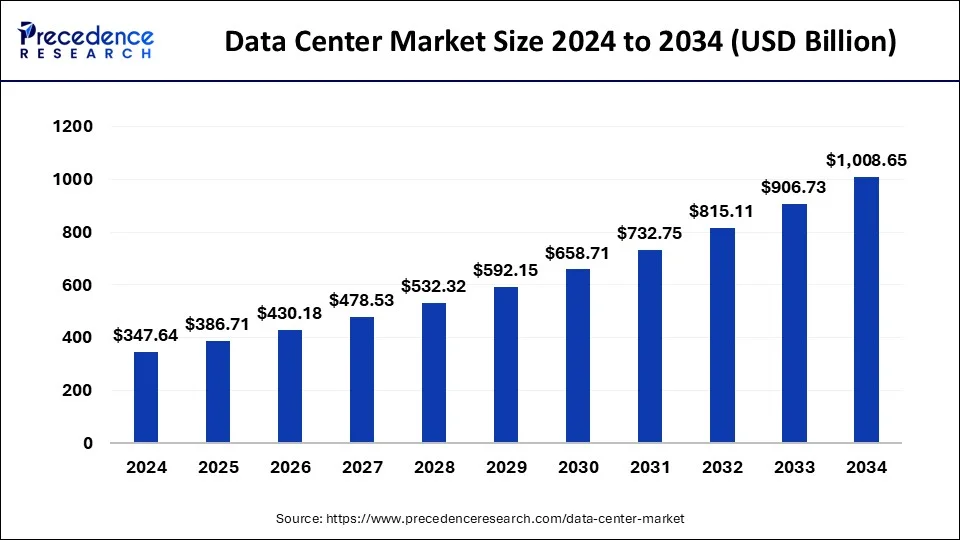
The global data center market size is estimated at USD 386.71 billion in 2025 and is predicted to increase from USD 430.18 billion in 2026 to approximately USD 1,103.70 billion by 2035, expanding at a CAGR of 11.06% from 2026 to 2035. The market is growing due to the increasing adoption of cloud computing and artificial intelligence and the rapid growth of digital data generation worldwide.
Market Highlights
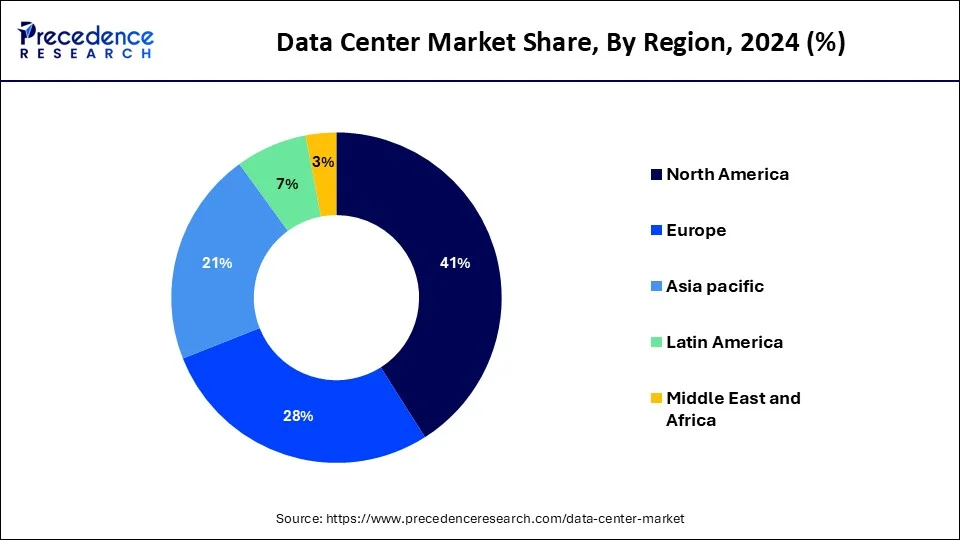
- North America dominated the global market with the largest market share of 41% in 2025.
- Asia Pacific is estimated to expand at the fastest CAGR between 2026 and 2035.
- By component, the solution segment has held the largest market share of 65.76% in 2025.
- By component, the services segment is anticipated to grow at a remarkable CAGR between 2026 and 2035.
- By type, the hyperscale segment is expected to expand at the fastest CAGR over the projected period.
- By enterprise size, the small & medium enterprises segment is expected to expand at the fastest CAGR over the projected period.
- By end-user, the BFSI segment had the largest market share in 2025.
- By end-user, the IT & telecom segment is expected to expand at the fastest CAGR over the projected period.
AI is Reshaping the Future of Data Center Infrastructure
Artificial intelligence is fundamentally transforming how data centers are designed, built, and operated worldwide. As enterprises race to scale AI workloads, the data center industry is experiencing an unprecedented wave of infrastructure investment to meet surging demand for AI computing power.
Today, nearly three out of every four new data center projects are purpose-built for AI workloads, a shift that's driving rapid innovation in data center design. To meet the intense thermal and power demands of AI infrastructure, providers are adopting advanced solutions such as liquid cooling systems and flexible power architectures, ensuring scalability, energy efficiency, and long-term reliability for enterprise clients.
Regulatory frameworks are evolving in step with this growth. In December 2025, the U.S. energy regulator directed PJM Interconnection, a major U.S. grid operator, to establish clear guidelines for connecting AI-driven data centers and large-scale electricity loads co-located with power plants. This move signals a broader industry push toward sustainable, grid-integrated AI infrastructure, a critical consideration for B2B stakeholders evaluating long-term data center partnerships.
To keep pace, leading technology companies are securing dedicated energy sources and expanding capacity at scale, ensuring uninterrupted performance for generative AI applications and enterprise cloud services. This proactive approach to energy procurement is becoming a key differentiator for organizations seeking resilient, future-ready data center solutions.
At the same time, new hubs of AI innovation are emerging beyond traditional tech corridors. Regions like West Texas are rapidly becoming strategic locations for next-generation data center development, offering access to power, land, and infrastructure suited for hyperscale AI deployments.
For enterprises and technology partners alike, the message is clear: AI is no longer just a workload, it's the driving force redefining digital infrastructure strategy. Organizations that invest early in scalable, energy-efficient, and AI-optimized data center solutions will be best positioned to lead in this new era of intelligent computing. As demand accelerates, strategic collaboration between technology providers, energy suppliers, and infrastructure developers will be essential to building a resilient, AI-ready digital ecosystem for the future.
Revolution in Data Centers Powered by Artificial Intelligence
The explosion of artificial intelligence (AI) is changing the way we use and develop data centers around the world. AI-centric data center facilities are creating an unprecedented worldwide infrastructure expansion to meet the global demand for AI-powered processing. Currently, approximately three out of every four data center projects specifically focus on AI-computing technologies, prompting the creation of advanced product design techniques, including liquid cooling and flexible power solutions, to accommodate increased thermal and power requirements.
In December 2025, The U.S. energy regulator directed U.S. grid operator, PJM Interconnection, to create rules on the connection of AI-driven data centers and large electricity loads located next to power plants. Major technology organizations continue to secure energy sources and expand their capacity to support the rapid expansion of generative AI; meanwhile, new centers of AI innovation are emerging in places such as West Texas. AI will continue to define the future of digital infrastructure.
What are the Growth Factors in the Data Center Market?
- Growing Cloud Adoption: Increasing cloud migration is driving demand for advanced data centers.
- Rising AI Workloads: Growing AI and high-performance computing applications are boosting market growth.
- Expansion of Hyperscale Facilities: Investments in hyperscale data centers are increasing worldwide.
- Digital Transformation: Enterprise digitalization is accelerating data center deployments.
- Growth of Edge Computing: Rising edge computing demand is supporting infrastructure expansion.
- Increasing Internet Traffic: Growing data generation requires greater storage and processing capacity.
- 5G Network Expansion: 5G deployment is increasing demand for low-latency data centers.
- Energy-Efficient Infrastructure: Adoption of energy-efficient technologies is driving new investments.
- Data Security Requirements: Rising cybersecurity and compliance needs are boosting demand.
- Technology Company Investments: Continuous investments by major tech firms are expanding data center capacity.
Transformational Trends Shaping the Global Data Centers Market
- Accelerating Hyperscale Expansion: Hyperscale data center growth continues at an accelerated rate by cloud providers in order to meet the increasing demand for streaming services, cloud-native applications and enterprise digital transformation both in mature economies and emerging markets.
- Increased Sustainability and Green Data Centers: As regulations become more stringent and as enterprises become more committed to environmental, social & governance (ESG) standards, operators are placing a greater emphasis on sourcing renewable energy, using innovative cooling technologies, and adopting carbon neutral designs.
- The Rise of Edge Data Centers: Rapid increases in both the use of 5G, internet of things (IoT) and real-time applications have led to greater capital investments into edge data centers to eliminate latency, enhance speed, and to facilitate localized data processing.
- Modular& Prefabricated Data Centers Adoption: Prefabricated and modular construction methods continue to gain popularity for their shorter construction schedules, superior scalable options and reduced construction timeframe risks for rapid capacity builds.
Technological Advancement
Technological advancements in the data center market include cooling technology, cloud computing, edge computing, artificial intelligence (AI), and machine learning. Edge computing processes data closer to the source, enabling faster response times and reducing latency. Machine learning, AI, and cloud computing are increasingly being used to improve data center infrastructure, optimize operations, and enhance resource utilization. Hybrid cloud solutions are also widely adopted by organizations to leverage the benefits of both cloud infrastructure and on-premises environments.
Cooling technology remains a critical component of data center operations, particularly as computing densities increase. Advanced solutions such as liquid cooling help dissipate heat from high-density computing equipment and improve energy efficiency.
AI technology is also contributing to the optimization of resource allocation and energy consumption while supporting greater automation across data center operations. In addition, green data centers help minimize environmental impact and promote sustainable data center operations. These technological advancements are collectively driving innovation and supporting the development of the global data center market.
Data Center Market Outlook
- Industry Growth Overview: The data center market will experience substantial growth from 2026 to 2035 due to increased use of cloud computing and AI during the transition phase of digital transformation, in addition to rising demand for edge computing resourcing. Key market players like Hyperscale's are increasing their data center market in the Asia-Pacific region and the North America region to support low-latency sensitive applications and overall enterprise digital transformation.
- Global Expansion: Major data center operators are scaling their global footprint across Asia, Europe, and Latin America, driven by rising cloud demand and increasingly favorable government regulations. Large-scale campus data center operators, for example, have built extensive data center campuses in Malaysia and Chile, tapping into fast-growing digital economies while meeting mandated data sovereignty requirements in each region.
- Major Investors: This expansion is fueling stronger interest from private equity firms and infrastructure investors in hyperscale and colocation assets. The appeal is twofold: intensifying competition for long-term contracts and colocation agreements, and the substantial upfront capital required to build modern facilities, all set against surging demand for AI-driven services that shows no sign of slowing.
- Startup Ecosystem: Alongside this capital influx, innovation across the data center ecosystem is accelerating, particularly in cooling technology, energy efficiency, and modular infrastructure. Companies such as Submer (Spain) and DepthAI Infra (USA) are gaining strong traction with venture capital backing, delivering scalable immersion cooling systems, AI-based power management solutions, and compact, edge-ready micro-data centers built for the next generation of digital infrastructure.
Various Governments Expanding Data Center Infrastructure to Power Digital Growth and Ai Innovation
As part of their digital transformation efforts, governments across major economies are now more focused than ever on establishing data center infrastructure as a critical component of economic competitiveness and national security. This shift is reshaping how public policy, investment incentives, and regulatory frameworks are being designed around digital infrastructure growth.
In India, sustained government-approved policies and support for data center development are projected to drive capacity from approximately 1.2GW currently to approximately 9GW by 2032. This growth is fueled largely by explosive demand from AI adoption, cloud computing, the rollout of 5G services, and government regulations mandating local data storage.
The UK is experiencing a significant boom in data center investment, with a substantial rise in new facilities being constructed each year, projected to exceed 10 billion annually by 2029. Government initiatives such as AI Growth Zones are playing a key role in accelerating this momentum, offering streamlined planning processes and creating opportunities to attract foreign investment through partnerships with global technology companies and emerging innovations.
In November 2025, Amazon announced a US$50 billion investment in data centers to power US government AI efforts. This investment removes long-standing technology barriers that had constrained government capabilities and further positions America to lead in the global AI era.
Together, these developments underscore how data centers have become critical national infrastructure, essential for powering AI and cloud services while providing safe, secure digital environments for businesses worldwide.
Market Scope
| Report Coverage | Details |
| Market Size in 2025 | USD 386.71 Billion |
| Market Size in 2026 | USD 430.18 Billion |
| Market Size by 2035 | USD 1,103.70 Billion |
| Growth Rate from 2026 to 2035 | CAGR of 11.06% |
| Largest Market | North America |
| Base Year | 2025 |
| Forecast Period | 2026 to 2035 |
| Segments Covered | Component, Type, Enterprise Size, End User, and Region |
| Regions Covered | North America, Europe, Asia-Pacific, Latin America, and Middle East & Africa |
Market Dynamics
Drivers
AI integration and hybrid cloud environments
Artificial intelligence (AI) is significantly surging demand in the data center market by introducing advanced analytics and automation. AI enhances operational efficiency, enabling predictive maintenance, intelligent workload management, and proactive issue resolution. With AI-driven insights, data centers can optimize resource utilization, improve energy efficiency, and ensure seamless performance, meeting the evolving demands of modern data processing.
The adoption of hybrid cloud environments also plays a pivotal role in driving market demand for data centers. Businesses are increasingly leveraging hybrid cloud strategies, combining on-premises infrastructure with cloud services for enhanced flexibility and scalability. Data centers, serving as the foundation of these hybrid setups, facilitate seamless integration, data mobility, and efficient resource allocation. As organizations prioritize a blend of private and public cloud solutions, demand for data centers capable of effectively supporting and integrating within hybrid cloud environments continues to see a substantial surge.
Restraint
Cybersecurity risks and energy consumption concerns
The data center market faces constraints due to escalating cybersecurity risks, with the increasing sophistication of cyber threats posing a significant challenge. The potential for data breaches, unauthorized access, and cyberattacks on critical infrastructure raises concerns among businesses and organizations, leading to hesitancy in adopting and expanding data center capabilities. The need for robust cybersecurity measures and constant advancements to counter evolving threats places a strain on resources, impacting the market's growth potential as stakeholders prioritize security over rapid expansion.
Energy consumption concerns also act as a substantial restraint on the data center market. The high-power requirements of data centers contribute to environmental impact and operational costs. With a growing focus on sustainability, businesses are cautious about the ecological footprint of data centers, prompting a shift toward energy-efficient solutions. Balancing the demand for increased computing power with the imperative to reduce energy consumption poses a challenge. Stricter regulations and corporate sustainability initiatives further intensify this pressure, influencing decision-makers to prioritize energy-efficient and environmentally friendly alternatives, ultimately impacting the pace of market expansion.
Opportunity
Edge computing solutions and data center expansion
The surge in market demand for the data center market is also significantly driven by the adoption of edge computing solutions. As organizations embrace the decentralization of data processing, edge computing brings computing power closer to end users, reducing latency and enhancing the efficiency of real-time applications. The need for quick decision-making, particularly in applications like IoT devices and autonomous systems, fuels demand for distributed edge data centers, creating a robust market for compact, high-performance infrastructure.
Data center expansion is another key driver amplifying market demand. With the escalating volume of digital data generated and processed globally, there is a critical need for expanded data center capacity. The increasing adoption of cloud computing, big data analytics, and digital transformation initiatives further intensifies this demand. Companies engaged in data center expansion projects contribute to the market's growth by ensuring scalable, secure, and efficient facilities that cater to the evolving requirements of businesses in the digital age.
Segments Inisghts
Component Insights
Which Component Segment Dominated the Data Center Market in 2025?
The solution segment dominated the data center market in 2025, driven by the increased deployment of servers, storage systems, networking hardware, power management systems, cooling systems, and data center infrastructure management software. Businesses and cloud service providers continue to make significant investments in upgrading their infrastructure to handle high-performance data processing, cloud computing, and AI workloads. The solution segment's dominance across both enterprise and colocation data centers has been further reinforced by growing demand for dependable, scalable, and energy-efficient infrastructure, along with rising investments in hyperscale facilities.
The services segment is expected to register the fastest growth during the forecast period, owing to the rising need for managed services, consulting, integration, maintenance, and migration assistance. To increase productivity, lower operational complexity, and ensure business continuity, organizations are increasingly outsourcing data center operations. This demand for specialized professional and managed services is being further fueled by the rapid adoption of edge computing, hybrid cloud, and AI-driven infrastructure.
Type Insights
Why did the Colocation Segment Dominated the Data Center Market in 2025?
The colocation segment dominated the market in 2025, as businesses increasingly chose to outsource their data center infrastructure to save on capital costs and take advantage of secure, scalable, and highly connected facilities. Colocation providers are a desirable option for companies of all sizes, offering flexible infrastructure, dependable power supplies, sophisticated security, and high network availability. The segment's dominant position has been further reinforced by growing demand for hybrid cloud connectivity, disaster recovery, and regulatory compliance.
The hyperscale segment is projected to witness the fastest growth in the market during the forecast period, driven by the rapid expansion of large-scale digital platforms, AI applications, and cloud service providers. Businesses are investing in hyperscale facilities to handle massive volumes of data while ensuring excellent computing performance and operational efficiency. Demand for hyperscale data centers continues to rise globally, fueled by the growing use of cloud-native applications, streaming services, generative AI, and machine learning.
Enterprise Size Insights
Why did the Large Enterprises Segment Dominated the Data Center Market in 2025?
The large enterprises segment accounted for the largest market share in 2025, owing to significant expenditure on cybersecurity, cloud migration, advanced IT infrastructure, and digital transformation projects. High-capacity data centers are essential for these enterprises to support global operations, mission-critical applications, and large-scale data processing requirements. This segment's dominance is further reinforced by ongoing investments in AI, advanced data analytics, and business continuity solutions.
The small and medium enterprises (SMEs) segment is anticipated to grow at the fastest rate during the forecast period, as cloud-based infrastructure, digital business models, and reasonably priced colocation services become increasingly popular. SMEs are increasingly adopting scalable data center solutions to lower infrastructure costs while improving data security and operational efficiency. Rapid market expansion among smaller firms is also being driven by growing digitalization and improved access to cloud technologies.
End User Insights
Why did the BFSI Segment Dominated the Data Center Market in 2025?
The BFSI segment dominated the market in 2025, driven by its increasing reliance on high-performance, secure data centers for financial analytics, online payments, fraud detection, digital banking, and regulatory compliance. Financial institutions generate and process large volumes of sensitive consumer data, necessitating dependable storage, fast processing, and strong cybersecurity infrastructure. Demand in this industry is being further strengthened by growing investments in AI-driven financial services and digital banking platforms.
The IT and telecom segment is expected to experience the fastest growth in the market during the forecast period, driven by the expansion of edge computing, 5G rollout, cloud usage, and rising internet traffic to accommodate AI applications, streaming services, and enterprise cloud solutions. Telecom operators and IT companies are steadily increasing the capacity of their data centers to keep pace with this demand. Infrastructure investments in this sector are being further propelled by the ongoing deployment of digital services and connected technologies.
Regional Insights
Which Region Dominate the Data Center Market in 2025?
North America dominated the market in 2025, owing to the significant presence of large technology companies, hyperscale data center operators, and leading cloud service providers. The region benefits from sophisticated digital infrastructure, substantial investments in cybersecurity, cloud computing, and artificial intelligence, as well as extensive enterprise-level digital transformation. North America's market dominance is further strengthened by the ongoing development of hyperscale facilities and strategic investments made by major technology companies.
U.S. Data Center Market Size and Growth 2026 to 2035
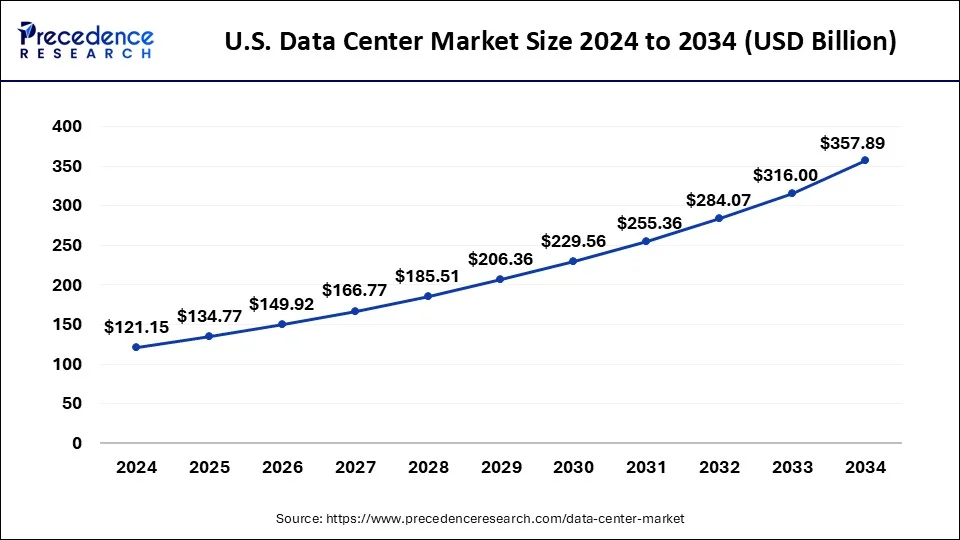
The U.S. data center market size is exhibited at USD 134.77 billion in 2025 and is projected to be worth around USD 393.14 billion by 2035, poised to grow at a CAGR of 11.30% from 2026 to 2035.
Asia Pacific is projected to experience the massive progression in the market during the forecast period, due to fast pace of digitalization, rising internet usage, growing cloud adoption, and growing expenditures in colocation and hyperscale data centers. Strong demand is being fueled by e-commerce, fintech, 5G deployment, and government-led digital economy efforts in nations including China, India, and Japan; the region's industry is expanding at an even faster rate due to rising enterprise IT investments and growing adoption of edge computing and artificial intelligence.
The region continues to exhibit a robust data center market, marked by substantial investments in data center infrastructure. The region is experiencing a shift toward modular and prefabricated data centers to address scalability needs. With a dynamic mix of mature and emerging markets, Asia Pacific shows a strong inclination toward adopting cutting-edge technologies, including AI and edge computing, to meet the increasing demand for digital services and data storage.
China Data Center Market Trends
China's market is experiencing rapid growth driven by soaring demand from AI, cloud computing, and 5G deployments, requiring high-performance facilities capable of handling intensive workloads. Government initiatives such as the East Data, West Computing program and the "New Infrastructure" policy are supporting the expansion of data center clusters, particularly in western provinces with lower power costs and available land. Hyperscale and modular data centers are increasingly deployed to meet the needs of cloud providers and AI applications, emphasizing efficiency and high-density computing.
Why did Europe grow rapidly in the Data Center Market?
Europe's data center market is anticipated to experience robust growth, spurred by the implementation of stringent data privacy regulations across the region and increasing investment in green data center initiatives. These initiatives include investments in energy-efficient cooling systems as well as broader cloud adoption, which have contributed to a rise in companies conducting artificial intelligence research and a growing need for enterprise-level digital upgrades.
Germany Data Center Market Trends
Germany's data center market is set to drive access into Europe, supported by its strong industrialized digital economy, strict data protection regulations, and high levels of investment in cloud infrastructure. With its location in Central Europe and outstanding interconnectivity, Frankfurt has established itself as the data center capital of Europe. Driven by demand for highly secure hosting solutions, advanced energy-efficient cooling systems, and large-scale capacity for enterprise workloads, many global operators have established data center operations within the country.
Why did Latin America grow steadily in the Data Center Market?
As the cloud becomes increasingly prevalent and businesses make the transition from traditional models to digitally based services in Latin America, the continent will enjoy massive and steady growth over the next several years. Growing investments in optical fiber networks, renewable energy sources, and new hyperscale data centers are just some examples of how Latin America is meeting this demand. The growth of e-commerce, fintech, and mobile data consumption has helped spur demand for more data center capacity in North America, Latin America, and Europe.
Brazil Data Center Market Trends
As cloud adoption becomes increasingly prevalent and businesses in Latin America transition from traditional models to digitally based services, the region is set to enjoy massive and steady growth over the next several years. Growing investments in optical fiber networks, renewable energy sources, and new hyperscale data centers are just some of the ways Latin America is meeting this rising demand. The growth of e-commerce, fintech, and mobile data consumption has further helped spur demand for greater data center capacity across North America, Latin America, and Europe.
Why did the Middle East & Africa grow rapidly in the Data Center Market?
Brazil has the largest internet user population in Latin America and the biggest user base of cloud services, making it the most attractive market for hyperscale operators establishing regional data centers. The rapid growth of Brazil's digital economy has fostered the development of new data centers by hyperscale providers across the country. E-commerce, digital banking, and streaming services have stimulated fresh demand for data in Brazil. For this reason, most hyperscale operators have selected Brazil as a location for their data centers, driven largely by the country's continued growth in infrastructure development and the availability of renewable energy.
UAE Data Center Market Trends
The United Arab Emirates has established itself as a leading hub for advanced digital infrastructure, supported by compliant cloud computing policies and forward-looking smart city initiatives. International operators have opened numerous new campus locations across the UAE, allowing them to focus on supporting the financial, tourism, and government sectors. With a reliable power grid and a well-developed regulatory environment for data center development, the UAE has positioned itself as a prime location for establishing data centers.
Market Data and Statistics
- As of November 2025, it is estimated that there are more than 12,000 operational data centers in the world.
- The U.S. reported around 5,427 data centers, making it the world's largest data center industry.
- Germany ranks second in terms of the number of data centers, accounting for 529.
- Furthermore, the UK, China, and Canada were among the top five countries with the highest data centers, representing 523, 449, and 337 data centers, respectively.
Competitive Landscape
The data center market remains consolidated, with dominance held by several leading companies. Prominent brands operating in this industry include Microsoft Corp., Amazon.com, Inc. (AWS), Alphabet Inc. (Google), Equinix, Inc., Oracle, and DataBank. These companies are expanding their geographical presence by offering specialized storage solutions to end users, while also investing heavily in R&D for continuous product improvement. Additionally, these brands are adopting strategies such as business expansions and joint ventures to strengthen and maintain their position in the market.
Microsoft, for instance, recently opened a new data center in Denmark to enable secure, state-of-the-art cloud infrastructure. Key barriers within this industry include the complexity of land acquisition, strict grid interconnection timelines, and substantial capital requirements. That said, the growing adoption of long-term lease commitments, along with strategic partnerships between established players and regional service providers, is expected to strengthen the industry's growth outlook in the years ahead.
Data Center Market Companies
- Equinix, Inc.: The company delivers IBX data centers, which provide colocation services and interconnection capabilities, together with hybrid multicloud services and AI-enabled global digital infrastructure solutions.
- Digital Realty Trust, Inc.: The company provides PlatformDIGITAL service, which enables customers to establish colocation facilities and access hyperscale data centers while maintaining secure interconnection and developing hybrid IT solutions.
- NTT Ltd. (NTT DATA): The company provides worldwide colocation services together with AI-ready infrastructure, cloud-based solutions, and advanced liquid cooling systems, which operate with ICT technologies.
- Global Switch Ltd.: The company operates extensive cloud-neutral data centers that deliver high power density and liquid cooling capabilities for AI processing requirements.
- CyrusOne Inc.: The company specializes in providing hyperscale colocation facilities that deliver dependable high-density infrastructure to serve cloud providers and enterprise IT requirements.
Other Major Key Players
- Interxion: A Digital Realty Company
- China Telecom Corporation Limited
- China Unicom (Hong Kong) Limited
- AT&T Inc.
- Amazon Web Services, Inc. (AWS)
- Microsoft Corporation
- Google LLC
- IBM Corporation
- Oracle Corporation
- Cisco Systems, Inc.
Recent Developments
- In April 2026, Aramark launched Aramark Nexus™, offering integrated hospitality and workforce support for hyperscale AI data centers. Selected by a global hyperscaler, Aramark will provide services across multiple locations under a multi-year agreement, starting revenue this fiscal year. (Source: https://www.businesswire.com)
- In April 2026, Alibaba and China Telecom announced the launch of a southern China data center featuring 10,000 Alibaba Zhenwu chips for AI training, supporting large AI models. China Telecom will own and operate the facility, enhancing local AI infrastructure. (Source: https://www.cnbc.com)
- In January 2026, Zoho launched its first data center in Dubai and Abu Dhabi, marking a key step in regional expansion. This AED 100 million investment supports over 100 cloud-based solutions, reinforcing Zoho's commitment to local customers and partners. (Source: https://www.linkedin.com)
Segments Covered in the Report
By Component
- Solution
- Services
By Type
- Colocation
- Hyperscale
- Edge
- Others
By Enterprise Size
- Large Enterprises
- Small & Medium Enterprises (SMEs)
By End User
- BFSI
- IT & Telecom
- Government
- Energy & Utilities
- Others
By Region
- North America
- Europe
- Asia-Pacific
- Latin America
- Middle East and Africa
For inquiries regarding discounts, bulk purchases, or customization requests, please contact us at sales@precedenceresearch.com
Frequently Asked Questions
Tags





Ask For Sample
No cookie-cutter, only authentic analysis – take the 1st step to become a Precedence Research client
 Get a Sample




 sales@precedenceresearch.com
 Schedule a Meeting
