



Modular Data Center Market Size, Share, and Trends 2026 to 2035
Modular Data Center Market (By Component: Solution, Services; By Organization Size: Large Enterprises, Small & Medium Enterprises; By Industry Verticals: BFSI, IT & Telecom, Retail, Manufacturing, Healthcare, Energy, Media & Entertainment, Government, Others) - Global Industry Analysis, Size, Trends, Leading Companies, Regional Outlook, and Forecast 2026 to 2035
Source: https://www.precedenceresearch.com/modular-data-center-market
 Get a Sample
 Table Of Content


What is the Modular Data Center Market Size?
The global modular data center market size is calculated at USD 36.37 billion in 2025 and is predicted to increase from USD 42.74 billion in 2026 to approximately USD 176.41 billion by 2035, expanding at a CAGR of 17.11% from 2026 to 2035.
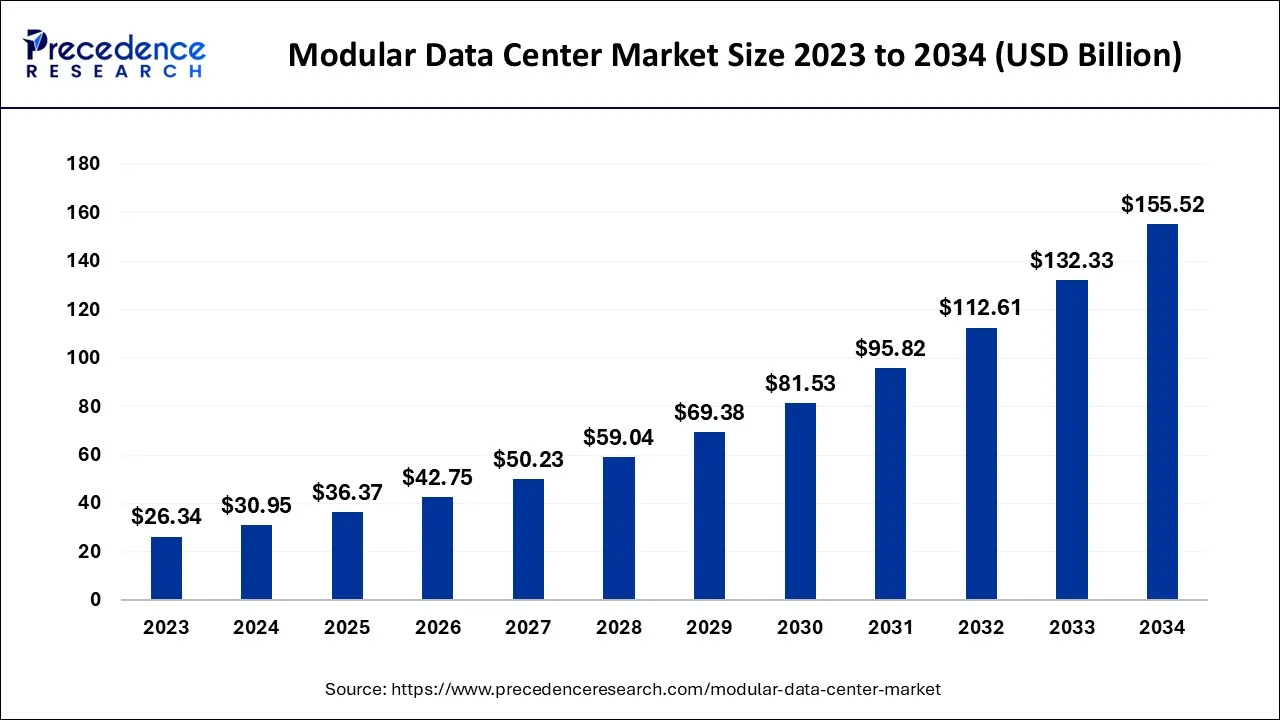
Modular Data Center Market Key Takeaways
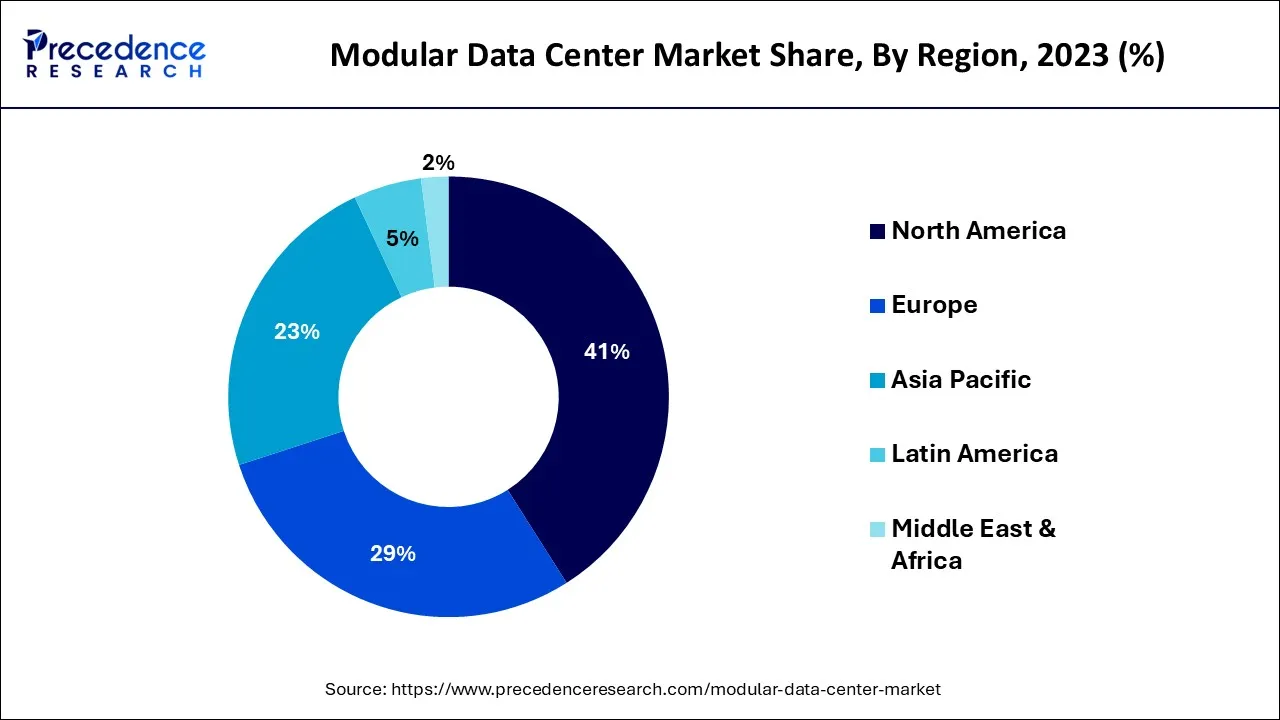
- North America region dominated the market and generated more than 41% of the revenue share in 2025.
- By Component, the services segment is contributing to the maximum market between 2026 and 2035.
- By Organization Size, the large enterprises segment is recording to largest market between 2026 and 2035.
- By Industry Verticals, the BFSI segment is generating to largest market between 2026 and 2035.
What is Modular Data Center?
A modular data center (MDC) is a portable data center that can be deployed anywhere, anytime. It is a self-contained computing environment that includes all the necessary components, such as power and cooling systems, servers, storage, and networking equipment. MDCs are designed to be scalable, flexible, and energy-efficient, and they can be used for various applications, including cloud computing, disaster recovery, edge computing, and mobile computing. The modular data center market is a rapidly surging industry driven by the rising demand for data storage and processing.
Furthermore, The global modular data center market is anticipated to grow considerably, driven by organizations increasingly adopting modular solutions to meet their growing data storage and processing needs. Modular data centers can be rapidly deployed, allowing organizations to respond to business needs and IT demands quickly. This is important in industries such as healthcare, finance, and e-commerce, where downtime can significantly impact operations and revenue.
Modular data centers can be quickly and easily scaled up or down, allowing organizations to adapt to changing business needs and IT requirements. This scalability enables companies to add capacity as needed without building an entire data center, which can be expensive and time-consuming.
However, security concerns, lack of standardization, and complexity of design, build, & management are anticipated to impede the market growth. Modular data centers can be complex to design, build, and manage. This complexity can lead to higher costs and longer deployment times, which may deter some organizations from adopting this technology. While modular data centers are designed to be scalable, their capacity may be limited compared to traditional data centers. This could be a constraint for organizations that require large amounts of computing power or data storage.
The COVID-19 pandemic have accelerated demand for modular data centers. The pandemic has forced several companies to adopt remote work policies, which has led to increased demand for IT infrastructure that can support remote work. Modular data centers are well-suited for this purpose, as they can be quickly deployed in remote locations to support remote workers.
How is AI contributing to the Modular Data Center Industry?
The use of artificial intelligence in the modular data centers industry makes them smart by providing automated power and cooling optimization, predictive maintenance, dynamic workload allocation, proactive security monitoring, and accurate capacity planning. The AI helps in fast rollout and adaptable modular layouts, and at the same time, it increases the energy efficiency, reliability, uptime, and cost control of the data centers, which are able to flexibly support the changing, high-density digital and AI-driven workloads in the current infrastructure environments.
Modular Data Center Market Growth Factors
The growing demand for various applications, including cloud computing, disaster recovery, edge computing, and mobile computing, propelled market demand. The various factors are helping to drive the market are:
- Modular data centers are flexible, modular, and scalable
- Cost-effectiveness
- Rapid deployment of modular data centers
Market Outlook
- Industry Growth Overview: The market growth is primarily driven by the increasing need for scalable, energy-efficient, and rapidly deployable IT infrastructure to support the proliferation of cloud computing, edge computing, AI, and 5G technologies.
- Major investors: Major investors in the modular data center market include tech giants like Dell, HPE, IBM, Cisco, Huawei, infrastructure specialists such as Schneider Electric, Vertiv, Eaton, ABB, Rittal, and Johnson Controls.
- Global Expansion: The proliferation of 5G networks and IoT devices increases the need for data processing closer to the end-user (edge computing) to reduce latency, which the portable, location-agnostic nature of modular data centers is ideal for.
Market Scope
| Report Coverage | Details |
| Market Size in 2025 | USD 36.37 Billion |
| Market Size in 2026 | USD 42.74 Billion |
| Market Size by 2035 | USD 176.41 Billion |
| Growth Rate from 2026 to 2035 | CAGR of 17.11% |
| Largest Market | North America |
| Base Year | 2025 |
| Forecast Period | 2026 to 2035 |
| Segments Covered | Component, Organization Size, Industry Verticals, and Region |
| Regions Covered | North America, Europe, Asia-Pacific, Latin America and Middle East & Africa |
Market Dynamics
Key Market Drivers
Modular data centers are flexible, modular, and scalable to brighten the market prospect
Traditional data centers are typically built as large, monolithic structures that are expensive to scale and inflexible to change. In contrast, modular data centers are designed to be flexible, modular, and scalable, allowing organizations to add capacity as needed without building an entire data center. Modular data centers consist of prefabricated modules assembled on-site, allowing rapid deployment and expansion. These modules can be easily added or removed, allowing organizations to scale their IT infrastructure up or down as required. This flexibility allows organizations to react quickly to changing business needs and IT requirements.
In addition to their scalability and flexibility, modular data centers are also designed to be energy-efficient, reducing operational costs over time. They use advanced cooling and power management technologies to reduce energy consumption, resulting in lower utility bills and a smaller carbon footprint. The scalability and flexibility of modular data centers make them perfect for a various range of applications, including cloud computing, edge computing, mobile computing, and disaster recovery.
They can be deployed in various environments, including remote or harsh locations, where traditional data centers may not be practical. Thus, the demand for modular data centers is driven by their ability to provide flexible, scalable, and energy-efficient IT infrastructure that can be quickly deployed and adapted to meet changing business needs and IT requirements.
Cost-effectiveness
Modular data centers are built off-site and shipped to the deployment location, reducing construction costs compared to traditional data centers typically built on-site. This can result in significant labor, materials, and time savings. Also, these are designed to be scalable, allowing organizations to add capacity as needed without building an entire data center. This can reduce the upfront costs of building a large data center and lower ongoing operating costs by allowing organizations to add capacity gradually as needed.
Furthermore, modular data centers can be quickly deployed, reducing the time-to-market and allowing organizations to start generating revenue sooner. This can be particularly important for businesses that need to rapidly scale their IT infrastructure to support new initiatives or changing market conditions. Moreover, they are designed for easy maintenance, with individual modules that can be easily replaced or repaired.
This can reduce maintenance costs compared to traditional data centers, which may require costly repairs or upgrades to entire facility sections. Thus, the cost-effectiveness of modular data centers is driving demand for this technology as organizations look for ways to optimize their IT infrastructure investments while maintaining scalability, reliability, and performance. As the demand for cloud computing, edge computing, and other data-intensive applications grows, modular data centers will likely become an increasingly popular option for organizations looking to modernize their IT infrastructure.
Key Market Challenges
Security concerns are causing hindrances to the market
Security threats become a major concern as organizations increasingly rely on data centers to process and store sensitive information. Modular data centers are typically located on-site, making them vulnerable to physical security threats such as theft or vandalism. These concerns can be addressed by implementing security measures such as access controls, surveillance systems, and fencing. Also, these modular data center stores and process sensitive information, making them attractive targets for cybercriminals seeking to steal data or disrupt operations. These concerns can be addressed by implementing robust security protocols such as firewalls, intrusion detection systems, and encryption.
Furthermore, modular data centers may need to comply with various regulations and standards governing data security and privacy, such as the Health Insurance Portability and Accountability Act (HIPAA) in the United States or the general data protection regulation (GDPR) in the European Union. Weakening to comply with these regulations can result in significant fines and damage to an organization's reputation. Thus, security concerns significantly restrain the demand for modular data centers. Addressing these concerns is essential to ensure that organizations can take benefit of the advantages of modular data centers without compromising the security of their data and operations.
Key Market Opportunities
These are the following factor which is likely to create opportunity over the forecast period.
- Rise of edge computing
- Deployment of 5G networks
- Support modular cloud infrastructure
Segment Insights
Component Insights
On the basis of component, the modular data center market is divided into solution and services, with the services segment accounting for most of the market because these services are essential for ensuring the optimal performance and smooth operation of a modular data center.
The services include a modular data center's hardware and software components, such as IT infrastructure, power and cooling infrastructure, and physical infrastructure. Providers of modular data center services may also offer training and education programs for customers and may assist in migrating the data center workload to the new environment.
Organization Size Insights
On the basis of the organization size, the modular data center market is divided into large enterprises and small & medium enterprises, with the large enterprises accounting for most of the market. This segment includes large organizations with extensive IT infrastructure requirements. These organizations typically have large data centers and complex IT environments, needing high performance, scalability, and security. They may also have strict compliance requirements that need to be met, such as those related to data privacy or industry regulations.
It may use modular data centers to expand its existing capacity, deploy new applications or services, support disaster recovery and business continuity efforts, and drive demand in this segment.
Industry Verticals Insights
On the basis of industry verticals, the modular data center market is divided into BFSI, IT & telecom, retail, manufacturing, healthcare, energy, media & entertainment, government, and others, with the BFSI accounting for most of the market because the BFSI sector requires high levels of security, reliability, and availability for their IT infrastructure. Modular data centers can provide a flexible and scalable solution for the BFSI sector, enabling them to quickly deploy and manage their IT infrastructure while maintaining high levels of security and reliability.
Regional Insighst
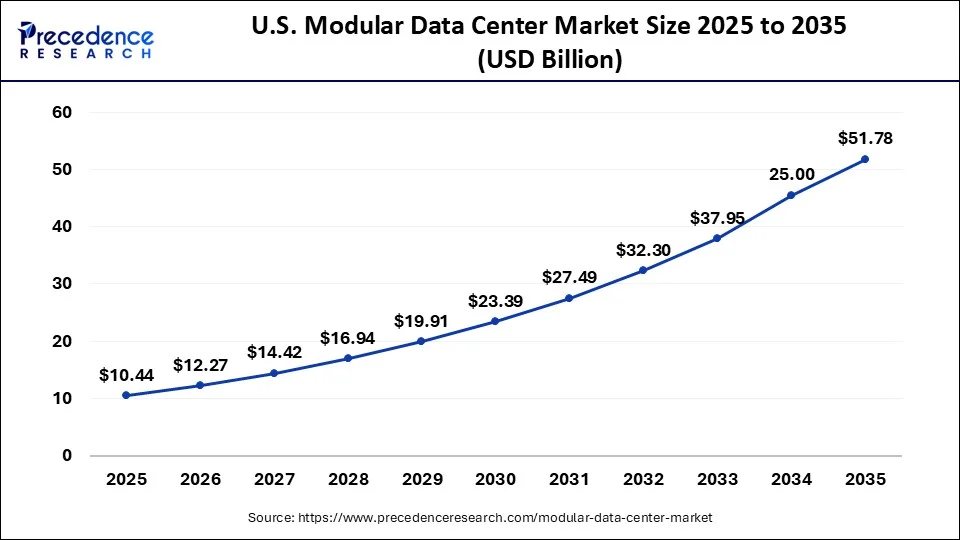
U.S. Modular Data Center Market Size and Growth 2026 to 2035
The U.S. modular data center market size is exhibited at USD 10.44 billion in 2025 and is projected to be worth around USD 45.50 billion by 2035, growing at a CAGR of 17.75% from 2026 to 2035.
North America
On the basis of geography, North America dominates the market, primarily driven by the mature IT infrastructure and a high adoption rate of cloud computing, big data, and IoT technologies, which are driving the demand for modular data centers. Thus, the North American modular data center market is anticipated to grow, driven by the surging demand for edge computing, high-performance computing, and green data center solutions.
U.S. Modular Data Center Market Trends
In North America, the U.S. dominated the market owing to extensive data growth, particularly from AI/ML, IoT, and 5G, requiring more scalable, faster, and cost-effective infrastructure. Also, this system minimizes construction time and costs while combining energy-efficient and advanced cooling systems and renewable energy.
Canada Modular Data Center Market Trends
Canada's market is growing rapidly as organizations seek scalable, quickly deployable infrastructure to support cloud, edge computing, and digital transformation initiatives. The market is driven by the flexibility, cost efficiency, and shorter deployment times of modular designs compared with traditional data centers. Sustainability and energy-efficient technologies, such as advanced cooling systems and renewable power integration, are becoming key design priorities.
Europe is also a significant market for modular data centers. Countries such as France, Germany, United Kingdom, and the Netherlands have many data centers and cloud service providers, increasingly adopting modular data center solutions. The increasing demand for edge computing and the need for high-performance computing solutions in industries such as BFSI, healthcare, and manufacturing are driving the growth of the European modular data center market.
The region in Asia-Pacific is anticipated to have the greatest CAGR. The Asia-Pacific modular data center market is anticipated to continue growing, driven by the increasing demand for edge computing, high-performance computing, and green data center solutions in the region. China is the largest market for modular data centers in Asia-Pacific, with many cloud service providers and a growing need for edge computing solutions. Japan is also a significant market for modular data centers in Asia-Pacific, with a strong focus on green data center solutions and a growing need for high-performance computing solutions in industries such as manufacturing and automotive.
China Modular Data Center Market Trends
China's market is witnessing strong growth, driven by rapid digitalization, expanding cloud services, AI workloads, and widespread 5G deployment that require scalable and fast-to-deploy infrastructure. Enterprises, hyperscalers, and telecom operators are increasingly adopting prefabricated modular data centers to reduce construction time, optimize costs, and enable flexible capacity expansion, particularly in edge and regional locations.
Europe
The UK Modular Data Center Market Trends
The UK market is growing as businesses seek rapidly deployable and scalable infrastructure to support cloud adoption, edge computing, and digital transformation. Modular solutions are favored over traditional data centers due to their cost efficiency, faster deployment, and flexibility to meet changing capacity needs. Sustainability and energy-efficient designs, including advanced cooling and renewable energy integration, are increasingly important to meet regulatory and corporate ESG requirements.
Germany Modular Data Center Market Trends
The growth of the market in the country can be driven by its stringent rules, particularly using waste heat to push modular designs, which facilitate PUE and integrate renewables. Extensive investments by AWS and Microsoft in emerging German regions create a good ecosystem for associated infrastructure, such as modular solutions.
Modular Data Center Market Companies
- Dell Technologies: Offers the EMC MDC and other solutions for localized data processing, emphasizing rapid IT capacity expansion and support for various workloads and industries.
- Hewlett Packard Enterprise (HPE): Provides modular solutions, including the AI Mod POD with advanced cooling and heat recovery systems, designed for efficient and sustainable AI deployments and hybrid cloud strategies.
Other Major Key Players
- BaseLayer Technology LLC
- CommScope Inc.
- Dell Inc.
- Eaton, Hewlett Packard Enterprise Company.
- Huawei Technologies Co. Ltd.
- IBM Corporation
- Rittal GmbH.
- Schneider Electric.
- Vertive Group Corporation
Recent Developments
- In August 2025, Vertiv launched Vertiv OneCore, providing a global solution for high-performance data centers. Its modular design supports 5 MW to 50 MW deployments, addressing the growing AI and HPC market's power needs. (Source: https://www.datacenterfrontier.com )
- In June 2025, Siemens, alongside Cadolto Datacenter and Legrand Data Center Solutions, introduced a new turnkey modular Edge data center. These customizable, prefabricated modules can be tailored to specific operational needs and deployed within six to 12 months, suitable for both permanent and interim operations.
(Source: https://www.datacenterdynamics.com ) - In October 2019, Dell Technologies launched its modular data center solution, the Dell EMC Modular Data Center Micro 415.
- In June 2020, IBM announced the launch of its IBM Modular Data Center Solution, a highly scalable, containerized data center solution designed to support edge computing environments.
- In July 2020, Rittal partnered with Hewlett Packard Enterprise (HPE) to develop a standardized, modular data center solution for use in industrial environments.
- In March 2021, Schneider Electric announced the acquisition of RIB Software, a software solutions provider for building and infrastructure projects, to expand its capabilities in the modular data center market.
- In September 2021, Lenovo announced the launch of its ThinkSystem SE350 edge server, a modular data center solution designed for use in edge computing environments.
Segments Covered in the Report
By Component
- Solution
- Services
By Organization Size
- Large Enterprises
- Small & Medium Enterprises
By Industry Verticals
- BFSI
- IT & Telecom
- Retail
- Manufacturing
- Healthcare
- Energy
- Media & Entertainment
- Government
- Others
By Geography
- North America
- Europe
- Asia-Pacific
- Latin America
- Middle East and Africa
For inquiries regarding discounts, bulk purchases, or customization requests, please contact us at sales@precedenceresearch.com
Frequently Asked Questions





Ask For Sample
No cookie-cutter, only authentic analysis – take the 1st step to become a Precedence Research client
 Get a Sample




 sales@precedenceresearch.com
 Schedule a Meeting
