



PumasAI Helps Launch India’s First Computational Lab for Quantitative Sciences to Advance AI in Drug Development
Published: 28 Jul 2026
Author: Towards Healthcare



PumasAI, an AI-driven healthcare pharmacology and pharmacometrics organization transforming how healthcare teams work, announced its role in supporting the establishment of the Dr. Ramalingam Sankaran Computational Lab for Quantitative Sciences at PSG Institute of Medical Sciences and Research (PSGIMSR) in Coimbatore, India.
Developed through a partnership among PumasAI, the Society of Pharmacometrics and Health Analytics Sciences (SOPHAS), and PSGIMSR, the well-developed state-of-the-art facility represents a significant investment in India's increasing scientific environment and is predictable to become a leading center for artificial intelligence (AI), medical care data analytics, pharmacometrics, and model-informed drug development (MIDD).
Powered by an advanced-performance computing cluster, the laboratory gives scholars, scientists, and healthcare professionals access to advanced computational resources that support AI-based drug discovery, predictive health models, real-world indication generation, and quantitative sciences. For PumasAI, deep participation in this initiative is a part of their long-term commitment to increasing access to modern scientific devices and supporting to cultivate the next generation of scientists shaping the future of drug development.
"Scientific innovation begins with people," said Dr. Vijay Ivaturi, Co-Founder and CEO of PumasAI. "We believe that providing researchers with access to advanced computational resources and modern AI technologies creates opportunities that extend far beyond a single institution. This laboratory represents an investment in future scientists, future discoveries, and ultimately better outcomes for patients around the world."
Building Computational Capacity in Drug Development
The facility helps scientists in clinical pharmacology, pharmacometrics, machine learning, and healthcare analytics. Students and scientists will be involved in live research projects, organization partnership, and translational research initiatives. Contributors will gain hands-on experience applying AI to drug advancement, clinical data modeling, pharmacometric simulations, and population health analytics alongside experts from academia and organizations.
The initiative strengthens the instructional foundation of SOPHAS' AI in Drug Development program by offering students dedicated computational infrastructure intended to support advanced scientific research.
India continues to support its position in worldwide pharmaceutical innovation via spending in research, technology, and life sciences talent. PumasAI believes initiatives such as Dr. Ramalingam Sankaran Computational Lab will speed up that momentum by giving researchers access to the devices, training, and computational resources required to solve tomorrow's medical care challenges.
"Our vision extends beyond building software," added Ivaturi. "We want to help build the scientific ecosystem that powers the next generation of innovation. Success will be measured by the discoveries made here, the researchers it develops, and the therapies that ultimately improve lives."
The Dr. Ramalingam Sankaran Computational Lab for Quantitative Sciences was officially inaugurated in July 2026 by Sri L. Gopalakrishnan, Managing Trustee of PSG & Sons' Charities Trust, alongside leaders from PSGIMSR, SOPHAS, and PumasAI.
According to Towards Healthcare, the AI and ML in drug development market is projected to experience significant growth, with estimates suggesting the market size will increase from USD 4.9 billion in 2026 to approximately USD 43.94 billion by 2035, representing a compound annual growth rate (CAGR) of 27.60% from 2026 to 2035, driven by, artificial intelligence and machine learning in drug discovery and advancement to creates them more effective and precise. AI-driven approaches are being deployed to optimize antibody design, predict small-molecule activity, detect novel antibiotic compounds, and explore innovative disease indications for investigational therapies.
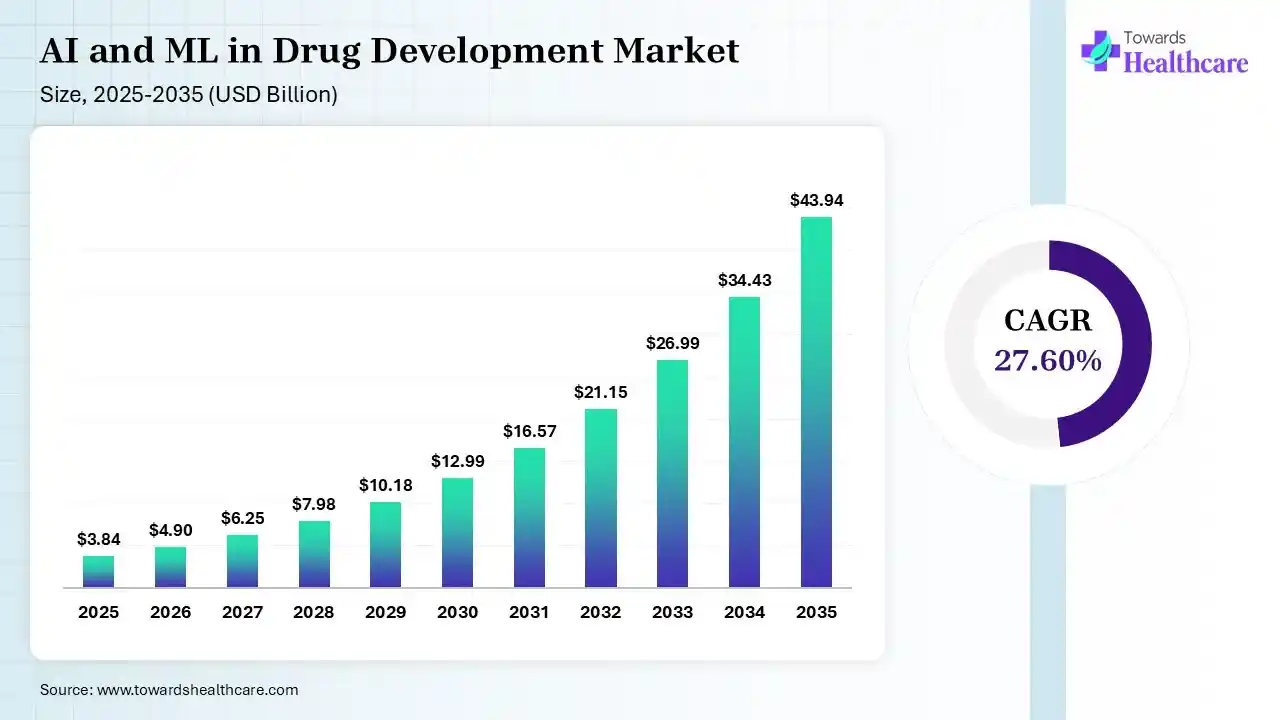
Applying AI in drug discovery needs increasingly significant computing capabilities to process the increasing amount of data and train algorithms. Artificial Intelligence is recently reshaping each stage of drug advancement with impressive outputs. Major companies are recently discovering ways to enhance success rates and speed up timelines.
About PumasAI
PumasAI is an award-winning worldwide medical care intelligence organization with a vision to speed up precision healthcare for patients. Proprietary software and AI-based devices developed by the organization include the Pumas suite of products, an integrated modeling and simulation platform intended to multiply productivity in the drug development lifecycle. Researchers at PumasAI offer consulting with leading healthcare innovators in clinical pharmacology, model-informed drug development (MIDD), pharmacometrics, front-end uses, and more.
A recent report by Towards Healthcare highlights that the AI and ML in drug development Market is growing as the role of AI-based approaches in accelerating drug development is emphasized, highlighting its strength to analyze massive information volumes, thus lessening the time and expenses related with advance drug market analysis. Machine learning algorithms detect subtle patterns in microscopic images that indicate drug effectiveness or toxicity, speed up the screening process, and enhance the reliability of preclinical testing outputs. AI-based technologies have converted this traditionally labor-intensive process by enabling precise prediction of absorption, distribution, metabolism, excretion, and toxicity (ADMET) characteristics. These technologies offer predictions for critical parameters like blood-brain barrier penetration, hepatotoxicity, cardiotoxicity, and drug-drug interaction strength. AI and machine learning are significant for analyzing this information, detecting patterns, and predicting drug responses or disease evolution.