



Sagimet Biosciences Receives FDA “Study May Proceed” Letter and IND Clearance for Phase 3 Trial in Acne in Adolescent and Adult Patients
Published: 24 Aug 2026
Author: Towards Healthcare



Phase 3 clinical trial of denifanstat in moderate to severe acne patients in the U.S. on track to initiate in second half of 2026
Sagimet Biosciences Inc., a clinical-stage biopharmaceutical organization advancing new therapeutics targeting dysfunctional metabolic and fibrotic pathways, announced that the U.S. Food and Drug Administration (FDA) has cleared the Investigational New Drug (IND) application and challenged a “Study May Proceed” letter for the company’s Phase 3 clinical trial of fatty acid synthase (FASN) inhibitor denifanstat in moderate to severe acne. The Phase 3 clinical trial is on track to initiate in the second half of 2026.
“This letter marks an important regulatory milestone for denifanstat,” said Andreas Grauer, MD, Chief Medical Officer of Sagimet. “The Phase 3 clinical trial is intended to enroll approximately 800 US patients, with 450 expected to be adolescents, using well-accepted co-primary endpoints that will be assessed at the end of the 12-week randomized double-blind period, followed by a 40-week open-label extension to evaluate long-term safety. We appreciate the FDA's review and look forward to advancing into Phase 3 this year.”
“Clearance of the IND and receipt of the “Study May Proceed” letter is a decisive step in our clinical development of denifanstat for acne,” said David Happel, Chief Executive Officer of Sagimet. “We are on track to initiate the trial and start dosing patients this year. As an oral once-daily FASN inhibitor, denifanstat offers a novel mechanism of action to treat acne, and we look forward to offering this novel treatment option, if approved, to a currently underserved patient population.”
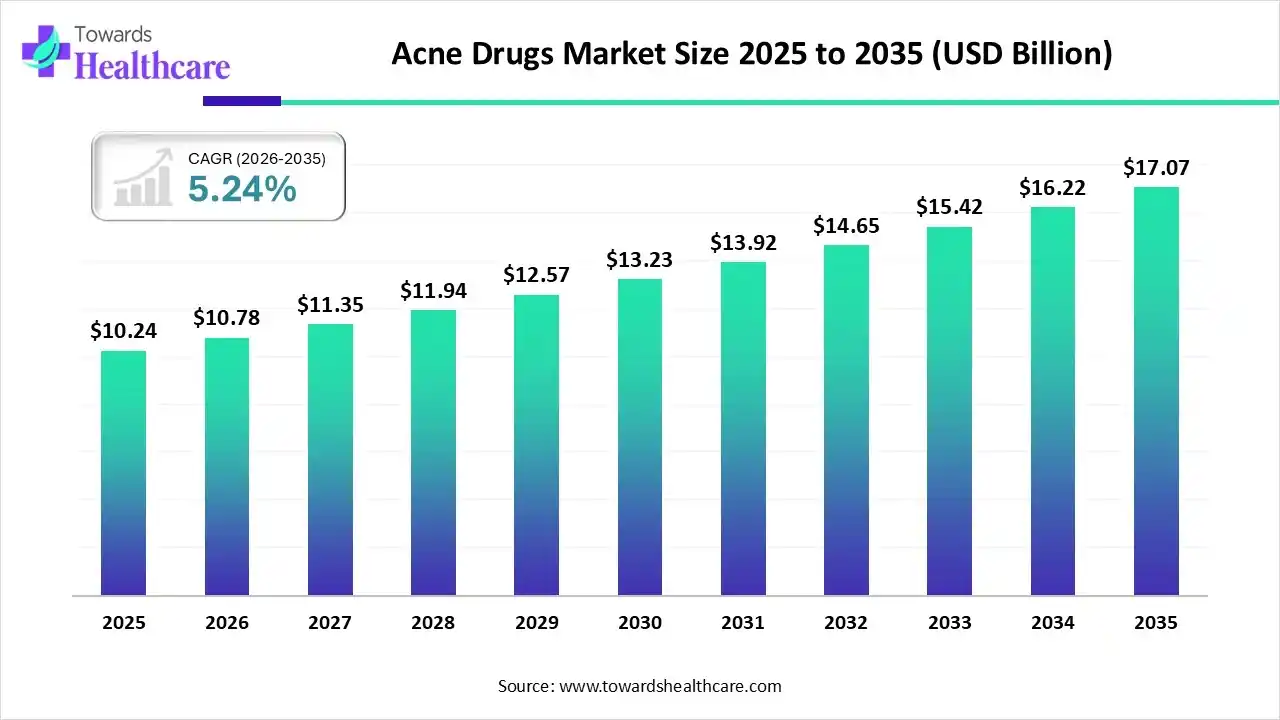
According to Towards Healthcare, the acne drugs market is projected to grow significantly, with estimates indicating the market size will increase from USD 10.78 billion in 2026 to approximately USD 17.07 billion by 2035, expanding at a CAGR of 5.24% from 2026 to 2035. Acne drugs clear blocked pores, kill bacteria on the skin, and calm inflammation. This management prevents permanent skin scars and reduces the load. They enhance daily life and increase self-confidence for millions of consumers. It takes several months or years for acne to clear up entirely. Fast-acting because acne products are intended to work rapidly with little to no adverse effects.
About the Phase 3 Clinical Trial
The multi-center, randomized, double-blind, placebo-controlled Phase 3 clinical trial of denifanstat in modest to severe acne is designed to enroll around 800 U.S. consumers aged 12 years and older, of which 450 are expected to be adolescents aged 12 to 17 years. Patients were randomized 2:1 to receive dacinostat 50 mg or placebo once daily for 12 weeks. The trial has three co-primary endpoints measured at week 12: the proportion of consumers attaining treatment success in a worldwide assessment score, well-defined as at least a 2-point lowers from baseline with a score of 0 or 1; absolute change in inflammatory skin lesion counts from baseline; and absolute change in non-inflammatory skin lesion counts from baseline. Patients completing the double-blind period will be eligible to enter a 40-week open-label extension assessing the long-term safety of denifanstat.
About Denifanstat
Denifanstat is an oral, once-daily FASN inhibitor in advancement for the management of moderate to severe acne. In trials conducted by companies license partner, Ascletis BioScience Co. Ltd. in China, Denifanstat met all significant and secondary endpoints in a 12-week randomized, double-blind Phase 3 clinical trial in moderate to severe acne vulgaris and was usually well-tolerated and designed enhancement in effectiveness endpoints measured at 52 weeks in an open-label Phase 3 clinical trial assessing its long-term safety in patients with moderate to severe acne. Denifanstat is being industrialized by Ascletis as ASC40 for acne in China and by Sagimet in the rest of the world.
About Acne
Acne is one of the most significant skin conditions in the U.S., with about 50 million Americans affected yearly and more than 5 million seeking healthcare management for acne every year. Acne affects about 85% of people between the ages of 12 and 24. Moderate to severe acne accounts for 20% of acne cases, or approximately 10 million people in the U.S. yearly. There is no cure for acne, and because of its pathology, most patients require long-term management and multiple yearly courses of management for flare control.
About Sagimet Biosciences
Sagimet is a clinical-stage pharmaceutical organization advancing novel FASN inhibitors intended to target specific dysfunctional metabolic and fibrotic pathways in situation output from the overproduction of the fatty acid palmitate. FASN is a controller of lipid synthesis and a significant pathway implicated in major diseases, like acne, MASH , and certain FASN-dependent tumor types.
A recent report by Towards Healthcare highlights that the acne drugs market is growing, as acne therapeutics work by lowering oil production and inflammation or by managing bacterial infection. With most prescription acne therapeutics, patients may not see results for four to eight weeks. It takes several months or years for a patient's acne to clear up entirely. For moderate to severe acne, consumers require oral antibiotics to lower bacteria. Generally, the first choice for managing acne is a tetracycline such as minocycline, doxycycline, or a macrolide such as erythromycin and azithromycin. A macrolide is an option for patients who can't take tetracyclines, involving pregnant women and children under 8 years old. Oral therapeutics and topical drugs control hormones or inhibit the skin’s overproduction of sebum, which causes acne. These therapeutics are generally very efficient, but for some patients the adverse effects of the therapeutics outweigh their advantages. Also, for others with serious acne, therapeutics might not fully manage their symptoms.