



Call for Submissions: Data to Support Alternative Pyrogen Tests
Published: 13 Jul 2026
Author: Towards Healthcare



The United States Pharmacopeia (USP) is scheduled to convene an expert panel on well-developed substitutes to pyrogen testing to appraise the appropriateness of non-animal pyrogen identification processes as substitutes to the rabbit pyrogen test (RPT) designated in the pyrogen test. This would involve assessment of potential non-endotoxin pyrogen investigative reference standards.
To provision the work of this Expert Panel, USP is tough, which requires stakeholders to submit scientific, technical, and validation information associated with the application of alternative pyrogen tests, involving, but not limited to, the monocyte activation test (MAT) and other in vitro or non-animal processes.
The acquired data used to update strength reviews to presenting USP–NF chapters and the advancement of novel general chapters, involving revisions to the USP-NF, which consider how to bring them into line with government expectations related to pyrogen testing.
Scope of Requested Data
USP inspires the submission of information generated using substitute pyrogen test processes designed to identify endotoxin and non-endotoxin pyrogens, specifically in cases where the rabbit pyrogen test has historically been used. Instances of relevant procedures include, but are not restricted to:
- Monocyte Activation Test (MAT), involving whole blood, PBMCs, and stable cell-line-based formats.
- Different validated or developing in vitro pyrogen assays.
- New or evolving non-animal pyrogen identification technologies.
- Non-endotoxin pyrogen ethics.
Information about small molecule products, biological products, healthcare tools, or raw materials where pyrogen testing is needed.
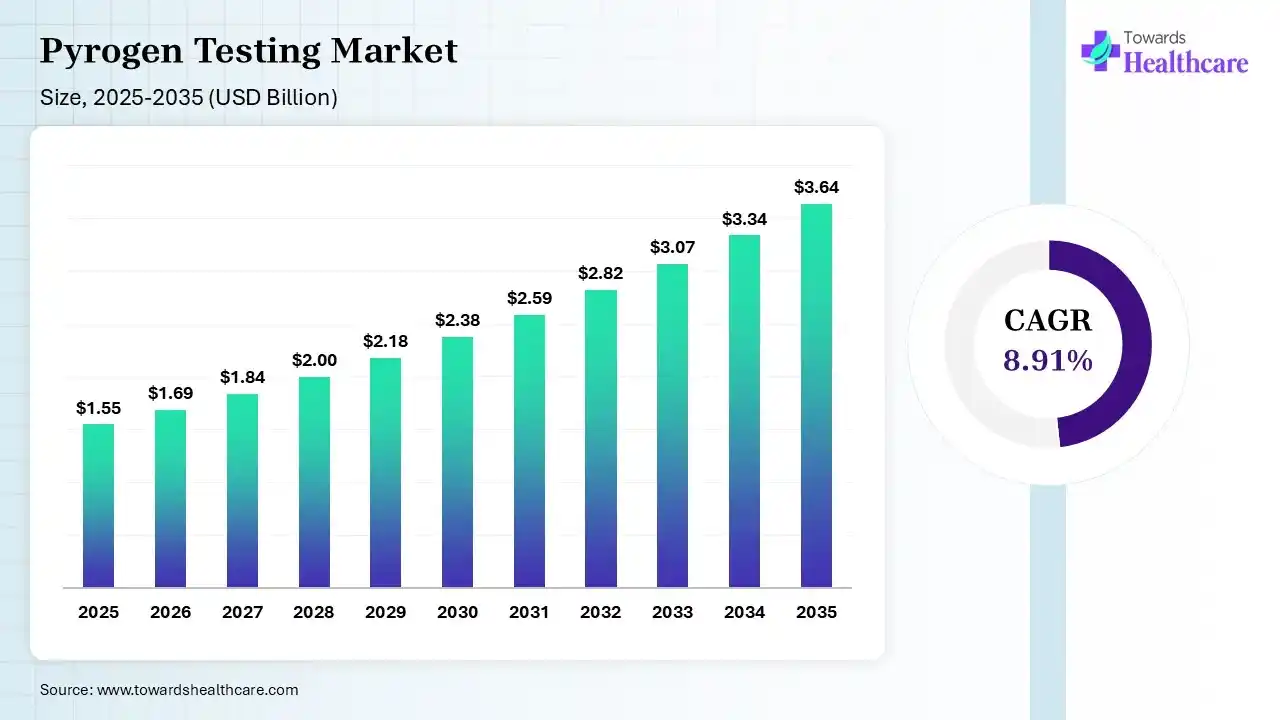
According to Towards Healthcare, the Pyrogen Testing Market is projected to experience significant growth, with estimates suggesting the market size will increase from USD 1.69 billion in 2026 to approximately USD 3.64 billion by 2035, representing a compound annual growth rate (CAGR) of 8.91% from 2026 to 2035, driven by pyrogen identification is significant for quality assurance and product security in the manufacturing of parenteral biopharmaceuticals, and decades, the rabbit pyrogen test (RPT) the traditional processe for pyrogenicity testing. Testing for pyrogens is a significant process in confirming healthcare products directed parenterally, pharmaceuticals, or biopharmaceuticals. It is a significant part of the mandatory announcement tests to avoid life-threatening fever effects encouraged by pyrogenic substances. This test uses human blood and cytokine release, which has the benefit of reflecting the human immune response more precisely than animal models. Pyrogenicity testing goal to lower the application of animal testing while enhancing the precision and effectiveness of identifying pyrogens. These procedures apply to challenging pharmaceuticals, blood-based products, biologics, and healthcare tools where surface pyrogens are checked.
Types of Data Requested
Stakeholders are invited to submit, as applicable:
- Method descriptions and scientific rationale
- Authentication or qualification information, involving accuracy, precision, specificity, sensitivity, reproducibility, and robustness.
- Comparative research versus the rabbit pyrogen test and bacterial endotoxins test.
- Product- or matrix-driven validation and suitability research.
- Clinical or nonclinical related data, involving connection to human pyrogenic replies where available.
- Government data, involving acceptance by medical care authorities or inclusion in regulatory submissions.
- Data demonstrating limits or known challenges related to a process.
Both published and unpublished information are acceptable. Information evidently intended as confidential is handled consistently with USP’s commitment to confidentiality.
Use of Submitted Data
Data submitted in response to this call will be reviewed by USP staff, the microbiology expert committee, and the expert panel on modern substitutes to pyrogen testing. The information applicable to:
- Support scientific debates of the expert panel.
- Inform strength USP–NF revisions or novel general chapters.
- Identify areas that need additional research or stakeholder engagement.
USP has recognized strategies and rules that offer the highest safeguards to confidential data submitted by promoters throughout the course of the revision procedure. USP’s confidentiality strategies and the CoE Rules need both USP expert volunteers and staff included in USP’s standards-setting technology to preserve the confidentiality of the submitter and the data submitted to USP by third parties.
A recent report by Towards Healthcare highlights that the pyrogen testing market is witnessing growth because pyrogen tests are significant to confirm the safety of various health interventions, involving pharmaceuticals, medical tools, and an array of pharmaceutical products. Pyrogen testing is a much-needed quality control step to confirm the safety of any substance, material, or tool that might contain or lead to the presence of undesirable pyrogens in the body. Major procedures are available to test pyrogens and endotoxins, a particular and broadly encountered type of pyrogen created in the outer membrane of Gram-negative bacteria.