



VA Expands Use of Extended Reality Tech in the Healthcare Operations
Published: 27 Jul 2026
Author: Towards Healthcare



The Department of Veterans Affairs is intensifying its applications of immersive technologies to improve health care, with a top agency official saying VA is looking to promote build upon early adoption of the tools in the its medical care operations.
These augmented, mixed and virtual reality strength to collectively call as extended reality simulate or overlay digital data onto real-world surroundings via the applications of wearable headsets. While immersive solutions are often applicable for gaming and entertainment purposes, scientists and healthcare specialists have found that these tools also have a broad range of healthcare uses.
In a recent interview with Nextgov/FCW, Anne Lord Bailey the executive director of VA’s Strategic Initiatives Lab said veterans are specifically suited to advantages from uses of prolonged reality tools alongside more traditional health care.
“What we're also seeing is that our patient population, as you can imagine, has a high incidence of chronic pain, high incidence of mental health complications, a high need for wellness tools, relaxation, stress management, mental health support,” Bailey said. “And those are areas where we've seen really unique benefits with immersive technology, like virtual reality, where we have a modality of engagement.”
Moving VR beyond Early Adoption
VA’s Strategic Initiatives Lab was launched in October 2023 with the aim to investigating, testing and scaling emerging technologies which leveraged to improve veteran care. It is housed in the Veterans Health Administration, the VA’s medical care arm.
The lab’s work has involved a specific focus on the benefits of using extended reality, which Bailey said “delivers some really unique value.”
Even before the lab was launched, though, Bailey noted that early VR adopters involving providers and caregivers have been off and running with this solution now for nine years. VA is trying to increaseing these early immersive solution uses with improve adoption of the headsets for veterans who would probable benefit the most from their applications.
VA has recognized more than 40 healthcare indications for immersive solution applies across its health operations, involving for PTSD, depression and long term pain. Veterans at most of the VA’s network of over 170 healthcare facilities are allows to receive the headsets if their physician deem them to be of possible advantages, although access can differ.
How it works
Though the process for accessing extended reality headsets can vary by veteran requirement, Bailey said providers generally either identify that the application of the technology would be advantageous, or the veteran increases the idea to their clinician and “then together they make a shared medical decision.”
Veterans who applies the VR devices at home first do a trial to understand how it works and see if it advantageous them. Providers document that experience, and then place an order for the tools to be sent to the veterans’ home if it is deemed to be supportive.
Veterans using VR are generally seated or lying down to reducing the challenges of falls. The visuals inside the headsets differ based on the underlying complaint. A veteran experiencing chronic pain, such as may experience a communicating environment meant to be relaxing or distracting.
Uses of Immersive Tech
Further deployments of VR for more besieged therapeutic aim have been guided by partnering between VA units, also on-the-ground input from physician.
Bailey noted that the Strategic Initiatives Lab is working with VHA’s Pain Management, Opioid Safety and Prescription Drug Monitoring Program Office to further expand chronic pain patients’ access to VR tools.
Recently, it majorly focus has extended to 25 healthcare centers; Bailey said the aim is to expand to 45 additional centers before the end of the year. VA collaborated with VR health provider Mynd Immersive to support intensify veteran access to these headsets.
These efforts, she added, are significantly assisted by the work of VA providers.
Bailey said, for instance, that a pain physical therapist at the San Francisco VA medical center has been playing a key role in this effort by “helping us from a really practical and human-centered design approach understand the clinical workflow, the documentation process some of those non-sexy parts of implementation, if you will. But those will ultimately make it easier to expand to all medical centers."
Furthermore efforts at other healthcare facilities involving VA Gulf Coast, VA Central Arkansas and the department’s Clinical Resource Hubs that provides remote care are also focused on the connection of chronic pain and insomnia, which Bailey noted is connected with an increased challenges of suicide.
According to Towards Healthcare, the mixed reality in healthcare market is projected to experience significant growth, with estimates suggesting the market size will increase from USD 2.81 billion in 2026 to approximately USD 100.17 billion by 2035, representing a compound annual growth rate (CAGR) of 48.74% from 2026 to 2035, driven by, mixed reality healthcare training is, in the long-term, an affordable and scalable services. By creating virtual environments and simulations, hospitals save noteworthy expenses associated with real-life scenarios such as purchasing expensive medical equipment or hiring actors to simulate patients. It is extremely powerful tool for medical training – and can even be used for other healthcare applications. By leveraging its capabilities, students can learn more efficiently without risking patient safety or putting extra strain on hospital resources, making it a win-win all round.
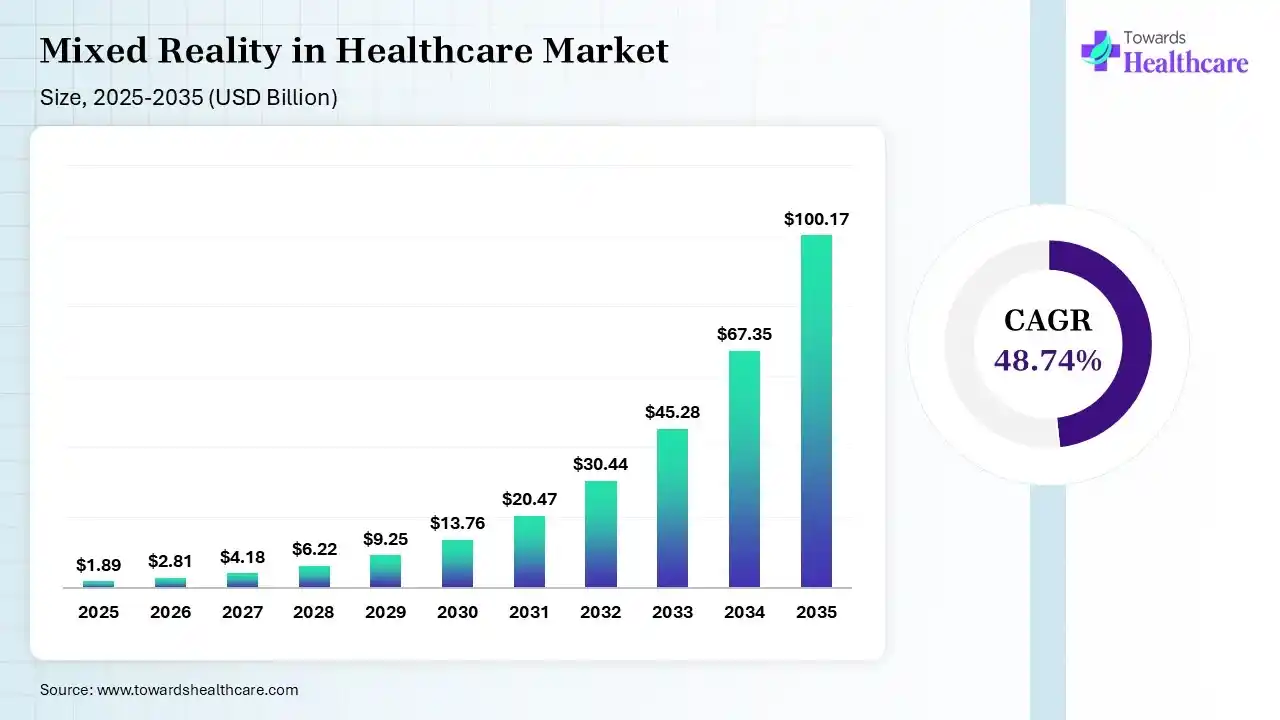
A recent report by Towards Healthcare highlights that the mixed reality in healthcare market is growing as mixed reality (MR) integrates real and virtual elements and has shown promise in various sectors, involving surgical technology. MR headsets supports healthcare navigation, planning, and training. It is significant to identify whether healthcare professionals consider this technology crucial. The applications of mixed reality technology to improve realistic health training enables medical students to practice their skills in a safe environment. With collaborative learning, trainees are allows to hone their skills without putting patients at challenges of injury or harm.