



Non-Oncology Precision Medicine Market Size, Key Companies, Company Product Portfolio, Hospital Procurement Trends, Manufacturing Capacity, Sales Performance, Regulatory Approvals, Company Market Share, and Forecast
Non-Oncology Precision Medicine Market (By Product: Diagnostics, Therapeutics; By Application: Oncology, CNS, Immunology, Respiratory, Infectious Diseases, Neurology, Others; By End-use: Hospitals, Diagnostic Centers, Research & Academic Institutes, Others; By Ecosystem: Applied Sciences, Precision Diagnostics, Precision Therapeutics, Digital Health and Information Technology) - Global Industry Analysis, Size, Share, Growth, Trends, Regional Outlook, and Forecast 2026 - 2035
Source: https://www.precedenceresearch.com/non-oncology-precision-medicine-market
 Get a Sample
 Table Of Content


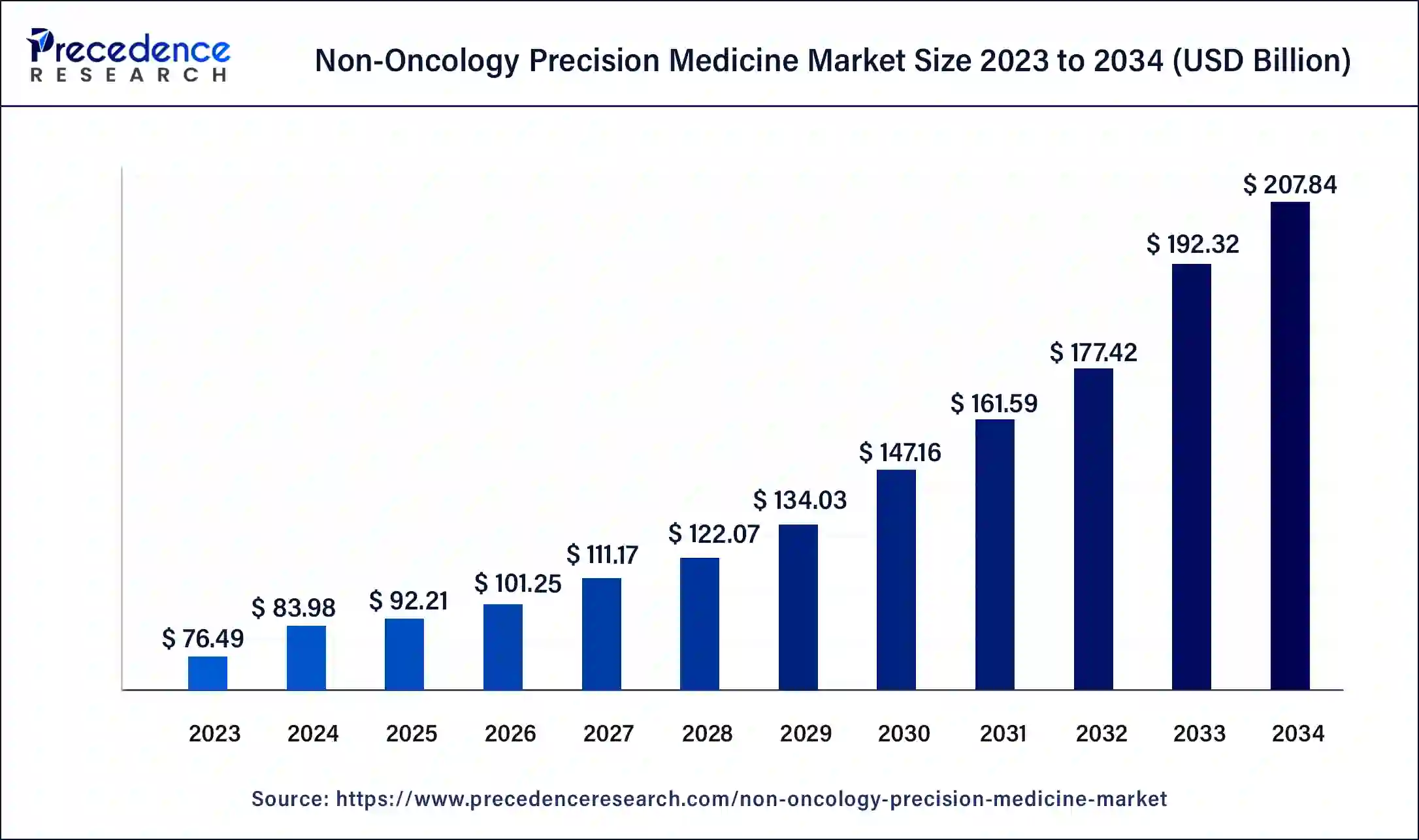
What is the Non-Oncology Precision Medicine Market Size?
The global non-oncology precision medicine market size is calculated at USD 92.21 billion in 2025 and is predicted to increase from USD 101.25 billion in 2026 to approximately USD 222.95 billion by 2035, expanding at a CAGR of 9.23% from 2026 to 2035.
Digital Diabetes Management Market Key Takeaways
- North America dominated in the non-oncology precision medicine Market with the largest market share of 44% in 2025.
- Asia-Pacific is observed to be the fastest growing in the non-oncology precision medicine Market during the forecast period.
Digital Diabetes Management Market Growth Factors
Headways in disease biologics will drive the development of non-oncology precision medicine. Improvement of fresher therapeutics approaches including quality treatment for disease treatment and expanding number of patients going through prescient analysis will push the market development. Then again, significant expense and expected danger to individual wellbeing information are a portion of the variables that might defeat the market development.
There have been critical improvements in the market somewhat recently. The quantity of organizations, government, and private examination establishments associated with the business has been consistently developing. Constant and untiring endeavors of researchers in surveying the human genome and distinguishing genomic biomarkers have been productive. Additionally, government drives play likewise had a significant impact being the development of the market.
Right now, the market is overwhelmed by non-oncology drugs. In any case, expanded R&D exercises for different illnesses are projected to build the number of medications for cardiovascular, irresistible, and neurological sicknesses among others. The quantity of non-oncology accuracy medication drugs is anticipated to develop dramatically, and the consistent extension of the non-oncology accuracy medication portfolio will drive the business development.
The Non-Oncology Precision Medicine Market Has Been Transformed By Key Trends
- Integration Of Multi-Omics: Data generated through genomic, proteomic, and metabolic profiling gives doctors a composite picture of the patient's biology resulting in greater accuracy in diagnosis and more optimally tailored therapies.
- AI Support Of Clinical Decision-Making: AI-based tools interpret vast amounts of complex molecular data making predictions about how patients will respond to different treatments and help clinicians choose the most effective targeted therapies.
- Targeted Treatments For Other Chronic Diseases: New methods have been developed to personalize treatments for cardiovascular, neurological, metabolic, autoimmune, and other chronic diseases, thereby improving disease outcomes using biomarkers to help develop individualized therapies.
- Advanced Companion Diagnostics: The use of high sensitivity molecular tests combined with DNA sequencing helps to identify patients at risk for developing non-oncology diseases earlier than previously possible, providing physicians with improved capability to provide the most effective treatments during the optimal time.
Market Scope
| Report Coverage | Details |
| Market Size by 2035 | USD 222.95 Billion |
| Market Size in 2025 | USD 92.21 Billion |
| Market Size in 2026 | USD 101.25 Billion |
| Market Growth Rate from 2026 to 2035 | CAGR of 9.23% |
| Largest Market | North America |
| Forecast Period | 2026 to 2035 |
| Segments Covered | Product Type, Application, End-use, Ecosystem, and Region |
| Regions Covered | North America, Europe, Asia-Pacific, Latin America, and Middle East & Africa |
A Glance at Chronic Diseases
The most common chronic disorders include high cholesterol, depression, hypertension, chronic obstructive pulmonary disease, diabetes, epilepsy, chronic kidney disorder, ischemic/coronary heart disease, heart failure, arthritis, and Alzheimer's disease and dementia. These common disorders affect millions of individuals globally. As per the reports of World Health Organization (WHO), approximately 50 million or more are suffering from dementia, and the same number of individuals are fighting epilepsy. From these cases of dementia, about 60 % to 70% are the case of Alzheimer's. Prominent players like Novartis AG and Pfizer are advancing therapies for the procedures of numerous nervous system diseases. The increasing concentration on a few therapies and the advancement of precision medicines for the populace impacted with chronic diseases is anticipated to bolster the extension of this sector.
Evolution of Precision Medicines
The global precision medicine industry has shown a notorious advancements in the last decade. All the organizations, academic and research institutes, and governments included in this sector have shown a steady growth. Various scientists constantly working on the development of these medicines got fruitful results in the studies of human genome and establishing genomic biomarkers. Several governments have also showed their presence in these developments in the form of launching various initiatives. For example, Barack Obama, the president of the U.S. announced the launch of an initiative named “Precision Medicine Initiative” in the year 2015. The purpose of this initiative was to create national research compliance of over 1 million Americans who contribute their inherited information as a means of their support to establish novel ways of enhancing the identification of the disorder and its treatment. These efforts resulted in the more number of drugs getting approval for the precision medicines.
The precision medicines accessible based on the numbers in the market was only 5 in the year 2005. This single digit grew to 81 in the year 2012. In 2016, the number of precision medicines available in the market were 132. As per the data collected for 2020, around 286 drugs are readily available in the market and there are many such drugs are in datebook. Cancer drugs are influencing the market at present. However, research and development (R&D) activities for the disorders like infectious, cardiovascular, neurovascular, and others are burgeoning, which in turn is expected to propel the number of drugs present in the market. The portfolio of these medicines is constantly expanding which is going to augment the growth of this industry.
Opportunities amid the Pandemic
The novel corona virus has had a significant impact on all the industries related to economy, growth, and physical and mental wellbeing of every populace. The purpose of every sector was to provide the best services with reference to safety and quality during this challenging period. The impact of the novel corona virus was the highest in the healthcare industry. However, this virus did not impact much on precision medicines. The outspread of the novel corona virus uplifted the demand for the technological developments, flexibility, and evolution of the non-oncology precision medicines. Rise in respiratory disorders at a quick rate is the propelling reason for the growth of the non-oncology precision medicines, as the same disorders need authentic drug procedure. A limelight has been brought by the novel corona virus in the markets of the non-oncology medicines. The novel corona virus did not have a straight effect on this market, but in return has offered lucrative opportunities for the advancement of these non-oncology precision medicines for numerous disorders like cardiovascular, among others.
Competitive Landscape
The global non-oncology precision medicine market appears to be extremely competitive in account of the various prominent players present in the market. Prominent players in this market are constantly focusing on increasing their product portfolio by expanding their applications or by filing the new ones for the molecules. A few other strategic moves like academic collaboration, acquisitions and mergers to get in popularized molecule or arranging methods is also expected to witness a significant impact on the current trends of the market. Key market players also focusing on the advancement of the available products to expand their footprints and progress their positions in the market across the globe. In addition, several products are getting approved, and in the race to increase the number of precision drugs, constant advancing activities and other strategic moves by the market key players is playing a vital role in the expansion of this industry in the years to come.The key market players are continually participated in different formative procedures like association, joint efforts, new item dispatches, and acquisitions to reinforce their market position and gain a piece of the pie.
Non-Oncology Precision Medicine Market Regional Insights
[[regional_insights]]
Non-Oncology Precision Medicine Market Companies
- Pfizer Inc.
- Qiagen Inc.
- Quest Diagnostics Inc.
- Medtronic
- Novartis
- Laboratory Corporation of America Holdings
- bioMérieux SA
- Abbott Laboratories
- F. Hoffmann-La Roche A
- Eli Lilly & Company
Key Market Developments
- The U.S. based company, Weill Cornell Medicine launched a campaign named “We're Changing Medicine” by investing $1.5 billion in the year 2021. The aim of this campaign is to develop biomedical inventions in the areas of precision medicines, artificial intelligence and machine learning (AI & ML) as well as genomics.
- An Indian multinational company Infosys launched a precision medicine solution on the basis of SAP technology for pharmaceutical organizations in the year 2020. This solution employs analytics, blockchain, as well as IoT to aim at patient management, supply chain and regulatory agreements.
- In July 2019, Pfizer reported the cooperation with Synapse to propel malignant growth research. This joint effort was meant to zero in on sub-atomic testing and treatment decisions on non-oncology precision oncology accordingly growing the item portfolio.
- In February 2019, Labcorp reported the development of a helpful medication checking portfolio DoseASSURE, to treat specific provocative illnesses including Crohn's infection and rheumatoid joint pain, accordingly fortifying its administrative role in non-oncology precision medicine.
Non-Oncology Precision Medicine Market Segments Covered in the Report
[[segment_covered]]
For inquiries regarding discounts, bulk purchases, or customization requests, please contact us at sales@precedenceresearch.com
Frequently Asked Questions





Ask For Sample
No cookie-cutter, only authentic analysis – take the 1st step to become a Precedence Research client
 Get a Sample
.webp)



 sales@precedenceresearch.com
 Schedule a Meeting
