



Product Information Management Market Size, User Adoption, Technology Deployment, Revenue Growth, Market Share Analysis, and Demand Forecast
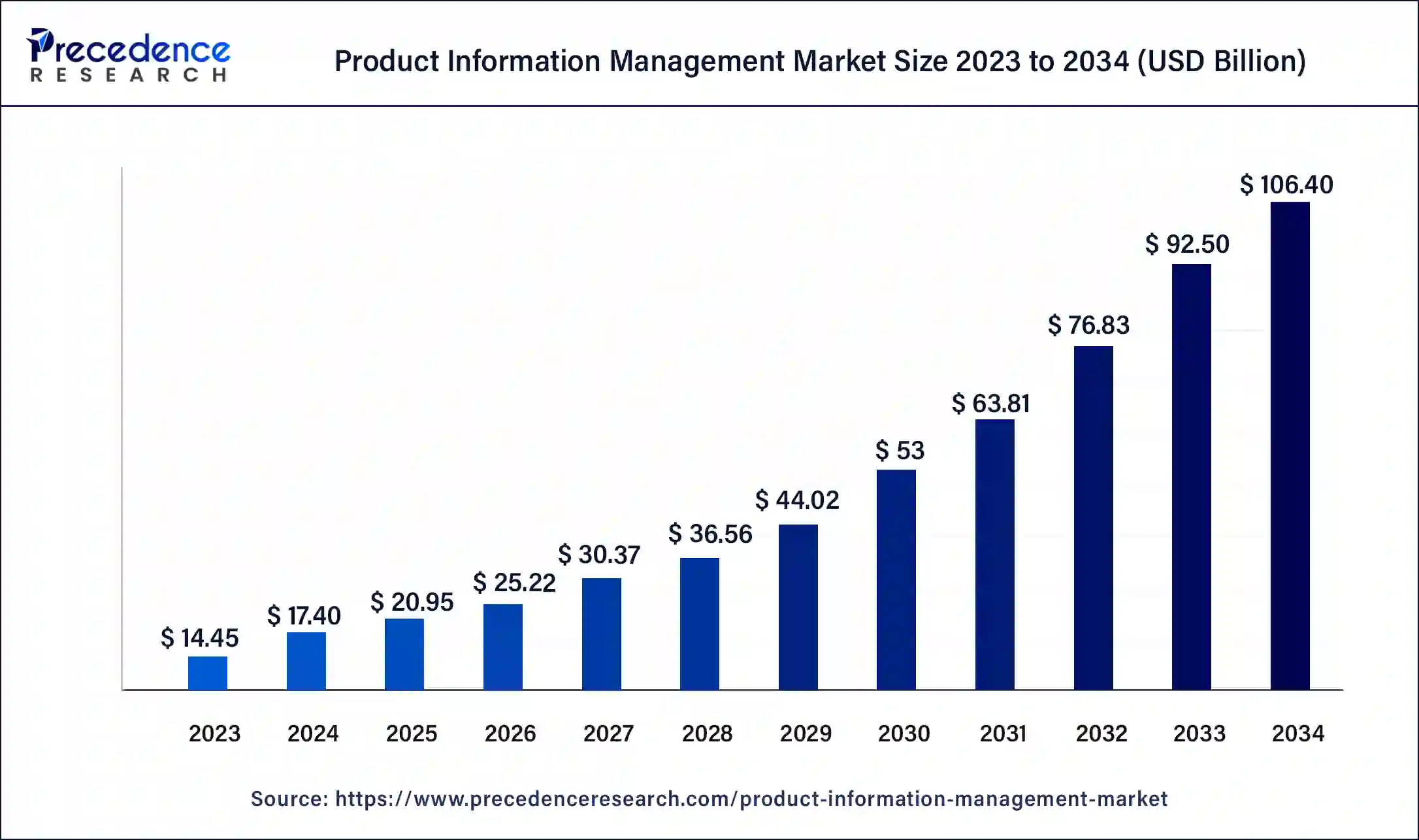
The global product information management market was valued at USD 25.22 billion in 2026 and is projected to grow from USD 25.22 billion in 2026 to nearly USD 121.48 billion by 2035, advancing at a CAGR of 19.22% over the 2026–2035 forecast period. The market growth is driven by the rapid expansion of e-commerce, rising demand for centralized product data management, increasing focus on data quality and security, and growing adoption of AI, cloud, and automation technologies.
Source: https://www.precedenceresearch.com/product-information-management-market
 Get a Sample
 Table Of Content


What is the Product Information Management Market Size?
The global product information management market size was estimated at USD 20.95 billion in 2025 and is predicted to increase from USD 25.22 billion in 2026 to approximately USD 121.48 billion by 2035, expanding at a CAGR of 19.22% from 2026 to 2035. The market is largely driven by the integration of blockchain technology, AI-driven product information management, and IoT integration. With an increasing focus on data quality, product information management is set to remain a cornerstone for businesses seeking to provide accurate and consistent product information.
Key Takeaways
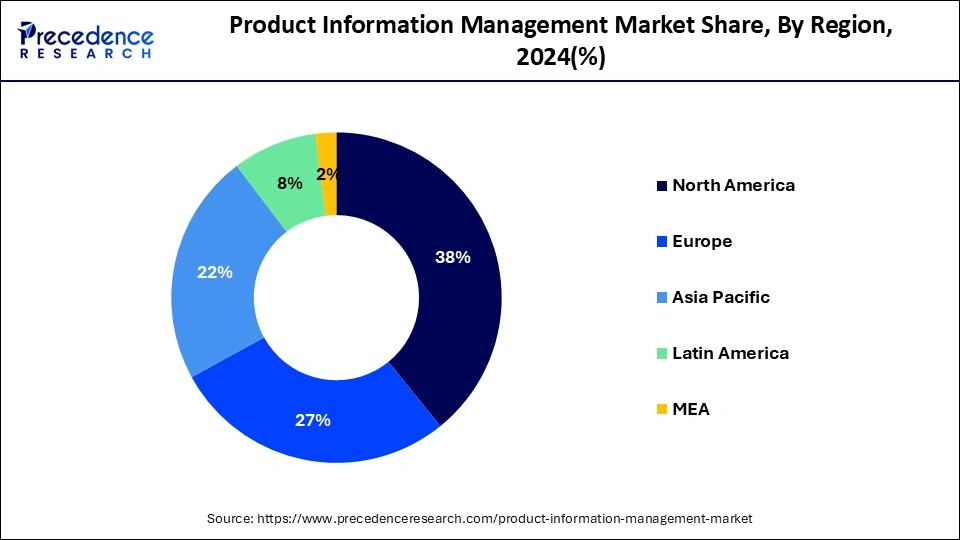
- North America led the global market with the highest market share of 38% in 2025.
- Asia Pacific region is estimated to expand the fastest CAGR between 2026 and 2035.
- By Component, the services segment has held the largest market share in 2025.
- By Enterprise Size, the large enterprises segment captured the biggest revenue share in 2025.
- By End Use, the retail segment has held the largest market share in 2025.
Market Overview
Product information management (PIM) is software that helps manage, store, and enrich the product content as well as update accurate information, which significantly helps to sell various products across multiple sales and marketing channels. This market helps to standardize the increasingly complex demands of product content, including size, ingredients, weight, colors, and other product specs.
As the digital commerce sector continues to expand, the demand for robust product information management solutions is likely to grow. Companies all over the world are increasingly investing in advanced technologies in order to streamline their operations, improve data quality, and ensure compliance with industry standards.
Impact of AI in the Product Information Management Market
Artificial intelligence (AI) and machine learning (ML) tools are significantly transforming PIM from manual data entry and curation toward automated enrichment, classification, and optimization workflows. Leading PIM vendors worldwide have integrated AI-powered image recognition, natural language processing, and product classification algorithms into their platforms, which helps in enabling enterprises to automatically extract product attributes from supplier documentation, marketplace listings, and digital product manuals.
AI-driven product recommendations and personalization engines require comprehensive, machine-readable product information to deliver relevant suggestions to customers, thus creating strategic value for retailers who are pursuing advanced customer experience initiatives. Computer vision and automated tagging systems are also helping retailers organize and categorize unstructured product images and videos, reducing manual content creation costs. The convergence of PIM and AI infrastructure is attracting high levels of venture capital investments and driving consolidation activity among specialized AI-enabled product data startups.
Product Information Management Market Growth Factors
- With the help of product information management systems, various organizations store data and information that is very crucial in nature. One of the key factors driving the growth of global product information management market is the surge in demand for centralized system for data storage.
- The firms can effortlessly manage and organize all of their product data due to centralized data storage. The data sources are modified with a single modification in the centralized data repository, reducing data administration costs and time.
- Due to the expanding number of risks to data security, compliance and verification needs are also increasing.
- In 2024, the U.S. Cybersecurity and Infrastructure Security Agency (CISA) highlighted a 38% rise in corporate cyberattacks, urging companies to adopt stronger data governance tools like product information management systems.
Product Information Management Market Trends
- Increased Focus on Data Quality: Organizations all over the world are prioritizing the accuracy and consistency of product information to help enhance customer trust and satisfaction. This indicates a shift towards implementing stringent data governance practices.
- Adoption of Cloud-Based Solutions: The shift to cloud-based product information management systems is gaining traction, as businesses seek flexibility and scalability. This helps to facilitate easier access to data and collaboration across teams. Enterprise PIM solutions are increasingly being adopted by large organizations in order to help centralize product information across multiple departments and business units.
- Integration of AI and Automation: The incorporation of artificial intelligence and automation tools into product information management processes is on the rise. This is highly beneficial for companies that are looking to streamline operations and improve efficiency through advanced technologies.
Market Outlook
- Industry growth overview: The product information management market is growing due to expanding e commerce, digital transformation and rising demand for accurate product data. This encourages the adoption of product information management solutions across retail, manufacturing, and healthcare industries.
- Sustainability trends: Companies are using product information management platforms to provide transparent product information, recyclable packaging details, and regulatory compliance. This helps consumers understand product meeting sustainability goals.
- Major Investor: Private firms and global technology companies are investing in the product information management market. Major investors in the market include SAP SE, Oracle Corporation and IBM Corporation.
- Startup ecosystem: The startup economy is introducing artificial intelligence powered product information management platforms focused on automation, product data enrichment and seamless integration.
Market Report Coverage and Key Metrics
| Report Coverage | Details |
| Market Size by 2035 | USD 121.48 Billion |
| Market Size in 2025 | USD 20.95 Billion |
| Market Size in 2026 | USD 25.22 Billion |
| Market Growth Rate from 2026 to 2035 | CAGR of 19.22% |
| Largest Market | North America |
| Fastest Growing Market | Asia Pacific |
| Base Year | 2025 |
| Forecast Period | 2026 to 2035 |
| Segments Covered | By Component, By Deployment, By Enterprise Size, By End Use, and By Operating System |
| Regions Covered | North America, Europe, Asia-Pacific, Latin America, and Middle East & Africa |
Market Dynamics
Driver
Expansion of E-commerce Platforms
The rapid expansion of e-commerce platforms is a major key driver that is propelling the market forward. As more and more businesses transition to online sales channels, the need for effective product information management becomes vital. This is because e-commerce platforms require accurate, detailed, and consistent product data to attract and retain customers, thus underscoring the urgency for businesses to implement PIM solutions. These systems enable organizations to manage vast amounts of product information efficiently, ensuring that customers receive the correct details at every touchpoint. This trend is likely to drive further growth in the PIM market as companies actively seek to optimize their online presence.
Restraint
Dealing with Multiple Sales Channel Requirements
Despite promising growth prospects, the market does have its fair share of challenges. One such challenge is that the growing usage of open-source PIM platforms requires a good IT service team for PIM implementation and customization. The collection of data from multiple sales channels can have errors. They can be misspelled, incomplete, and deliver product information inaccurately and inconsistently.
Moreover, various marketing channels are involved with cloud-based PIM software to collect and manage a large amount of product content. This software is accessible by multiple users to deal with multiple sales channel requirements, and hence, it becomes challenging to meet consumers' demands from various e-commerce sites.
Opportunity
Technological Advancements
The market is being propelled by rapid technological advancements in PIM solutions. Innovations and advancements in artificial intelligence, machine learning, and automation are helping to transform how businesses manage product information. These technologies enable organizations to automate data entry, enhance data accuracy, and also improve the overall efficiency of product information workflows. As a result, companies are increasingly adopting advanced PIM systems to stay competitive and capture the highest market share in this fast-paced market. This also indicates a strong potential for growth in the market as businesses seek to leverage technology to optimize their product information management processes.
Market Segmentation Analysis
Component Insights
Which Component Segment Dominated the Market in 2025?
The services segment dominated the product information management market in 2025. The market players offer support, training, and servicing to help in-house employees understand product information management systems. These services are a low-cost way to ensure that in-house employees are performing at their best. As some businesses cannot understand the intricacies of implementing product information management, end users involve maintenance services. The product information management solutions require these services to function properly.
The software segment is expected to witness the fastest growth throughout the forecast period as it plays a central role in technology platforms in modern product information management workflows. Core PIM software platforms help to provide foundational capabilities for centralized product data governance, multi-channel synchronization, and workflow automation. This segment offers more agile, user-friendly alternatives to legacy enterprise PIM solutions, making them popular in today's market landscape.
Enterprise Size Insights
Which Enterprise Led the Product Information Management Market?
The large enterprises segment led the market in 2025. The use of PIM services and solutions is quite high in large organizations, and this trend is projected to continue over the projection period. The product information management is designed to handle product information across industries using a single centralized system. To increase overall production and efficiency, large corporations are investing heavily in novel technology. The demand for scalable, flexible, and easy large-scale services is also expected to accelerate industry participants to develop new solutions and technologies.
The small and medium enterprises (SMEs) segment is expected to witness the fastest CAGR during the forecast period. The increasing importance of e-commerce for SMEs drives the growth of this particular segment. As more SMEs recognize the potential of online sales channels to reach new customers and expand their market presence, effective product data management is becoming essential. They help to centralize, organize, and enrich their product information, enabling them to compete in the digital market ecosystem.
Deployment Insights
Which Deployment Segment Dominated the Product Information Management Market?
The cloud-based segment dominated the global market in 2025 due to its flexibility and scalability. This dominance is further characterized by its ability to provide seamless integration, flexibility, and enhanced collaboration across various platforms. As businesses increasingly prioritize digital transformation and remote accessibility, cloud-based deployments are becoming the preferred choice for organizations that are seeking efficient and streamlined information management.
The on-premises segment is expected to have the fastest growth during the forecast period, driven by organizations that prefer better control over their data and compliance requirements. This segment is a viable alternative for businesses that have a high focus on stringent data security and regulatory compliance, as it allows organizations to retain complete control over their data, thus reducing risks associated with data breaches.
End Use Insights
How the Retail Segment Dominated the Product Information Management Market?
The retail segment held the largest market share in 2025 due to the increased focus on developing customer experience and the implementation of retail analytics and AI technologies in the e-commerce and retail industries. Retailers are increasingly adopting PIM solutions to manage vast product catalogs, ensuring consistency across multiple sales channels. This also allows retailers to handle large volumes of product data more efficiently and effectively, thereby improving operational efficiency and reducing time-to-market for new products.
The telecom and IT segment is expected to grow at the fastest CAGR during the forecast period, driven by the growing emphasis on customer experience and personalization. With increasing competition and high customer expectations, telecom and IT companies are trying to deliver personalized and engaging product experiences across multiple channels. PIM solutions help enrich their product data with multimedia content, technical specifications, and customer reviews, thus creating consumer experiences that resonate with consumers and also drive brand commitment.
Market Regional Analysis: North America, Europe, Asia-Pacific
What is the U.S. Product Information Management Market Size?
The United States represents the largest share of the product information management market in North America. The expansion of e-commerce, omni-channels, integration of AI and ML, cloud adoption, and support for digital transformation are driving the growth of the U.S. industry. Strong adoption of cloud based PIM solutions is enabling businesses to centralize and streamline product catalogue management, improve data governance, and accelerate time to market. Strong investment in artificial intelligence and the presence of major technology providers further drive market expansion.
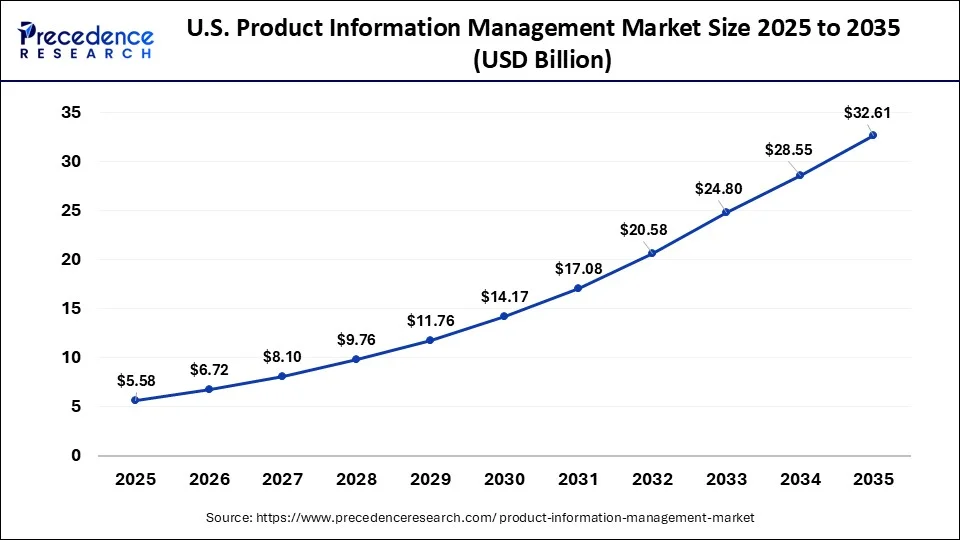
The U.S. product information management market size was estimated at USD 5.58 billion in 2025 and is predicted to be worth around USD 32.61 billion by 2035, at a CAGR of 19.31% from 2026 to 2035.
North America's Lead in the Product Information Management Market
North America dominated the market with the highest revenue share in 2025. The product information management market in North America region is being driven by the existence of significant market players. In addition, technological developments and adoption of latest and advanced technologies, growing research and development activities are boosting expansion of product information management market in North America region.
U.S. Product Information Management Market Analysis
The expansion of e-commerce, omnichannels, integration of AI and ML, cloud adoption, and support for digital transformation are driving the growth of the U.S. industry. Strong adoption of cloud based PIM solutions is enabling businesses to centralize and streamline product catalog management, improve data governance, and accelerate time to market.
Asia Pacific's Fast Reach in the Product Information Management Market
Asia-Pacific is expected to develop at the fastest rate during the forecast period. China and India dominated the product information management market in Asia-Pacific region. The growth of product information management market in Asia-Pacific region is attributed to the rising need for data storage and security. The enormous market potential in Asia-Pacific is projected to entice several foreign companies to grow there. The Indian e-commerce sector, for instance, is predicted to reach $200 billion by the end of 2026, up from 38.5 billion in 2017. In addition, the growing internet and smartphone penetration is driving the growth of Asia-Pacific product information management market.
India Product Information Management Market Trends
The AI integration, cloud adoption, and government initiatives, including digital infrastructure projects, are boosting the expansion of the product information management market in India. Increasing integration of artificial intelligence and automation is helping businesses enhance product content quality, reduce manual errors, and accelerate time-to-market.
Which Factors Made Europe a Significantly Growing Region in the Market?
Europe is expected to grow at a considerable CAGR in the product information management market in the coming period. The growth is supported by strict regulatory mandates and technological advancements that boost operational efficiency. Demand for cloud-based PIM solutions is rising, driven by the need for scalability, integration with e-commerce platforms, and streamlined workflows that support omnichannel experiences. Continuous digital modernization and sustainability reporting requirements are encouraging broader PIM adoption.
Europe is expected to grow at a considerable CAGR in the product information management market in the coming period. The growth is supported by strict regulatory mandates and technological advancements that boost operational efficiency. Demand for cloud-based PIM solutions is rising, driven by the need for scalability, integration with e-commerce platforms, and streamlined workflows that support omnichannel experiences. Continuous digital modernization and sustainability reporting requirements are encouraging broader PIM adoption.
Germany Market Trends
Germany leads the European product information management market in 2025. The integration of AI and automation, regulatory compliance, national regulations, and the increased shift towards omnichannel retail are driving the German market. Businesses are increasingly adopting PIM platforms to manage complex product portfolios and improve digital sales channels. Organizations are leveraging artificial intelligence and automation within PIM to improve data enrichment, quality control, and reduce manual processes. The growing investment in automation, digital commerce, and enterprise software continues to support long term market growth.
Boom of the Product Information Management Market in Latin America
Latin America is expected to grow at a significant rate in the market due to the huge adoption of Industry 4.0, modernization in manufacturing, and advanced solutions that offer scalability and lower upfront costs. This market is growing as businesses across retail, manufacturing, and distribution sectors adopt centralized systems to manage and distribute product data across e-commerce platforms and physical retail channels. Increasing e-commerce penetration and omnichannel retailing are driving demand for cloud-based PIM solutions that can support scalable growth and real-time data synchronization.
Brazil Market Trends
Brazil accounts for the largest share of the Latin American product information management market in 2025. Regulatory and sustainability compliance, and a significant shift towards cloud-based product information management solutions, are accelerating the expansive reach of the Brazilian market. Retail, consumer goods, and the manufacturing sector are leading adoption of PIM due to increasing internet access and changing consumer buying habits. Demand for cloud-based PIM solutions is rising, enabling businesses to scale operations, improve data quality, and support omnichannel experiences in a competitive market.
What are the Key Trends in the Market in the Middle East and Africa Region?
The Middle East & Africa held a notable share of the product information management market in 2025, driven by the increasing adoption of digital businesses and investments in cloud-based infrastructure. Expanding e commerce, rising smartphone usage and increasing investment in cloud technologies are encouraging businesses to centralise product information. Major companies emphasized improving visibility, multilingual product catalogue management, and enhancing the customer experience. Government led digital economy initiatives are also supporting wider adoption across the region.
UAE Market Trends
The UAE represents the leading market within the Middle East and Africa product information management market in 2025, supported by increased demand for Product Information Management (PIM) systems as a result of the growth of intelligent retail solutions and luxury e-commerce businesses. Organizations have been implementing more sophisticated PIM systems to assist with omnichannel sales and enhance digital engagement with their customers. Retail, luxury goods, logistics, and distribution companies are investing in cloud based data management solutions.
Market Competitive Landscape: Leading Companies and Strategies
The global product information management market is currently characterized by a dynamic competitive landscape, driven by the increasing need for businesses to manage vast amounts of product data efficiently. Key players are focusing on innovation, digital transformation, and strategic partnerships to enhance their market positioning. Companies such as Informatica, Salsify, and Akeneo are at the forefront, leveraging advanced technologies to streamline product information workflows and improve customer experiences.
Their collective strategies not only foster competition but also push the boundaries of what PIM solutions can achieve, thereby shaping a more integrated and responsive market environment. In terms of business tactics, companies are increasingly localizing their operations and optimizing supply chains to better serve regional markets. The market appears to be moderately fragmented, with a mix of established players and emerging startups.
Product Information Management Market Companies
- Oracle– It offers cloud-based product information management for product data management and omnichannel commerce integration.
- SAP– It offers product content management services to ensure that the product catalog, digital commerce, and supply chain integration to maintain accuracy.
- IBM– It offers AI-driven product data management and product information management solutions to improve customer experience.
- Informatica – It specializes in master data management systems and product information management to unify product information.
- Pimcore – It offers open source product information management systems for product data and omnichannel publishing.
Other Major Key Players
- Akeneo
- Inriver
- Winshuttle
- Riversand
- Salsify
Recent Developments
- In July 2026, Proton.ai launched the Order & Quote Entry Automation system, an AI powered system designed for the wholesale distribution sector. It handles incoming inquiries such as emails, unclear product descriptions, and PDFs and transforms them into preliminary quotes or orders. This automated tool eliminates manual and time consuming processes.
- In August 2025, Akeneo launched a new version of its PIM solution, incorporating advanced AI features aimed at automating data enrichment processes. This innovation is expected to significantly reduce the time required for product data management, allowing businesses to respond more swiftly to market changes. The introduction of AI into PIM solutions reflects a growing recognition of the need for agility in product information management, which is crucial in today's fast-paced retail environment. (Source: https://help.akeneo.com)
- In July 2025, Informatica expanded its PIM portfolio through a strategic acquisition of a local data management firm called Salesforce. This expansion not only diversifies Informatica's offerings but also enhances its ability to cater to the unique needs of Asian businesses, which are increasingly adopting digital solutions. (Source: https://www.salesforce.com)
- In September 2025, Proton Soft introduced its AI-based PIM system called Proton PIM for distributors. This platform contains an automatic scraping, collection, and enrichment of product data from manufacturer websites, PDF documents, and specification sheets through AI agents. According to the company, this solution was able to cut down the time taken to manage SKU data manually. (Source: https://www.mdm.com)
- In December 2024, ATLANTA Canto, a top provider of digital asset management software, announced the introduction of Canto PIM, a comprehensive platform integrating digital asset management (DAM) with product information management (PIM) functionalities. This new solution addresses the difficulties brands encounter in handling, sharing, refining, optimizing, and safeguarding digital assets and product data across a growing range of channels, campaigns, and use cases.
- In September 2024, bimstore, a leader in designing and hosting BIM content, announced the launch of Sinc, a groundbreaking Product Information Management (PIM) platform crafted exclusively for manufacturers. Sinc is the result of bimstore's 15-year collaboration with manufacturers and their deep understanding of product data challenges.
- In March 2024, N Brown Group, a digital retail platform specializing in inclusive fashion and homeware, unveiled its new Product Information Management (‘PIM') system, a major milestone in its transformation efforts to enhance the customer journey. The PIM system improves customer experiences by enhancing product display pages with better descriptions, including size, fit, and fabric details. This improvement fosters consistency and clarity in pre-purchase messaging across channels, better informing buying decisions. Consequently, it is anticipated to lower return rates, further improving the overall customer satisfaction.
Segments Covered in the Report
By Component
- Solution
- Multi-domain
- Single Domain
- Services
- Consulting and Implementation
- Training, Support and Maintenance
By Deployment
- On-premise
- Cloud
By Enterprise Size
- Large Enterprises
- Small & Medium Enterprises (SMEs)
By End Use
- BFSI
- Retail
- Manufacturing
- Telecom and IT
- Transportation and logistics
- Media and entertainment
- Other
By Operating System
- iOS
- Windows
- Android
- Others
By Geography
- North America
- U.S.
- Canada
- Europe
- U.K.
- Germany
- France
- Asia-Pacific
- China
- India
- Japan
- South Korea
- Malaysia
- Philippines
- Latin America
- Brazil
- Rest of Latin America
- Middle East & Africa (MEA)
- GCC
- North Africa
- South Africa
- Rest of the Middle East & Africa
For inquiries regarding discounts, bulk purchases, or customization requests, please contact us at sales@precedenceresearch.com
Frequently Asked Questions





Ask For Sample
No cookie-cutter, only authentic analysis – take the 1st step to become a Precedence Research client
 Get a Sample




 sales@precedenceresearch.com
 Schedule a Meeting
