



Voice-based AI Companion Product Market Size, Key Companies, Company Product Portfolio, Technology Innovation, User Adoption, Business Model Adoption, Competitive Landscape, and Market Outlook
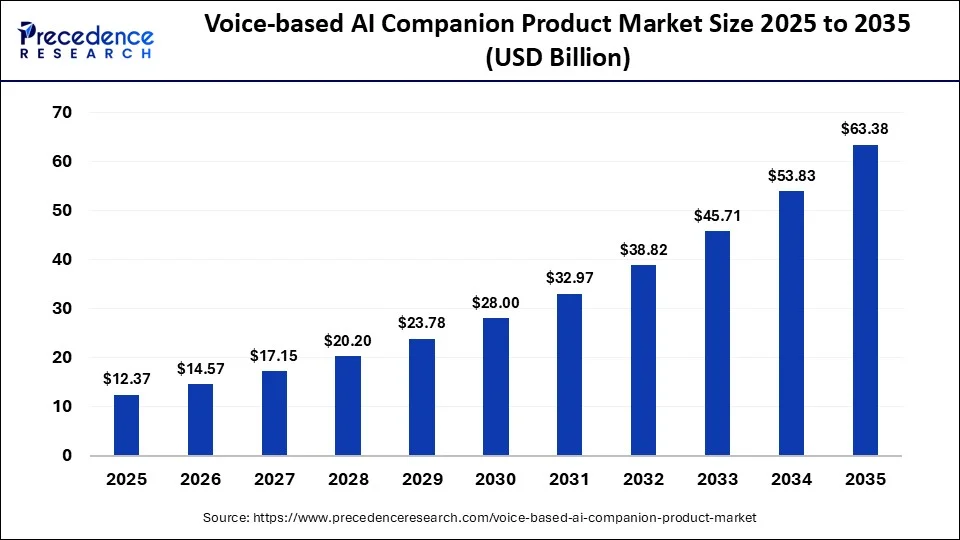
ICT industry specialist Shivani Zoting estimates the voice-based AI companion product market at USD 14.57 billion in 2026, with continued technology adoption expected to take the market to USD 63.38 billion by 2035 at a CAGR of 17.75%. Leading voice-based AI companion product market providers such as Luka, Inc. Â (U.S.), PolyAI Ltd. (U.K.), Meela, Inc. (U.S.), are expanding their capabilities across segments including by product type, by application, by end user, by deployment model, by business model.
Source: https://www.precedenceresearch.com/voice-based-ai-companion-product-market
 Get a Sample
 Table Of Content


What is the Voice-based AI Companion Product Market Size?
The global voice-based AI companion product market size accounted for USD 12.37 billion in 2025 and is predicted to increase from USD 14.57 billion in 2026 to approximately USD 63.38 billion by 2035, expanding at a CAGR of 17.75% from 2026 to 2035. The market is expanding due to the increasing adoption of smart devices, connected vehicles, and IoT adoption, which makes a voice-based AI companion product essential across many sectors by leveraging Gen AI and emotional intelligence.
Market Highlights
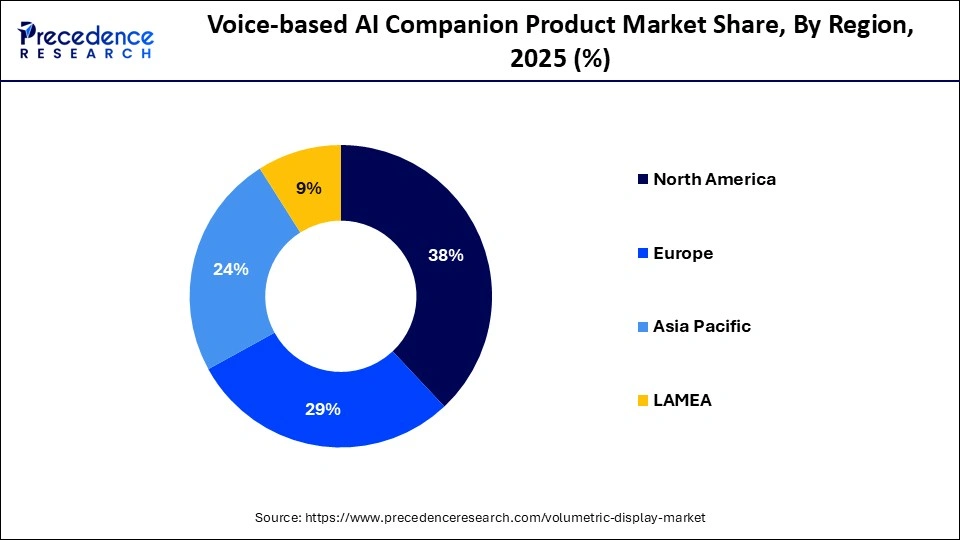
- North America accounted for the largest market share of 38% in 2025.
- The Asia Pacific is expected to grow at the fastest CAGR of 26% between 2026 and 2035.
- By product type, the embedded AI companions segment captured the biggest market share of 46% in 2025.
- By product type, the dedicated companion devices/robots segment is growing at a double-digit CAGR of 26% between 2026 and 2035.
- By end user, the individual consumers segment contributed the highest market share of 55% in 2025.
- By end user, the healthcare & care providers segment is expanding at a notable CAGR of 27% between 2026 and 2035.
- By application, the productivity & personal assistance segment generated the highest market share of 32% in 2025.
- By application, the mental health & emotional support segment is growing at a healthy CAGR of nearly 29% between 2026 and 2035.
- By deployment model, the cloud-based segment recorded the biggest market share of 50% in 2025.
- By deployment model, the hybrid segment is poised to grow at a remarkable CAGR of 25% between 2026 and 2035.
- By business model, the subscription-based segment held the major market share of 44% in 2025.
- By business model, the enterprise Licensing/contracts segment is projected to witness the fastest CAGR of 24% between 2026 and 2035.
A Technological Leap: Voice-based AI Companion Product
Voice-based AI companion products are basically AI-powered systems designed to communicate with users based on voice signals or natural language spoken by humans. It leverages advanced technologies like NLP and speech recognition to understand human language. It offers assistance in several tasks, ranging from information retrieval to emotional support and guidance on any topic.
Its key characteristics include 24/7 availability, hands-free operation, a personalized solution with high-level privacy, and natural, real-time interaction that feels like talking with another human being, unlike mechanical and script-based chatbots that were used previously. Google Assistant, Bixby, and Alexa are some of the examples of voice-based AI companion products.
Key Technological Shifts in Voice-based AI Companion Product Market
Voice-based AI companion products are increasingly leveraging large language models to evolve continuously and deliver more natural, context-aware interactions. As these systems mature, the focus is shifting from basic task execution toward creating deeply engaging and immersive voice-driven experiences that can sustain long-term user interaction. Industry sources indicate that nearly 72% of users expect voice-based experiences to see widespread adoption over the next five years, reflecting growing comfort with conversational interfaces across daily applications.
Recent advances in large language models are expected to significantly elevate the capabilities of voice assistants by enabling more accurate understanding, contextual continuity, and natural conversational flow. The release of advanced multimodal and speech-enabled LLMs has expanded the potential for integrating real-time reasoning, nuanced language interpretation, and adaptive responses into voice-based systems. These developments are improving speech recognition accuracy, reducing transcription errors, and supporting more complex voice commands, which strengthens the usability of AI companions across applications such as personal assistance, customer support, accessibility tools, and smart devices.
Voice-based AI Companion Product Market Outlook
- Industry Growth Overview: The voice-based AI companion products market is rapidly growing due to the active launches by major tech players with various features in it that support seamless data transfer by simple speech, presenting unprecedented convenience to use technology as a companion, not as a mechanical machine. Other growth factors include widespread availability of high-speed internet, easy integration of an AI companion into daily routine, enhanced user accessibility, and the elimination of the need for complex coding to interact with AI.
- Sustainability Trends: The market is witnessing sustainability trends, particularly in terms of transparency and ethical considerations, fueling the market's growth further. The rise of explainable AI ensures that AI output should be fair, unbiased, and responsible to stay in the market in the long run. Also, emerging regulations for the use of AI are contributing to its ethical use and identifying major loopholes in the AI systems.
- Startup Ecosystem: A startup ecosystem for the voice-based AI companion product market is vibrant and growing significantly. For example, Maven AGI, a startup that builds enterprise-level AI agents to offer customer support, has secured a $50 million series B, backed by Dell Technologies Capital. Another example is Assembly AI, a startup that develops speech-to-text and audio intelligence models.
Makret Scope
| Report Coverage | Details |
| Market Size in 2025 | USD 12.37 Billion |
| Market Size in 2026 | USD 14.57 Billion |
| Market Size by 2035 | USD 63.38 Billion |
| Market Growth Rate from 2026 to 2035 | CAGR of 17.75% |
| Dominating Region | North America |
| Fastest Growing Region | Asia Pacific |
| Base Year | 2025 |
| Forecast Period | 2026 to 2035 |
| Segments Covered | Product Type, End User, Application, Deployment Model, Business Model, and Region |
| Regions Covered | North America, Europe, Asia-Pacific, Latin America, and Middle East & Africa |
Segments Insights
Product Type Insights
Why Does Embedded AI Companion Lead the Voice-Based AI Companion Product Market?
Embedded AI Companions: This segment held the largest market share of nearly 46% in 2025, driven by the widespread integration of AI companions directly into devices, software platforms, and operating systems. Embedded AI companions deliver highly personalized and context-aware interactions by continuously learning from user behavior, preferences, and usage patterns, enabling responses that feel more natural and human-like. These systems process data in real time and operate seamlessly in the background, eliminating the need for users to actively switch between separate AI tools.
Dedicated Companion Devices and Robots: This segment is projected to witness the fastest CAGR of nearly 26% during the foreseeable period, supported by rising demand for physical AI companions that provide continuous, interactive support. Growth is being driven by the increasing need for personal assistance and companionship among elderly populations, where AI-enabled robots can offer medication reminders, health monitoring prompts, and emergency assistance. These devices are also gaining traction for providing emotional engagement, reducing loneliness, and facilitating communication with caregivers and family members.
End User Insights
Why Do Individual Consumers Dominate the Voice-Based AI Companion Product Market?
Individual Consumers: The segment held the largest market share of nearly 55% in 2025, due to the increasing need for emotional support for individuals dealing with issues like anxiety, depression, or other disorders that need constant help without any judgment. Also, engaging with AI companions may enhance social and communication skills and offer a safe environment for individuals with social anxiety or autism disorders.
Healthcare & Care Providers: The segment is projected to grow at the fastest CAGR of nearly 27% during the foreseeable period, due to the enhanced healthcare accessibility and patient experience, as personalized and on-demand AI interaction may lead to faster recovery. Voice-based AI companions like Suki AI and Dragon Ambient eXperience Copilot by Microsoft can further help automate clinical documentation.
Application Insights
Why Do Productivity & Personal Assistance Find Extensive Applications in the Voice-Based AI Companion Product Market?
Productivity & Personal Assistance: The segment held the largest market share of nearly 32% in 2025, dominating as it offers convenient communication, automates daily tasks, limits cognitive load, and helps manage schedules, making this technology highly accessible even for professional purposes. Also, the integration with business apps enables AI to streamline workflow without interrupting critical meetings.
Mental Health & Emotional Support: The mental health & emotional support segment is projected to grow at the fastest CAGR of nearly 29% during the foreseeable period, as it offers a safe environment to express feelings of people having mental disorders without any taboo or stigma, which provides a highly private and non-judgmental ground, and maintains anonymity. It is accessible at any time, and immediate responses make it highly popular as it solves issues instantly.
Deployment Model Insights
What Are the Offerings of the Cloud-Based Deployment in the Voice-Based AI Companion Product Market?
Cloud-Based: The segment held the largest market share of nearly 50% in 2025. The segment is dominating as it offers highly scalable and cost-effective deployment for advanced voice-based AI companion models and does not require hardware. Also, cloud platforms provide huge computing power and high scalability, which is crucial for AI models to work efficiently. Cloud platforms provide a strong foundation for advanced capabilities like language learning models, image recognition, and data analytics as well.
Hybrid (Cloud + On-device): The segment is projected to witness the fastest CAGR of nearly 25% during the foreseeable period, driven by its ability to combine the scalability and flexibility of cloud-based deployment with the control, security, and reliability of on-premises infrastructure. This hybrid approach allows enterprises to tailor deployment models to specific workload, compliance, and data residency requirements, making it especially attractive for organizations managing sensitive data alongside highly scalable applications.
Business Model Insights
Why Do Subscription-Based Prefer Voice-Based AI Companion Product Market?
Subscription-based: The segment held the largest market share of nearly 44% in 2025, dominating as the subscription-based business model offers a higher ROI than current investments for the voice-based AI companion product. What makes it unique is the context of recurring relationships among consumers and service providers, and understanding lifecycle like triggers, upgrades, renewals, and cancellations, handling various tasks efficiently.
Enterprise Licensing/Contracts: The segment is projected to witness the fastest CAGR of nearly 24% during the foreseeable period, driven by the cost efficiencies enabled through licensing-based AI deployments. Licensed AI solutions significantly reduce manpower requirements by automating high-volume, repetitive customer interactions, helping organizations lower operational costs by an estimated 60–80%. For instance, Wendy's has implemented an automated AI-driven ordering system capable of processing nearly 50,000 orders per day with approximately 95% accuracy, demonstrating how licensed AI platforms can deliver scalable, reliable performance while improving service speed and consistency.
Regional Insights
How Big is the North America Voice-Based AI Companion Product Market Size?
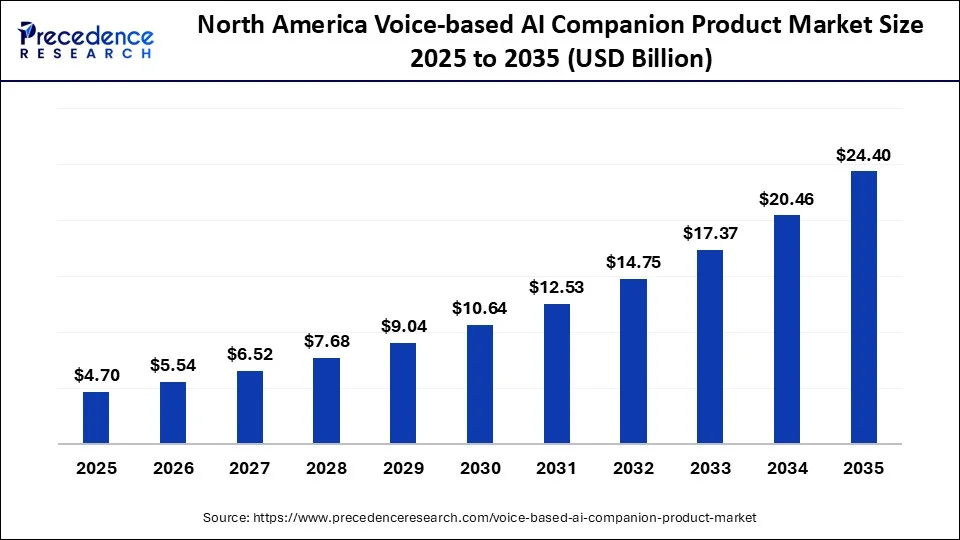
The North America voice-based AI companion product market size is estimated at USD 4.70 billion in 2025 and is projected to reach approximately USD 24.40 billion by 2035, with a 17.90% CAGR from 2026 to 2035.
What Made North America the Leader in the Voice-Based AI Companion Product Market?
North America held the largest market share of nearly 38% in 2025. The region is majorly dominating due to the various leading factors like the expansion of smart home devices and growing demand for voice-based technology in the leading sectors like retail, healthcare, and automotive. According to the sources, nearly 75% of newly launched vehicles in the U.S. are embedded with voice assistance systems for navigation, infotainment control, and guidance to the driver.
The ongoing demand for 5G networks across North America has facilitated smartphone penetration with high-speed internet on a large scale, which is also a supporting factor for the expansion of voice-based AI companion product market in the region. Moreover, strict regulations for data protection, like CCPA, have assisted the development of highly secure cloud-based AI voice assistants.
What is the Size of the U.S. Voice-Based AI Companion Product Market?
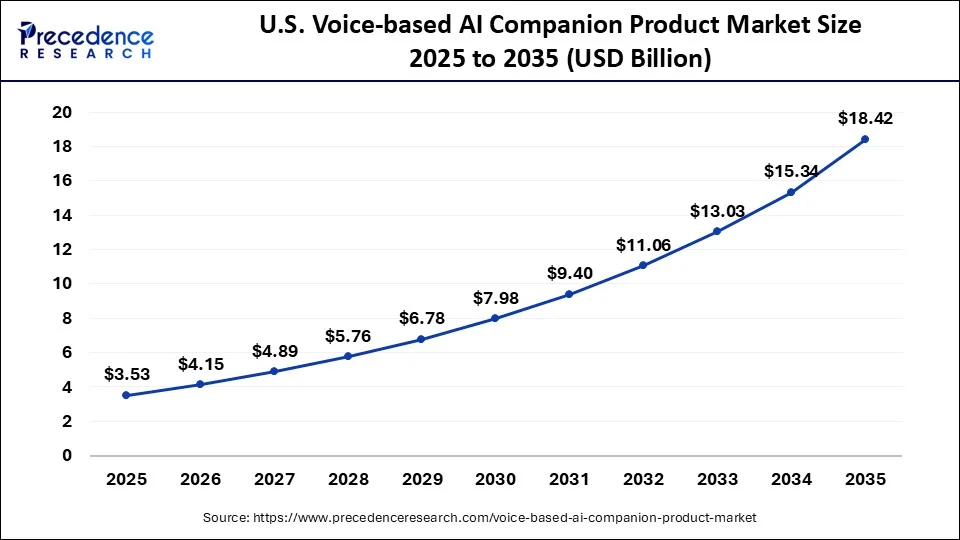
The U.S. voice-based AI companion product market size is calculated at USD 3.53 billion in 2025 and is expected to reach nearly USD 18.42 billion in 2035, accelerating at a strong CAGR of 17.96% between 2026 and 2035.
U.S. Voice-Based AI Companion Product Market Trends
The U.S. voice-based AI companion product market is experiencing strong growth, driven by rapid advances in artificial intelligence, large language models, and natural language processing that enable more natural, conversational, and context-aware voice interactions. Increasing consumer and enterprise demand for hands-free, voice-first interfaces across smartphones, smart homes, vehicles, and customer engagement platforms is accelerating the adoption of voice-based AI companions in daily use cases.
U.S.-based technology companies are actively launching next-generation AI companion products that move beyond rule-based or scripted chatbots toward real-time, adaptive conversational models. These solutions leverage advanced speech recognition, contextual memory, and intent understanding to support continuous dialogue, emotional tone detection, and personalized responses
What Factors Helps Propelling the Asia Pacific Voice-based AI Companion Product Market?
Asia Pacific is projected to grow at the fastest CAGR of nearly 26% during the foreseeable period, driven by a combination of demographic, technological, and societal factors. The region benefits from a large and digitally active population, high smartphone and internet penetration, and rapid adoption of AI-enabled consumer technologies across both urban and semi-urban markets. These conditions create a strong foundation for voice-based AI companion products that rely on continuous connectivity and frequent user interaction.
Growth is further supported by increasing deployment of AI-powered companions designed to provide emotional support, companionship, and mental wellness assistance through voice-first interfaces. Countries across the region are witnessing rising awareness of mental health challenges, social isolation, and work-related stress, particularly among younger populations and the elderly. Voice-based AI companions are increasingly positioned as accessible, non-judgmental, and always-available support tools, offering conversational engagement without the stigma often associated with traditional mental health services.
China Voice-Based AI Companion Product Market Analysis
China is a leading contributor in the Asia Pacific voice-based AI companion products market due to the rapid integration of AI technology into several leading sectors, ranging from manufacturing to healthcare, transforming the landscape of China's AI innovation. China's growing adoption of AI-powered personal assistant tools provides valuable insights about user behavior that can transform the market dynamics further. The growing demand for mental health support, personalized healthcare, and smart lifestyle management has prompted leading players in China to launch new AI-powered voice-based companions.
- For instance, in January 2024, a leading player in China, iFLYTEK SPARK 3.5, was launched that surpasses Chat-GPT-4 Turbo, especially in understanding, mathematical abilities, and voice interaction capabilities, which possesses 96% of ChatGPT Coding.
How Is Europe Witnessing a Significant Growth Rate in the Voice-Based AI Companion Product Market?
The region is experiencing strong growth driven by rising industrial output and the need for advanced technologies that reduce continuous human intervention in operational workflows. Voice-based AI companions are increasingly being deployed across manufacturing, logistics, customer service, and industrial operations to provide real-time guidance, task assistance, and decision support in environments where manual oversight is costly or impractical. These systems enable hands-free interaction, process monitoring, and contextual instructions, helping organizations scale output while managing workforce limitations and operational complexity.
Growth is further reinforced by the European Union's emphasis on Industry 4.0 and sustainability-focused initiatives, which encourage automation, energy efficiency, and smarter use of resources across industrial sectors. As manufacturers and service providers adopt connected systems, smart factories, and digital supply chains, voice-based AI companions are emerging as practical interfaces that bridge human operators and automated systems. This combination of industrial automation needs and policy-driven modernization is expanding the role of voice-based AI technologies across the region.
Germany Voice-based AI Companion Product Market Analysis
The market is rapidly expanding in Germany, driven by the increasing advancements in AI/ML technology, its integration with human-dependent sectors owing to the NLP advancements, speech-to-text technology innovation that creates highly context-aware responses to humans. The increasing adoption of AI Avatars in Germany is mirroring the global trends, which are majorly driven by consumers' expectations for personalized interactions and increased emphasis on data privacy and security regulations in the EU region.
Why Is the Middle East & Africa Growing in the Voice-Based AI Companion Product Market?
The Middle East and Africa region is witnessing steady growth in the voice-based AI companion product market, primarily driven by rising internet penetration and widespread adoption of smartphones. Improved access to high-speed mobile networks has made voice-based AI companions more accessible to a broader population, enabling everyday use across communication, information access, and smart device control. This expanding digital access is creating favorable conditions for the adoption of voice-first AI technologies.
Growth is further supported by increasing consumer interest in smart home automation and enhanced user experiences, particularly in urban households. Falling prices of smart speakers and voice-enabled devices are accelerating adoption by lowering entry barriers and encouraging hands-free interaction with digital services. These trends reflect a broader cultural shift toward convenience-driven, voice-enabled digital engagement, positioning voice-based AI companions as practical tools for home automation, entertainment, and daily task assistance across the region.
UAE Voice-based AI Companion Product Market Analysis
The UAE voice-based AI companion product market is growing steadily, driven by widespread adoption of smart home technologies and strong consumer preference for convenience-oriented digital solutions. High smartphone penetration, advanced broadband infrastructure, and rising use of voice-enabled devices across households are supporting increased interaction with AI companions for home control, information access, and daily task management. Growth is further supported by government-led digital innovation strategies aimed at economic diversification and the adoption of advanced technologies across the public and private sectors. The UAE has actively promoted the use of artificial intelligence in public services, smart cities, and digital governance initiatives, creating a favorable ecosystem for AI-driven products.
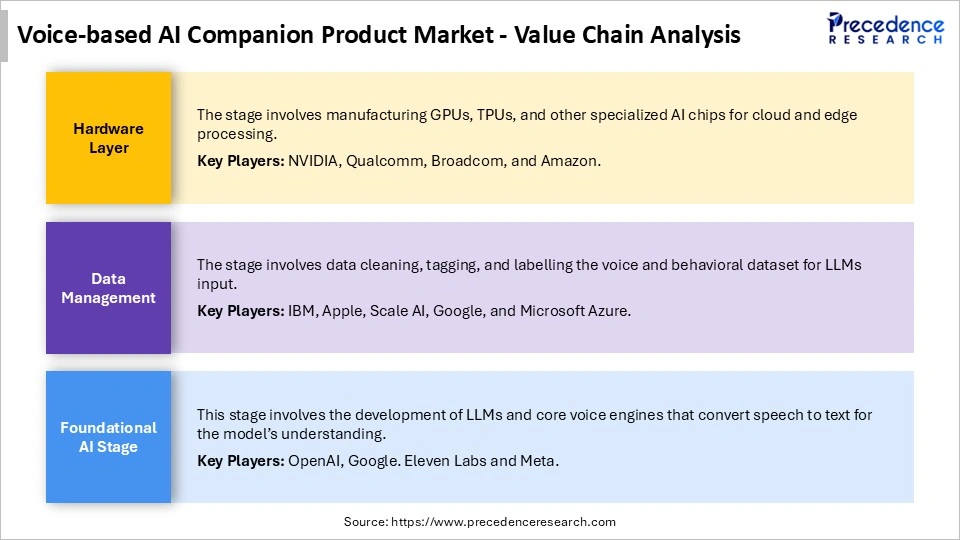
Voice-based AI Companion Product Market Value Chain
Voice-based AI Companion Product Market Companies
- Luka, Inc. (U.S.)
- Chai Research Corp (U.S.)
- Earkick (U.S.)
- PolyAI Ltd. (U.K.)
- Witlingo (U.S.)
- SoundHound AI Inc. (U.S.)
- Hume AI Inc (U.S.)
- Meela, Inc. (U.S.)
- Miko.ai (India)
- Intuition Robotics Inc. (Israel)
- Amazon, Inc. (U.S.)
- Google LLC (U.S.)
Recent Developments
- In November 2025, Samsung Vision AI companion launched a multilingual support feature at the IFA 2025 event. This version is driven by generative AI and can be controlled/accessed from the AI button on the remote control.(Source: https://www.gadgets360.com)
- In October 2025, a Leading tech giant, Microsoft have introduced an innovative and more humanly next Gen AI companion, called Mico, aiming to make digital interactions more approachable, intuitive, and engaging. The new character can blend with a friendly face for everyday tasks and productivity.(Source: https://aispectrumindia.com)
Segments Covered in the Report
By Product Type
- Standalone AI Companion Apps
- Embedded AI Companions (smartphones, wearables, smart speakers)
- Dedicated Companion Devices/Robots
By End User
- Individual Consumers
- Enterprises/Organizations
- Healthcare & Care Providers
- Education Institutions
By Application
- Companionship & Social Interaction
- Mental Health & Emotional Support
- Productivity & Personal Assistance
- Learning & Tutoring
- Elderly Care & Assisted Living
By Deployment Model
- Cloud-based
- On-device (Edge AI)
- Hybrid (Cloud + On-device)
By Business Model
- Subscription-based
- Freemium with In-app Purchases
- Enterprise Licensing/Contracts
- Advertising/Sponsored Models
By Region
- North America
- Europe
- Asia-Pacific
- Latin America
- Middle East and Africa
For inquiries regarding discounts, bulk purchases, or customization requests, please contact us at sales@precedenceresearch.com
Frequently Asked Questions





Ask For Sample
No cookie-cutter, only authentic analysis – take the 1st step to become a Precedence Research client
 Get a Sample




 sales@precedenceresearch.com
 Schedule a Meeting
