



Smart Agriculture Market Size, Agricultural Production, Resource Utilization, Technology Adoption, Market Penetration, and Sustainability Trends
Smart Agriculture Market (By Agriculture Type: Precision Farming, Livestock Monitoring, Precision Aquaculture, Precision Forestry, Smart Greenhouse, Others; By Offering: Hardware, Sensing Devices, Software, Services; By Farm Size: Small, Medium, Large) - Global Industry Analysis, Size, Trends, Leading Companies, Regional Outlook, and Forecast 2026 to 2035
Source: https://www.precedenceresearch.com/smart-agriculture-market
 Get a Sample
 Table Of Content


What is the Smart Agriculture Market Size?
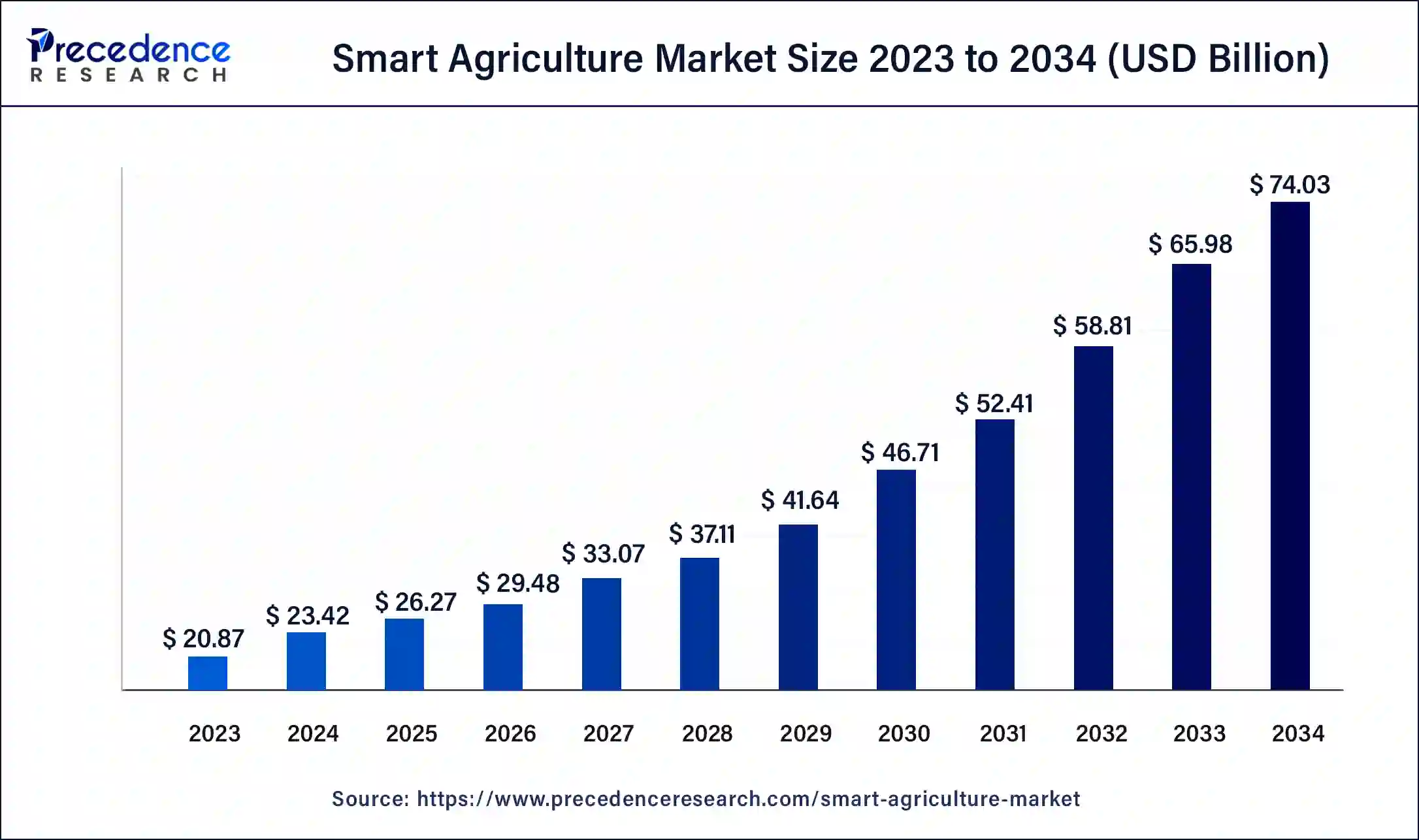
The global smart agriculture market size is accounted at USD 26.27 billion in 2025 and is predicted to increase from USD 29.48 billion in 2026 to approximately USD 81.49 billion by 2035, expanding at a CAGR of 11.99% from 2026 to 2035. This growth is due to growing demand for sustainable agriculture and the integration of AI and IoT.
Smart Agriculture Market Key Takeaways
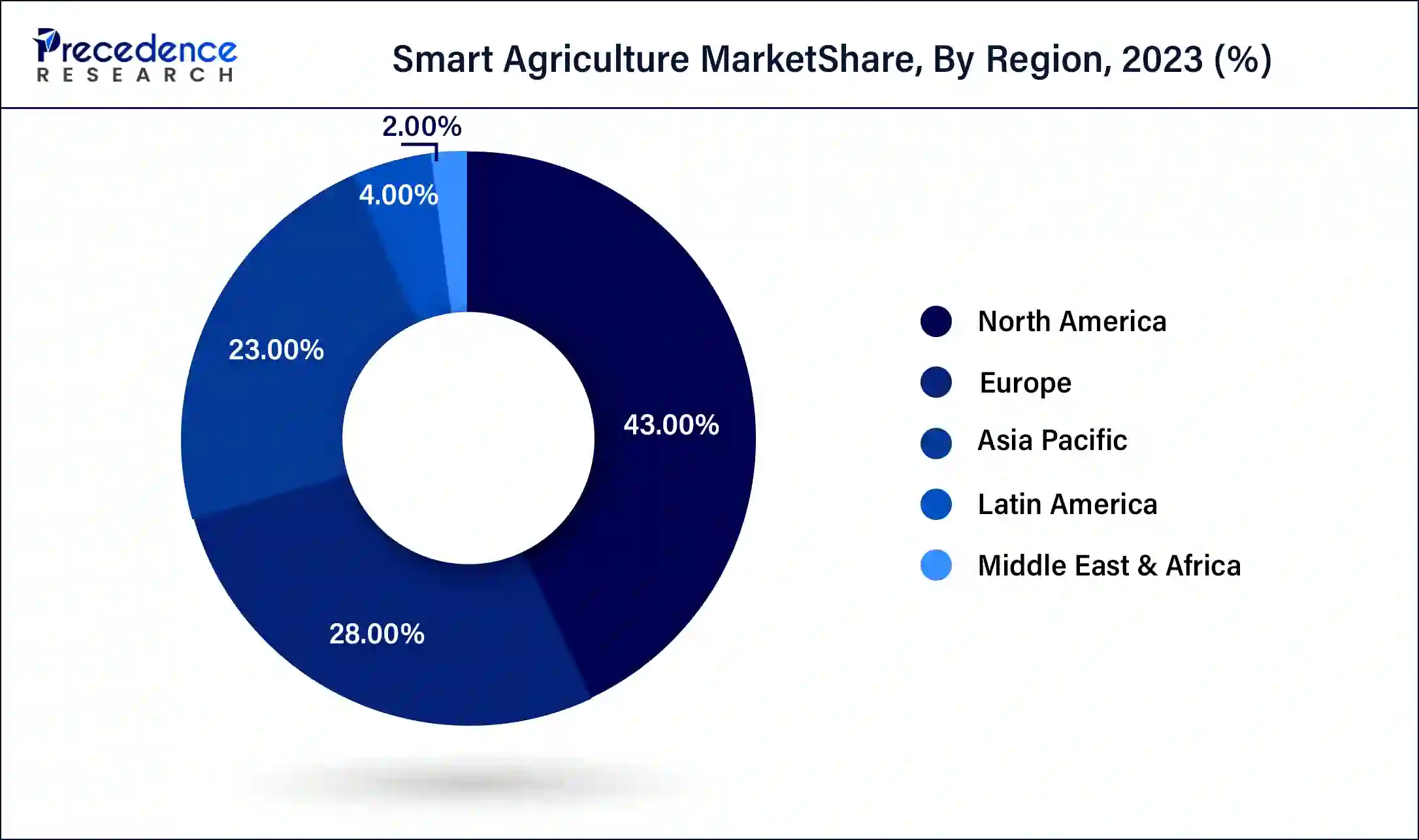
- North America led the global market with the highest market share of 43% in 2025.
- By offering, the software segment has held the largest market share in 2025.
- By application, the precision farming application segment captured the biggest revenue share in 2025.
- By agriculture type, the livestock monitoring segment registered the maximum market share in 2025.
Strategic Overview of the Global Smart Agriculture Industry
Smart agriculture refers to farming practices using technologies and smart devices to improve sustainability, resource management, and production efficiency. Incorporating data analytics, drones, and sensors in farming practice enables precise monitoring of crops, livestock health, and soil conditions. AI-driven insights and automation empower farmers to mitigate environmental impact, reduce waste, enhance yield, and make informed decisions, ensuring a profitable and resilient agricultural sector.
Key players operating in the market are focusing on developing advanced farming equipment integrated with advanced cameras and sensors. Advanced technologies such as biometrics, GPS, and RFID enable precision farming. Additionally, the increasing trend of automation and the rising government support and subsidies to support smart agriculture are likely to contribute to the market growth.
Artificial Intelligence: The Next Growth Catalyst in Smart Agriculture
Artificial Intelligence (AI) is significantly impacting the smart agriculture industry by enhancing efficiency and sustainability through data-driven decisions. The technology is used in precision farming for tasks such as yield prediction, crop monitoring, disease detection, and optimizing irrigation and fertilization schedules. By leveraging machine learning, sensors, and computer vision, farmers can automate operations like robotic weeding and harvesting, reducing labor costs and minimizing resource waste.
Market Outlook
- Industry Growth Overview: The smart agriculture market is growing rapidly as farmers adopt IoT sensors, drones, AI-driven analytics, and automation to improve crop yields, resource efficiency, and climate resilience. Rising global food demand, shrinking arable land, and the need for precision farming solutions are further accelerating the adoption of advanced agricultural technologies.
- Sustainability Trend: The sustainability trend is reshaping the market by driving adoption of precision technologies that reduce water use, minimize chemical inputs, and lower the environmental footprint of farming. As climate pressures intensify, farmers are increasingly investing in IoT monitoring, data analytics, and automation to enhance soil health, conserve resources, and support long-term sustainable food production.
- Major Investors: Major investors in the market include leading technology companies such as John Deere, Trimble, IBM, and AGCO, as well as ag-tech venture capital firms like Temasek, SoftBank, Pontifax AgTech, and S2G Ventures. These investors contribute by funding innovations in IoT sensors, AI-driven analytics, robotics, and automation, enabling farmers to improve productivity, reduce resource use, and adopt more sustainable and data-driven farming practices.
Smart Agriculture Market Growth Factors
- Smart agriculture is helping farmers to grow crops with more efficiency by utilizing advanced technologies. One of the key factors driving the growth of global smart agriculture market is growing technological advancements and adopting innovative technologies. The technologies such as internet of things, artificial intelligence, blockchain, and machine learning are creating lucrative opportunities for the growth and development of global smart agriculture market over the forecast period.
- Another factor driving the growth of global smart agriculture market is growing government initiatives for the adoption of latest and advanced technologies. In addition, government of various developing and developed regions is providing tax benefits to those market players who are operating in smart agriculture market. Moreover, government is also heavily investing for the growth of global smart agriculture market.
- The impact of the COVID-19 pandemic on the growth of global smart agriculture market was quite moderate in nature. The market players operating in smart agriculture market saw growth as well as decline in the sales of food grains and dairy products. The supply chain disruption and trade restrictions had negative impact on the growth of global smart agriculture market. On the other hand, the stringent government regulations regarding food safety and security had positive outlook on the expansion of global smart agriculture market during 2020.
- The other factors such as increasing adoption of smartphones and growth of telecom sector are driving the growth and development of global smart agriculture market. The growing usage of smartphones is helping farmers to track and monitor agriculture activities on farm. It also provides accurate information and data and also helps to keep record on various parameters. Thus, this factor is propelling the demand for smart agriculture in the global market over the forecast period.
Market Outlook
- Market Growth Overview: The smart agriculture market is expected to grow significantly between 2025 and 2034, driven by the increasing food security and population growth, rapid advancement and reduced cost of IoT sensors, AI, drones, and data analytics, and growing adoption of precision farming.
- Sustainability Trends: Sustainability trends involve precision farming and resource optimization, climate-smart and regenerative practices, and integration towards data-driven decisions.
- Major Investors: Major investors in the market include John Deere, Trimble, IBM, AGCO, Temasek, SoftBank, Pontifax AgTech, and S2G Ventures.
- Startup Economy: The startup economy is focused on precision farming, data and advisory, and resource farming.
Market Scope
| Report Coverage | Details |
| Market Size in 2025 | USD 26.27 Billion |
| Market Size in 2026 | USD 29.48 Billion |
| Market Size by 2035 | USD 81.49 Billion |
| Growth Rate from 2026 to 2035 | CAGR of 11.99% |
| Base Year | 2025 |
| Forecast Period | 2026 to 2035 |
| Segments Covered | Agriculture Type, Offering, Application, Farm Size, Regions |
| Regions Covered | North America, Asia Pacific, Europe, Latin America, Middle East and Africa |
Market Dynamics
Driver
Increasing adoption of smartphones and drones
The increasing adoption of smartphones and drones in farming practices drives the growth and development of the global smart agriculture market. Smartphones allow farmers to track and monitor agriculture activities, providing accurate information and data and also helping to keep records on various parameters. Moreover, key players are making efforts to develop advanced farming equipment, which propel the market. For instance,
- In May 2024, DJI, China-based drone maker company, launched the Agras T25 and Agras T50 drones for agricultural applications. These drones are designed to deliver precision services in agricultural operations.
Restrain
Lack of connectivity infrastructure
Lack of internet access in rural areas may create challenges in adopting smart farming solutions, restraining the market growth. Connectivity issues deter farmers from adopting advanced technologies necessary for efficient agricultural operations, limiting their access to data and tools for improving sustainability and productivity in agriculture practices. Addressing this obstacle is necessary for expanding the effectiveness and reach of smart agriculture solutions in rural communities.
Opportunity
Increasing adoption of livestock monitoring solutions in developing countries
The increasing acceptance of livestock monitoring solutions creates immense opportunities in the market. Livestock monitoring solutions enable farmers to track animal's status and well-being from remote locations. The increasing demand for dairy products and milk is expected to accelerate the demand for livestock monitoring technologies, including feeding robots, in the coming future.
- For instance, In July 2023, SK Telecom collaborated with bio venture company uLikeKorea and launched a livestock monitoring system called ‘Live Care,' which allows farmers to monitor the health of their cattle using smart biocapsules.
Segments Insights
Agriculture Type Insight
How did the precision farming segment dominate the smart agriculture market in 2025?
The precision farming segment dominated the market in 2025. This dominance is due to technological advancements and government initiatives for smart agriculture. Precision farming technologies transform crop production by enabling more sustainable and efficient agricultural practices. By optimizing inputs such as water, fertilizers, and pesticides, precision farming reduces waste, minimizes environmental impact, and promotes sustainable farming practices.
The smart greenhouse segment is expected to grow at the fastest rate during the forecast period, driven by the rising demand for sustainable and high-yield agricultural practices. Unpredictable rainfall, prolonged droughts, heat waves, and sudden frost events disrupt open-field agriculture and reduce yield reliability. Smart greenhouses offer a resilient alternative, providing controlled environments.
Solution Insights
Which Solution Segment Dominated the Smart Agriculture Market in 2025?
The agriculture asset management segment dominated the market in 2025. This is due to demand for resource optimization and enhanced productivity. Agriculture asset management helps smart farming by supporting farmers in tracking machinery, tools, and livestock digitally. Using RFID tags, GPS trackers, and mobile apps, farmers can monitor equipment health, schedule maintenance, and manage resource allocation efficiently. By integrating spatial data with an asset management system, farmers streamline operations.
The smart water management segment is anticipated to grow at the fastest rate during the forecast period. This is due to demand to conserve water, improve crop yield, and reduce farming costs. Smart water management helps in conditioning and improving the soil's ability to hold and capture moisture as well as the basic infrastructure for water harvesting, storage, and use as nature-based cropping solutions.
Offering Insights
How did the Hardware Segment Dominate the Smart Agriculture Market in 2025?
The hardware segment held the largest share of the market in 2025. This dominance is due to its crucial role in improving precision and efficiency in agricultural operations. Key hardware components, such as sensors, drones, GPS systems, and automated machinery, are required for real-time monitoring and optimization of farm activities. The trend of growing automation technologies is also helping the segment to grow at a strong growth rate.
The services segment is anticipated to grow at the fastest CAGR during the forecast period. This is due to the rising implementation and incorporation of digital technologies in traditional agricultural practices, which require integration services. In addition, growing demand for expert consulting, maintenance support, and data analytics is driving demand for services.
Application Insights
Which Application Segment Dominated the Smart Agriculture Market in 2025?
The yield monitoring segment dominated the market in 2025. This is due to the rising demand for precision agriculture practices. Yield monitoring enables farmers to measure, record, and analyze crop yield and moisture levels in real-time during harvesting contributing to enhanced field management decisions. The yield monitoring devices are experiencing a transformative shift driven by the integration of artificial intelligence and machine learning algorithms.
The weather tracking and forecasting segment is anticipated to grow at the fastest CAGR during the forecast period, as weather forecasting is directly related to increased productivity by enabling farmers to take proactive rather than reactive actions. Accurate weather forecasting and tracking for agriculture empowers farmers to allocate resources efficiently, making precise decisions on irrigation, fertilization, and crop care.
Regional Insights
What Makes North America the Dominant Region in the Smart Agriculture Market?
North America dominated the smart agriculture market in 2024 with a revenue share of 43%. The growth of the smart agriculture market in the North America region is attributed to the growing government initiatives and favorable guidelines for the expansion of the agriculture sector. In addition, several market players are collaborating with government agencies to implement the concept of smart agriculture. Moreover, the government in this region is also providing subsidies and tax incentives for the development of smart agriculture markets. All of these factors are driving the growth of the smart agriculture market in North America.
North America leads in the commercial adoption of precision agriculture technologies because of large farms, high mechanization levels, and significant investment from venture capital and corporations in agrotech. Farmers more often use GPS-guided tractors, variable-rate applicators, multispectral imagery, and yield-mapping systems to increase profit from every hectare. Data platforms that integrate weather, soil, and market information are facilitating predictive management and risk reduction on a wide scale. Meanwhile, aggregation services and farm-management-as-a-service models are making it easier for mid-sized growers to access advanced tools.
U.S. Smart Agriculture Market Trends
The U.S. leads in agtech commercialization, with large row-crop farms quickly adopting drones, soil probes, and autonomous equipment. Silicon Valley–backed startups and traditional OEMs work together on farm-scale data platforms that connect sensors, machinery, and marketplaces. USDA programs and state extension services support pilot projects and proof-of-value demonstrations that help scale solutions. However, the U.S. still faces challenges with fragmented data standards and the need for farmer-friendly, low-latency tools for real-time decision-making.
What is the U.S. Smart Agriculture Market Size?
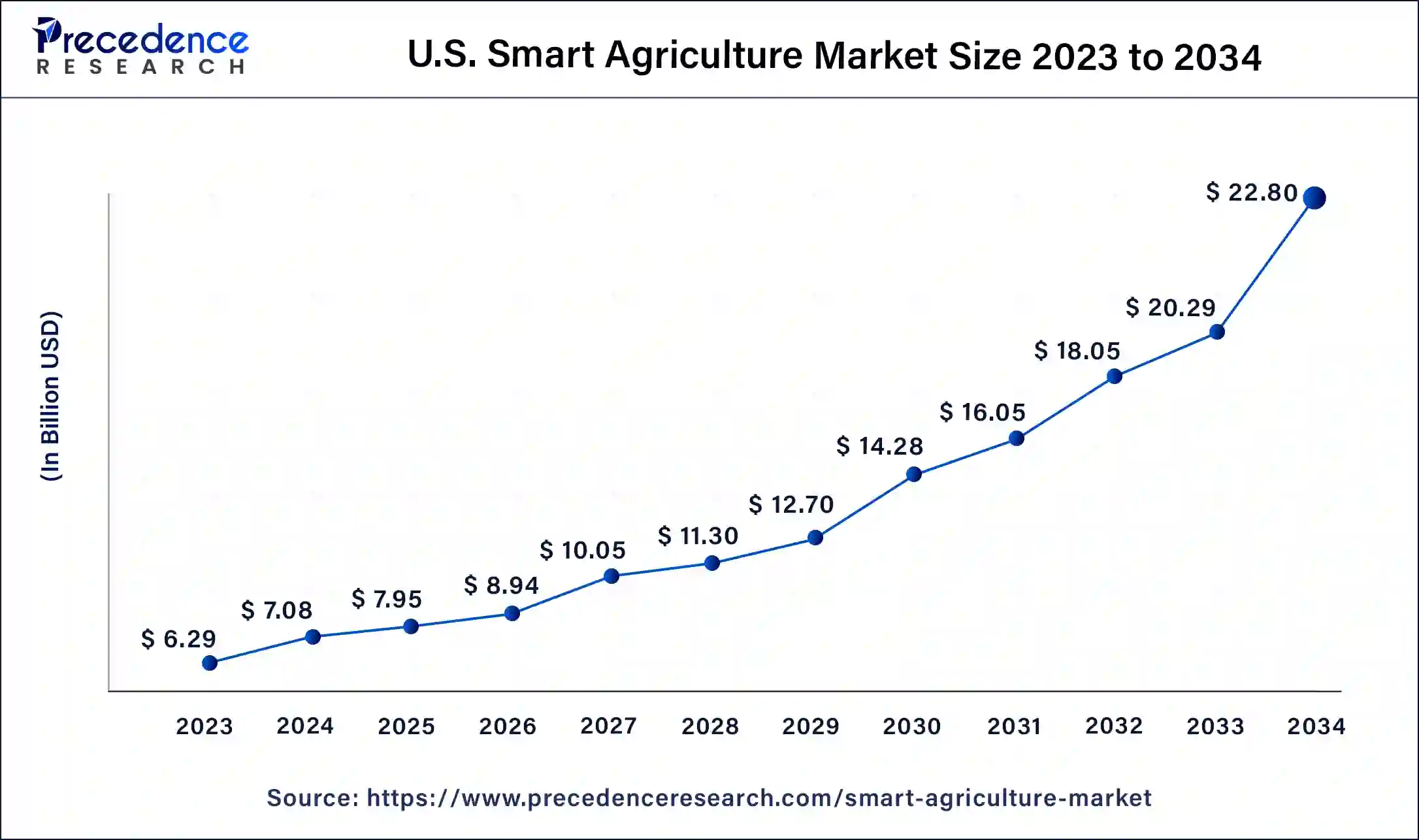
The U.S. smart agriculture market size is estimated at USD 7.95 billion in 2025 and is predicted to be worth around USD 25.13 billion by 2035, at a CAGR of 12.20% from 2026 to 2035.
What Makes Asia Pacific the Fastest-Growing Market?
The market in Asia Pacific is expected to expand at the fastest growth rate during the forecast period. The growth of the smart agriculture market in Asia Pacific is being driven by rising government initiatives for agriculture industry. The nations such as Singapore, Japan, and India are taking constant efforts for the growth of smart agriculture market in this region. In addition, the government of these countries is providing financial help for developing smart agriculture. Thus, the rise in adoption of organic agriculture is also supporting the growth of smart agriculture market in Asia Pacific.
- India is leading in organic farming across the globe. For instance, according to the provisional data released by the Directorate General of Commercial Intelligence and Statistics (DGCI&S), the exports of processed food and agricultural products rose by 13% to $19.69 Bn in the nine months of the Financial Year 2022-23 (Apr-Dec).
India Smart Agriculture Market Trends
India's smart agriculture sector is characterized by the seamless integration of AI and IoT, enabling precision farming and enhancing climate resilience. Robust government backing and a thriving startup ecosystem are making high-tech tools, such as drones and automated irrigation, accessible to smallholder farmers.
Union Budget 2023 Highlights
| Agricultural Credit Target with a focus on fisheries, fairy, and husbandry sector | INR 20 Lakh Cr. |
| Aatmanirbhar Bharat Horticulture Clean Plant Program | INR 22,000 Cr |
| Pradhan Mantri Kisan Samman Nidhi | INR 60,000 Cr. |
| Digital Agriculture Mission was started by the Modi Government | INR 450 Cr. |
| PM Matsya Sampada Yojana | INR 6,000 Cr. |
What Potentiates the Growth of the European Smart Agriculture Market?
Europe's smart agriculture market is growing due to a strong focus on sustainability, regulatory incentives for carbon reduction, and the widespread use of precision tools to achieve both productivity and environmental goals. Farmers utilize variable-rate application, satellite nitrogen monitoring, and real-time animal health telemetry to meet strict EU environmental targets while maximizing yields. Public funding mechanisms and agricultural policy reforms encourage the adoption of digital technologies that support biodiversity, soil health, and water conservation. A strong startup ecosystem and robust agricultural research institutions drive continuous innovation and thorough validation trials.
Germany Smart Agriculture Market Trends
Germany combines strong engineering skills with advanced farm advisory services to speed up the adoption of robotics, sensor arrays, and data platforms. Its precision-machinery manufacturers and agtech startups work closely with research universities to test industrial-grade solutions. Large arable and dairy farms serve as early adopters and demonstration sites for autonomous equipment and sensor-based nutrient management. German policies focusing on climate mitigation and rural digital infrastructure support long-term expansion.
How is the Opportunistic Rise of Smart Agriculture in the Middle East & Africa?
In the Middle East & Africa, smart agriculture is emerging as a strategic response to water scarcity, desertification, and the urgent need to boost domestic food production. Precision irrigation drip systems with sensor control, protected-culture greenhouses, and hydroponics are being rapidly adopted in arid regions to maximize yields per unit of water. Public investments, donor grants, and PPPs support pilots that combine satellite monitoring with soil moisture sensors to optimize limited resources. Urban and vertical farming are also gaining traction in dense cities to shorten supply chains and stabilize fresh-food availability.
UAE Smart Agriculture Market Trends
The UAE is investing heavily in controlled-environment agriculture, vertical farms, and desalination-powered greenhouses to enhance food security. Smart irrigation, climate control, and sensor systems maximize productivity in challenging climates. Public R&D centers and free-zone incubators promote pilot commercialization with global tech partners. The UAE model focuses on scalability, export potential, and integration with logistics and retail chains.
Latin America Smart Agriculture Market Trends
Smart agriculture presents significant potential for Latin America, with the potential to significantly enhance agricultural production. Agriculture plays a crucial role in the economies of Latin American countries, with countries such as Brazil, Argentina, and Mexico relying heavily on agricultural output as a key driver of their economic growth. By utilizing data on climate, soil, and crops, AI can offer a promising approach to increasing food production while using fewer resources.
Brazil Market Trends
Brazil smart agriculture sector is being increasingly shaped by the integration of Internet of Things technologies and automation. Farmers are adopting IoT devices such as sensors, drones, and autonomous tractors to improve productivity and efficiency. According to a report by McKinsey, the adoption of agricultural technology in Brazil could potentially boost farm productivity by 20-30%.
Government Initiatives for Smart Agriculture
- The US Department of Agriculture has launched various programs and initiatives to support farmers in adopting sustainable practices and investing in agricultural technology. The USDA is dedicated to helping a diverse range of farmers, ranchers, and private forest landowners through Partnerships for Climate-Smart Commodities.
- The government in India has introduced several initiatives to promote farming techniques and digital services that enhance farmer income and climate resilience. The National AI Mission (NAIM) is an initiative launched by the Government of India to leverage artificial intelligence for economic growth and social development.
- The Digital Europe Programme (DIGITAL) provides a comprehensive approach to fostering innovation and digital transformation in the agricultural sector. Horizon Europe, the EU's research and innovation framework programme, emphasizes developing sustainable and inclusive food systems.
- Countries and institutions from Africa and the Middle East have collaborated under the facilitation of the Global Green Growth Institute to initiate the groundbreaking Africa and Middle East SAFE Initiative. This landmark initiative aims to scale up agriculture and food systems for economic development in these regions.
Value Chain Analysis
- Technology & Platform Development
Companies develop IoT sensors, drones, AI-based analytics, farm management software, and cloud platforms to enable precision farming and data-driven decision-making.
Key Players: Trimble, IBM, Microsoft, AG Leader Technology. - Equipment Manufacturing & Integration
This stage involves producing smart farm machinery and integrating digital technologies such as GPS, automated irrigation systems, and robotics.
Key Players: John Deere, AGCO, CNH Industrial, Kubota. - Implementation & Field Services
Smart agriculture solutions are deployed on farms, including installation of sensors, irrigation systems, drones, and digital platforms, with training and support for farmers.
Key Players: Trimble, Raven Industries, AG Leader, Yara International.
Recent Investments
- In April 2026, the UK government announced a £50 million investment in farming technology to enhance smart farming, agri-tech innovation, productivity, and sustainable food production across the agricultural sector. This funding will support the development of up to 12 innovative tools for farms, helping farmers produce more while reducing labor, energy, and fertilizer use.
- In May 2026, Oishii raised $150 million in Series C funding, boosting its mission to advance indoor strawberry farming through robotics and precision agriculture. Investors include major institutional partners who see long term value in its Smart Farm model.
Competitive Landscape
The competitive landscape of the smart agriculture market is driven by key players emphasizing product innovation, technology upgrades, strategic collaborations, regional expansion, mergers and acquisitions, pricing optimization, and portfolio diversification. These companies are building their market presence by enhancing operational efficiency, investing in research and development, growing distribution networks, and aligning their offerings with changing consumer demand. The quick advancement of precision agriculture technologies and Agri-tech startups is revolutionizing the global agricultural landscape.
Smart Agriculture Market Companies
- AG Leader Technology: This company develops precision agriculture hardware and software, often as retrofit solutions, to upgrade existing farm machinery for modern performance and data collection.
- AGCO Corporation: AGCO provides a full line of smart farming solutions and equipment, including advanced machinery and the PTx precision ag technologies acquired through a joint venture with Trimble.
- AgJunction Inc.: A pioneer in automated steering and guidance solutions, AgJunction holds over 130 patents for machine control and hands-free farming technologies.
- Autonomous Solutions Inc.: ASI provides the Mobius fleet management platform, which enables a single operator to remotely control and coordinate multiple autonomous vehicles, such as tractors and sprayers.
- Deere & Company: A leader in agricultural machinery, John Deere integrates advanced robots, AI, and IoT into its equipment to provide a complete smart farming ecosystem.
- DroneDeploy: This company provides a platform for agricultural drones that enables farmers to map fields, monitor crop health, and analyze data through aerial imagery. Their software helps in identifying issues like pest infestations or water stress, allowing for timely and targeted interventions.
- Farmers Edge Inc.: Farmers Edge offers a vertically integrated digital platform that combines hardware, such as on-farm weather stations and telematics, with advanced data analytics and satellite imagery.
Other Major Key Players
- GEA Group Aktiengesellschaft
- The Climate Corporation
- DeLaval Inc.
Recent Developments
- In August 2024, Sri Lanka commenced the formulation of its first Climate-Smart Agriculture (CSA) Investment Plan implemented by the Food and Agriculture Organization of the United Nations (FAO) and funded by the Green Climate Fund (GCF).
- In April 2024, the agriculture sector's first purpose-built open-source Micro Language Model for climate-smart agriculture, ‘aksara' was launched by the Bengaluru-based company Google-backed Cropin. The aim behind this launch was to meet the world's increasing demand for nutritious, safe, and sufficient food.
- In April 2024, C-DAC launched the SMART FARM System on the occasion of the 37th Foundation Day in Pune, which is supposed to be the future of agriculture. The aim behind this launch was to help farmers plan fertilization and irrigation based on soil and environmental conditions to ensure maximum yield.
- Trimble released the GFX-350, an android based display for farm auto steering application control, in November 2019. It can be used in conjunction with the NAV-500 and NAV-900 guidance systems to meet a variety of user accuracy requirements.
- In November 2020, AG Leader Technology improved its InCommand displays and expanded its SteerCommand product portfolio to include built in house SteerCommand Z2 and SteadySteer. End users can use a single use interface to steer and operate any farming equipment with these items.
- DeLaval introduced the RC700 and RC550 robot collectors for solid floors in March 2021, with the goal of improving cow comfort. They can handle any manure intake technology.
- John Deere, a major player in the smart agriculture sector, partnered with Solorrow in March 2021 to offer a new site-specific software that uses changeable application maps to do various fertilizing and other field operations.
Segments Covered in the Report
By Agriculture Type
- Precision Farming
- Yield monitoring
- On-farm
- Off-farm
- Field mapping
- Crop scouting
- Weather tracking & forecasting
- Irrigation management
- Inventory management
- Farm labor management
- Yield monitoring
- Livestock Monitoring
- Milk harvesting
- Breeding management
- Feeding management
- Animal comfort management
- Others
- Precision Aquaculture
- Precision Forestry
- Smart Greenhouse
- Water & fertilizer management
- HVAC management
- Yield monitoring
- Others
- Others
By Offering
- Hardware
- HVAC system
- LED grow lights
- Valves & pumps
- Sensors & control systems
- Others
- Sensing Devices
- Soil sensor
- Water sensors
- Climate sensors
- Others
- Software
- Web-based
- Cloud-based
- Services
- System integration & consulting
- Maintenance & support
- Managed services
- Data services
- Analytics services
- Farm operation services
- Assisted professional services
- Supply chain management services
- Climate information services
By Farm Size
- Small
- Medium
- Large
By Region
- North America
- U.S.
- Canada
- Europe
- U.K.
- Germany
- France
- Asia-Pacific
- China
- India
- Japan
- South Korea
- Malaysia
- Philippines
- Latin America
- Brazil
- Rest of Latin America
- Middle East & Africa (MEA)
- GCC
- North Africa
- South Africa
- Rest of the Middle East & Africa
For inquiries regarding discounts, bulk purchases, or customization requests, please contact us at sales@precedenceresearch.com
Frequently Asked Questions





Ask For Sample
No cookie-cutter, only authentic analysis – take the 1st step to become a Precedence Research client
 Get a Sample



 sales@precedenceresearch.com
 Schedule a Meeting
