



Solid Oxide Fuel Cell Market Size, Key Companies, Technology Trends, Regional Outlook, and Demand Forecast
Solid Oxide Fuel Cell Market (By Type: Linear, Tubular; By Application: Portable, Stationary, Transport; By End User: Commercial & Industrial, Data Centers, Military & Defense, Residentials) - 2026 to 2035
Source: https://www.precedenceresearch.com/solid-oxide-fuel-cell-market
 Get a Sample
 Table Of Content


What is the Solid Oxide Fuel Cell Market Size?
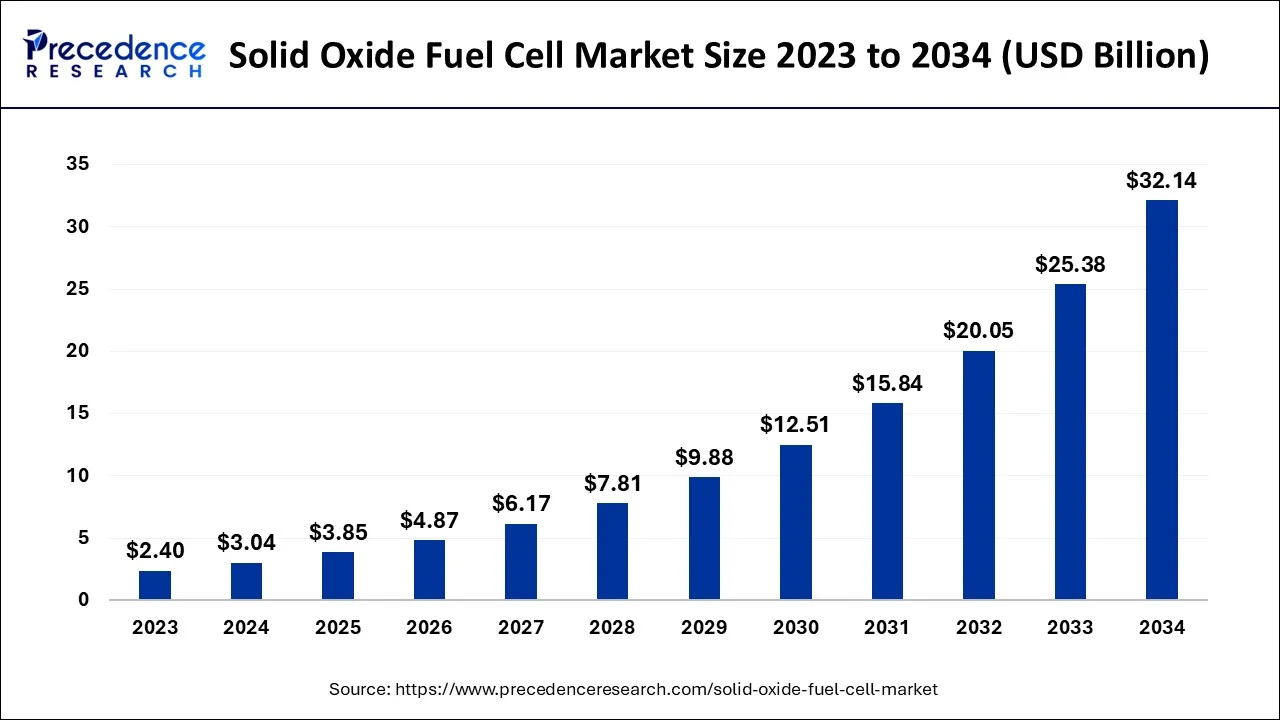
The global solid oxide fuel cell market size is accounted for at USD 4.87 billion in 2026 to approximately USD 32.14 billion by 2034, growing at a CAGR of 26.60% from 2026 to 2034. The market is growing due to the increasing demand for efficient, low-emissions, and reliable distributed power generation solutions.
Key Takeaways
- Asia Pacific dominated the global solid oxide fuel cell market in 2026.
- North America is expected to grow at the fastest CAGR in the foreseeable future.
- By type, the linear segment held a dominant position in the market in 2026.
- By type, the tubular segment is growing at the fastest CAGR in the market between 2026 and 2035.
- By application, the stationary segment dominated the market in 2026.
- By application, the portable segment is expected to grow with the highest CAGR of 26.60% in the market during the studied years.
- By end user, the commercial & industrial segment accounted for the largest share in the market in 2026.
- By end user, the data center segment is expected to grow in the market during the studied years.
Market Overview
The solid oxide fuel cell market is witnessing significant growth due to the growing need for efficient and clean energy generation technology in the commercial, industrial, and residential sectors. SOFCs are electrochemical devices that use fuels like natural gas, hydrogen, and biogas to produce electricity with low emissions and high efficiency. Growing use of decentralized power production systems, strict environmental restrictions, and rising investments in hydrogen infrastructure are driving the industry. Further driving market expansion are developments in fuel cell materials, government programs encouraging renewable energy, and the growing use of SOFCs in data centers, backup power solutions, and combined heat and power systems. Global market expansion is anticipated to be greatly aided by the shift to sustainable energy systems and carbon neutrality.
AI in the Solid Oxide Fuel Cell Market
AI is revolutionizing the solid oxide fuel cell market by allowing performance optimization, predictive maintenance, enhancing manufacturing efficiency, and improving system intelligence. By lowering operational risks and improving reliability, AI makes SOFC technology more attractive for commercial and industrial users. AI is also impacting research and development in the market. Developing new materials for electrodes, electrolytes, and interconnects traditionally requires long testing cycles.
Solid Oxide Fuel Cell Market Growth Factors
- Rising Demand for Clean Energy Solutions: Increasing emphasis on reducing carbon emissions and transitioning toward sustainable energy sources is driving the adoption of SOFC technologies.
- Growing Investments in Hydrogen Infrastructure: Expanding investments in hydrogen production, storage, and distribution infrastructure are supporting the deployment of SOFC systems.
- Increasing Adoption of Distributed Power Generation: The rising need for reliable and decentralized energy generation systems across residential, commercial, and industrial sectors is fueling market growth.
- Supportive Government Policies and Incentives: Government initiatives, subsidies, and funding programs promoting fuel cell technologies and renewable energy are accelerating market expansion.
- Advancements in Fuel Cell Technology: Continuous innovations in cell materials, durability, and efficiency are improving SOFC performance and reducing operational costs.
- Expanding Use in Combined Heat and Power (CHP) Applications: The high electrical efficiency and ability to simultaneously generate heat and power are increasing the adoption of SOFC systems in CHP applications.
- Rising Demand for Backup Power Solutions: Growing concerns regarding grid reliability and power outages are boosting the use of SOFCs for backup and uninterrupted power supply applications.
- Increasing Industrial Decarbonization Efforts: Industries are increasingly adopting low-emission energy technologies, creating significant growth opportunities for SOFC manufacturers.
Market Outlook
- Industry Growth Overview: The market is growing due to increasing investments in renewable energy and supportive government policies, particularly in regions such as North America, Europe, and Asia-Pacific. Companies such as Ceres, Bloom Energy, and Mitsubishi Heavy Industries are mainly innovating in this space, focusing on enhancing operational lifespan and lowering production costs.
- Sustainability Trends: Growing awareness of environmental sustainability, particularly the need to reduce greenhouse gas emissions, is boosting demand for SOFCs. Solid oxide fuel cells have emerged as a serious candidate to meet growing demand for cleaner, more resilient energy systems because they offer high electrical efficiency, fuel flexibility, and minimal-to-zero emissions.
- Startup Ecosystem: New entrants are focusing on catering to the rising demand for fuel flexibility and strong policy support for clean energy. There are 56 Solid Oxide Fuel Cells startups such as Bloom Energy, FuelCell Energy, Elcogen, Dynelectro, and Watt Fuel Cell. 42 startups are funded, with 16 having secured Series A+ funding, out of these startups.
Market Dynamics
Drivers
Government financial assistance and expanded fuel cell program R&D: One of the key determinants of the expansion of a solid oxide cell sector is the government's solar cell rules and initiatives. Energy storage programs are among the forefront in states like Delaware, California, and Connecticut, which also provide incentives and assistance for hydrogen fuel deployments, resulting in SOFC as well as other fuel infrastructure in the United States. The Identity Incentive System of California provides incentives for producers to assist current, newer, and emergent decentralized electricity production. The program has now been expanded, with the most recent change becoming a seminar on SGIP Renewable Power hosted by the Power Department.
The global market for SOFC is positively impacted by the desire for renewable energy: Another element that raises the need for the industry is understanding sustainable SOFC power. The natural gas industry is being developed at an accelerating rate. The solid-oxide fuel cells' economic outlook has fundamentally changed as a result of these issues. To supply constant energy, it is incorporated into the current fuel infrastructure. There are several business and industrial uses for SOFC energy. Every fuel mixture will work with that too. Partial oxidation fuels do not generate any carbon pollution. Government backing and the necessity for sustainable energy globally are thus the main drivers propelling the SOFC industry.
Challenges
High operational heat and the SOFC's long start-up times: In comparison to other electrochemical devices, SOFC takes a greater time to get started. Because SOFCs are technologically advanced, they take longer to start up because they need to achieve the essential thermal performance before they can operate at full efficiency. Additionally, a SOFC's functioning generates a lot of energy that is released into the environment, which considerably raises the requirement for effective thermal insulation and eventually adds to the mass of the device. Those are the primary factors contributing to SOFC's low market penetration in transportable and disaster high power applications. The process of creating SOFC devices with quicker start rates has just begun. Organizations like Sunfire, SOLID Power, and Bloom Energy were presently making R&D investments to address the technical issues related to SOFC.
The SOFC operation's start-up time is longer: When compared to certain other energy sectors, the SOFC firm's startup time is longer. It takes longer for the element to achieve the essential working temperature because it's an elevated element. Therefore, longer starting times are necessary for the energy to operate and run at its maximum capacity.
Extreme heat emissions when the operation is underway: When operating, the SOFC emits a tremendous volume of heat into the environment. Inordinate insulation is needed to manage the temperature. The thick thermal insulation helps make a solid oxide fuel heavier. The SOFC is much less popular in transportable and power supply systems as a result of these reasons. Such performance problems are significant obstacles for the whole SOFC sector.
Opportunities
End users' increasing utilization in data centers and the military sector: The end-user need offers the SOFC market tremendous growth potential. The main end customers with the highest energy usage are computed clusters. They are indeed the ones using SOFC power that are expanding the quickest. The uninterrupted supply of electricity also is necessary again for visualization tools' proper operation and the avoidance of losing data. The SOFC is just a source of energy that satisfies all criteria for cloud services. Additionally, a cost-effective energy supply is needed for the data centers because of their high electricity usage. The industry has enormous room to grow as a result of SOFC usage by cloud services.
SOFC marketplace in the military segment: A significant market of SOFCs seems to be the governments, where fixed and mobile SOFC power output is rising. A market opportunity for SOFC exists within this industry as well, given the need for efficient & noise-free power generation for military uses. This is projected that SOFC moveable technology used in military applications will progress as the likelihood of this company's continuous growth increases.
Segments Insights
By Type
Why Linear Segment Dominated the Market in 2026?
The linear segment held a dominant share of the solid oxide fuel cell market in 2026 due to its straightforward stack construction, ease of production, and effective thermal management features. Commercial and industrial applications can benefit from the enhanced scalability and easier integration of linear SOFC designs into stationary power generation systems. Additionally, their comparatively simple construction lessens operating complexity and maintenance needs.
The tubular segment is expected to be the fastest-growing in the market because of its increased durability, higher mechanical strength, and capacity to tolerate heat cycling without experiencing sealing problems. Large-scale stationary and distributed power production applications find tubular designs especially appealing due to their extended operational lifespans and exceptional reliability.
By Application
Why the Stationary Segment Dominated the Market in 2026?
The stationary segment dominated the solid oxide fuel cell market in 2026 owing to the commercial, industrial, and utility sectors' increasing use of distributed power generation and combined heat and power generation and combined heat and power systems. The implementation of stationary SOFC systems has greatly expanded globally due to the growing demand for continuous, energy-efficient, and low-emission electricity generation. Additionally, stationary SOFCs are more appealing for long-term energy generation due to their high electrical efficiency and ability to run on a variety of fuel sources. Another factor contributing to the segment's dominance is the growing focus on decentralized energy infrastructure.
The portable segment is expected to gain the fastest growth during the forecast period due to the growing need for long-lasting, lightweight, high-energy-density power sources for military operations in remote areas and emergency backup systems. Compared to traditional batteries, SOFCs provide fuel flexibility and longer running durations, which makes them ideal for portable applications that need a steady and dependable power source.
By End User
Which End-User Dominated the Market in 2026?
The commercial & industrial segment accounted for the largest solid oxide fuel cell market share in 2026 because of the increasing demand for a steady and dependable power supply, increased energy efficiency, and lower operating expenses. To improve energy security and support sustainability goals, businesses and manufacturing facilities are increasingly implementing SOFC systems for on-site power generation and CHP applications. Additionally, enterprises are being encouraged to embrace cleaner energy technologies by strict emission restrictions and corporate carbon reduction targets. Segment growth is further reinforced by SOFC systems' capacity to lessen reliance on the grid and cut operational costs.
The data center segment is anticipated to expand at the fastest CAGR during the forecast period, propelled by the fast growth of AI workloads, cloud computing, and hyperscale data center infrastructure. Solid oxide fuel cells are a desirable substitute for primary and backup power applications in contemporary data centers because they offer extremely dependable, effective, and low-emission power solutions. Data center operators are investigating fuel cell technology due to growing concerns about sustainability and power reliability. The use of SOFC systems is also anticipated to be accelerated by rising investments in green data centers.
Regional Insights
Asia Pacific Solid Oxide Fuel Cell Market Size and Growth 2026 and 2034
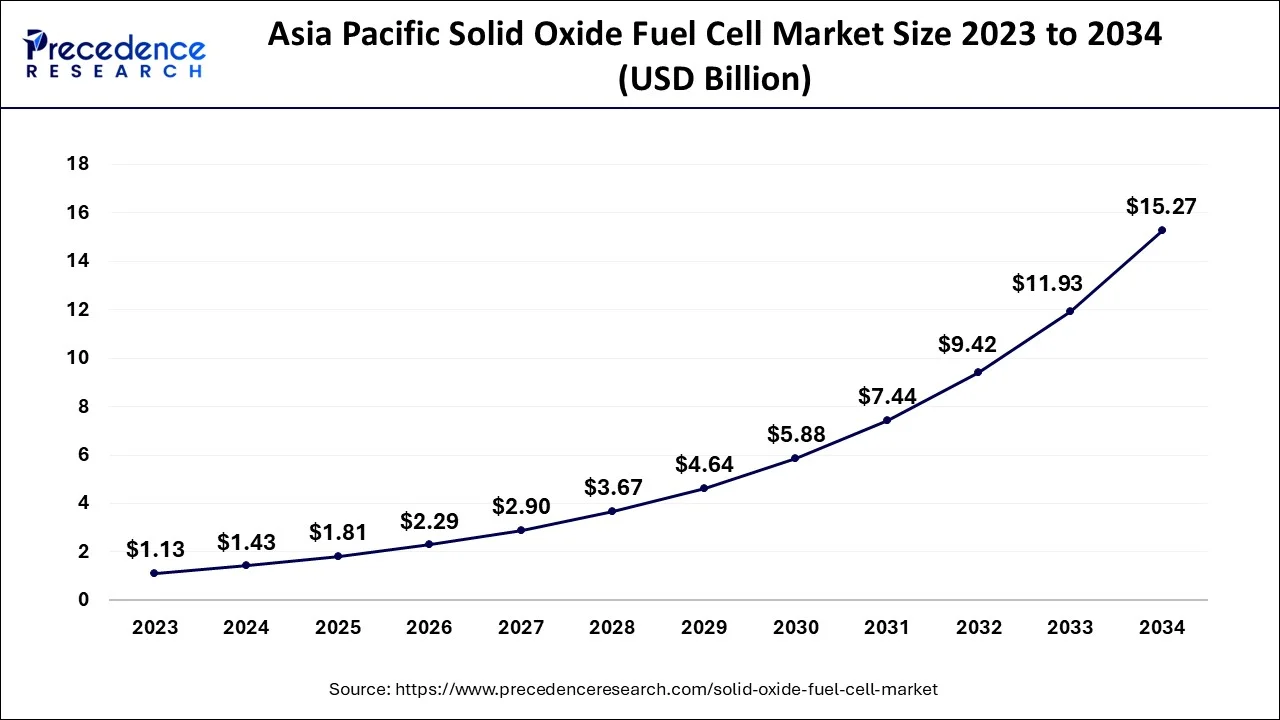
The Asia Pacific solid oxide fuel cell market size is evaluated at USD 2.29 billion in 2026 and is predicted to be worth around USD 15.27 billion by 2034, rising at a CAGR of 26.71% from 2026 and 2034.
Which Region Dominated the Market in 2026?
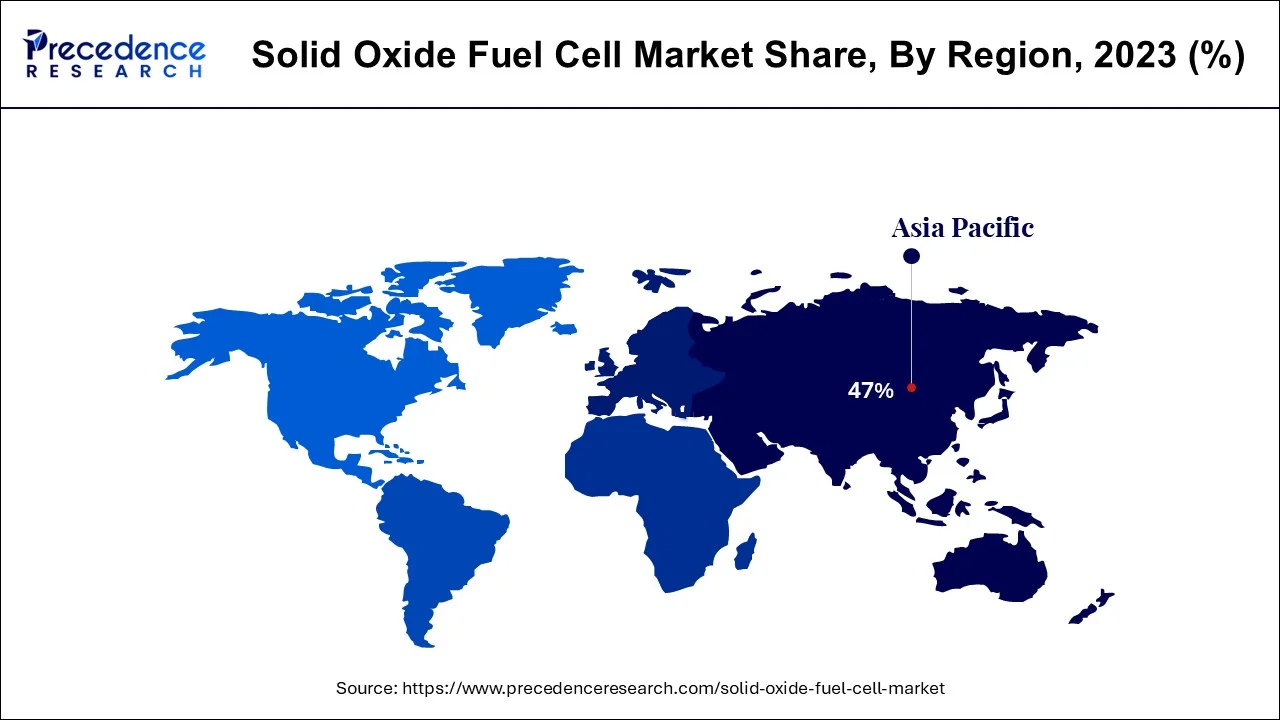
The Asia-Pacific dominated the global solid oxide fuel cell market in 2026 because of large expenditures in fuel cell and hydrogen technology, supportive government regulations, and extensive use of distributed energy systems. By actively encouraging fuel cell use through subsidies and national hydrogen plans, nations like China, South Korea, and Japan are strengthening the region's market dominance. Major fuel cell producers and an established supply chain ecology are also advantageous to the area. The Asia-Pacific market is expanding due to rising investments in smart energy projects and residential fuel cell systems.
China Market Trends
China's market is expanding because of rapid urbanization, rising disposable incomes, and increasing consumer interest in advanced healthcare and aesthetic solutions. Government initiatives supporting domestic medical technology manufacturing, expanding hospital infrastructure, and greater access to innovative treatments stimulate demand. A large patient population, growing medical tourism, continuous technological advancements, and increasing investments from local manufacturers further drive sustained market development across the country.
What is Supporting the Market's Growth in North America?
North America is expected to witness the fastest growth in the solid oxide fuel cell market during the forecast period due to expanding fuel cell deployment in the commercial and industrial sectors, government measures to support sustainable energy technology, and rising investments in hydrogen infrastructure. Regional market growth is also being aided by the robust presence of top fuel cell producers and continuous technological developments. Growing investments in decentralized and resilient energy systems are also contributing to the region's market expansion. Demand is also being increased by the growing use of fuel cells in data centers and critical infrastructure applications.
The U.S. Market Trends
The U.S. market is growing due to strong investments in advanced healthcare infrastructure, continuous technological innovation, and rising consumer demand for minimally invasive treatments. Favorable reimbursement frameworks, increasing research and development activities, and the presence of leading manufacturers accelerate product commercialization. Growing awareness of aesthetic procedures, expanding outpatient care facilities, and supportive regulatory pathways further encourage adoption, strengthening market expansion across diverse medical and cosmetic applications nationwide.
Why is Europe Considered a Notably Growing Region in the Solid Oxide Fuel Cell Market?
Europe is expected to grow at a notable rate in the market in the upcoming period due to strong government support for clean energy and decarbonization initiatives, particularly in countries like Germany, France, and the UK. The Clean Energy Hydrogen Partnership accelerated innovation by funding 26 cutting-edge projects across Europe. It aims to speed up the development and deployment of hydrogen technologies throughout Europe. The launch of new manufacturing facilities, EU funding for manufacturing scale-up, and government-supported projects are boosting the European market. Research and regulatory frameworks demonstrate a strong European commitment to advancing SOFC technology.
France Solid Oxide Fuel Cell Market Analysis
France leads the European market due to its commitment to decarbonization and renewable energy integration, which encourages high adoption of advanced fuel cell technologies. In February 2026, France initiated a process to support the production of renewable or low-carbon hydrogen. The French Ministry of Industry and Energy launched a competitive dialogue phase to promote the production of decarbonized hydrogen.
What Opportunities Exist in Latin America for the Solid Oxide Fuel Cell Market?
Latin America presents significant opportunities for the market due to growing demand for clean, reliable, and decentralized power, particularly in regions with grid instability or off‑grid needs. Governments across the region focus on implementing financial incentives, policies, and regulatory frameworks to promote sustainable and clean energy technologies. There is a growing trend of integrating solid oxide fuel cells with green hydrogen production as part of decarbonization efforts. Private sector initiatives and international collaborations are fueled by partnerships and research projects related to hydrogen and fuel cell technology in this region.
Brazil Solid Oxide Fuel Cell Market Analysis
Brazil dominates the market in Latin America. Supportive government policies, increasing renewable energy and hydrogen initiatives, and expanding industrial and commercial applications further drive the adoption of SOFC technology across the country. Recently, Brazil announced funding of over $1 billion for clean hydrogen hubs. The country also introduced policies and initiatives in sustainable energy and hydrogen that support the development and adoption of solid oxide fuel cell technology.
How is the Opportunistic Rise of the Middle East & Africa in the Solid Oxide Fuel Cell Market?
The Middle East & Africa (MEA) is expected to see an opportunistic rise in the market in the coming years, driven by growing investment in clean energy infrastructure and rising demand for efficient, decentralized, and off grid power solutions in remote or underserved areas. The expansion of hydrogen economy initiatives, especially in Gulf countries such as the UAE and Saudi Arabia, also drives market growth. The large-scale investments in clean energy, reduced dependence on fossil fuels, and the goal of achieving net-zero emissions by 2050 are the main driving forces of this regional market. The extensive use of solid oxide fuel cells across residential, industrial, and remote power sectors is due to their high efficiency and capacity to operate on various fuels.
Competitive Landscape
The global solid oxide fuel cell market is highly competitive, with established energy technology companies and emerging fuel cell developers focusing on efficiency improvements, cost reduction, and commercialization. Leading players are investing in research and development, strategic partnerships, pilot projects, and manufacturing expansion to strengthen their market positions. Companies are also emphasizing hydrogen-ready systems, distributed power generation, and combined heat and power applications to address growing demand for clean energy solutions. Key participants include Bloom Energy Corporation, Mitsubishi Heavy Industries, Ceres Power Holdings plc, Aisin Corporation, Kyocera Corporation, Robert Bosch GmbH, Elcogen AS, Sunfire GmbH, SOLIDpower S.p.A., Convion Ltd., FuelCell Energy, Inc., Nexceris LLC, Atrex Energy, Inc., Hexis AG, and ZTEK Corporation.
Solid Oxide Fuel Cell Market Companies
- Adaptive Energy LLC
- Adelan Ltd.
- Aisin Corporation
- Atrex Energy Inc.
- AVL (Austria)
- Bloom Energy Corporation
- Bosch (Germany)
- Catator AB (Sweden)
- Ceramic Fuel Cells Limited
- Ceres Power Holdings plc
- Convion ltd. (Finland)
- Cummins Inc.
- Elcogen AS (Estonia)
- FuelCell Energy, Inc. (U.S.)
- Fuji Electric Co. Ltd.
- General Electric
- h2e Power (India)
- Hexis AG
- Hitachi Zosen Corporation (Japan)
- Kyocera Corporation (Japan)
- Mitsubishi Hitachi Power Systems, Ltd.
- Miura (Japan)
- Nexceris, LLC (U.S.)
- NGK SPARK PLUG CO., LTD.
- Ningbo SOFCMAN Energy
- POSCO Energy
- Robert Bosch GmbH
- Rolls-Royce Fuel Cell Systems Ltd.
- Solid Power (Italy)
- Sunfire GmbH (Germany)
- Suzhou Huatsing Jingkun New Energy Technology Co., Ltd. (China)
- Ultra-Electronics Holdings Plc
- Upstart power (US)
- Watt fuel cell corporation (US)
- ZTEK Corporation (US)
Recent Developments
- In March 2026, Ceres Power and Centrica entered a strategic partnership to accelerate the deployment of multi-gigawatt solid oxide fuel cell power solutions across the UK and Europe. The collaboration aims to provide low-carbon, on-site power solutions for commercial and industrial customers, particularly data centers and critical infrastructure applications.
- In February 2026, Mitsubishi Heavy Industries successfully demonstrated the production of liquid synthetic fuels using an integrated process incorporating solid oxide electrolysis cell (SOEC) technology and Fischer-Tropsch synthesis. The demonstration supports the commercialization of high-efficiency hydrogen and synthetic fuel production technologies.
- In February 2026, Elcogen signed a Memorandum of Understanding (MoU) with JNK India Limited to explore collaboration opportunities in solid oxide technology in India. The partnership aims to accelerate the deployment of SOFC and SOEC technologies in the Indian market.
- In March 2025, FuelCell Energy (FCEL) and Malaysia Marine and Heavy Engineering (MMHE) will co-develop large-scale hydrogen production systems across Asia, New Zealand, and Australia. Under a Joint Development Agreement (JDA), they will combine FCEL's solid oxide electrolyser cell (SOEC) technology with MMHE's expertise to develop modular solutions suitable for hydrogen production facilities.
- In May 2025, Global Clean Energy, Inc. launched a cogeneration division and entered a strategic agreement with Axiom Energy and SolydEra. "We are enthusiastic about the partnership with Global Clean Energy, Inc. and Axiom Energy to bring our Solid Oxide Fuel Cell technology to North America," said Alexander Liberov, CEO of SolydEra. (Reference)
- On 21 February 2025, Bosch announced the termination of its SOFC partnership with Ceres Power. The move follows slower-than-expected commercialization of SOFCs and a strategic focus on hydrogen electrolysis. Bosch also plans to divest its 17.44% stake in Ceres and withdraw its board members. The CEO of Ceres stated that the company remains confident in its technology and other global partnerships.
Segments covered in the report
By Type
- Linear
- Tubular
By Application
- Portable
- Stationary
- Transport
By End User
- Commercial & Industrial
- Data Centers
- Military & Defense
- Residentials
By Geography
- North America
- Europe
- Asia-Pacific,
- Latin America
- Middle East & Africa
For inquiries regarding discounts, bulk purchases, or customization requests, please contact us at sales@precedenceresearch.com
Frequently Asked Questions





Ask For Sample
No cookie-cutter, only authentic analysis – take the 1st step to become a Precedence Research client
 Get a Sample




 sales@precedenceresearch.com
 Schedule a Meeting
