



Carbon Market Size, Key Companies, Applications, Trends and Forecast, 2026-2035
Activated Carbon Market (By Type: Powdered Activated Carbon (PAC), Granular Activated Carbon (GAC), Extruded/Pressed Activated Carbon (EAC), Bead Activated Carbon (BAC), Impregnated Activated Carbon, Others; By Raw Material: Coal, Coconut Shell, Wood, Peat, Others; By Phase/Form: Powder, Granule, Pellet, Liquid Suspension, Carbon Cloth; By Application: Water Treatment, Air & Gas Purification, Food & Beverage, Pharmaceutical & Medical, Automotive, Mining & Metal Recovery, Chemical & Industrial Processing, Consumer Products; By End-Use Industry: Municipal, Industrial, Residential; By Distribution Channel: Direct Sales (OEMs, B2B), Distributors/Wholesalers, Online Retail) - Global Industry Analysis, Size, Trends, Leading Companies, Regional Outlook, and Forecast 2026 to 2035
Source: https://www.precedenceresearch.com/activated-carbon-market
 Get a Sample
 Table Of Content


What is Activated Carbon Market Size?
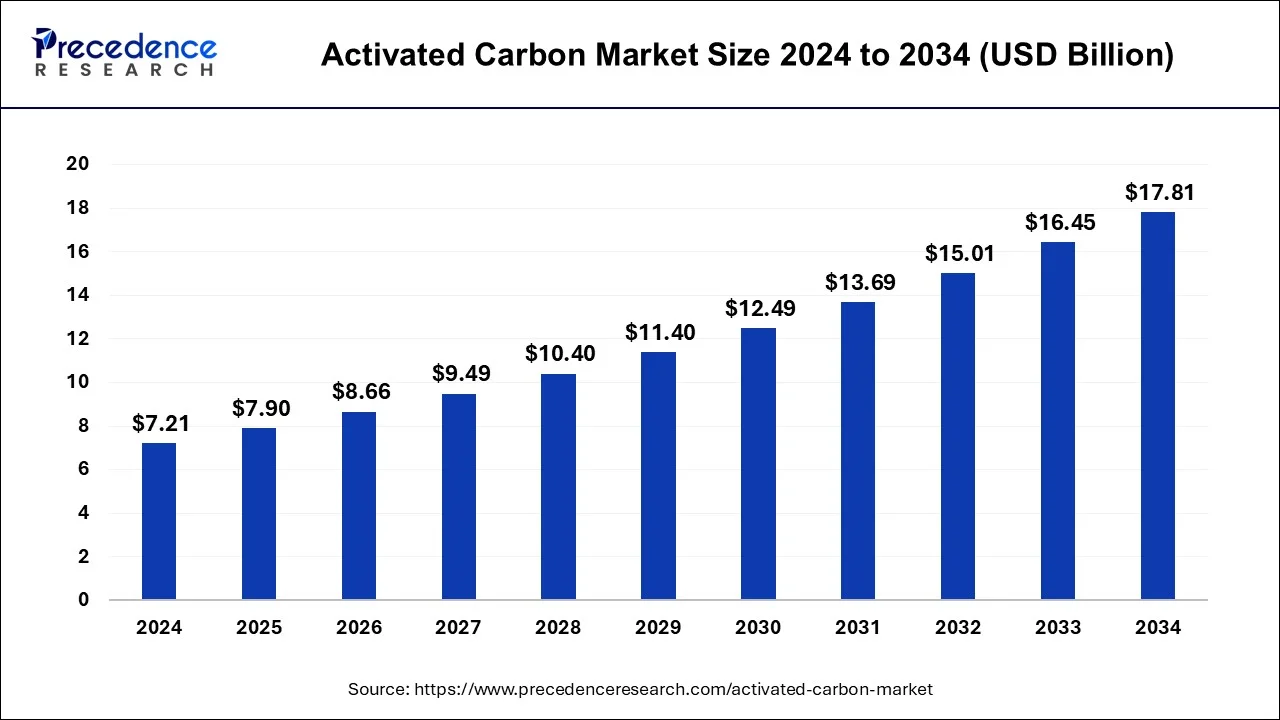
The global activated carbon market size is accounted for USD 8.66 billion in 2026, and is expected to reach around USD 19.22 billion by 2035, expanding at a CAGR of 9.3% from 2026 to 2035. The activated carbon market is driven by rising demand for water and air purification, growing investment in sustainable filtration technologies and stricter environmental regulations.
Market Highlights
- By type, the powdered activated carbon (PAC) segment dominated the market with a 37.80% share in 2026.
- By type, the extruded activated carbon (EAC) segment is expected to grow at the highest CAGR of 8.50% in 2026.
- By raw material, the coal segment held a 42.50% market share in 2026.
- By raw material, the coconut shell segment is expected to grow at the fastest CAGR over the forecast period.
- By application, the water treatment segment dominated the market with a 45.60% share in 2026.
- By application, the air & gas purification segment is expected to grow at the highest CAGR of 9.40% in 2026.
- By end-use industry, the municipal segment held a 39.10% market share in 2026.
- By end-use industry, the industrial segment is expected to grow at the highest CAGR of 8.70% during the projected period.
- By distribution channel, the direct sales segment held a 51.40% market share in 2026.
- By distribution channel, the online retail (B2C) segment is expected to grow at the highest CAGR of 9.00% in 2026.
What is the Activated Carbon ?
The activated carbon industry is a one-stop industry responsible for manufacturing, operating, and distributing porous carbon materials. These materials plays fundamental role in filtration and purification. It is further formulated in various forms to best suit the clients and industry needs. The enriched carbon-based raw materials like wood, coconut shells, and coal are turned into effective absorbents, eliminating hazardous nuisance from water, air, and the company's operational system.
The activated carbon sector crosses various applications and manufacturing processes to end up focusing on environmental concerns, and covers sustainable criteria. Due to stringent regulatory laws, manufacturing has advanced and benefited in pharmaceutical manufacturing, air/gas purification, food and beverage processing, and water treatment lines.
The activated carbon plays a crucial role in water purification as it eliminates massive pesticides, chlorine, and organic pollutants, and it shields reverse osmosis membranes from oxidative attack. The activated carbon is used to optimise oils, discarding caffeine and decolourising sugar. It is also used in crucial medical treatments as a global antidote to treat poisonings and overdosing.
How is AI Elevating the Strength of the Activated Carbon Sector?
AI in the activated carbon sector is used for predictive modelling and acts as a process parameter tuner. The data-inspired optimization has accelerated the strength of this sector. AI has become an important part of various industries, but what remains common is its accuracy, confidence, and commitment. The commendable Gradient Boosting Regressors (GBR) and Artificial Neural Networks (ANN) are used to analyse quality meters such as carbon yield and BET surface area.
This technology can also address the fundamental areas like soaking time, impregnation ratio, and activation temperature. This aligns all the factors in one line to stay in tune with the overall precision process. AI also supports the fluctuating frameworks, harnessing strong genetic algorithms and Generative Adversarial Networks (GANs).
Activated Carbon Market Growth Factors
One of the main sources of mercury emissions is coal-fired power stations. The U.S. Environmental Protection Agency's Mercury and Air Toxics Standards (MATS), a provision of the Clean Air Act, have established limitations on the amount of mercury and other toxins that these power plants are permitted to produce. One way for reducing mercury emissions has been found to be activated carbon injection. And while the Mercury and Air Toxics Standards compliance date has since passed and it is unlikely that activated carbon demand will increase significantly in the US, a recent report by the Freedonia Group points out that Western Europe has just started their journey to controlling mercury emissions, which will likely cause increased demand for activated carbon as businesses move to comply with these regulations.
Moreover, demand for activated carbon is being driven by industrializing countries; emerging countries are investing more in infrastructure for clean drinking water, and activated carbon will continue to be an important water filtration technique.
As more industrializing nations battle with serious air pollution problems, industrial air remediation is receiving more attention. As a result, in order to reduce mercury levels, the major industrial economies are increasing their demand for activated carbon. The product's granular variants are anticipated to experience strong demand from the wastewater treatment sector since they efficiently remove organic pollutants and residual disinfectants.
Also, auto industry's revival will have an impact on the demand for activated carbon as well. Canisters with activated carbon are used in vehicles to improve engine performance and reduce hydrocarbon emissions. The necessity for more cars will result in an increase in the demand for this material. Additionally, as people's living standards and disposable income rise, demand for cars rises along with it, which bodes well for the future need for activated carbon. Hence, these factors are supposed to drive the growth of the market across globe.
Market Outlook
- Industry Growth Offerings- The market is growing due to increasing demand for water and wastewater treatment, stricter environmental regulations, and rising use in air purification, pharmaceutical, and food processing. Technological advancements and sustainable production methods further support market expansion.
- Global Expansion- Global expansion of the market is driven by rising industrialization, growing water treatment needs, and strict pollution control regulations across regions. Increasing adoption in Asia-Pacific, North America, and Europe, along with new production facilities and export growth, is strengthening worldwide market reach.
- Startup ecosystem- The startup ecosystem is expanding as new companies focus on eco-friendly production, innovative adsorption technologies, and low-cost filtration solutions. Support from government programs, sustainability initiatives, and collaborations with water treatment and environmental firms is accelerating their market presence.
- Sustainability Trends: The sustainability trend is reshaping the activated carbon market as manufacturers adopt green manufacturing processes and increasingly use eco-friendly materials such as reactivated carbon and renewable feedstocks. These practices reduce environmental impact, support circular economy goals, and drive demand for sustainably produced activated carbon across water treatment, air purification, and industrial applications.
- Major Investors: Major investors in the activated carbon market include multinational chemical companies, environmental technology firms, and private equity players focused on water and air treatment solutions. Their investments support capacity expansion, sustainable production methods, reactivation facilities, and R&D to develop high-performance and eco-friendly activated carbon products.
Market Trends
- Manufacturers are increasingly producing activated carbon from renewable sources such as bamboo, coconut shell and agricultural residue, which supports sustainability goals.
- The growing demand for activated carbon in water treatment, air control pollution and industrial and wastewater management further drives market growth.
- The growing stringent guidelines regarding air pollution and environmental standards are further encouraging adoption of activated carbon.
- Activated carbon is being used in purification, decolourisation and impurity removal by pharmaceutical and food and beverage industries.
- Companies are investing in advanced activation methods and reactivation of carbon, which reduces polluting manufacturing waste and toxic gas emissions.
Market Dynamics
Driver
Rising Demand for Water Treatment
The growing need for safe drinking water and effective wastewater management is a major driver of the activated carbon market. Activated carbon is highly effective in removing contaminants, chemicals, colour, odour, and heavy metals from water and making it safe for drinking. The government and industries are investing in effective purification technologies to improve water quality and also meet the regulatory standards.
Restraint
Fluctuation in Raw Material Prices
Volatility in raw material prices remains a significant challenge for activated carbon manufacturers. The raw materials used to make activated carbon include coal, coconut shells, and wood. The shortage of raw materials and disruption of the supply chain due to geopolitical tensions or regulatory changes lead to a rise in costs and affect profit margins. These cost variations make pricing less predictable for customers and create difficulties for manufacturers. The changing raw material cost makes a barrier in the price sensitive market for products.
Opportunity
Growing Adoption in Air Pollution Control
Increasing efforts to reduce industrial emissions are creating a strong opportunity for the activated carbon market. Industries such as power generation, chemicals, and waste management are installing advanced air filtration systems to comply with stricter environmental regulations. Activated carbon is effective in capturing harmful gases, mercury, volatile organic compounds and odours. These qualities make it suitable for any industry to adopt for filtration and purification purposes.
Segment Insights
Type Insights
What made the Granule Segment Lead the Activated Carbon Market?
The granule segment registered its dominance over the global activated carbon market in 2026 because it combines high adsorption efficiency with long service life and easy regeneration. It is used in fixed bed filtration systems for municipal water treatment, industrial wastewater purification and food and beverage processing to remove impurities, odour, pollutants and heavy metals. The growing demand for granular form due to its easy regeneration and reusability supports the growth of the segment in the market.
The pellet segment is expected to witness the fastest growth in the activated carbon market with a CAGR over the forecast period. The segment id growing due to its uniform shape, low dust generation and excellent mechanical strength. It is widely used in gas purification, solvent recovery, and industrial air treatment systems to remove organic contaminants. The stringent emission regulations and increasing investment in air pollution control technologies encourage the adoption of this segment.
Application Insights
The water treatment segment dominated the market with a 45.60% share in 2026. The liquid phase product is often used in water treatment to adsorb harmful chemicals, oils, and organic compounds with odor and taste. It has a high porosity and a big surface area for adsorption, making it frequently employed. The increasing need for water treatment across the globe is a result of the depletion of natural resources and the increase in contaminants. Additionally, the market expansion is anticipated to be supported by the stringent standards imposed on clean industrial wastewater.
The air & gas purification segment is expected to grow at the highest CAGR of 9.40% in 2026. The best method for removing all kinds of volatile organic compounds from the environment is to use activated carbon filters. They also aid in clearing the air of various odors, fumes, and gaseous pollutants. In air purifiers, the HEPA filter, which is intended to catch additional microscopic particles like dust, lint, mold spores, pet dander, and pollen, is frequently used in conjunction with the activated carbon filter. Beyond merely the particulate filtration offered by HEPA filters, an extra layer of filtration is supplied by an activated carbon filter.
Raw Material Insights
Why has the Coal Segment dominated the Activated Carbon Market?
The coal segment held a dominant position in the activated carbon market in 2026, due to the growing demand for air and water purification, along with the ongoing industrialization across the globe. It is widely used in municipal water treatment, wastewater purification, air pollution control and industrial processing. Strong demand for power generation, chemical manufacturing and mining industries continues to support the market growth. Additionally, coal-based activated carbon is highly effective in adsorbing organic compounds from gases as well as from liquids.
The coconut shell segment is expected to grow at the fastest CAGR during the studied period in the activated carbon market. The growth of the segment can be linked to the growing need for sustainable and eco-friendly solutions, coupled with the higher adsorption properties of coconut shell-based carbon. Moreover, coconut shells are an abundant raw material, especially in tropical regions. It is used in drinking water purification, gold recovery, pharmaceutical processing and air filtration applications.
End-Use Industry Insights
The municipal segment held a 39.10% market share in 2026. The dominance of the segment is owing to the growing awareness of air and water quality, requiring stringent environmental regulations for wastewater. Furthermore, advancements in the production of activated carbon, particularly granular activated carbon (GAC) and powdered activated carbon (PAC), improve its adsorption efficiency and capacity.
The industrial segment is expected to grow at the highest CAGR of 8.70% during the projected period. The growth of the segment can be driven by a surge in consumer awareness regarding air and water quality, along with the growing use of air purifiers. In addition, the demand for purification and filtration in pharmaceutical manufacturing is increasing, which can support segment expansion further.
Distribution Channel Insights
The direct sales segment held a 51.40% market share in 2026. The dominance of the segment can be attributed to the ongoing economic development, especially in the Asia Pacific, with the rising living standards. Also, various industrial processes such as food and beverage, chemical processing, and pharmaceutical applications are rapidly using activated carbon, contributing to segment growth soon.
The online retail (B2C) segment is expected to grow at the highest CAGR of 9.00% in 2026. The dominance of the segment can be credited to the rising demand for air filtration in personal as well as residential settings, coupled with the innovations in product formulations. The rapid growth of e-commerce offers a direct platform for activated carbon products to reach an extensive consumer base.
Regional Insights
What is the Asia Pacific Activated Carbon Market Size?
The market for activated carbon was dominated by the Asia-Pacific. In terms of volume and value, the activated Carbon market in Asia-Pacific is predicted to develop at the greatest CAGR. Due to the rise in demand for the automotive industry, developing nations like China, India, and others have very high demand for activated carbon. The end-use industries, including the food and beverage and pharmaceutical sectors, are driving up demand for activated carbon products. Additionally, it is anticipated that over the course of the projected period, regional market expansion would be driven by the growing water scarcity caused by rising high population economies.
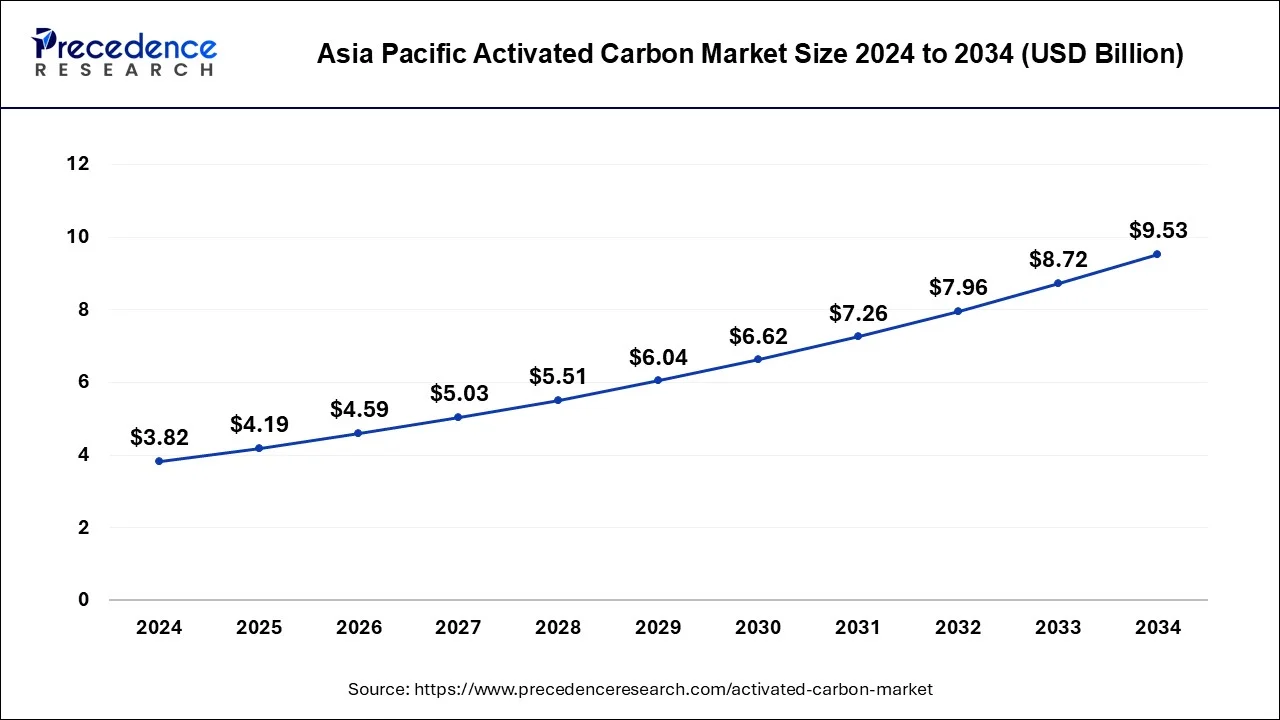
The Asia Pacific activated carbon market size is estimated at USD 4.59 billion in 2026 and is predicted to be worth around USD 10.3 billion by 2035, at a CAGR of 9.41% from 2026 to 2035
China Leads the Way in Activated Carbon Adoption
China's activated carbon market is growing due to increasing demand for water purification, air filtration, and industrial wastewater treatment. Rapid urbanization, industrial expansion, and stricter environmental regulations are driving the adoption of activated carbon across municipal and industrial applications. Additionally, rising awareness of air and water quality, government initiatives to reduce pollution, and growth in sectors like chemicals, food and beverage, and pharmaceuticals are further fueling market expansion, positioning China as a key player in the global activated carbon industry.
What Factors Are Fueling the Rapid Rise of Activated Carbon Demand in North America?
North America is the region with the greatest market. North America's most developed nations are the U.S. and Canada. In terms of value, the U.S. held the greatest portion of the North American activated carbon market. The three main variables anticipated to have a beneficial impact on the market are an increase in elderly population, rising automotive demand in the region, and rising environmental concerns. Gas phase applications are predicted to follow a similar trajectory, while powdered activated carbon applications are anticipated to have a sharp increase.
Activated Carbon Market Grows with Rising Demand for Clean Water
An effective adsorbent for purifying, dechlorinating, deodorizing, and decolorizing liquid and vapor applications is activated carbon. The purpose of activated carbon is to enhance the surface area available for chemical reactions and adsorption. It is treated carbon with tiny, low-volume pores. Processing organic material with a high carbon content yields activated carbon. The primary characteristic of activated carbon is physical adsorption, which makes it helpful for filtering, decaffeinating, metal polishing, medication, removing pollutants, and storing fuel.
A key element that is anticipated to support the market is the rising demand for water treatment techniques as a consequence of standards and laws for enterprises to implement these techniques. As the population has increased and continue to grow, the need for clean water is an essential part of everyone's life. Almost every severe problems are caused by contaminated water hence, the government is working closely with the entities to provide clean and safe water. Thus, the market is expected to grow.
Advanced Industries are Boosting the U.S. Activated Carbon Market
The U.S. market is expanding due to increased use of energy storage, gas adsorption, and air purification technologies. Growth in industrial sectors like automotive, electronics, and chemical manufacturing is boosting demand. Additionally, rising investments in sustainability initiatives, advanced filtration systems, and the adoption of activated carbon in carbon capture and environmental remediation projects are driving market growth, while technological innovations are improving efficiency and broadening application areas.
Activated Carbon Demand is Rising across Europe's Industrial Sectors
The Europe market is expanding due to increasing industrialization, strict environmental regulations, and growing emphasis on sustainable water and air treatment solutions. Rising demand in sectors such as chemicals, food and beverage, pharmaceuticals, and automotive for purification and filtration applications is driving growth. Additionally, investments in advanced wastewater treatment, carbon capture technologies, and renewable energy projects, along with the adoption of high-performance and specialty activated carbon products, are further accelerating market expansion across the region.
The UK is Expanding its Use of Activated Carbon Solutions
The UK market is increasing due to rising demand for clean water, air purification, and industrial filtration solutions. Government regulations and environmental standards are driving adoption in municipal and industrial applications. Additionally, growth in sectors like chemicals, pharmaceuticals, food and beverage, and energy, along with increasing use of activated carbon in carbon capture, waste treatment, and air quality management, is supporting market expansion. Technological advancements and the development of high-performance activated carbon products further fuel growth.
What Potentiates the Market in Latin America?
The activated carbon market in Latin America is growing as regulations on wastewater discharge in the mining, food, and municipal sectors become more stringent. Increased investments in potable water infrastructure in countries such as Brazil, Chile, and Mexico are expected to drive higher demand for both powdered and granular activated carbon. Additionally, expanding gold mining and sugar refining operations across the region are contributing to increased localized consumption of activated carbon.
Brazil Market Trends
Brazil accounts for the largest share of the Latin American activated carbon market in 2026, driven by expanding water treatment, food processing, mining, and industrial manufacturing sectors. Gold recovery operations use activated carbon in extraction processes. The region has stringent regulatory guidelines regarding environmental which demand air emission control. Rising investment in municipal water infrastructure and industrial pollution control are expected to sustain market growth.
What Opportunities Exist in the Middle East & Africa (MEA)?
The Middle East & Africa (MEA) offers significant opportunities in the activated carbon market, driven by growing desalination projects and the need for purification in the oil and gas sector. In countries such as Saudi Arabia and the UAE, activated carbon is increasingly used to remove mercury from industrial gas streams and treat gases generated during oil and gas processing. Additionally, water scarcity and expanding sanitation projects across Africa are expected to further accelerate demand for activated carbon throughout the region
Saudi Arabia Market Trends
Saudi Arabia represents the leading market within the Middle East and African activated carbon market in 2026, supported by increasing investment in large scale water desalination, wastewater treatment and industrial air purification. The country's oil and gas and mining industries rely on activated carbon for filtration and environmental compliance. The continuous infrastructure expansion and ri6sing environmental standards are further strengthening demand for activated carbon.
Value Chain Analysis
- Feedstock Procurement
Activated carbon production starts with acquiring carbon-dense raw materials such as coconut shells, wood, biomass, and coal.
The selected feedstock shapes the final carbon's pore size, strength, and adsorption efficiency.
Efficient sourcing depends on maintaining stable, economical, and sustainable material supply chains.
Global suppliers collaborate with manufacturers to ensure quality, regulatory compliance, and continuous availability.
Key Players: Haycarb Ltd., Kuraray Co., CarbPure Technologies, CarboTech AC GmbH, Bryce Carbon. - Compound Formulation and Blending
Activated carbon formulation involves combining the base carbon material with binders, additives, or performance-enhancing agents.
Blending techniques are customized to achieve specific qualities such as improved adsorption, strength, or chemical resistance.
The process differs depending on whether the product is meant for water treatment, air purification, industrial filtration, or specialty uses.
Consistent blending ensures uniform quality and application-specific performance.
Key Players: Kuraray Co., Haycarb Ltd., CarboTech AC GmbH, CarbPure Technologies, Bryce Carbon. - Quality Testing and Certification
Quality evaluation focuses on measuring adsorption efficiency, contamination levels, and structural characteristics.
Tests such as iodine value help determine liquid-phase adsorption strength, while methylene blue assesses color removal capability.
CTC activity is used to evaluate pore volume and suitability for vapor-phase applications.
These assessments ensure the material meets industry standards for water, air, and industrial purification uses.
Key Players: Haycarb Ltd., Kuraray Co., CarboTech AC GmbH, CarbPure Technologies, Bryce Carbon.
Competitive Landscape
The activated carbon market is moderately consolidated, with global and regional manufacturers competing through product quality, performance, and raw material availability. The leading companies in the market include CarbPure Technologies, Cabot Corporation, CarboTech AC GmbH, Jacobi Carbons Group, Osaka Gas Chemical Co., Ltd., Evoqua Water Technologies LLC, Hangzhou Nature Technology Co., Ltd. and Carbon Activated Corporation. The companies are strengthening their market position by expanding manufacturing facilities and investing in advanced activation technologies to improve adsorption efficiency. Strategic acquisitions, partnerships and collaborations with water treatment and pharmaceutical companies help to maintain long term market presence.
To achieve long term growth in the activated carbon market, companies should focus on developing sustainable activated carbon from renewable raw materials and investing in research to deliver high performance products.
Key Players in Waterborne Coatings Market and their Offerings
- CarbPure Technologies: CarbPure Technologies provides high-performance activated carbon solutions for water purification, industrial filtration, odor control, and environmental remediation. The company focuses on advanced adsorption materials designed for wastewater treatment, chemical processing, and air quality management.
- Bryce Carbon: Bryce Carbon offers activated carbon products tailored for air purification, solvent recovery, gas treatment, and industrial emissions control. Its solutions emphasize high adsorption capacity, cost efficiency, and customized grades for manufacturing, environmental, and filtration applications.
- Kuraray Co.: Kuraray Co. delivers premium activated carbon under its Kuraray Chemical division, serving water treatment, automotive emission control, food purification, medical filtration, and energy storage sectors. The company specializes in high-quality wood-based and synthetic activated carbon.
- CarboTech AC GmbH: CarboTech AC GmbH provides a wide range of activated carbon products for air treatment, wastewater purification, biogas cleaning, solvent recovery, and industrial gas filtration. The company also offers customized adsorption systems and regeneration services.
- Haycarb Ltd.: Haycarb Ltd. manufactures coconut-shell-based activated carbon for water purification, gold recovery, air filtration, food and beverage processing, and industrial applications. The company is known for sustainable production, advanced grades, and high adsorption efficiency across multiple sectors.
Other Waterborne Coatings Market Companies
- Jacobi Carbons Group
- Kureha Corporation
- Osaka Gas Chemicals Co, Ltd
- Evoqua Water Technologies LLC
- Oxbow Activated Carbon ALC
- Carbon Activated Corporation
Recent Developments
- In June 2026, Calgon Carbon Corporation, the world's largest activated carbon manufacturer, launched Filtrasorb Rx, a premium reactivated carbon solution for municipal drinking water systems.  Filtrasorb Rx merges Filtrasorb virgin feedstock with Calgon Carbon's unique reactivation process to provide performance on par with. The reactivation process is supported by third-party validation demonstrating high quality, reliable performance.
- In September 2025, Kemira received approval to build a new activated carbon reactivation plant in Helsingborg, Sweden, boosting its Nordic water treatment capabilities and addressing rising demand for micropollutant removal. The low double-digit million-euro investment supports Kemira's water treatment expansion and aligns with stricter regulations on substances like PFAS. (Source: https://www.indianchemicalnews.com)
Activated Carbon Market Segments
By Type
- Powdered Activated Carbon (PAC)
- Coal-Based
- Coconut Shell-Based
- Wood-Based
- Granular Activated Carbon (GAC)
- Coal-Based
- Coconut Shell-Based
- Wood-Based
- Extruded/Pressed Activated Carbon (EAC)
- Bead Activated Carbon (BAC)
- Impregnated Activated Carbon
- Others (Polymer-Coated Activated Carbon, etc.)
By Raw Material
- Coal
- Bituminous
- Lignite
- Coconut Shell
- Wood
- Peat
- Others (Nutshells, etc.)
By Phase/Form
- Powder
- Granule
- Pellet
- Liquid Suspension
- Carbon Cloth
By Application
- Water Treatment
- Air & Gas Purification
- Food & Beverage
- Pharmaceutical & Medical
- Automotive
- Mining & Metal Recovery
- Chemical & Industrial Processing
- Consumer Products
By End-Use Industry
- Municipal
- Industrial
- Residential
By Distribution Channel
- Direct Sales (OEMs, B2B)
- Distributors/Wholesalers
- Online Retail (B2C)
By Region
- North America
- Europe
- Asia-Pacific
- Latin America
- Middle East and Africa
For inquiries regarding discounts, bulk purchases, or customization requests, please contact us at sales@precedenceresearch.com
Frequently Asked Questions
Tags





Ask For Sample
No cookie-cutter, only authentic analysis – take the 1st step to become a Precedence Research client
 Get a Sample




 sales@precedenceresearch.com
 Schedule a Meeting
