



Advanced Biofuels Market Size, Key Companies, Company Market Share, Production Capacity, Raw Material Pricing, Export & Import Analysis, Manufacturing Cost, Competitive Positioning, and Demand Forecast
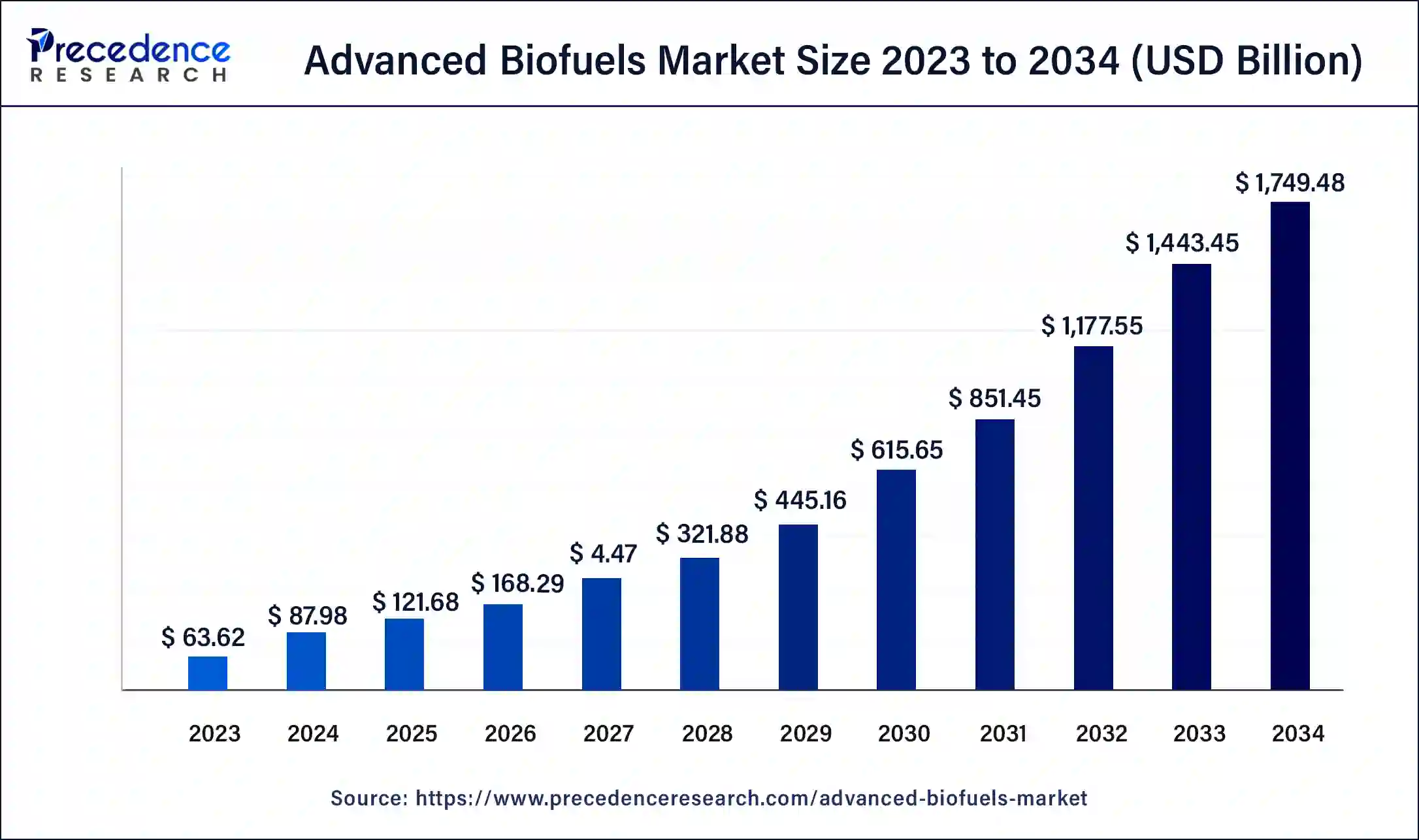
The global advanced biofuels market is projected to grow from USD 168.29 billion in 2026 to USD 2,028.76 billion by 2035, registering a CAGR of 32.50%. Growth is driven by increasing demand for low-carbon transportation fuels, supportive renewable energy policies, and advancements in bio-refining technologies. North America dominates the market, while Asia Pacific is expected to witness the fastest growth, supported by rising investments in sustainable aviation fuel, waste-to-fuel technologies, and AI-enabled biofuel production optimization.
Source: https://www.precedenceresearch.com/advanced-biofuels-market
 Get a Sample
 Table Of Content


What is the Advanced Biofuels Market Size?
The global advanced biofuels market size is valued at USD 121.68 billion in 2025 and is predicted to increase from USD 168.29 billion in 2026 to approximately USD 2,028.76 billion by 2035, growing at a CAGR of 32.50% from 2026 to 2035. The advanced biofuels market is driven by growing demand for low-carbon transportation fuels and enabling renewable energy policies.
Key Takeaways
- By Region, North America accounted for the largest revenue share of the advanced biofuels market in 2025.
- By Region, Asia Pacific is expected to grow at the fastest CAGR in the market during the forecast period.
- By process, the biochemical process segment registered its dominance over the global market with a share in 2025.
- By process, the thermochemical process segment is expected to witness the fastest growth in the market with a CAGR over the forecast period.
- By advanced biofuel type, the biodiesels segment dominated the global market with a share in 2025.
- By advanced biofuel type, the cellulosic advanced biofuels segment is expected to gain the highest market share with a CAGR between 2026 and 2035.
- By raw material, the algae segment held the largest revenue share in the market in 2025.
- By raw material, the lignocellulose segment is expected to show the fastest growth with a CAGR over the forecast period.
Advancing the Advanced Biofuels Market Through Sustainable Fuel Technologies
Advanced biofuels are biofuels derived from non-food biofuel feedstocks like agricultural wastes, algae, municipal solid waste, forestry wastes, or lignocellulosics. Such fuels offer a superior benefit in greenhouse gas emissions, energy security, and sustainability when compared to conventional fossil fuels. Advanced biofuels represent the purest option for the use of biofuels in transport, aviation, marine, and industrial sectors. The market encompasses the use of refined bio-oils, compliance with strict environmental laws, incentives to use renewable/zero carbon fuels by the government, and investments in bio-refineries.
Key AI Integration in the Advanced Biofuels Market
AI is being applied to the emerging advanced biofuels market to optimize feedstocks and biorefinery processes and improve production efficiency. Using AI and predictive analytics is key to identifying suitable biomass sources and lowering processing costs and waste. AI can be a key component in predictive maintenance, thereby reducing the downtime of machines and cutting operating expenses.
Key Market Insights
Compared to petroleum fuels, advanced biofuels are exciting and new types of fuels that will reduce greenhouse gas emissions by at least 50%. The automotive and aviation industries worldwide are focused on the use of efficient yet environmentally friendly fuels that will help decarbonize the transport industry. As it meets greenhouse gas mitigation goals as well as tough aircraft requirements, advanced biofuels have become an ideal option. In order to operate conventional jet engines and use current fuel delivery systems, advanced biofuels are efficient and safe enough. In addition, in the automotive or aviation market, the use of advanced biofuels allows passengers to perceive the same efficiency. In addition, strict government regulations are also another main factor in developing advanced biofuels for use in transport sector. For instance, advanced biofuels in North America allow carbon credits to be obtained and projects to achieve financial equilibrium.
Growth Factors
- Limited availability of fossil fuel-based resources
- Growing awareness regarding curbing carbon emissions
- Favorable government policies in leading countries
- Use of advanced biofuels in the automotive & aviation industry Government support for research activities and favorable regulations
- Rising awareness about use of renewables
Future of Global Advanced Biofuel Market
Leading players of the global advanced biofuel industry are focusing on the strategic partnerships similar mergers and acquisitions in order to enhance their position in the global market and to get the comparative edge. This trend is anticipated to continue and will flourish growth of target market over the forecast time-frame. For instance, GranBio Technologies, collaborated with Indian Birla Carbon in order to provide the nanocellulose compound.
Market Outlook
- Industry Growth Overview- The market is experiencing strong growth driven by rising demand for clean energy, government policies promoting carbon reduction, and advancements in biofuel technologies that convert waste and non-food feedstocks into sustainable fuel alternatives.
- Global Expansion- The global market is expanding rapidly due to increasing renewable energy investments, supportive government mandates, and rising demand for low-carbon transportation fuels, with major growth seen in North America, Europe, and emerging Asian economies.
- Startup Ecosystem- The startup ecosystem in the advanced biofuels market is thriving, driven by innovation in waste-to-fuel technologies, algae-based fuels, and carbon capture solutions, supported by government incentives, venture capital funding, and growing interest in sustainable energy alternatives.
Market Scope
| Report Coverage | Details |
| Market Size by 2035 | USD 2,028.76 Billion |
| Market Size in 2025 | USD 121.68 Billion |
| Market Size in 2026 | USD 168.29 Billion |
| Market Growth Rate from 2026 to 2035 | CAGR of 32.50% |
| Largest Market | North America |
| Base Year | 2025 |
| Forecast Period | 2026 to 2035 |
| Segments Covered | Process, Advanced Biofuel Type, Raw Material, and Regions Covered |
| Regions Covered | North America, Europe, Asia-Pacific, Latin America, and the Middle East & Africa |
Market Dynamics
Driver
Rising Demand for Low-Carbon Transportation Fuels
Low-carbon transportation fuels are the market force behind the growth of advanced biofuels. This market is supported by the increasing investments in sustainable aviation fuel, renewable diesel, and bioethanol production. Advanced biofuels are being increasingly adopted due to the awareness of industries and consumers of environmental issues.
Restraint
High Production Costs and Feedstock Challenges
The advanced biofuels market is constricted by its high production costs. There are improvements in machinery and equipment, special buildings, and feedstock collection, which will improve manufacturing costs over conventional fossil fuels. Also, due to the scarcity of sustainable biomass feedstocks and the seasonality of supplies, production efficiency is limited.
Opportunity
Expansion of Sustainable Aviation Fuel and Bio-Refineries
Advanced biofuels hold major growth prospects due to the fast growth of sustainable aviation fuel production. Investments are pouring into cities and aviation companies that are bringing their industry closer to achieving its Net Zero emission targets with solutions like ‘low carbon aviation'. With the development of technologies for generating waste-to-fuel and algal fuels, new commercial opportunities are emerging.
Segment Insights
Process Insights
Why Did the Biochemical Process Segment Dominate the Advanced Biofuels Market?
The biochemical process segment dominated the market in 2025 as it involves fermentation and enzymatic technologies to efficiently convert biomass resources into liquid or gaseous renewable fuels. It is widely adopted for using agricultural residues and organic wastes to make advanced biofuels such as bioethanol. The process is of high conversion efficiency and comparatively low greenhouse gas emissions.
The thermochemical process segment is expected to grow significantly during the forecast period as a result of the adoption of gasification, pyrolysis, and HTL technologies. These processes have a high efficiency in the production of high-energy biofuels from various types of biomass feedstocks. Several investments are going into waste-to-fuel technologies, which are helping commercial deployment.
Advanced Biofuel Type Insights
How the Biodiesels Segment Dominated the Advanced Biofuels Market?
The biodiesels segment dominated the market in 2025 due to an increasing demand for cleaner transportation fuels and the presence of production infrastructure. Biodiesel is commonly used as a substitute for regular diesel, in a mix to lower greenhouse gas emissions. Renewable fuel policies and government policies remain supportive, and production and use are continuing to grow.
The cellulosic advanced biofuels segment is expected to grow steadily during the forecast period. These fuels are lower in GHGs than the conventional fuels, which are high in GHGs. As long as continuous development in biomass pretreatment technology and enzyme technology proceeds, the commercialization of the product keeps leveling up. The public is demonstrating a keenness to invest in large production units because of incentives from the government.
The biogas segment is projected to grow at a healthy pace as the recycling of organic wastes and the circular economy are becoming an increasing focus in the world. Biogas is used for electricity generation and transportation. The rise in investment in anaerobic digestion plants has increased production capacity.
Governments are encouraging WTE projects under favorable policies and funding.
The biobutanol segment is expected to experience considerable growth during the forecast period, with existing fuel infrastructure. It can be easily mixed with gasoline and also provides better fuel performance. Continuous research is being conducted to maximize yield and minimize manufacturing cost. Growing interest in advanced transportation fuels is helping to bring advanced transportation fuels to market.
Raw Material Insights
Which Algae Segment Led the Advanced Biofuels Market?
The algae segment dominated the market in 2025 due to its higher oil yield, faster growth period, and ability to grow without competing for agricultural land. Algae, which are very beneficial in carbon reduction for sustainable fuel production, can be used as the raw materials for biofuels. The technology for growing and harvesting algae has been continually improving, and its viability is growing.
The lignocellulose segment is expected to witness notable growth with plenty of readily available agricultural residues, forestry waste, and special energy crops. These are alternative non-food-derived biomasses that are sustainable. Pretreatment and conversion technologies are getting better to make production more efficient. The use and development of agricultural waste for renewable fuel is being promoted by the government.
The jatropha segment is expected to grow steadily, as it has so much oil content and can be grown on marginal lands that are not good for food cultivation. Harvests can be produced without compromising food security and can also be used to make sustainable biofuels. Incentive for adoption is received through increased investments in growing non-edible feedstock.
The camelina segment is projected to witness stable growth during the forecast period as it requires fewer inputs and is considered a sustainable feedstock for energy purposes. Higher consumption of camelina oil has been seen for manufacturing sustainable aviation fuel and renewable diesel. Demand is supported by growing investments in sustainable aviation fuel projects.
Regional Insights
What are the Advancements of the Advanced Biofuels Market in North America?
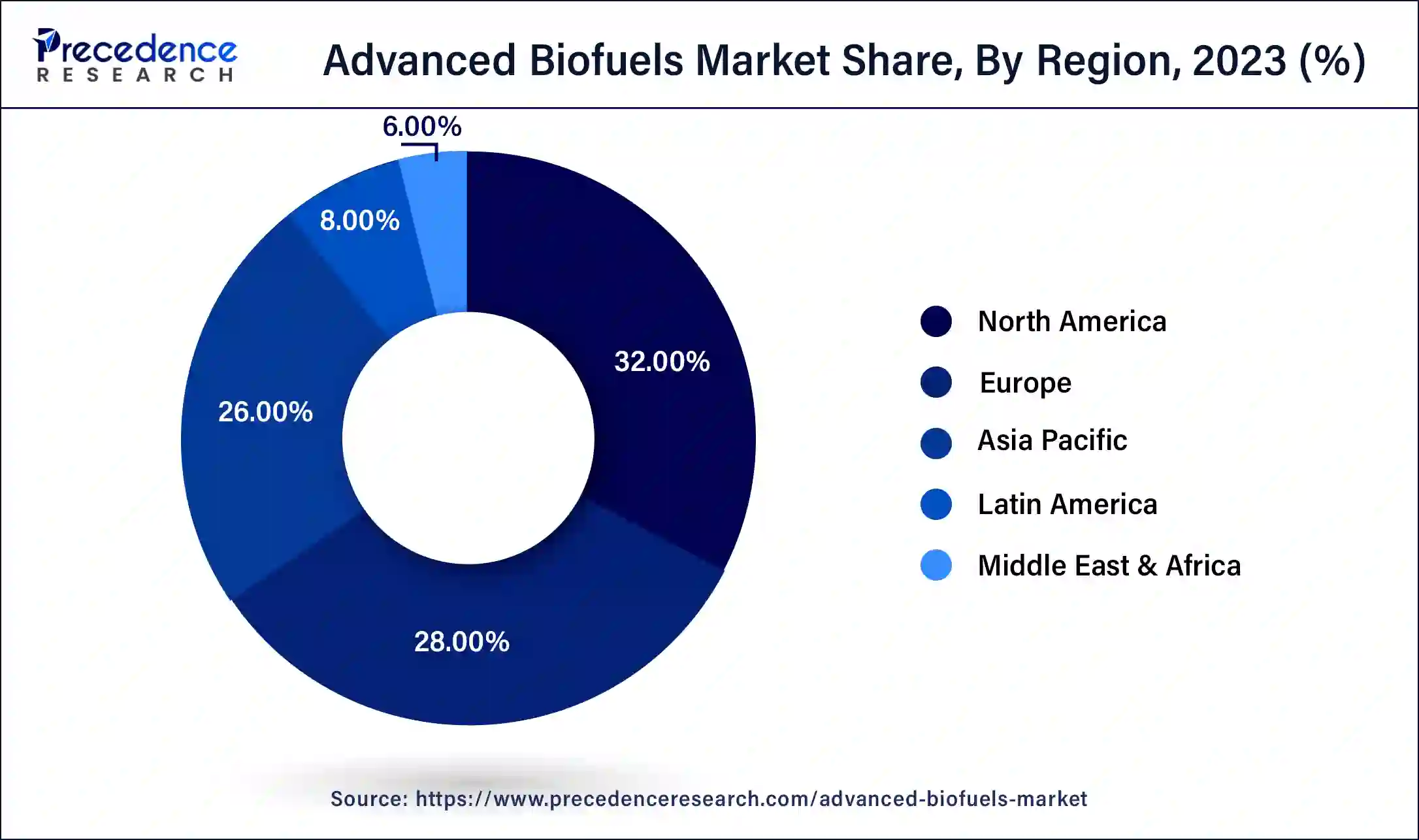
North America dominated the global market in 2025 with advanced biofuel production facilities and policies. This region is focused on investments in renewable fuels, such as sustainable aviation fuel, renewable diesel, and cellulosic ethanol plants. There are still prospects for commercial production, particularly in terms of government incentives and reduced carbon fuel standards.
U.S. Advanced Biofuels Market Size and Growth 2026 to 2035
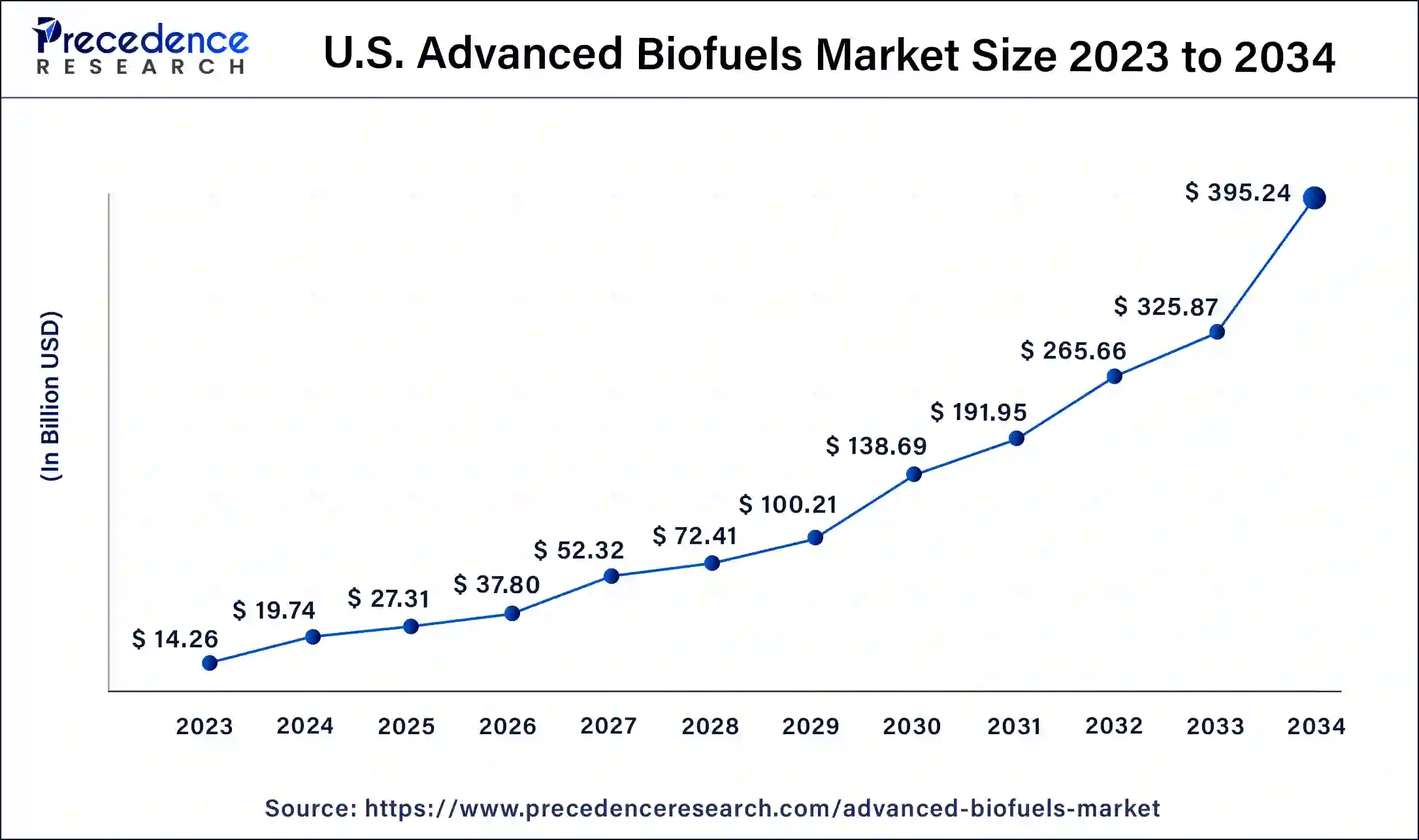
The U.S. advanced biofuels market is valued at USD 27.31 billion in 2025 and is expected to grow to around USD 458.50 billion by 2035, at a CAGR of 32.59% from 2026 to 2035.
Rising Green Energy: Driving Forces Behind the Growth of the U.S.
The U.S. market is growing due to increasing government support for renewable energy, rising concerns about carbon emissions, and the push to reduce dependence on fossil fuels. Advancements in biofuel production technologies, availability of sustainable feedstocks, and strong investments from key industry players are driving growth. Additionally, supportive policies like the Renewable Fuel Standard (RFS) are boosting biofuel adoption across transportation and industrial sectors.
Asia Pacific is Undergoing the Fastest Growth in the Advanced Biofuels Market
Asia Pacific is expected to grow at the fastest rate in the market, attributed to the increasing demand for energy and the positive renewable energy policies in the region. Bio-refineries are being developed, and agricultural residues and biomass are being encouraged to be used in fuel production by governments. The need for advanced biofuels is emerging with growing transport and aviation markets.
Powering Sustainability: Unleashing Growth in China's Market
China's advanced biofuels market is expanding due to strong government policies promoting clean energy and carbon neutrality goals. Growing demand for sustainable transportation fuels and efforts to reduce reliance on imported oil are driving investment in biofuel production. Additionally, advancements in bio-refining technologies, availability of agricultural waste as feedstock, and support for innovation in renewable energy are accelerating market growth across the country.
Europe: Driving Decarbonization
Europe's market is expanding due to stringent environmental regulations, ambitious carbon reduction targets, and strong government support for renewable energy. The European Union's Renewable Energy Directive (RED II) encourages the use of low-carbon fuels, driving investment in advanced biofuel technologies. Growing demand for sustainable aviation and transportation fuels, along with rising corporate sustainability commitments, is further propelling market growth across the region.
Fueling Progress: The UK's Surge in Advanced Biofuels Innovation
The UK market is growing due to strong government initiatives supporting renewable energy and net-zero emissions goals. Policies like the Renewable Transport Fuel Obligation (RTFO) are promoting biofuel adoption in transportation. Additionally, rising investments in waste-to-fuel technologies, growing focus on energy security, and the shift toward sustainable aviation fuels are driving the development and expansion of the advanced biofuels sector in the UK.
Key Trends in the Advanced Biofuels Market in Latin America
Latin America is expected to witness significant growth in the market as biomass feedstocks are readily available and biofuels are already in production. The Government's policy for Renewables is providing a platform of support for advanced Biofuels technology investment. These export opportunities and increased demand for sustainable transportation fuels are bolstering market growth. Excellent potential for future growth is anticipated as more waste-based feedstocks are used.
Brazil Market Trends
Brazil's advanced biofuels market is anticipated to grow significantly due to its advanced biofuel infrastructure as well as its big sugarcane production. Actions taken by the government, both national and international, are supporting the use of renewables for domestic supply and export. Increasing use of agricultural residues for biofuel production is enhancing resource efficiency.
Growth of the Middle East and Africa in the Advanced Biofuels Market
The Middle East and Africa region is expected to witness significant growth in the market as investments are made in the increased diversification of renewable energy and sustainable fuel sources. Waste-to-energy and biomass utilization are contributing to the market development. Advanced biofuel technologies are being increasingly rolled out via international collaboration. As sustainability commitments increase, there are likely to be long-term growth prospects.
Saudi Arabia Market Trends
Saudi Arabia market is anticipated to grow significantly due to the growing investments in clean energy and economic diversification projects under Vision 2030. The country is developing high-level production methods of advanced biofuels using waste biomass and other renewable feedstocks. Strategic alliances with overseas renewable energy firms are helping with technology development. Increasing focus on carbon emission reductions is helping to drive investment in non-fossil fuel energy.
Supply Chain Analysis-Advanced Biofuels Market
- Feedstock Procurement: Enterprise agreements with certified suppliers for feedstock, ensuring a sustainable and reliable supply of feedstock with cost-effectiveness.
Key Players: POET LLC, Neste Oyj, Clariant AG - Quality Testing and Certification: Biofuels are tested for their characteristics, such as their viscosity, purity, fuel stability, emissions, and energy content, to make sure they meet regulatory requirements.
Key Players: SGS SA, Intertek Group plc, Bureau Veritas S.A. - Distribution to Industrial Users: Product integrity during distribution and logistics by fuel distributors to aviation, transportation, marine, and industrial users.
Key Players: Neste Oyj, Valero Energy Corporation, Chevron Renewable Energy Group
Value Chain Analysis
- Resource Extraction: Resource extraction for advanced biofuels involves cultivating non-food biomass like switchgrass, woody crops, or algae, and harvesting agricultural or forestry residues. The feedstock is then pretreated through mechanical or chemical processes to break down tough lignocellulose, making it ready for conversion. Key companies active in this initial phase include POET LLC, GranBio, and Clariant.
- Power Generation: Advanced biofuels are primarily used as transportation fuels, but they also contribute to power generation. In integrated biorefineries, byproducts like lignin or waste streams can be combusted for combined heat and power (CHP), boosting process efficiency. Major players in the broader power and advanced biofuels generation space include large energy companies like BP, TotalEnergies, and Shell, which are transitioning to cleaner energy solutions.
- Distribution Network Management: Distribution involves the efficient movement of the final biofuel products from biorefineries to terminals and end-users via trucks, railcars, or barges. Management ensures seamless integration into existing supply chains and infrastructure, including potential blending with conventional fuels. Companies like Neste, Chevron, and Renewable Energy Group (REG) manage these complex logistical networks to meet market demand.
Competitive Landscape
The advanced biofuels market consists of various companies that are associated with the renewable energy sector and companies that deliver biofuel technology products. Major companies such as Fujian Zhongde Energy Co., Ltd., Bangchak Petroleum Plc., Abengoa Bioenergy, DowDuPont Inc., and Chemtex have a significant market share. These companies compete through technological innovation, by expanding production, building strategic alliances, and investing in new biorefinery technology.
The players are fighting for a sustainable aviation fuel, a cellulosic biofuel, an algae fuel, and a waste-to-fuel plant. As demand for low-carbon fuel rises, the companies are expanding their sourcing ability for feedstocks and commercial production units. Production cost, availability of raw materials, changing environmental policies, and other renewable energy technologies are some of the major issues.
Top Vendors and their Offerings
- GranBio- Focuses on converting non-food lignocellulosic biomass (like agricultural residues) into 2nd-generation ethanol and sustainable aviation fuel (SAF) using its proprietary technologies.
Inbicon A/S- Developed and demonstrated biomass-conversion technology using straw and other residues to produce cellulosic ethanol, lignin, and animal feed, enabling advanced biofuel production from waste. - Clariant- Offers its sunliquid technology to convert agricultural residues into cellulosic ethanol, with full licensing, services, and supply for advanced biofuel plants globally.
- A2BE Carbon Capture, LLC- Utilises industrial COâ‚‚ emissions captured and algae-based photo-bioreactor systems to create biomass that can be converted into fuels and other products
value-added products. - Algenol Biotech- Uses proprietary algae cultivation and processing platforms to produce ethanol and other high-energy biofuels from COâ‚‚, salt water, and sunlight, aiming for low-carbon fuel production.
Advanced Biofuels Market Companies
Major market companies are aiming towards innovative advancements in order to enhance their position in the target industry. Major companies are:
- Fujian Zhongde Energy Co., Ltd
- Bangchak Petroleum Plc.
- Abengoa Bioenergy
- DowDuPont Inc.
- Chemtex company
For improved recognize the current status of advanced biofuels, and policies adopted by the foremost countries, Precedence Research predicted the future evolution of the advanced biofuels market. This research study bids qualitative and quantitative insights on advanced biofuels market and assessment of market size and growth trend for potential global market segments.
Recent Developments
- In July 2025, Neste and DHL Express strengthened their collaboration by providing 7,400 tons (or 9.5 million liters) of unblended Neste MY Sustainable Aviation Fuel™ at Singapore Changi Airport. The collaboration aims to help reduce the emissions of air cargo and foster the use of sustainable aviation fuel in international air cargo. (Source: https://www.dhl.com)
- In January 2025, Galp was awarded the so-called “advanced biofuel project” key reactors at its Sines refinery in Portugal. Based on an integrated industrial-scale green hydrogen production facility, the plant is expected to start sustainable aviation fuel and renewable diesel production in 2026 (Source: https://finance.yahoo.com)
Segments Covered in the Report
By Process
- Biochemical Process
- Thermochemical Process
By Advanced Biofuel Type
- Cellulosic Advanced Biofuels
- Biodiesels
- Biogas
- Biobutanol
- Others
By Raw Material
- Lignocellulose
- Jatropha
- Camelina
- Algae
- Others
By Geography
- North America
-
- U.S.
- Canada
-
- Europe
-
- Germany
- France
- United Kingdom
- Rest of Europe
-
- Asia Pacific
-
- China
- Japan
- India
- Southeast Asia
- Rest of Asia Pacific
-
- Latin America
-
- Brazil
- Rest of Latin America
-
- Middle East & Africa (MEA)
-
- GCC
- North Africa
- South Africa
- Rest of Middle East & Africa
-
For inquiries regarding discounts, bulk purchases, or customization requests, please contact us at sales@precedenceresearch.com
Frequently Asked Questions
Tags





Ask For Sample
No cookie-cutter, only authentic analysis – take the 1st step to become a Precedence Research client
 Get a Sample




 sales@precedenceresearch.com
 Schedule a Meeting
