



Commercial Seeds Market Size, Share, and Trends 2026 to 2035
Commercial Seeds Market (By Product: Maize (Corn), Soybean, Vegetable, Cereals, Cotton, Rice, Canola (Rapeseed), Others; By Genetically Modified Seed Products: Maize (Corn), Soybean, Cotton, Canola (Rapeseed), Others) - Global Industry Analysis, Size, Trends, Leading Companies, Regional Outlook, and Forecast 2026 to 2035
Source: https://www.precedenceresearch.com/commercial-seeds-market
 Get a Sample
 Table Of Content


What is the Commercial Seeds Market Size?
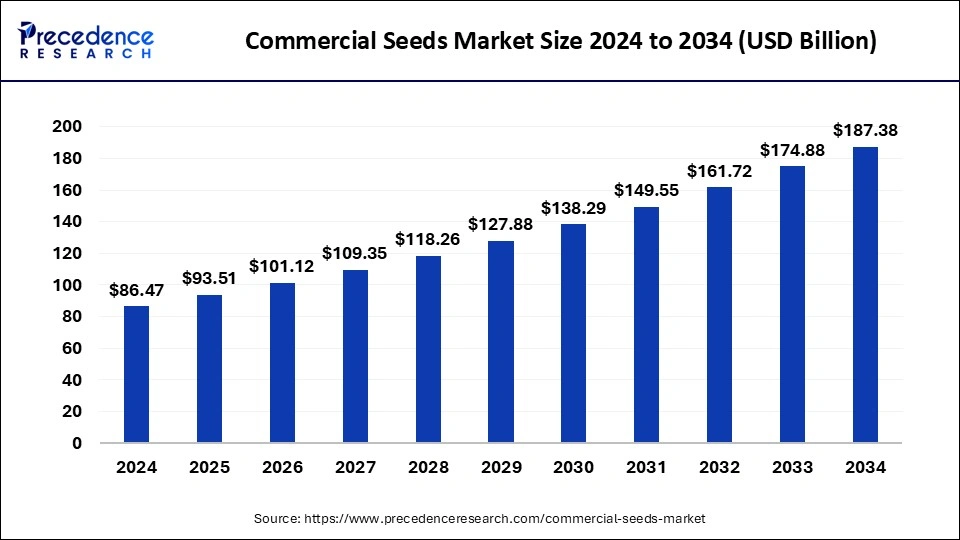
The global commercial seeds market size was estimated at USD 93.51 billion in 2025 and is predicted to increase from USD 101.12 billion in 2026 to approximately USD 200.32 billion by 2035, expanding at a CAGR of 7.92% from 2026 to 2035. The ability of commercial seeds to maximize crop yield whilst decreasing arable land is the significant factor driving the commercial seeds market growth.
Commercial Seeds Market Key Takeaways
- In terms of revenue, the global commercial seeds market was valued at USD 93.51 billion in 2025.
- It is projected to reach USD 200.32 billion by 2035.
- The market is expected to grow at a CAGR of 7.92% from 2026 to 2035
- North America dominated the market with the largest revenue share of 38% in 2025.
- Asia Pacific is projected to grow at the fastest rate in the market over the forecast period.
- By product, the maize (corn) segment has held a major revenue share of 48% in 2025.
- By product, the soybean segment is predicted to grow at a significant rate in the market over the forecast period.
- By genetically modified (GM) seed products, the maize segment has contributed the largest revenue share of 49% in 2025.
- By genetically modified (GM) seed products, the cotton segment is anticipated to grow at the fastest rate during the forecast period.
Market Overview
Commercial seeds are vital to contemporary agriculture and horticulture, and they serve as the cornerstone for crop production globally. These seeds are specifically developed, produced, and marketed by seed companies for diverse agricultural, horticultural, and industrial purposes. They are essential for cultivating food crops such as rice, potatoes, onions, broccoli, corn, wheat, soybeans, cauliflower, and various other fruits, vegetables, and grains.
Technological advancements and supportive government policies are key drivers of growth in the commercial seeds market. The leading commercial seed companies worldwide are concentrating their research on enhancing agricultural productivity while managing limited resources. Major countries like the United States, Brazil, Argentina, Canada, and India are at the forefront of adopting genetically modified (GM) agricultural practices.
Artificial Intelligence: The Next Growth Catalyst in Commercial Seeds
AI is revolutionizing the commercial seeds industry by driving analytics accelerate R&D, reducing breeding cycles for climate-resilient and disease-resistant varieties by over 30%. On the production front, machine vision and AI-powered sorting platforms, like Seed-X, are revolutionizing quality control by providing granular, seed-level analysis to predict germination rates and optimize grading.
This data-centric approach enables highly personalized seed treatments, driving operational efficiency by optimizing agricultural inputs and significantly minimizing resource waste.
Commercial Seeds Market Growth Factors
- The growing population globally, along with rising food security concerns, can drive the commercial seeds market growth.
- Governing agencies of various countries are supporting the adoption of sustainable farming, which can fuel the commercial seeds market growth shortly.
- Several manufacturers are also offering hybrid seeds, which is expected to boost market growth further.
- Rising global energy demand is likely to help in the commercial seeds market expansion in upcoming years.
Market Outlook
- Market Growth Overview: The commercial seeds market is expected to grow significantly between 2025 and 2034, driven by the rising demand for high-yielding, disease-resistant, and climate-resilient seeds, rising global food demand and food security, and integration of research and developments in biotechnology.
- Sustainability Trends: Sustainability trends involve the regenerative agriculture practices, organic and non-GMO demand, and advanced breeding technologies.
- Major Investors: Major investors in the market include Bayer Group, Corteva Agriscience, Bayer Group, Syngenta Group, BASF SE, and Sakata Seed Corporation.
Market Scope
| Report Coverage | Details |
| Market Size by 2035 | USD 200.32 Billion |
| Market Size in 2025 | USD 93.51 Billion |
| Growth Rate from 2026 to 2035 | CAGR of 7.92% |
| Largest Market | North America |
| Base Year | 2025 |
| Forecast Period | 2026 to 2035 |
| Segments Covered | Product, Genetically Modified Seed Products, and Regions |
| Regions Covered | North America, Europe, Asia-Pacific, Latin America, and Middle East & Africa |
Market Dynamics
Driver
Population growth around the world
The demand for commercial seeds is rising alongside the global population, driving the commercial seeds market growth. Higher disposable incomes are expected to lead to increased resource use and boost the demand for commercial seeds. This, in turn, will enhance crop yields compared to traditional farm seeds. Advances in molecular biology have made it simpler and more cost-effective to map plant genetic codes, likely increasing the production of commercial seeds.
Commercial seeds are crucial for achieving food security by boosting agricultural output. Economic growth typically follows population growth. As incomes increase, people consume a more diverse and higher-quality diet, requiring a broader variety of crops produced from commercial seeds.
- In May 2024, S&W Seed Company, a global agricultural technology company, announced the expansion of its novel and proprietary sorghum trait technology portfolio with the commercial launch of Double Team Forage Sorghum. Double Team Forage Sorghum gives forage sorghum growers an over-the-top, non-GMO, grassy weed control option.
Restraint
Managing intellectual property rights
In the commercial seeds market, managing intellectual property rights related to seed technologies, patents, and licensing agreements introduces additional complexity. Negotiating these rights and navigating legal frameworks can create challenges and disputes that significantly impact market dynamics. Overcoming these issues requires coordinated efforts from industry players, policymakers, and regulatory bodies.
Key strategies for addressing these challenges include collaborative research, regulatory harmonization, sustainable agricultural practices, and consumer education. These approaches are essential for developing a robust commercial seeds market.
Opportunity
Advancements in biotechnology
Biotechnology allows the creation of seeds tailored for specific farming methods by enabling precision agriculture. These seeds are designed to thrive in conditions, which makes them attractive to modern farmers who prioritize efficiency and sustainability. Biotech seeds incorporate genetic traits that offer built-in resistance to pests and diseases. This largely impacts the dynamics of the commercial seeds market.
With the increasing global trade and transportation, there is a higher risk of new pests emerging. Biotechnology offers a proactive solution by reducing the reliance on chemical pesticides, thereby safeguarding crop yields. Given the growing emphasis on sustainability from both consumers and regulators, biotech seeds have become crucial in minimizing the environmental impact of agriculture. As a result, this has contributed to the growth of the commercial seeds market.
- In February 2024, Hemp food specialist Manitoba Harvest teamed up with food tech co Brightseed to launch a new product nationwide at Whole Foods in the U.S. featuring Brightseed's first commercial ingredient: a bioactive fiber offering an intriguing new slant on gut health.
Segment Insights
Product insights
The maize (corn) segment dominated the commercial seeds market in 2025. The demand for corn is expected to increase, especially for animal feed, as meat consumption rises in emerging countries. Moreover, the extensive use of corn in producing starch and sweeteners is predicted to drive the growth of this segment during the forecast period. Corn seeds remain highly popular among various types of crops.
The soybean segment is predicted to grow at a significant rate in the commercial seeds market over the forecast period. The high protein content and extensive oil extraction from soybeans are expected to drive their demand. Soybeans are widely used for animal feed, as a direct food source, and as a raw material in various industrial food products. The significant oil extraction and high protein content of soybeans are predicted to drive their demand.
- In June 2023, BioLumic and Gro Alliance LLC announced a strategic partnership to deploy BioLumic's ultraviolet (UV) light seed treatment technology for corn and soybean seed production, propelling commercial-scale entry of UV light technology into the global row-crop seed industry.
Genetically Modified Seed Product Insights
The maize segment dominated the commercial seeds market in 2025. The expansion of land dedicated to GM crops and the growing acceptance of GM crop yields in various regions are expected to boost market growth. These seeds are modified in laboratories to possess special characteristics, such as resistance to pests and diseases. They are designed to enhance crop growth and strength by making them valuable for modern agriculture. The increasing acceptance of GM produce, and the introduction of seeds with beneficial traits are anticipated to drive strong growth in the genetically modified crop seeds segment during the forecast period.
- In January 2024, The Federal Government of Nigeria approves the commercial release of GM maize varieties. Nigeria has approved the commercial release of transgenic insect-resistant and drought-tolerant maize varieties, known as TELA maize. The approval was granted by the National Committee on Naming, Registration, and Release of Crop Varieties, Livestock Breeds/Fisheries
The cotton segment is anticipated to grow at the fastest rate in the commercial seeds market during the forecast period. The increased yield of cotton, potential cost savings in cultivation, and reduced insecticide use contribute to this segment's growth. The U.S., China, and India are the leading adopters of GM cotton seeds. Their ability to address issues such as pest resistance, herbicide tolerance, and improved yield has made GM cotton highly desirable for farmers aiming to optimize crop production and reduce risks.
Regional Insights
What is the U.S. Commercial Seeds Market Size?
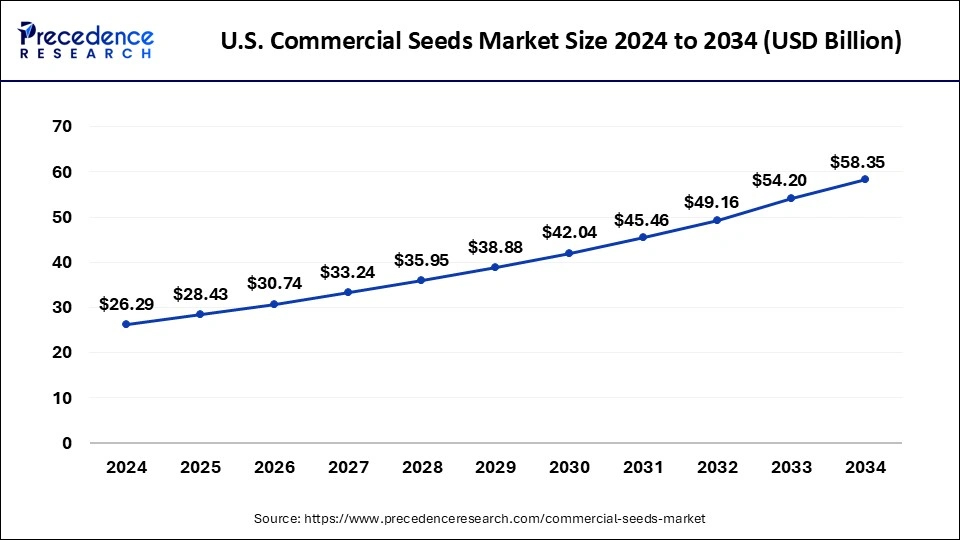
The U.S. commercial seeds market size was valued at USD 28.43 billion in 2025 and is expected to be worth around USD 63.09 billion by 2035 with a CAGR of 8.30% from 2026 to 2035.
North America dominated the commercial seeds market in 2025. The regional market growth is expected to be fueled by extensive R&D, favorable government policies, and the cost-effectiveness of commercial seeds. Precision farming has enabled the collection of more detailed data and increased farmers' awareness and usage of these seeds. Also, North America has a highly developed agricultural sector, with the United States and Canada possessing extensive arable land and advanced farming practices. This substantial agricultural base drives a significant demand for commercial seeds to support crop production.
- In September 2023, Precision Irrigation Management startup Treetoscope completed its latest seed fundraising round, securing $7 million to aid with R&D, fuel growth, and accelerate commercial agriculture expansion in North America and beyond. The round was led by the Champel Capital venture capital fund, a leading European-Israeli fund focusing on impact technology investments.
U.S. Commercial Seeds Market Trends
U.S.'s continued dominance of genetically modified and high-yield hybrid varieties, which remain essential for maximizing per-acre productivity in corn and soybeans. Industry leaders are increasingly leveraging CRISPR-based genome editing and digital agriculture to deliver climate-resilient traits that ensure stability against drought and disease.
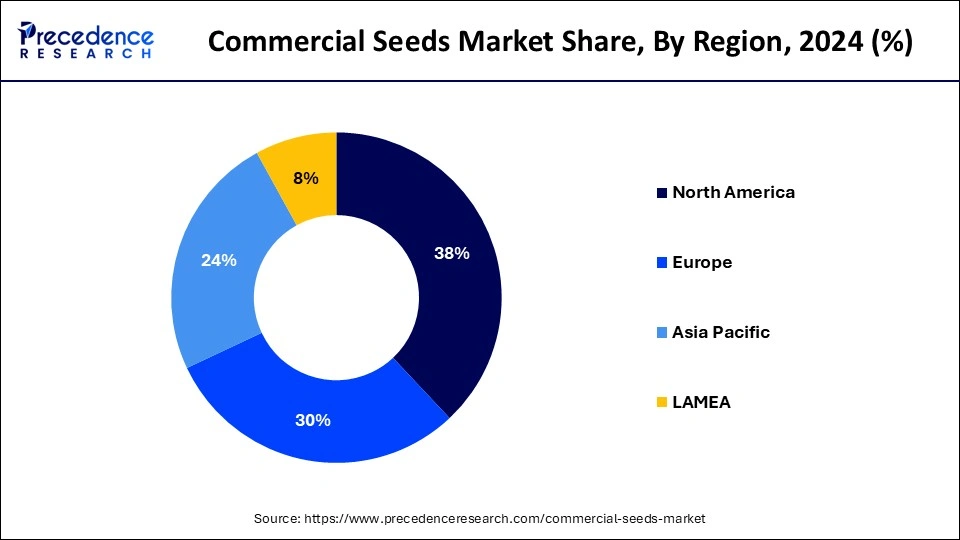
Asia Pacific is projected to grow at the fastest rate in the commercial seeds market over the forecast period. Asia Pacific has a rich history of agriculture, with many countries relying heavily on farming as a crucial part of their economies. Continuous advancements in agricultural practices, including the adoption of high-yield and hybrid seeds, have bolstered the region's growth. The region is home to more than half of the world's population, driving a high demand for food. This demand necessitates improved agricultural outputs, which are achieved through the use of commercial seeds designed for higher yields and better resistance to pests and diseases. Many governments in the region actively support the agricultural sector through subsidies, research and development initiatives, and favorable policies. This support encourages farmers to adopt advanced agricultural inputs like commercial seeds.
China Commercial Seeds Market Trends
China's shift toward biotech adoption, with the commercial expansion of GM corn, soybeans, and wheat driving agricultural modernization. Government-led self-sufficiency initiatives have ensured that over 95% of planted areas utilize domestic varieties, significantly reducing reliance on international imports.
How Did Europe Experience A Notable Growth in the Commercial Seeds Market?
Europe's integration of technological advancements and the dominance of high-yielding hybrids, which ensures informality and robots' resistance to disease and climate stresses. The industry is fundamentally shaped by stringent EU regulations, such as the European Green Deal, which mandate a strategic shift towards sustainable and certified organic seed production to meet evolving consumer demand for healthy produce. Precision farming adoption is accelerating the need for specialized.
Germany Commercial Seeds Market Trends
Germany's sophisticated traditional breeding and biotechnology, rather than genetic modification. This regulatory environment has fostered a highly consolidated, R&D-intensive landscape focused on delivering high-quality hybrid seeds that meet both rigorous environmental standards and food security needs.
Latin America is expected to witness notable growth in the commercial seeds market in the upcoming years. The agriculture sector is a vital part of the region's economy, encompassing diverse farming practices and structures, including farmers in Brazil and those in Argentina. Latin America is a key player in global agricultural trade, with Brazil, Argentina, and Chile being the largest exporters of soybeans and corn.
- In October 2023, Sakata Seed Corporation's wholly owned South American subsidiary, Sakata Seed Sudamerica LTDA, announced an agreement to purchase all shares of Isla Sementes LTDA and Isla's holding company, Administração E Participações Spalding LTDA for 63.5 million Brazilian real.
Value Chain Analysis of the Commercial Seeds Market
- R&D and Germplasm Conservation
This foundational stage involves plant breeding, biotechnology, and genomic research to develop new seed varieties with improved traits like drought resistance, high yield, and pest tolerance.
Key Players: Bayer Crop Science, Corteva Agriscience, Syngenta Group, BASF, and Limagrain. - Seed Multiplication
Breeder seeds are multiplied into foundation seeds and finally certified seeds through contracted farming and specialized production units.
Key Players: National Seeds Corporation, State Seeds Corporations, Bayer, Corteva, Advanta Seeds (UPL), Mahyco. - Processing, Treatment, and Packaging
Harvested seeds undergo cleaning, drying, grading, sorting, and chemical treatment (seed coating/pelleting) to protect against early-stage diseases and pests.
Key Players: Bayer, Syngenta, Rijk Zwaan, Sakata Seed Corporation, Nuziveedu Seeds. - Distribution and Marketing
This stage involves storing, transporting, and selling seeds through a network of dealers, distributors, and direct-to-farm channels.
Key Players: Bayer, Corteva, Syngenta, Sakata Seed Corporation, East-West Seed International, and regional agro-dealer networks.
Commercial Seeds Market Companies
- Syngenta International AG: Syngenta, as a leading agribusiness, develops and markets a wide range of genetically optimized, high-technology field crops, vegetables, and flower seeds designed to improve yield and resist environmental pressures.
- DuPont Pioneer: DuPont Pioneer (now part of Corteva) is a global leader in seed innovation, known for its extensive R&D in developing high-quality, high-yielding maize, soybean, and canola hybrids.
- Vilmorin & Cie SA: As the 4th largest seed company in the world, Vilmorin & Cie specializes in the creation, production, and distribution of high-value-added vegetable and field seeds, holding a top position in vegetable breeding.
- Monsanto Company: Monsanto, formerly the world's largest seed company, dominated the market by developing and licensing genetically modified (GM) seeds, particularly with their Roundup Ready and Bt technologies for corn, soy, and cotton.
Recent Developments
- In March 2025, BioLumic launched the first commercial light-activated seed trait system (xTrait technology), which uses UV light to trigger natural gene expression for yield gains of over 20% in hybrid corn without genetic modification. This system utilizes light to program plant performance, offering a non-GMO alternative to genetic engineering.
(Source: https://www.biolumic.com ) - In October 2023, Corteva, Inc. announced the commercial launch of Straxan™ fungicide seed treatment in Canada, bringing farmers a new, ready-to-use, and easy-to-apply formulation that targets prominent seed and soil-borne cereal diseases.
- In April 2022, Monsanto announced that it was investing $100 million in a new research facility in India. This facility will focus on developing new crop varieties that are resistant to pests and diseases and that are also suitable for the Indian climate.
- In June 2022, a new variety of tropicalized lettuce was launched named Arunas RZ. This lettuce is specifically designed for tropical climates and is resistant to heat, drought, and diseases. It is expected to help farmers in tropical regions increase their yields and improve their profits.
- In June 2022, Bayer company launched 'INH 16019', a hybrid rice seed with inbuilt tolerance to Brown Plant Hopper and bacterial Leaf Blight (BLB) in Bangladesh. This new rice seed is designed to help farmers in Bangladesh protect their crops from these two major pests.
- In July 2022, Corteva Agriscience, BASF, and MS Technologies signed an agreement to develop next-generation Enlist E3 soybeans with the nematode-resistant soybean (NRS) trait for farmers in the United States and Canada. This new trait is designed to help farmers protect their soybeans from nematodes, which are a major pest that can damage crops and reduce yields.
Segment Covered in the Report
By Product
- Maize (Corn)
- Soybean
- Vegetable
- Cereals
- Cotton
- Rice
- Canola (Rapeseed)
- Others
By Genetically Modified Seed Products
- Maize (Corn)
- Soybean
- Cotton
- Canola (Rapeseed)
- Others
By Geography
- North America
- Europe
- Asia Pacific
- Latin America
- Middle East & Africa
For inquiries regarding discounts, bulk purchases, or customization requests, please contact us at sales@precedenceresearch.com
Frequently Asked Questions
Tags





Ask For Sample
No cookie-cutter, only authentic analysis – take the 1st step to become a Precedence Research client
 Get a Sample




 sales@precedenceresearch.com
 Schedule a Meeting
