


Compressor Oil Market Size, Key Companies, Company Market Share, Production Capacity, Raw Material Pricing, Export & Import Analysis, Manufacturing Cost, Competitive Positioning, and Demand Forecast
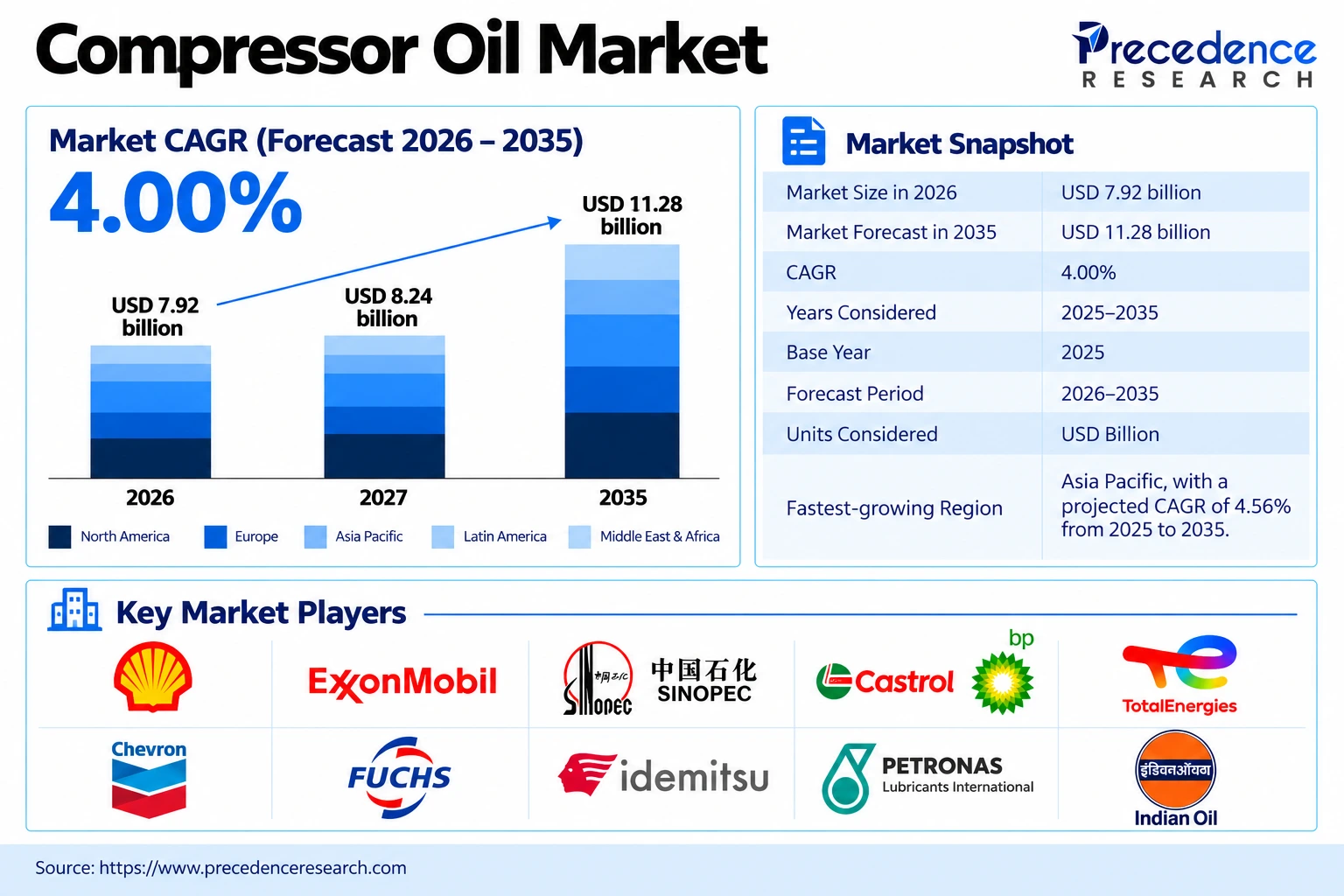
Vidyesh Swar, a Chemical and Materials Industry Expert, estimates the compressor oil market at USD 7.92 billion in 2026, with the market projected to reach USD 11.28 billion by 2035 at a CAGR of 4%. Major compressor oil market companies such as Shell, ExxonMobil, Sinopec Lubricant are competing across key material and application segments, including base oil, compressor type, application, end use and region.
Source: https://www.precedenceresearch.com/compressor-oil-market
 Get a Sample
 Table Of Content


Compressor Oil Market Size, Share, Trends, and Growth Forecast 2036
The compressor oil market is estimated at USD 7.92 billion in 2026 and is projected to reach USD 11.28 billion by 2035, expanding at a CAGR of 4% from 2026 to 2035. The compressor oil market was valued at USD 7.92 billion in 2026, the base year.
Key Takeaways
Market Size & Growth Outlook
- Market size in 2026: USD 7.92 billion
- Estimated market size in 2027: USD 8.24 billion
- Projected market size by 2036: USD 11.28 billion
- CAGR (2026-2035): 4%
Regional Market Spotlight
- Asia Pacific led the market with a 42.80% (USD 3.26 billion) share in 2025 and is projected to be the fastest-growing region, at a CAGR of 4.56% from 2026 to 2035.
- North America accounted for 22.60% (USD 1.72 billion) of the market in 2025.
- Europe accounted for 21.40% (USD 1.63 billion) of the market in 2025.
Segmental Spotlight
- By base oil, Synthetic accounted for 46.40% (USD 3.54 billion) in 2025.
- By compressor type, Positive Displacement accounted for 64.60% (USD 4.92 billion) in 2025.
- By application, Air Compressors accounted for 52.80% (USD 4.02 billion) in 2025.
- By end use, Manufacturing accounted for 31.40% (USD 2.39 billion) in 2025.
Compressor Oil Market Size and Forecast, 2025 to 2035
Compressor oils include mineral, semi-synthetic, and synthetic types used in air, gas, and refrigeration compressors, such as rotary screw, reciprocating, vane, scroll, and centrifugal compressors, in sectors like manufacturing, oil and gas, power, chemicals, mining, food processing, among others. Synthetic oils have dominated the base oil type segment with 46.40% in 2025 owing to high durability and resistance to oxidation of polyalphaolefin (PAO), ester, and polyalkylene glycol (PAG) fluids in rotary screw compressors operating under extreme conditions. Asia Pacific held the highest share of 42.80% in terms of revenue in 2026 thanks to industrial output, construction of infrastructure, and manufacture of compressors in countries such as China, India, and Southeast Asia. The market is driven by the increasing number of industrial air and gas compressor installations, move towards synthetic compressor oil with increased drain time, food-grade and energy-efficient lubricants, growth of refrigeration and heat pumps, among others.
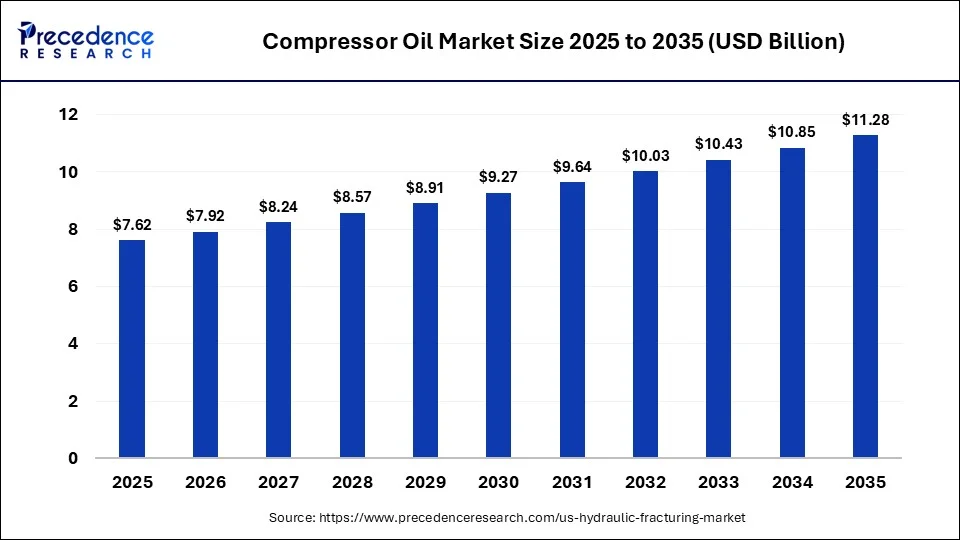
Note: 2025 is the base year; 2026–2035 values are forecasts.
Sources: Expert interviews, secondary sources, Precedence Research database, and Precedence Research analysts.
Market for compressor oil is expected to increase from USD 7.62 billion in 2026 to USD 11.28 billion in 2035 due to increased use of compressors in industrial facilities, process plants and gas systems that require periodic change of oil, along with the shift towards more expensive synthetic oils by consumers. Growth in the refrigeration, heat pump and LNG market will contribute to the demand for specialized compressor oil and take market value up to USD 9.27 billion by 2030.
- Analyst View: The estimate was derived based on the number of compressors in use classified according to types and end-use industries and then multiplied by oil fill volumes, drain intervals, top-up amounts and prices of mineral, semi-synthetic and synthetic oils. The installed base is determined based on compressor shipments and replacement cycles, while the drain intervals are a function of the proportion of long-life synthetic oils. The total is then benchmarked against sales figures from major oil companies and lubricants manufacturers and the estimates provided in the literature. Our base year estimate falls slightly higher than the comparables.
Market Trends
- Synthetic compressor oils are extending drain intervals.
- Compressor makers are promoting their own branded fluids.
- Oil condition monitoring is guiding drain decisions.
- Refrigeration oils are being adapted to natural refrigerants.
- Food-grade compressor oils are growing in food plants.
- Energy-efficient oils are cutting compressor power use.
Drivers, Restraints and Opportunities
Driver
The installed base of compressors for industrial air, gas, and refrigeration continues to increase along with the growth of manufacturing, gas processing, and cold chain industries. The users are shifting to synthetic lubricating oils that help reduce downtime and save on energy consumption. Lubricating oils will be required for heat pumps and refrigeration applications with the new refrigerants.
Restraint
The reduction of drain intervals due to synthetic oils leads to a decrease in sales of oils. Oil-free compressors are being used in more and more applications, such as in food, pharmaceutical, and electronics manufacturing companies.
Opportunity
Compressor oils for hydrogen and liquefied natural gas (LNG) are required. Food grade and biodegradable oils for compressors are in demand.
Market Segmentation: 2025 Share and Value
Compressor Oil Market By Base Oil 2025 Share & Size
| Segments | 2025 Share | 2025 Market Value |
| Synthetic | 46.40% | USD 3.54 billion |
| Mineral | 41.20% | USD 3.14 billion |
| Semi-synthetic | 12.40% | USD 0.94 billion |
Note: 2025 is the base year.
Sources: Expert interviews, secondary sources, Precedence Research database, and Precedence Research analysts.
Synthetic oils make up 46.40% (USD 3.54 billion) and are the fastest-growing base oils as they offer longer drain intervals of several thousand hours, have good resistance to oxidation, and help reduce energy consumption in rotary screw compressors. Mineral oils, which make up 41.20% (USD 3.14 billion), continue to dominate the market in reciprocating and lower duty compressors where price is the priority.
Compressor Oil Market By Compressor Type 2025 Share & Size
|
Segments
|
2025 Share
|
2025 Market Value
|
|
Positive Displacement
|
64.60%
|
USD 4.92 billion
|
|
Dynamic
|
35.40%
|
USD 2.70 billion
|
Note: 2025 is the base year.
Sources: Expert interviews, secondary sources, Precedence Research database, and Precedence Research analysts.
Positive Displacement compressors, comprising rotary screw, reciprocating, vane, and scroll type machines, will amount to 64.60% (USD 4.92 billion) in 2025 as positive displacement compressors form the bulk of air and refrigeration compressors used in industries, and oil is utilized for their sealing and cooling. Dynamic compressors, including centrifugal and axial types, constitute 35.40% (USD 2.70 billion) of compressor market value.
Compressor Oil Market By Application 2025 Share & Size
| Segments | 2025 Share | 2025 Market Value |
| Air Compressors | 52.80% | USD 4.02 billion |
| Gas Compressors | 28.60% | USD 2.18 billion |
| Refrigeration & AC Compressors | 18.60% | USD 1.42 billion |
Note: 2025 is the base year.
Sources: Expert interviews, secondary sources, Precedence Research database, and Precedence Research analysts.
Air compressors were valued at 52.80 percent (USD 4.02 billion) in 2025, with their use in manufacturing, construction, and mining. Gas compressors, on the other hand, were valued at 28.60 percent (USD 2.18 billion) and are used for applications such as natural gas, LNG, hydrogen, process gas, and refrigeration/air conditioning compressors at 18.60 percent (USD 1.42 billion).
Compressor Oil Market By End Use 2025 Share & Size
|
Segments
|
2025 Share
|
2025 Market Value
|
|
Manufacturing
|
31.40%
|
USD 2.39 billion
|
|
Oil & Gas
|
21.80%
|
USD 1.66 billion
|
|
Chemicals & Petrochemicals
|
13.40%
|
USD 1.02 billion
|
|
Power Generation
|
12.60%
|
USD 0.96 billion
|
|
Construction & Mining
|
11.20%
|
USD 0.85 billion
|
|
Food & Beverage & Others
|
9.60%
|
USD 0.73 billion
|
Note: 2025 is the base year.
Sources: Expert interviews, secondary sources, Precedence Research database, and Precedence Research analysts.
Manufacturing had 31.40% (USD 2.39 billion) in 2025, being the biggest end-use of the compressed air market. Oil & gas is responsible for 21.80% (USD 1.66 billion), which uses gas compressor oils in manufacturing, pipeline, and processing; chemicals and petrochemicals contribute 13.40% (USD 1.02 billion); power generation contributes 12.60% (USD 0.96 billion); construction & mining contribute 11.20% (USD 0.85 billion); and food & beverages and other segments contribute 9.60% (USD 0.73 billion).
- Analyst View: The numbers for segments are obtained by mapping the compressor installed base by type, application, and industry against the oil volumes, drain intervals, and price levels. Synthetic oils represent the highest value segment due to much higher cost than mineral oils per liter.
Regional Analysis
Compressor Oil Market By Region 2025 Share & Size
| Region | 2025 Share | 2025 Market Value |
| Asia Pacific | 42.80% | USD 3.26 billion |
| North America | 22.60% | USD 1.72 billion |
| Europe | 21.40% | USD 1.63 billion |
| Middle East & Africa | 7.60% | USD 0.58 billion |
| Latin America | 5.60% | USD 0.43 billion |
Note: 2025 is the base year.
Sources: Expert interviews, secondary sources, Precedence Research database, and Precedence Research analysts.
Asia-Pacific represented 42.80% ($3.26 billion) in 2025 and represents the fastest-growing region, thanks to manufacturing, construction, mining, and compressors from China, India, and Southeast Asia. North America, representing 22.60% ($1.72 billion), is driven by gas compression, manufacturing, and a significant move towards synthetic oil, whereas Europe, which represents 21.40% ($1.63 billion), is driven by energy efficiency regulations, heat pumps, and manufacturing. The Middle East & Africa, representing 7.60% ($0.58 billion), is driven by gas processing and petrochemicals, and Latin America, representing 5.60% ($0.43 billion), is driven by mining and manufacturing in Brazil, Chile, and Mexico.
Asia Pacific accounted for 42.80% (USD 3.26 billion) in 2025 and is the fastest-growing region. Manufacturing and compressor production in China and India drive demand.
North America accounted for 22.60% (USD 1.72 billion) in 2025. Gas compression and synthetic oil use support growth.
Europe accounted for 21.40% (USD 1.63 billion) in 2025. Energy-efficiency rules and heat pumps support demand.
The Middle East and Africa accounted for 7.60% (USD 0.58 billion) in 2025. Gas processing and petrochemicals drive demand.
Latin America accounted for 5.60% (USD 0.43 billion) in 2025. Mining and industry support demand.
- Analyst View: Shares of regions were developed using the compressor installed base and industry activities in each region, based on the type and cost of the oil in the region. Asia Pacific takes the top spot due to its large industrial base and compressor manufacturing capacity. Asia Pacific is attributed the highest growth premium due to its growth exceeding that of mature regions.
Top 10 Companies in the Compressor Oil Market
|
Rank
|
Company Name
|
Market-Specific Revenue (USD Billion)
|
2025 Share
|
Key Products / Business
|
Headquarters
|
|
1
|
0.88
|
11.55%
|
Corena compressor oils
|
United Kingdom
|
|
|
2
|
0.82
|
10.76%
|
Mobil Rarus and Mobil SHC Rarus compressor oils
|
United States
|
|
|
3
|
Sinopec Lubricant
|
0.46
|
6.04%
|
Compressor and industrial oils
|
China
|
|
4
|
BP (Castrol)
|
0.42
|
5.51%
|
Castrol industrial compressor oils
|
United Kingdom
|
|
5
|
0.40
|
5.25%
|
Dacnis compressor oils
|
France
|
|
|
6
|
Chevron
|
0.38
|
4.99%
|
Cetus and Compressor Oil EP series
|
United States
|
|
7
|
FUCHS
|
0.28
|
3.67%
|
Renolin compressor oils
|
Germany
|
|
8
|
Idemitsu Kosan
|
0.20
|
2.62%
|
Daphne compressor and refrigeration oils
|
Japan
|
|
9
|
PETRONAS Lubricants International
|
0.18
|
2.36%
|
ProKomp and compressor oils
|
Malaysia
|
|
10
|
Indian Oil
|
0.17
|
2.23%
|
Servo compressor oils
|
India
|
Note: Company revenues and shares are 2025 estimates.
Sources: Company press releases, expert interviews, secondary sources, Precedence Research database and Precedence Research analysts.
Shell dominated the compressor oil industry with an estimated share of 11.55% (USD 0.88 billion) in 2025 revenues, with ExxonMobil at 10.76% (USD 0.82 billion) and Sinopec with 6.04% (USD 0.46 billion) market shares. Both Shell and ExxonMobil have leading global compressor oil brands and approvals from leading manufacturers of compressors. However, Sinopec is the market leader in the industrial market of China. The leading 10 companies controlled about 54.99% (USD 4.19 billion) of 2025 revenues, while the other 45.01% (USD 3.43 billion) of the market revenues came from the compressor manufacturer's branded oil, regional lubricant blenders, and specialty refrigeration oils.
Recent Developments
- April 2026: PETRONAS Lubricants International launched its Pro Series of industrial lubricants, including ProKomp compressor oils, with initial availability in India and Brazil.
- January 2026: Repsol Lubricants launched Maker Synthetic Compressor, a PAO-based ashless compressor oil in ISO VG 46 and 68 designed for change intervals above 4,000 hours.
Market Segments
By Base Oil
- Synthetic
- Mineral
- Semi-synthetic
By Compressor Type
- Positive Displacement
- Dynamic
By Application
- Air Compressors
- Gas Compressors
- Refrigeration & AC Compressors
By End Use
- Manufacturing
- Oil & Gas
- Chemicals & Petrochemicals
- Power Generation
- Construction & Mining
- Food & Beverage & Others
By Region
- North America (U.S., Canada, Mexico)
- Europe (Germany, U.K., France, Italy, Spain, Rest of Europe)
- Asia Pacific (China, Japan, India, South Korea, Taiwan, Rest of Asia Pacific)
- Latin America (Brazil, Argentina, Rest of Latin America)
- Middle East & Africa (GCC, South Africa, Rest of MEA)
Research Methodology
The compressor oil market was considered to be mineral, semi-synthetic, and synthetic oils for air, gas, and refrigeration compressors used in various industries all over the world. The 2025 base year has been calculated from the compressor fleet, the volume of oil to fill per compressor, oil change interval, oil topping up, and oil price. Also, the numbers have been reconciled from the top using the sales of industrial lubricants in leading oil producers and industrial lubricants producers. Segment, regional and company numbers have been assigned based on base oils, compressor types, applications, end uses and the level of industrial development in the region. Important numbers have been validated through the cross-checking of the information disclosed by companies, government and industry sources and third party estimates. All segment, regional and company numbers have been reconciled to the 2025 base year, and the forecast for 2026-2035 has been validated.
Analyst View Overall Market
The compressor oils market is already mature but stable, with increasing value due to switching to synthetic oils by consumers. Our estimates consider demand dependent on the compressor fleet, volumes of oil used, draining frequency, and prices; thus, our forecast depends on industrial activity and the development of high-quality fluids. Upside will come from gas compressors, refrigerant compressors, and synthetic oils; downside – longer draining frequency and oil-free compressors.
Sources and References
- Repsol Lubricants. "Maker Synthetic Compressor: Repsol Lubricants launches synthetic industrial lubricant for compressors". 2026-01-27. Synthetic compressor oil launch. (Source: https://lubricants.repsol.com)
- Hydrocarbon Processing. "PETRONAS Lubricants International launches flagship PETRONAS Pro Series". 2026-04-23. ProKomp compressor oils. (Source: https://hydrocarbonprocessing.com
- Cooling Post. "Bock introduces dedicated compressor oils". 2021-08-03. BOCKlub compressor oils. (Source: https://www.coolingpost.com)
For inquiries regarding discounts, bulk purchases, or customization requests, please contact us at sales@precedenceresearch.com
Frequently Asked Questions





Ask For Sample
No cookie-cutter, only authentic analysis – take the 1st step to become a Precedence Research client
 Get a Sample




 sales@precedenceresearch.com
 Schedule a Meeting